UK Immigration News for Tech Professionals: What Changed This Month
Indefinite leave to remain news for tech workers: earned settlement, the MAC Global Talent review, rule changes and fees, updated monthly.


In this article
- What changed in UK immigration this month?
- November 2026: the news in detail
- Does the Global Talent visa still lead to ILR in 3 years?
- What does this month's news mean for Skilled Worker visa holders?
- What does it mean for Graduate and HPI visa holders?
- Earlier changes still worth knowing: October 2026
- Is it law yet? How to read immigration news
- What is coming next?
- What should tech workers do now?
- Is the Global Talent visa still open?
- Want the no-sponsor route to ILR in 3 years?
- Frequently Asked Questions
- How We Checked This Article
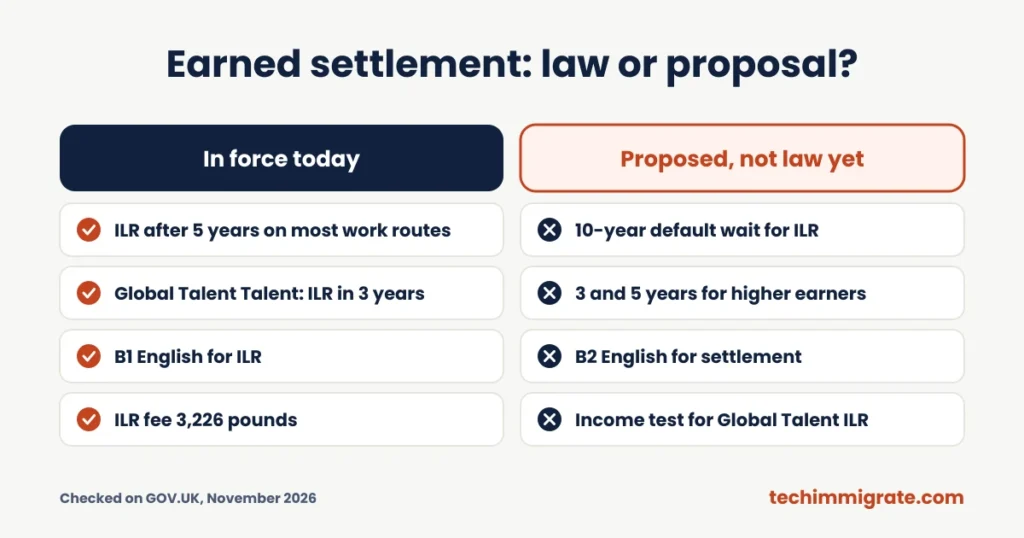
UK immigration news for tech professionals this month is dominated by two things: the government's earned settlement plan, which moves the standard wait for indefinite leave to remain (ILR) from 5 to 10 years, and the Migration Advisory Committee's review of the Global Talent and Innovator Founder routes. Neither has changed the Immigration Rules yet. Today, a Tech Nation Exceptional Talent holder can still settle after 3 years and the Global Talent fee is still £766.
This page is a dated log of the indefinite leave to remain news and visa changes that matter to software engineers, data and AI specialists, product people, founders and other tech workers on Global Talent, Skilled Worker, Graduate and High Potential Individual visas. Each entry says what happened, whether it is law or only a proposal, and what it means for you, with a link to the full article. We add a new section on the 1st of every month and keep the newest at the top.
Key takeaways
- Earned settlement is policy, not law. The government response was published on 2 November 2026; the rules that make it real have not been laid yet.
- The proposed default wait for ILR is 10 years, with 5- and 3-year routes for higher earners and a 20-year route for people who broke the rules.
- The MAC says Global Talent is largely working and needs only "small tweaks", but it wants referee letters sent direct to endorsing bodies and a settlement income test.
- The MAC recommends abolishing the Innovator Founder visa in its current form. The government has not responded yet.
- Fees have not moved this month: £561 endorsement plus £205 visa fee for Global Talent, £1,035 a year health surcharge, and £3,226 for ILR.
- If you are on a Tech Nation Exceptional Talent visa, the 3-year route to ILR is unchanged today. Plan with today's rules and watch for the December Statement of Changes.
What changed in UK immigration this month?
November 2026 brought two big documents and no new rules. The table below is the short version. The sections after it explain each item and what it means for tech workers.
| Date | What happened | Status | Who it affects most |
|---|---|---|---|
| 18 Nov 2026 | MAC adds data tables to its talent routes review | Published evidence | Global Talent applicants |
| 17 Nov 2026 | MAC publishes its Review of Talent Routes (Global Talent and Innovator Founder) | Advice to government, not law | Global Talent and Innovator Founder |
| 13 Nov 2026 | GOV.UK Global Talent guidance page updated; fees unchanged when we checked | Current guidance | All Global Talent applicants |
| 12 Nov 2026 | Accessible version of the earned settlement response added to GOV.UK | Policy document | Anyone planning ILR |
| 2 Nov 2026 | Government publishes its response to the earned settlement consultation | Policy, not law | Skilled Worker, Graduate, HPI, Global Talent |
| Late Nov 2026 (expected) | Quarterly immigration statistics for the year ending September 2026 | Not yet scheduled on GOV.UK when we checked | Anyone tracking visa numbers |
November 2026: the news in detail
17 November: what did the MAC say about Global Talent?
The Migration Advisory Committee (MAC) is the independent body that advises the Home Office on migration. On 17 November 2026 it published its Review of Talent Routes, an 80-page report on the Global Talent and Innovator Founder visas, with data tables added the next day.
Its main finding is that Global Talent is "largely meeting its objectives". The MAC recommends small changes rather than a redesign. The ones that matter most to tech applicants are:
- Referee letters sent directly. Letters of recommendation should go straight from the referee to the endorsing body, with conflict-of-interest guidelines for referees. Today you collect the letters and submit them yourself.
- An income check at settlement. Global Talent holders applying for ILR would need to show earnings of at least the full-time National Living Wage, plus a light-touch check that they are still working in their field.
- A wider fast track. The MAC suggests the government explore expanding the fast-track option for job offers at top institutions.
The report also gives hard numbers. Across all endorsing bodies, about 8,300 endorsements were issued between October 2024 and September 2025, and Tech Nation issued about 900 of them, the fewest of the six bodies. On the standard route (all bodies except UKRI), the endorsement rate fell from 70% in 2020 to 44% in 2025. The MAC links the fall to more poor-quality, premature and AI-generated applications. It also found that 14% to 28% of main applicants who arrived in 2022/23 earned less than £22,300 in their second year, which is why it wants an income test at settlement.
What it means for you: nothing changes until the government accepts a recommendation and lays new rules. But the direction is clear. Letters that read as written by the applicant, or that come from people with a conflict of interest, are already a common refusal reason. If the MAC's idea is adopted, referees will need to be ready to send their letters themselves. For the latest figures in context, see our article on the Tech Nation endorsement success rate.
17 November: is the Innovator Founder visa being abolished?
Not yet. The MAC recommends that the government "abolishes the Innovator Founder route in its current form". If the government keeps it, the MAC says it needs substantial reform and a five-year settlement period instead of the current three. The report found endorsement rates of 13% to 25% across the non-government endorsing bodies in 2024/25.
The government has not responded. Anyone holding an Innovator Founder visa today keeps it on its current terms until new rules are laid. If you are a founder choosing between routes, our comparison of Innovator Founder vs Global Talent explains the differences, and Global Talent does not need an endorsed business plan.
13 November: have Global Talent fees changed?
No. GOV.UK's Global Talent guidance was updated on 13 November 2026, but when we checked it on 24 November the fees were the same:
| Fee | Amount | When you pay |
|---|---|---|
| Endorsement application (Stage 1) | £561 | When you apply for endorsement |
| Visa application (Stage 2) | £205 | When you apply for the visa |
| Total for the main applicant | £766 | Split across both stages |
| Each dependant | £766 | At Stage 2 |
| Immigration Health Surcharge | £1,035 per adult per year | At Stage 2, for the whole visa length |
| ILR application | £3,226 per person | When you apply to settle |
The ILR fee comes from the Home Office fee table in force from 8 October 2026. For a full worked total, see our Global Talent visa cost breakdown and the guide to indefinite leave to remain fees.
2 November: what is earned settlement?
Earned settlement is the government's new model for ILR: the time you wait depends on what you contribute, mainly your taxable earnings, rather than a fixed 5 years. On 2 November 2026 the government published A fairer pathway to settlement: government response to the consultation. The consultation ran from 20 November 2025 to 12 February 2026 and received 204,667 responses.
The headline is that "the starting point for settlement will move to 10 years". Higher earners can settle sooner, and people who broke the rules wait longer:
| Proposed pathway | Earnings test (as published) | Who it is aimed at |
|---|---|---|
| 3 years | At least £125,141 a year in 3 of the last 4 years | The highest earners; a separate highest-talent group depends on the MAC review |
| 5 years | At least £50,271 a year in 3 of the last 5 years | Well-paid professionals; also some public service roles and people with a British family connection |
| 10 years (default) | At least £12,571 a year in 5 of the last 7 years | Most workers |
| 20 years | Earnings do not shorten it | Adults with specified immigration breaches or recent use of public funds |
Some other points from the response and from law firm summaries of it:
- English rises to B2. B2 becomes the standard English requirement for settlement, up from B1. Firms report that the B2 requirement takes effect for applications from 26 March 2027 under rules already laid. Our article on B2 English for ILR tracks this.
- The 15-year route was dropped. The consultation proposed 15 years for workers below degree level (RQF 6). The response removed it.
- No general protection for people already here. Firms including Lewis Silkin report there is no blanket exemption for current visa holders, though some health and care workers who arrived before 12 May 2025 keep a 5-year route.
- Couples. A couple can meet the earnings test together with a combined household income of £25,142.
- Criminal records. Any adult with a UK criminal record would be refused settlement.
When does it start? Not yet. Law firms report the Home Secretary told Parliament the rules will begin to be laid from the December Statement of Changes, with implementation through 2027. Until a Statement of Changes is laid and comes into force, today's rules apply. Our explainer on indefinite leave to remain new rules covers the 10-year change in more depth.
Does the Global Talent visa still lead to ILR in 3 years?
Yes, today it does. A Tech Nation endorsement under Exceptional Talent leads to ILR after 3 years; Exceptional Promise leads to ILR after 5 years. The MAC report confirms this split: the 3-year route applies to Tech Nation and Arts Council England only under "exceptional talent", and to the science and research bodies.
What happens next is less certain. The earned settlement response keeps a 3-year pathway for the highest earners and refers to a highest-talent group whose shape depends on the MAC review. The MAC in turn recommends keeping Global Talent largely as it is but adding an income test at settlement of at least the full-time National Living Wage. Put together, the most likely outcome is that Global Talent stays a fast route to settlement with an extra earnings check, but nothing is confirmed until the rules are laid. Neither document says clearly what happens to Exceptional Promise.
Applicant reports back this up for now. In July 2026, a member of the Tech Nation Visa Forum reported that their 3-year Exceptional Talent ILR was approved (applicant-reported). Another member in the same thread noted that dependants "usually need to complete 5 years", so families often extend a partner's visa while the main applicant settles.
We explain the route in detail in Global Talent and the new UK settlement rules and Global Talent visa to ILR in 3 years.
What does this month's news mean for Skilled Worker visa holders?
For Skilled Worker holders, earned settlement is the bigger story. Today most Skilled Workers can apply for ILR after 5 years. Under the proposed model, the default becomes 10 years unless you earn enough for the 5-year or 3-year pathway.
A software engineer earning £55,000 would meet the proposed 5-year test if they earned at least £50,271 in 3 of the last 5 years. A data analyst earning £38,000 would fall into the 10-year default. These are fictional examples to show how the thresholds work; the final earnings rules, including exactly how income is assessed, are still to be published.
There is no confirmed transition rule for people already on the route. That is why we recommend planning with today's rules while keeping evidence of your earnings (P60s, payslips and tax records) in good order. Our article on new ILR rules for Skilled Worker visa holders has scenarios by salary.
One smaller Skilled Worker change took effect this autumn. Under Statement of Changes HC 584 (laid 3 September 2026), from 8 October 2026 a Skilled Worker recognised as a victim of modern slavery can work in any occupation for the rest of their visa.
What does it mean for Graduate and HPI visa holders?
Law firm summaries of the response say that time on temporary routes, including the Graduate and High Potential Individual visas, will not count towards earned settlement. They also report that the long residence route will close, with no date given yet. Long residence is currently the main way Graduate time can count towards ILR.
If you are on a Graduate or HPI visa, the practical question is which route you switch to next and how long settlement takes from there. Our guides to whether the Graduate visa counts towards ILR and ILR through long residence explain the current position.
Earlier changes still worth knowing: October 2026
This is the first edition of this page, so here is a short catch-up on the autumn changes that are already in force and still affect tech workers.
8 October: which rule changes took effect?
Statement of Changes HC 584 was laid on 3 September 2026 and most of it came into force on 8 October 2026. For tech workers, most of it is technical rather than dramatic:
- Skilled Worker and modern slavery. As above, a Skilled Worker recognised as a victim of modern slavery can now work in any occupation for the rest of their permission.
- Suitability. A new ground treats someone who frustrated immigration controls, for example by absconding from bail, as having breached immigration law. This matters because the earned settlement plan puts people with specified breaches on a 20-year route.
- Fee waivers and biometrics. The date of a fee waiver request now counts as the application date only if the later application is on the same route, and people who vary an application must still meet the biometrics deadline for the earlier one.
- Visitors. Intra-corporate training no longer needs the earlier test that the training is unavailable in the visitor's home country. This helps tech companies bringing overseas staff to the UK for short training.
Richmond Chambers notes that applications made before 8 October are often decided under the rules in force on 7 October, but saving provisions differ by change.
8 October: did any fees change?
The Home Office published a new fee table in force from 8 October 2026. The ILR fee stayed at £3,226 per person, the same as since April 2026, and the Global Talent fees stayed at £561 and £205. Fees usually rise in April, so expect the next change then. When it happens, we will add it here with the old and new amounts side by side.
Why did Global Talent letters get harder this year?
Not because of a rule change, but because of how applications are assessed. Through 2026, applicants on the Tech Nation Visa Forum have shared refusals where the panel questioned whether letters were independent or read as if the applicant wrote them. In one October 2026 thread, a refused Exceptional Talent applicant reported that the panel questioned the independence of their recommendation letters and treated their awards as company-level rather than personal (applicant-reported). The MAC's recommendation to send letters direct to endorsing bodies comes from the same concern. If you are applying soon, choose referees who know your work first-hand, have no business interest in your visa, and can describe your contribution in their own words.
Is it law yet? How to read immigration news
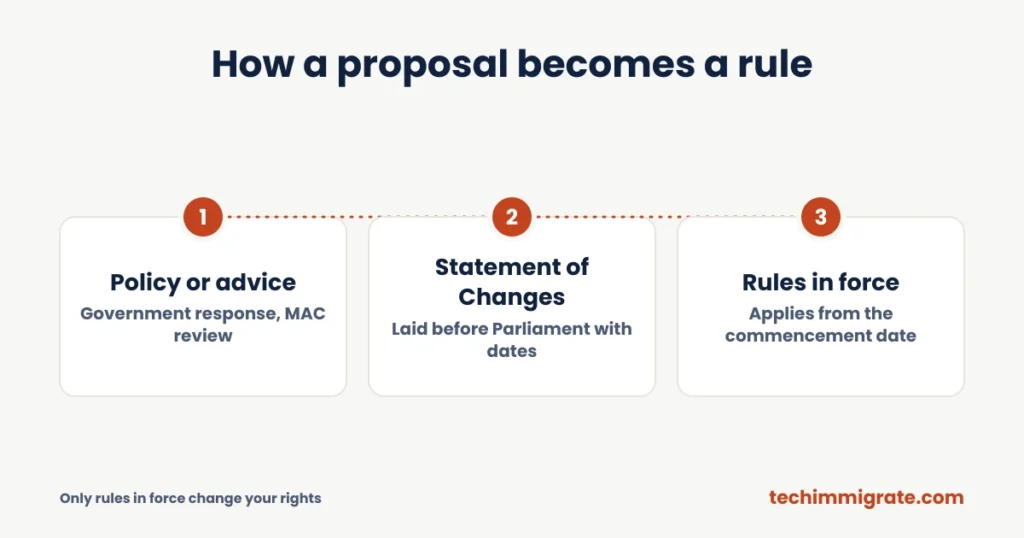
Most headlines this month describe proposals, not law. UK immigration changes go through stages, and only the last one changes your rights:
| Stage | Example this month | Does it change your rights? |
|---|---|---|
| White paper or consultation | "A fairer pathway to settlement" (Nov 2025) | No |
| Government response | Earned settlement response (2 Nov 2026) | No, it sets out the plan |
| Independent advice | MAC talent routes review (17 Nov 2026) | No, the government can accept or reject it |
| Statement of Changes laid | Expected from December for earned settlement | Not until it comes into force |
| Rules in force | HC 584 changes from 8 October 2026 | Yes |
A Statement of Changes usually comes into force on a set date after it is laid, and Parliament can object within 40 days. Applications are normally decided under the rules in force on the date you apply, but each Statement has its own transitional provisions, so always check the wording.
Three habits help:
- Check the GOV.UK page itself, not a headline. If the guidance page has not changed, the rule has not changed.
- Look for the phrase "Statement of Changes" and a commencement date. Without both, it is a proposal.
- Look for transitional protection in the Statement itself, since the response does not promise any general protection.
What is coming next?
These are the dates to watch over the next few months. We will update this page as each one happens.
| Date | What to expect | Confirmed or expected? |
|---|---|---|
| Late November 2026 | Quarterly immigration statistics, year ending September 2026 (last year's came out on 27 November) | Expected; not yet scheduled on GOV.UK when we checked |
| 30 November 2026 | Higher maintenance funds for Student visa applicants (HC 584) | Confirmed |
| December 2026 | First Statement of Changes for earned settlement | Expected, per the Home Secretary's statement as reported by law firms |
| 9 December 2026 | BRPs stop being accepted as proof of identity under Appendix EU (HC 584) | Confirmed; affects EU Settlement Scheme applicants |
| Date not set | Government response to the MAC talent routes review | Not announced |
| 26 March 2027 | B2 English for settlement applications | Reported by firms; check the rules before you apply |
When the quarterly statistics come out, we will add the Global Talent and Tech Nation figures here and update our success rate article.
What should tech workers do now?
You do not need to rush, but a little preparation now protects you whichever way the rules land.
- Check your current route and dates. Work out when you could apply for ILR under today's rules. Our guide to when you can apply for ILR explains the 28-day early window.
- Keep earnings evidence. P60s, payslips and HMRC records will matter more under earned settlement.
- Prepare for B2 English if you will apply for ILR after March 2027 and do not have an exemption.
- If you qualify for Global Talent, consider it sooner. It does not need a sponsor and, for Exceptional Talent, still leads to ILR in 3 years today.
- Ask your referees early. If letters must go direct to Tech Nation in future, you will depend more on referees who reply quickly.
This is general information, not legal advice. For decisions about your own case, speak to a regulated immigration adviser or solicitor.
Is the Global Talent visa still open?
Yes. The Global Talent visa is open to new applicants, Tech Nation is still the endorsing body for digital technology, and fees are unchanged. The MAC recommends keeping the route. We check this every month in our article Is the Global Talent Visa Still Open?, and our article on Global Talent visa changes lists the process changes since 2025, including the end of the Tech Nation portal and the move to typing the personal statement into the Home Office form.
Want the no-sponsor route to ILR in 3 years?
If this month's news makes a 10-year wait on Skilled Worker look likely for you, the Global Talent visa is the main alternative for tech professionals. It needs no employer sponsor, lets you change jobs or start a company, and for Exceptional Talent still leads to ILR after 3 years today.
The hard part is Stage 1. The MAC found the standard-route endorsement rate across endorsing bodies fell to 44% in 2025, and most refusals come from evidence and letters that do not prove what the assessor needs to see. I was refused the first time I applied, then reapplied and was endorsed. Our role-specific Global Talent guides show what Tech Nation looks for in your role, with checklists, refusal fixes and a 12-week planner. Start with what the UK Global Talent visa is and how it works if you are new to the route.
Frequently Asked Questions
In November 2026 the government published its earned settlement response (2 November), which proposes a 10-year default wait for ILR, and the Migration Advisory Committee published its review of the Global Talent and Innovator Founder routes (17 November). Neither has changed the Immigration Rules yet.
Not yet. The 10-year default is government policy announced on 2 November 2026, but it only becomes law when a Statement of Changes is laid and comes into force. Law firms report the first rules are expected from December 2026, with implementation during 2027.
Yes, under today's rules a Tech Nation Exceptional Talent holder can apply for ILR after 3 years, and Exceptional Promise after 5 years. The MAC has recommended adding an income test at settlement, but the government has not responded.
No decision has been made. The MAC recommended on 17 November 2026 that the route be abolished in its current form or substantially reformed. The government must respond and lay new rules before anything changes.
The government response proposes a 3-year route for people earning at least £125,141 in 3 of the last 4 years, a 5-year route at £50,271 in 3 of the last 5 years, and a 10-year default at £12,571 in 5 of the last 7 years.
When checked on 24 November 2026, GOV.UK listed £561 for endorsement and £205 for the visa, £766 in total, plus the Immigration Health Surcharge of £1,035 per adult per year. ILR costs £3,226 per person.
We add a new dated section on the 1st of every month and add entries in between when GOV.UK publishes a rule change, a fee change or new statistics. The newest entries are always at the top.
How We Checked This Article
We checked every fact on this page on 24 November 2026, starting with GOV.UK:
- GOV.UK: A fairer pathway to settlement: government response (published 2 November 2026; accessible version 12 November 2026).
- GOV.UK: Talent routes review, Migration Advisory Committee (17 November 2026; data tables 18 November 2026).
- GOV.UK: Global Talent visa (fees and settlement periods; page updated 13 November 2026).
- GOV.UK: Home Office immigration and nationality fees (in force from 8 October 2026).
- GOV.UK: Immigration statistics quarterly release (latest release year ending June 2026, published 27 August 2026).
- Statement of Changes HC 584 (laid 3 September 2026), via Electronic Immigration Network and Richmond Chambers.
- Law firm summaries of the earned settlement response: Lewis Silkin (3 November 2026), EIN blog (3 November 2026) and NHS Employers.
- Tech Nation Visa Forum (applicant-reported): 3-year ILR and dependant extension experience (June to July 2026) and Stage 1: review, reapply or switch to Promise (October 2026, letter independence questioned by the panel).
Where law firm summaries and GOV.UK differed on dates, we used GOV.UK. Items marked "expected" or "reported" are not confirmed by a Statement of Changes. Salary examples are fictional.
Tech Immigrate is independent of Tech Nation and the Home Office. This page is general information, not legal advice. Rules can change quickly, so check GOV.UK or speak to a regulated adviser before you apply.
We write practical guides for tech professionals applying for the UK Global Talent visa. Tech Immigrate is independent of Tech Nation and the Home Office, and our articles are general information, not legal advice. Rules and fees change, so always check gov.uk before you apply.