Global Talent Visa to ILR in 3 Years: Who Qualifies and How to Apply
Global Talent visa ILR explained: who settles after 3 or 5 years, the 180-day rule, earnings evidence, fees, and what the 2027 settlement reforms change.


In this article
- What Is Global Talent ILR?
- 3 Years or 5 Years: Which Applies to You?
- The Requirements for Global Talent ILR
- How to Count Your 180 Days
- Proving Earned Money: What Applicants Use
- How to Apply for Global Talent ILR
- What It Costs
- Dependants: The 3-Year Paradox
- What the Earned Settlement Reforms Mean for Global Talent
- Founders and Freelancers: Extra Care With Earnings
- Switching Into Global Talent Part-Way Through
- Common Reasons Global Talent ILR Goes Wrong
- A Simple Settlement Timeline
- After ILR: British Citizenship
- Frequently Asked Questions
- Start Planning Before You Are Endorsed
- How We Checked This Article
One of the biggest reasons tech professionals choose the Global Talent visa is the fast route to settlement. Under the current rules, people endorsed by Tech Nation as Exceptional Talent can apply for indefinite leave to remain (ILR) after 3 years in the UK, compared with 5 years on most work routes and up to 10 years under the government's new settlement plans. Exceptional Promise holders settle after 5 years.
This guide explains who qualifies for Global Talent ILR, the requirements you must meet, how to count your time and absences, what evidence of earnings works, how to apply, and what the November 2026 earned settlement reforms mean for Global Talent holders.
Key takeaways
- Tech Nation Exceptional Talent holders can apply for ILR after 3 years. Exceptional Promise holders need 5 years.
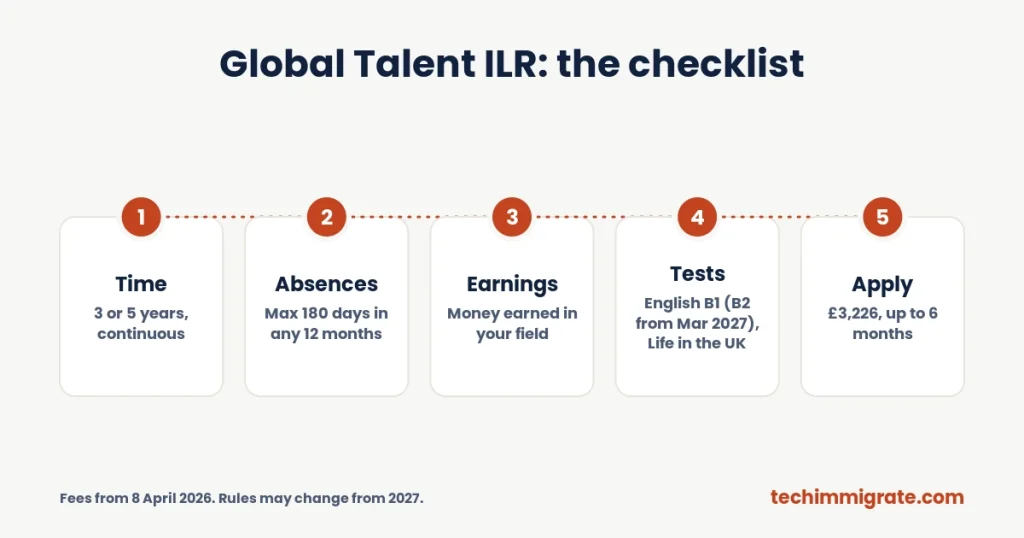
- You must not have spent more than 180 days outside the UK in any 12-month period during your qualifying period.
- You must show you have earned money in your field in the UK. There is no minimum amount and no fixed list of documents, but evidence must be independent and verifiable.
- You need English at B1 level (rising to B2 for applications from 26 March 2027) and a Life in the UK test pass.
- The ILR fee is £3,226 per person. Standard decisions usually take up to 6 months, with priority options at extra cost.
- The government's earned settlement response of 2 November 2026 keeps a 3-year route for a "Highest Talent Group" expected to include Global Talent, but the details depend on Migration Advisory Committee advice and new rules due over 2027.
- Partners and children usually need 5 years under the current rules, even when the main applicant settles after 3.
What Is Global Talent ILR?
Indefinite leave to remain is permanent residence in the UK. Once you have it, you no longer need a visa to live and work in the UK, you do not pay the Immigration Health Surcharge, and you can usually apply for British citizenship 12 months later.
The Global Talent route has its own settlement rules in Appendix Global Talent of the Immigration Rules. They are more generous than most work routes in two ways: the qualifying period is shorter for most applicants, and there is no minimum salary.
For a wider explanation of the benefits, see our article on the benefits of the Global Talent visa.
3 Years or 5 Years: Which Applies to You?
Your qualifying period depends on how you got your Global Talent visa.
| How you were granted Global Talent | Qualifying period for ILR |
|---|---|
| Tech Nation endorsement, Exceptional Talent | 3 years |
| Tech Nation endorsement, Exceptional Promise | 5 years |
| Arts Council England, Exceptional Talent | 3 years |
| Arts Council England, Exceptional Promise | 5 years |
| Royal Society, Royal Academy of Engineering, British Academy or UKRI endorsement | 3 years |
| Eligible prestigious prize | 3 years |
Your endorsement letter says whether you were endorsed as Exceptional Talent or Exceptional Promise. If you are not sure, check it before you plan your settlement date.
If you hold Exceptional Promise and have since become a recognised leader, some people apply for a new endorsement as Exceptional Talent to shorten their path. That is a fresh Stage 1 application with its own evidence and risk, so weigh it carefully. Our comparison of Exceptional Talent and Exceptional Promise explains the difference.

The Requirements for Global Talent ILR
To settle on the Global Talent route, you must meet all of these requirements.
1. Continuous residence for the qualifying period
You must have lived in the UK continuously for 3 or 5 years. The Home Office caseworker guidance confirms that time on certain routes can be combined, including Global Talent, Skilled Worker and Innovator Founder. That is why many people who switch from Skilled Worker to Global Talent count their earlier years.
Time on routes such as Student, Graduate and Visitor does not count towards this period.
2. The 180-day absence rule
You must not have spent more than 180 days outside the UK in any rolling 12-month period during the qualifying period. This is not a calendar-year test. Any 12-month window counts.
The research absence exemption, which lets some researchers exclude time abroad for research, does not apply to Tech Nation endorsements.
3. Earned money in your field
You must show you have earned money in the UK in your field of expertise during your permission. Under the current caseworker guidance, there is no minimum amount and no specified list of documents. The evidence must be independent and verifiable.
4. English language
You must show English at B1 level on the Common European Framework of Reference, unless you are exempt. Appendix Global Talent says this rises to B2 for applications made on or after 26 March 2027. Nationals of majority English-speaking countries and people with a degree taught in English, confirmed where needed, usually meet the requirement.
5. Life in the UK test
You must pass the Life in the UK test before you apply. It costs £50 and is taken at an approved test centre.
6. Your endorsement must still stand
Settlement is refused if your endorsing body has withdrawn your endorsement.
7. Suitability
The usual suitability rules apply, including criminality and immigration history.
How to Count Your 180 Days
Absence counting is where many applicants trip up, so it is worth doing carefully from day one.
- List every trip. Use your travel records, flight bookings and passport stamps. Many applicants keep a spreadsheet from the start of their visa.
- Count whole days outside the UK. The usual approach is that the days you leave and return are not counted as absences, but only whole days spent outside the UK. Check the current guidance for the method that applies to your application.
- Check every 12-month window. Do not just total each calendar year. A long trip in December and another in January can push one rolling window over 180 days.
- Keep a margin. Planning to stay well below 180 days avoids problems if a trip is extended unexpectedly.
If you go over the limit because of exceptional circumstances, such as serious illness, the Home Office may use discretion, but you should take advice before applying.
Proving Earned Money: What Applicants Use
Because the guidance does not list specific documents, applicants often ask what is enough. These are the types of evidence applicants report using on the Tech Nation Visa Forum. They are applicant-reported, not official guidance.
| Your work | Evidence applicants report using |
|---|---|
| Employed by a UK company | Payslips, P60s, an employment letter confirming role and salary |
| Employed by an overseas company while living in the UK | Employment contract, payslips, bank statements showing salary received, UK tax records |
| Self-employed or freelance | SA302 tax calculations, tax year overviews, invoices, bank statements, an accountant's letter |
| Company director | Dividend and salary records, company accounts, an accountant's letter, Companies House filings |
| Academic or research roles | Employment letters, payslips, grant award letters |
The key test is whether the work was in your field. If you were endorsed for software engineering and have been working in an unrelated job, you may struggle. If your role has shifted within digital technology, for example from engineering into product or leadership, explain the link.
Several forum threads discuss income from overseas clients or employers while living in the UK. Applicants generally report that it can count if it is properly evidenced and taxed in the UK, but if your situation is unusual, take advice.
How to Apply for Global Talent ILR
- Check your date. Work out when you will complete the qualifying period. Applicants commonly apply up to 28 days before that date, but check the current rules and calculate carefully: applying too early leads to refusal.
- Pass the Life in the UK test and gather English evidence if needed.
- Collect your evidence: passport, current immigration status, absence records, earnings evidence and your endorsement details.
- Apply online on GOV.UK using the settlement application for Global Talent and pay the fee of £3,226 per person.
- Prove your identity, either through the UK Immigration: ID Check app or at an appointment, depending on your circumstances.
- Wait for a decision. The standard service usually takes up to 6 months. Priority service costs £500 extra and usually gives a decision within 30 working days of your identity appointment. Super priority costs £1,000 extra and aims for a decision by the end of the next working day. Availability varies.
Do not travel outside the UK, Ireland, the Channel Islands or the Isle of Man while your ILR application is pending. On work routes, GOV.UK warns that travelling withdraws your application.
What It Costs
| Cost | Amount |
|---|---|
| ILR application | £3,226 per person |
| Priority service (optional) | £500 extra |
| Super priority service (optional) | £1,000 extra |
| Life in the UK test | £50 |
| English test, if needed | Varies by provider |
| Immigration Health Surcharge | Not payable on ILR |
For a family of four, ILR fees alone come to £12,904 if everyone applies together. Our Global Talent cost breakdown shows the full cost from endorsement to settlement.
Dependants: The 3-Year Paradox
Under the current rules, partners and children usually need 5 years of continuous residence to settle as dependants, even if the main applicant qualifies after 3.
A family on the Tech Nation Visa Forum described this in June 2026. All four arrived in 2022 on 3-year visas. The main applicant settled after 3 years, but the partner and children then needed dependant extensions, with another round of health surcharge payments. The poster suggested families plan longer dependant visas from the start. That is one applicant's experience, but it is a common planning gap.
The earned settlement response proposes that partners who arrive with the main applicant can settle at the same time, and that partners joining later complete the same qualifying period as the main applicant. Children under 18 can settle with their parents. These changes are not in force yet.
What the Earned Settlement Reforms Mean for Global Talent
On 2 November 2026, the government published its response to the earned settlement consultation, "A Fairer Pathway to Settlement". It sets out a new framework in which the default qualifying period for settlement becomes 10 years, with shorter periods for people who contribute more.
The headline points for Global Talent holders:
- A 3-year pathway is kept for people earning at least £125,141 in three of the last four years, and for a "Highest Talent Group". Commentary on the response says this is expected to include Global Talent and Innovator Founder holders, but the group is not yet defined and depends on the Migration Advisory Committee's work on talent routes.
- New mandatory requirements apply to everyone: no UK criminal record, no debts to the NHS, HMRC or the Home Office, English at B2, the Life in the UK test, and a record of sustained earnings, normally at least £12,571 a year.
- Implementation is gradual. The Home Secretary said changes would start to be laid from the December immigration rules and be implemented over 2027.
- No general protection. There is no blanket exemption for people already in the UK. Applications are normally decided under the rules in force on the decision date, unless transitional rules say otherwise.
The Migration Advisory Committee's Review of Talent Routes, published on 17 November 2026, also recommended an income threshold at settlement for talent routes. That is a recommendation, not a rule, but it is the first sign that "earned money in your field" with no minimum could change.
What this means for you: if you are close to your 3-year date, the current rules are clear and you should plan to apply as soon as you are eligible. If you are earlier in your visa, keep good records of your UK earnings and tax, avoid any debts to public bodies, and consider taking a B2 English test if you are not exempt. Watch for the rule changes in 2027.
Founders and Freelancers: Extra Care With Earnings
Employees usually have the easiest time proving earnings, because payslips and P60s show salary from a recognisable employer in a recognisable role. Founders and freelancers need to think harder.
If you run your own company, your income may come as a small salary plus dividends, or there may be years when you paid yourself very little while the company grew. The current guidance does not set a minimum, but it does expect evidence that you earned money in your field. Applicants in this position report using a combination of company accounts, Companies House filings, payroll records, dividend vouchers, personal tax returns and an accountant's letter that explains how the money flowed. The aim is to make it easy for a caseworker to see that you were paid for work in digital technology.
Freelancers should keep invoices, contracts and bank statements that match, and file Self Assessment on time every year. Late or missing tax returns cause problems twice: they weaken your earnings evidence, and under the earned settlement plans, debts to HMRC would become a reason for refusal.
If there were gaps, for example parental leave, illness or a period between roles, explain them briefly with evidence. The earned settlement response describes a "best years" approach that would let earnings dips be offset across a longer window, but that is part of the future framework, not today's Global Talent rules.
Switching Into Global Talent Part-Way Through
Many people do not start their UK journey on Global Talent. They arrive on a Skilled Worker visa, get endorsed later, and switch. How does that affect settlement?
The caseworker guidance allows time on certain routes, including Skilled Worker, to count towards continuous residence for Global Talent settlement. In practice, applicants report combining years on both routes towards their qualifying period. What matters is that your qualifying period is unbroken, that each period of permission was on a route that counts, and that you meet the Global Talent settlement requirements when you apply.
Time on the Graduate route, as a student or as a visitor does not count. If you switched from a Graduate visa to Global Talent, your clock usually starts on the date your Global Talent permission began. If your history is mixed, map every period of permission with its start and end dates before you rely on a settlement date.
Common Reasons Global Talent ILR Goes Wrong
- Applying too early. Miscounting the qualifying period by a few days.
- Too many days abroad. Breaching 180 days in a rolling 12-month window, often through several medium-length trips.
- Weak earnings evidence. Especially for founders and freelancers whose income is irregular or paid through a company.
- Work outside your field. Earning money in work unrelated to the field you were endorsed in.
- Wrong qualifying period. Exceptional Promise holders applying at 3 years.
- Travelling while the application is pending.
- Forgetting the family. Assuming dependants can settle at the same time when they cannot yet.
A Simple Settlement Timeline
Here is how a typical Exceptional Talent holder might plan the 3 years:
- From day one: keep a travel log and save payslips, P60s or tax returns every year.
- Year 1 to 2: check absences every few months against rolling 12-month windows.
- Around month 30: book the Life in the UK test and sort English evidence.
- Around month 33 to 34: gather earnings evidence for the whole period and prepare the application.
- Up to 28 days before your 3-year date: apply, if the rules allow it for your case.
- 12 months after ILR: consider British citizenship.
After ILR: British Citizenship
Most people with ILR can apply to naturalise as a British citizen 12 months after getting ILR, or straight away if married to a British citizen. Naturalisation costs £1,709 plus £130 for the citizenship ceremony. You must meet the residence and absence requirements for citizenship, which are different from ILR, so check them before you apply.
Frequently Asked Questions
Yes, if you were endorsed as Exceptional Talent by Tech Nation or Arts Council England, endorsed by one of the research bodies, or granted on a prize. Tech Nation Exceptional Promise holders need 5 years.
Not under the current rules. You must show you earned money in your field in the UK, but no amount is set. The earned settlement reforms and the Migration Advisory Committee's recommendations could change this.
No more than 180 days in any 12-month period during your qualifying period.
The caseworker guidance says time on certain routes, including Skilled Worker and Innovator Founder, can be combined with Global Talent. Time on Student, Graduate or visitor routes does not count.
Under the current rules, partners and children usually need 5 years. The earned settlement reforms propose that partners arriving with you can settle at the same time, but this is not yet in force.
£3,226 per person, plus £50 for the Life in the UK test and any English test. Priority and super priority services cost £500 and £1,000 extra.
The government's response keeps a 3-year pathway for a Highest Talent Group expected to include Global Talent, but the definition depends on Migration Advisory Committee advice and rules due over 2027.
Start Planning Before You Are Endorsed
The fastest route to settlement starts with the right endorsement. Exceptional Talent gets you to ILR 2 years sooner than Exceptional Promise. Our role-specific Global Talent guides show what Tech Nation looks for at each level, so you can aim for the route that fits your evidence.
From our own experience: when a Global Talent visa holder on our team applied for ILR with their family using super priority, the main application was approved on the same day as the biometrics appointment, and the partner's and child's applications were approved the next day. That is one family's experience, not a promise. GOV.UK says super priority usually gives a decision by the end of the next working day, and some cases take longer if extra checks are needed.
Related reading: Global Talent Visa Dependants: Bringing Your Partner and Children.
How We Checked This Article
We checked the rules against GOV.UK's Global Talent settlement page, Appendix Global Talent and the Home Office Global Talent caseworker guidance (version 19.0, 3 August 2026), in November 2026. Fees come from the Home Office fee schedule in force from 8 April 2026. The reform section draws on the government's response to the earned settlement consultation, "A Fairer Pathway to Settlement" (2 November 2026), as summarised by law firms including Lewis Silkin, and the Migration Advisory Committee's Review of Talent Routes (17 November 2026). Evidence examples and the dependants case come from the Tech Nation Visa Forum, including threads on ILR documents, overseas income and the 3-year dependant paradox. Forum material is applicant-reported, not official guidance.
Tech Immigrate is independent of Tech Nation and the Home Office. This article is general information, not legal advice. Settlement rules are changing, so check GOV.UK before you apply.
We write practical guides for tech professionals applying for the UK Global Talent visa. Tech Immigrate is independent of Tech Nation and the Home Office, and our articles are general information, not legal advice. Rules and fees change, so always check gov.uk before you apply.