When Can You Apply for ILR? How to Work Out Your Date
When can you apply for indefinite leave to remain? Your qualifying period, start date, the 28-day rule, absences and the new settlement rules.


In this article
- Step 1: Know Your Qualifying Period
- Step 2: Find Your Start Date
- Step 3: Apply the 28-Day Rule
- Step 4: Check Your Absences
- Step 5: Check Which Earlier Visas Count
- Step 6: Make Sure Your Visa Covers the Date
- Worked Examples
- How the Earned Settlement Reforms Change the Calculation
- Common Mistakes
- Building a Simple Settlement Calendar
- Counting Absences Accurately
- When Your Visa Expires Before You Qualify
- Combining Time on Different Routes
- Dependants' Dates
- Getting the English and Life in the UK Requirements Ready
- Choosing Between Standard and Faster Decisions
- If You Applied Too Early
- The Bottom Line
- Getting Advice
- Special Situations That Affect Your Date
- How Global Talent Holders Work Out Their Date
- How Skilled Workers Work Out Their Date
- A Quick Self-Check
- Why Precision Matters More Now
- Partners of British Citizens
- Keeping Evidence of Your Dates
- What Happens on the Day You Apply
- Your Next Step
- How We Checked This Article
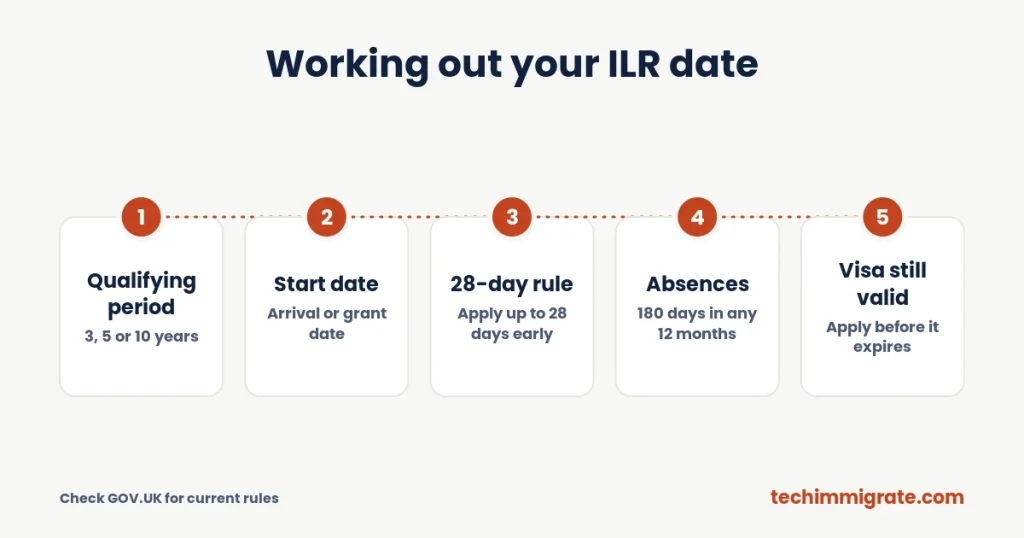
Knowing that your route leads to settlement after 3, 5 or 10 years is only half the answer. The other half is working out the exact date when you can apply. Get it wrong and you risk applying too early and being refused, or leaving it so late that your visa expires. Many people are surprised to learn when their qualifying period actually started, how early they are allowed to apply, and how a single long trip abroad can push their date back.
This guide explains how to work out when you can apply for indefinite leave to remain. It covers the qualifying periods on the main routes, when the clock starts, the 28-day early application rule, how absences can delay your date, how time on different visas can or cannot be combined, and how the planned settlement reforms may change the calculation.
Key takeaways
- On most routes, you can apply for ILR up to 28 days before you complete your qualifying period.
- The qualifying period usually starts from the date you entered the UK with valid permission, or the date your permission was granted if you were already in the UK.
- Current qualifying periods are 3 years for Global Talent (Exceptional Talent and research-endorsed) and Innovator Founder, 5 years for Skilled Worker and most family routes, and 10 years for long residence.
- On most work routes, you must not have spent more than 180 days outside the UK in any 12-month period, or your date may move.
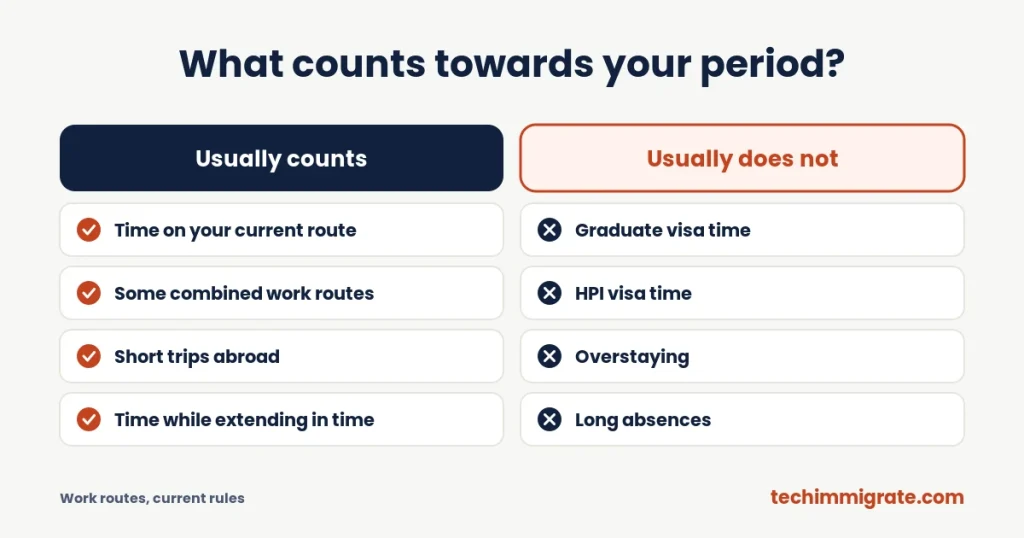
- Time on some routes, such as Graduate and High Potential Individual, does not count towards work-route settlement.
- The earned settlement reforms plan a 10-year default from 2027, with shorter paths for some.
Step 1: Know Your Qualifying Period
Start by identifying the qualifying period for your route under the current rules.
| Route | Current qualifying period |
|---|---|
| Global Talent (Exceptional Talent, research bodies, prize) | 3 years |
| Global Talent (Exceptional Promise, Tech Nation or Arts Council England) | 5 years |
| Innovator Founder | 3 years |
| Skilled Worker | 5 years |
| Scale-up | 5 years |
| Partner of a British citizen or settled person | 5 years (or 10 years on the longer route) |
| UK Ancestry | 5 years |
| Long residence | 10 years |
Our article on ILR rules by visa route explains each route in more detail.
Step 2: Find Your Start Date
The qualifying period usually starts:
- From the date you entered the UK with valid permission on the route, if you applied from abroad.
- From the date your permission was granted, if you applied from inside the UK.
If you held a visa before travelling, the start date is usually the date you arrived, not the date the visa was issued. Check your travel records and keep evidence of your arrival date, such as a boarding pass or travel itinerary.
Step 3: Apply the 28-Day Rule
On most routes, you can apply for settlement up to 28 days before you complete your qualifying period. For example, if you will complete 5 years on 1 June, you can usually apply from 4 May. If you apply earlier than this, your application is likely to be refused, and you lose the fee.
The 28-day rule is not a grace period after your visa expires. You must still make your application before your current permission ends.
Step 4: Check Your Absences
On most work routes, continuous residence means you must not have spent more than 180 days outside the UK in any 12-month period during your qualifying period. It is a rolling test, not a calendar-year test. If any 12-month window contains more than 180 days of absence, your continuous residence may be broken, and you may need to start counting again from a later date.
For the long residence route, the rules on absences are different and, after changes in 2024, also use a 180-day limit in any 12-month period for applications made under the new rules.
Step 5: Check Which Earlier Visas Count
If you have held more than one visa, work out which periods count.
- Skilled Worker with Global Talent or Innovator Founder: GOV.UK's continuous residence guidance allows some work routes to be combined in certain circumstances.
- Student and Graduate time: does not count towards the 5-year Skilled Worker period, but may count towards long residence while that route remains open.
- High Potential Individual time: does not count towards work-route settlement.
- Time as a dependant: usually counts only towards settlement as a dependant, not as a main applicant on a work route.
Step 6: Make Sure Your Visa Covers the Date
Your current visa must still be valid when you apply. If your visa will expire before you can apply for settlement, you may need to extend it first. When you choose a visa length, think ahead to your settlement date.
Worked Examples
Example 1: Skilled Worker from abroad
Priya was granted a Skilled Worker visa in March and arrived in the UK on 10 April. Her 5-year qualifying period usually starts on 10 April. She completes 5 years on 10 April five years later, and can apply from 13 March, 28 days earlier.
Example 2: Switching inside the UK
Tom switched from a Graduate visa to a Skilled Worker visa, granted on 1 September. His Graduate time does not count, so his 5-year qualifying period usually starts on 1 September.
Example 3: A long trip
Aisha is on a Skilled Worker visa and spent 200 days abroad in one 12-month period to care for a relative. Unless an exception applies, her continuous residence may be broken, and her settlement date may move later.
These examples are fictional and simplified.
How the Earned Settlement Reforms Change the Calculation
The government's response to the earned settlement consultation, published on 2 November 2026, plans a new framework from 2027. The headline paths are 3 years for people earning £125,141 or more in 3 of the last 4 years or in the Highest Talent Group, 5 years for people earning £50,271 or more in 3 of the last 5 years and some others, 10 years as the default and 20 years for people with breaches or public funds claims. Everyone will also need B2 English from 26 March 2027, no criminal record, no public debts and a sustained contribution.
The response does not include general transitional protection, so your date may depend on whether you apply before or after the relevant changes take effect. Our article on ILR new rules explains the reforms.
Common Mistakes
- Counting from the visa issue date instead of the arrival date.
- Applying more than 28 days early.
- Letting your visa expire while waiting to become eligible.
- Ignoring a long absence that breaks continuous residence.
- Assuming Graduate or HPI time counts towards work-route settlement.
- Not checking whether the new rules will apply to you.
On most routes, up to 28 days before you complete your qualifying period, as long as your visa is still valid.
Usually from the date you entered the UK with permission on the route, or the date your permission was granted if you were already in the UK.
5 years under the current rules.
On some routes, such as Global Talent (Exceptional Talent) and Innovator Founder, under the current rules.
Yes. On most work routes, more than 180 days outside the UK in any 12-month period can break continuous residence.
They plan a 10-year default from 2027, with shorter paths for some. Check GOV.UK for the final rules.
Building a Simple Settlement Calendar
A simple calendar can stop you missing your window. Put these dates in your diary as soon as you know them.
- Your start date: the date your qualifying period began.
- Your earliest application date: your completion date minus 28 days.
- Your visa expiry date: the latest date you can apply on your current permission.
- Six months before your earliest application date: a reminder to book the Life in the UK test and check your English evidence.
- Three months before: a reminder to gather documents and, for Skilled Workers, ask your sponsor for a letter.
- One month before: a reminder to check your absences one last time and prepare the online form.
If your visa expiry date comes before your earliest application date, you will need to extend first.
Counting Absences Accurately
The absence rule is where many people make mistakes. Count the days you were outside the UK for each trip, usually excluding the days you left and returned. Then check every rolling 12-month window, not just calendar years. A spreadsheet with departure and return dates makes this much easier. If you are close to the limit, it may be safer to wait a little longer before applying, so that the window used for your application has fewer absences. Some absences for serious or compelling reasons, such as serious illness, may be allowed, but you will need evidence.
When Your Visa Expires Before You Qualify
It is common for a visa to expire a few months before the qualifying period ends. For example, a Skilled Worker might have been granted 3 years and then extended for 2 years, ending exactly at 5 years, or might have chosen a shorter visa. If your visa will expire before you can apply for settlement, you must extend it in time. Applying for an extension before your current visa expires usually lets you stay on the same conditions while the extension is decided. Do not let your visa run out while you wait to become eligible, because a gap in lawful status can cause serious problems.
Combining Time on Different Routes
Many tech professionals arrive on one route and switch to another. Whether that earlier time counts depends on the routes. Under the current continuous residence guidance, time on certain work routes, such as Skilled Worker, Global Talent and Innovator Founder, can in some cases be combined towards settlement. Time on routes such as Graduate and High Potential Individual cannot. If you are unsure, list every visa you have held, with dates, and check each one against the guidance. Our article on switching to a Skilled Worker visa and our guide to switching to the Global Talent visa cover common switches.
Dependants' Dates
Your partner and children have their own qualifying periods. Under the current rules, dependants usually need to complete their own period, which may start later than yours if they joined you after you arrived. Under the planned reforms, partners who are with the main applicant are expected to settle at the same time, while partners who join later may need to complete their own period. Work out each family member's dates separately, and plan the family's applications together. Our guide to ILR for dependants explains the rules.
Getting the English and Life in the UK Requirements Ready
Two requirements need planning before your application date. The Life in the UK test costs £50, has 24 questions and must be booked at least 3 days ahead. Book it well before your earliest application date so that a retake does not delay you. For English, you currently usually need B1, but the reforms plan B2 from 26 March 2027. If you will apply after that date and need a test, book a B2 test in good time. Our articles on the Life in the UK test and the English test for ILR explain both.
Choosing Between Standard and Faster Decisions
Once you know your date, think about how long you can wait for a decision. Standard settlement decisions usually take up to 6 months. Priority, at £500 extra, usually takes 30 working days for settlement. Super priority, at £1,000 extra, usually gives a decision by the end of the next working day. While your application is pending, you should usually avoid travelling abroad. If you have travel planned, a faster decision may be worth the cost.
If You Applied Too Early
If you apply more than 28 days before you complete your qualifying period, your application is likely to be refused, and the fee is usually not refunded. If your visa is still valid, you can usually reapply once you are eligible, but you will pay again. If your visa expired while the early application was being considered, get advice quickly about your position. The best protection is to calculate your date carefully, and to leave a small margin.
The Bottom Line
Working out when you can apply for ILR takes a few careful steps: know your qualifying period, find your real start date, apply the 28-day rule, check every 12-month window for absences, confirm which earlier visas count, and make sure your visa will still be valid. With the reforms coming, it is also worth checking whether you can apply under the current rules before the changes take effect.
Getting Advice
If your history includes several routes, gaps in status, long absences or previous refusals, a short consultation with a regulated immigration adviser before you apply can be worth the cost. They can check your dates, your absences and which periods count, and help you avoid a refusal.
Special Situations That Affect Your Date
Some situations need extra care when you work out your date.
- Gaps between visas. If you applied to extend before your visa expired, the time while the application was being decided usually counts as lawful. If your visa expired before you applied, there may be a gap, which can break continuous residence.
- Periods of overstaying. Short periods of overstaying in limited circumstances may be disregarded under the rules, but they can still cause problems, and under the planned reforms a qualifying breach could lead to a much longer path.
- Time in prison. Time spent in prison does not count towards settlement and can affect eligibility.
- Absences for work. Some routes allow absences for work-related reasons to be treated differently. For example, people endorsed by the research bodies on the Global Talent route have more flexibility for research absences.
If any of these apply to you, check the continuous residence guidance carefully or get advice before you apply.
How Global Talent Holders Work Out Their Date
For Global Talent holders, the qualifying period depends on your endorsement. Under the current rules, Exceptional Talent holders, prize winners and anyone endorsed by the Royal Society, British Academy, Royal Academy of Engineering or UKRI can usually apply after 3 years. Exceptional Promise holders endorsed by Tech Nation or Arts Council England usually need 5 years. You also need to have earned money in your field. Under the planned reforms, Global Talent is expected to be in the Highest Talent Group, with a 3-year path, but details are still to be confirmed. Our guide to Global Talent visa to ILR explains the process.
How Skilled Workers Work Out Their Date
For Skilled Workers, the qualifying period is currently 5 years. Time with different sponsors usually counts towards the same period, as long as there are no gaps. When you apply, your current sponsor must confirm that they still need you, and your salary must meet the relevant threshold. Under the planned reforms, Skilled Workers earning £50,271 or more in 3 of the last 5 years are expected to keep a 5-year path, while others may face the 10-year default. Our article on ILR requirements for Skilled Workers explains each requirement.
A Quick Self-Check
Before you apply, answer these questions:
- What is my route's qualifying period?
- What is my real start date?
- What is my earliest application date, using the 28-day rule?
- Is my visa valid until at least that date?
- Have I stayed within 180 days of absence in every 12-month window?
- Do any of my earlier visas count, and have I confirmed that?
- Am I ready with the Life in the UK test and English evidence?
- Will the new rules apply to me?
If you cannot answer any of these with confidence, take time to check before you pay the fee.
Why Precision Matters More Now
Under the current rules, a small miscalculation usually means a refused application and a lost fee, which is painful but fixable. With the earned settlement reforms approaching and no general transitional protection, timing could also decide which set of rules applies to you. Applying correctly, as soon as you are eligible, may make the difference between settling under the current framework and having to meet the new one. That is why it is worth calculating your date carefully now.
Partners of British Citizens
If you are on the partner route as the spouse, civil partner or unmarried partner of a British citizen or settled person, your qualifying period is usually 5 years, made up of two grants of permission of 30 months each. You can usually apply for settlement up to 28 days before you complete the 5 years. You must continue to meet the relationship, financial, accommodation and English requirements. If you are on the longer 10-year partner route, the calculation is different. The partner route has its own detailed guidance on GOV.UK, which is worth reading closely before you apply.
Keeping Evidence of Your Dates
The Home Office will check your dates against its own records, but it helps to keep your own evidence. Useful records include your visa decision letters, your eVisa details, boarding passes or travel itineraries for your first arrival, and a log of every trip abroad. If there is ever a disagreement about when your qualifying period started or whether you broke continuous residence, these records can make all the difference. Store them in one place, ideally both digitally and on paper.
What Happens on the Day You Apply
You apply online through GOV.UK, pay the fee of £3,226 per person, and then prove your identity, either with the UK Immigration: ID Check app or at a service point. Your application date is usually the date you submit the online form and pay. Keep the confirmation email, because it proves you applied before your visa expired. Our article on how to apply for ILR walks through each step of the form.
Your Next Step
For tech professionals, the Global Talent visa offers one of the shortest qualifying periods. Our role-specific Global Talent guides explain what Tech Nation looks for in software developers, data and AI specialists, product managers, designers, founders and more.
How We Checked This Article
We checked qualifying periods, the 28-day rule and continuous residence against GOV.UK's guidance on indefinite leave to remain and the Home Office's continuous residence guidance, in November 2026. The planned framework is from summaries of the earned settlement response of 2 November 2026.
Tech Immigrate is independent of the Home Office. This article is general information, not legal advice. Check GOV.UK before you apply.
We write practical guides for tech professionals applying for the UK Global Talent visa. Tech Immigrate is independent of Tech Nation and the Home Office, and our articles are general information, not legal advice. Rules and fees change, so always check gov.uk before you apply.