Tech Nation Endorsement Assessor: Who Reviews Your Application and What They Look For
Who is the Tech Nation endorsement assessor? What assessors check, how much discretion they have, what feedback means and how reviews work.


In this article
- Who Is the Tech Nation Endorsement Assessor?
- Where Does the Assessor Fit Into Stage 1?
- What Does a Tech Nation Assessor Actually Check?
- How Much Discretion Does an Assessor Have?
- What Does Assessor Feedback Look Like?
- What Real Refusals Show About How Assessors Think
- Is a Review Looked at by a Different Assessor?
- How Do You Write an Application for an Assessor?
- Is the Way Assessors Work Changing?
- Want an Application Built for the Assessor?
- Frequently Asked Questions
- How We Checked This Article
A Tech Nation endorsement assessor is the independent expert who reads your Global Talent Stage 1 application and decides whether to recommend you for endorsement. Assessors sit on Tech Nation's independent panel, judge your evidence against the mandatory and optional criteria, and write the feedback you receive if you are refused. The Home Office does not second-guess their decision: under the endorsing body rules, the endorsement decision is final.
This article is for tech professionals preparing a Tech Nation application, or reading a refusal, who want to know who the assessor is, what they actually check, how much discretion they have and how reviews work. It explains the process from the assessor's side of the desk, using GOV.UK, Home Office rules for endorsing bodies, a 2026 Tech Nation job advert that describes how assessors are managed, and refusal feedback that applicants have shared on the Tech Nation Visa Forum (applicant-reported and paraphrased).
Key takeaways
- Your application is judged by assessors on Tech Nation's independent panel, not by Home Office caseworkers. The Home Office only checks the visa stage.
- Assessors have discretion. Meeting the wording of a criterion is not enough; they decide whether, overall, you are a leader or potential leader in digital technology.
- They look for evidence that is independent, verifiable, recent, personal to you and recognised outside your job.
- Feedback is written by the assessor and often marks each criterion met or not met. Soft words such as "respectable" usually mean recognition beyond your job was missing.
- A review goes back to Tech Nation, is free, must be requested within 28 days and cannot include new evidence.
- Write every document so a busy expert outside your niche can see the claim, the criterion and the proof in under a minute.
Who Is the Tech Nation Endorsement Assessor?
The Tech Nation endorsement assessor is a member of Tech Nation's independent panel of assessors. Tech Nation is the body the Home Office has designated to endorse Global Talent applicants in digital technology, and Tech Nation's applicant guide says its panel decides whether, overall, an applicant should be endorsed and for which route (Exceptional Talent or Exceptional Promise).
Three facts shape what that means for you:
- The assessor is not a civil servant. The Home Office's code of practice for endorsing bodies says endorsing bodies assess applicants without Home Office involvement, and that the Home Office will not give advice on or involve itself in individual endorsement decisions.
- The assessor's view is final at Stage 1. The same code says the endorsing body's decision is final. The Home Office only decides the visa application that follows (Stage 2).
- Tech Nation manages a group of assessors, not one person. A July 2026 job advert for a Programme Manager, Global Talent Visa, in the Tech Nation department of Founders Forum Group, describes owning the relationship with "our assessor group" from recruitment and onboarding onwards, chairing regular assessor meetings and reviewing their output for consistency, evidence standards and rigour.
Tech Nation does not publish assessors' names, how many there are or exactly how each one is paid. What we can say from the public sources is that the panel is made up of people judged able to assess digital technology careers, that they work to Tech Nation's own assessor guidance, and that their decisions are quality-checked centrally. If you want the wider picture of which bodies endorse which fields, see our guide to Global Talent endorsing bodies.
Where Does the Assessor Fit Into Stage 1?
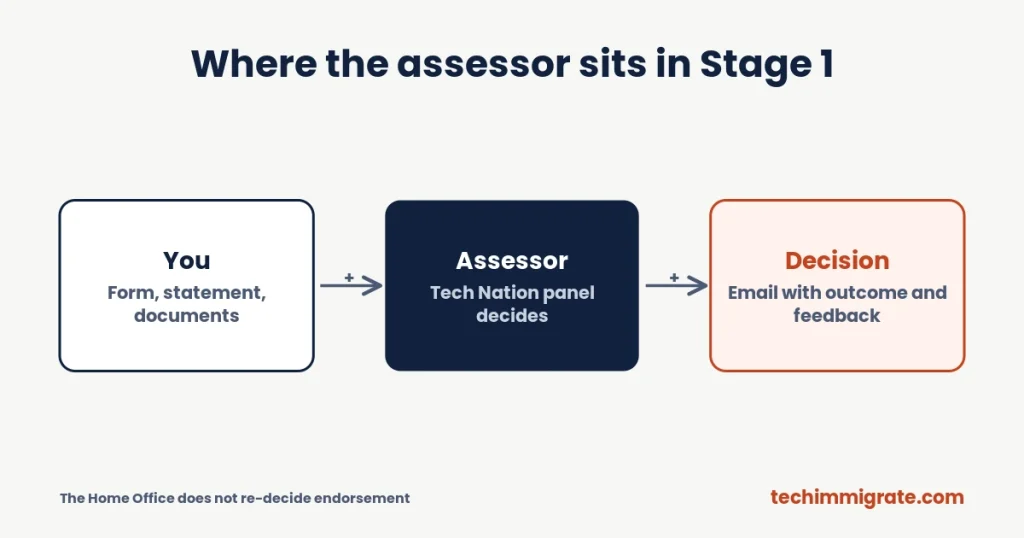
The assessor sits in the middle of Stage 1, between your application form and the decision letter. You never deal with them directly. Since August 2025 there has been no separate Tech Nation portal: you apply on the Home Office form, type your personal statement into it (since February 2026), and email your documents to the Home Office, which passes the application to Tech Nation for assessment.
| Step | Who acts | What happens | What it means for the assessor |
|---|---|---|---|
| 1. Apply | You | Home Office form, £561 endorsement fee, personal statement typed in the form | The statement is the first thing that frames your case |
| 2. Documents | You | CV, 3 letters and up to 10 evidence documents, emailed to the Home Office | Links are not accepted, so the assessor only sees what is in the files |
| 3. Allocation | Tech Nation | The application is passed to the panel | Your case is read by an assessor working to Tech Nation's guidance |
| 4. Assessment | Assessor | Each criterion is judged, then an overall decision on endorsement and route | Discretion applies at both levels |
| 5. Decision | Tech Nation and the Home Office | You get an email with the outcome and, if refused, the feedback | The feedback is the assessor's reasons, criterion by criterion |
The Home Office's 2020 code of practice set a service standard for endorsing bodies of at least 80% of cases decided within 25 working days and all cases within eight weeks. In practice, applicants report Stage 1 decisions in roughly 5 to 8 weeks. One applicant who shared a refusal on the forum applied on 8 January 2026 and received the decision on 25 February 2026, about seven weeks later (applicant-reported). For a stage-by-stage view of waiting times, read Global Talent visa Stage 1: from submission to decision.
What Does a Tech Nation Assessor Actually Check?
A Tech Nation assessor checks two things: whether each criterion you claimed is met, and whether, overall, you are a leader (Exceptional Talent) or potential leader (Exceptional Promise) in digital technology. You need the mandatory criterion plus two of the four optional criteria. The full wording is in our guide to the Global Talent visa criteria; this section is about how an assessor reads your evidence against them.
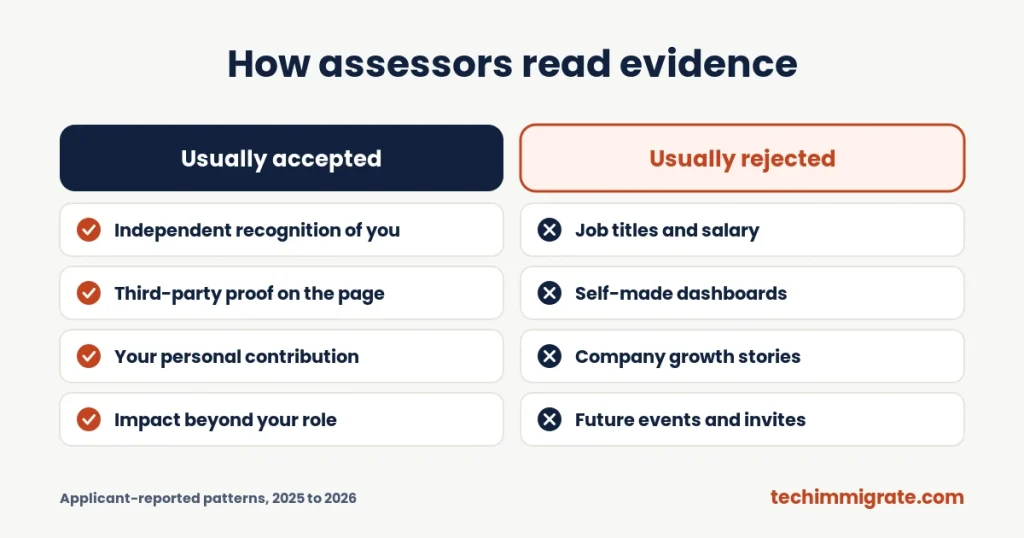
Across 2025 and 2026 refusals shared on the forum, the same five tests come up again and again (applicant-reported and member opinion):
- Is it independent? Recognition from people and organisations outside your employer, your clients and your friends.
- Can it be verified? Something the assessor can check from the page itself, not a dashboard only you can log in to.
- Is it about you personally? Your own contribution, not what your team or company achieved.
- Is it beyond your job? Recognition or impact above what someone in your role would normally produce.
- Is it recent and sustained? Within the last five years, and part of a pattern rather than one event.
| Criterion | The question the assessor is really asking | Evidence assessors often reject |
|---|---|---|
| Mandatory criterion (MC) | Is this person recognised as a leader or emerging leader in the digital technology sector, beyond their employer? | Job titles, salary, internal awards, company press, podcasts about your company |
| OC1: innovation | Did this person personally create something new in digital technology, with evidence of its use? | Product launches described only by the company, support letters with no technical detail |
| OC2: recognition beyond occupation | Do they contribute to the field outside their paid work, and does anyone notice? | Being invited to judge an event, self-published blogs with no audience data, mentoring with no outside confirmation |
| OC3: significant technical or commercial impact | Did their work change results in a measurable way that a third party confirms? | Internal OKRs, screenshots, self-written case studies, company growth stories |
| OC4: academic contribution | Has their research advanced the field, and do others rely on it? | Very recent papers with no citations, venues of limited standing |
The phrase "independently verifiable" appears so often in member advice that it is worth treating as the assessor's default question. In a 2026 thread on Exceptional Talent, a reviewer summed up the gap as validation an assessor "can verify without your input" (member opinion, Tech Nation Visa Forum). If a document only works because you explain it, it is weak evidence.
How Much Discretion Does an Assessor Have?
An assessor has real discretion. Tech Nation's guide says the decision is not determined solely by the criteria and that each application is assessed on its own merits. In practice that means two things.
First, ticking the criteria is not the same as being endorsed. An assessor can accept individual documents and still decide that, overall, the case does not show a leader in digital technology. This is why some refusals read as general ("not at the level expected") rather than pointing at one missing item.
Second, different assessors can read the same evidence differently. Applicants have reported this for years. One applicant wrote in 2022 that a review response told them one assessor might accept evidence that another would not when similar evidence was reused (applicant-reported). In 2026, applicants who reapplied after a refusal reported that a criterion marked as met the first time failed on the second application, because each application is judged independently.
Tech Nation's own hiring suggests it is working on consistency. The July 2026 Programme Manager advert describes spotting patterns across endorsement decisions and turning them into updated assessor guidance, training and individual feedback, and measures success partly by feedback that is consistently higher quality. That is a sign that differences between assessors are known and managed, not that they have disappeared.
| What discretion means | What it does not mean |
|---|---|
| An assessor can refuse even if each criterion looks covered on paper | An assessor can ignore the criteria altogether |
| Similar evidence can get a different result in a new application | A criterion that passed once is guaranteed to pass again |
| The assessor weighs your whole story, including your career path | Years of experience on their own make you exceptional |
| A review can correct an error in how evidence was read | A review will re-judge how strong your evidence is |
What Does Assessor Feedback Look Like?
If you are refused, the decision email includes the assessor's reasons, usually going through your letters, your career and each criterion you claimed, often marking each one as met or not met. Applicants call this document the proforma. Our guide to the Global Talent visa rejection proforma explains its layout in detail; here is what the assessor's language tends to mean.
Most proformas open with a standard line saying all evidence was reviewed but not every item may be commented on. A January 2026 Exceptional Promise refusal shared on the forum said the assessor examined all evidence, "though not every piece may be explicitly addressed" (applicant-reported). So if a document is not mentioned, do not assume it was missed. It may simply have carried no weight.
| Phrase you may see | What the assessor usually means |
|---|---|
| "Primarily internal or self-authored" | Your evidence comes from you or your employer, not from independent sources |
| "Limited independently verifiable" evidence | The assessor could not check the claim from what was on the page |
| "Recognition beyond employment" was not shown | You are good at your job, but the sector does not visibly recognise you |
| "Not at the level expected for Exceptional Talent" | The evidence may fit Promise, or may not be strong enough for either route |
| "Company growth narrative" | The document shows what the company did, not what you personally did |
| "Respectable" or "capable" professional | Solid career, but nothing that sets you apart in the field |
The wording above combines phrases from refusals that applicants posted in 2026, paraphrased except where quoted, and is not an official glossary. Wording changes over time and between assessors.
What Real Refusals Show About How Assessors Think
These dated cases come from the Tech Nation Visa Forum. They are applicant-reported, anonymised and paraphrased, and show patterns rather than rules.
- Senior roles at well-known companies, refused on every criterion (February 2026). An Exceptional Talent applicant with senior go-to-market roles at two well-known tech companies applied on 8 January and was refused on 25 February, with the mandatory criterion, OC1 and OC3 all rejected. The panel acknowledged the roles but said the evidence did not show "industry-level recognition beyond employment". It wanted objective proof of personal contribution rather than support letters and company growth stories, and said internal OKRs and presentations did not show impact beyond the role.
- Promise refused for self-authored evidence (May 2026). A Promise applicant's feedback described the evidence as primarily internal or self-authored, with limited independently verifiable third-party material, and the OC3 evidence as internal screenshots and self-written descriptions. Members advised that a review would only help on a narrow threshold point, because most of the feedback was a judgement call rather than a processing error.
- Founder media read as company coverage (2026). A technical founder refused under Promise was told, in member analysis, that assessors separate coverage of a start-up from recognition of the founder personally, and that analytics dashboards and bank notifications count as self-reported metrics.
- Event judging and podcasts not accepted as recognition (2026). An applicant quoted assessor feedback they had seen saying that being invited to judge an event is not the kind of recognition the criteria require, and that speaking and podcast appearances did not show recognition at the Exceptional Talent level (applicant-reported).
- Future events carry no weight (2026). A member advising a second-time Promise applicant warned that an award nomination and a speaking invitation for events that had not yet happened are prospects, not recognition, because assessors judge what has already been validated.
The common thread: assessors reward evidence that someone outside your employer has already recognised, in a form they can check. Everything else is context.
Is a Review Looked at by a Different Assessor?
GOV.UK says a review of a refused endorsement "will be done by the endorsing body that looked at your original application", so for digital technology it goes back to Tech Nation. GOV.UK does not say whether the same person reads it again. Forum members have long reported that reviews are handled by different assessors from the original decision (member opinion), but there is no official confirmation of how Tech Nation allocates them.
What is official is the scope of a review:
- It is free and must be requested within 28 days of the decision.
- You cannot add new evidence.
- It checks whether evidence was not properly looked at, or whether there was a mistake in how the application was processed. It is not a second assessment of how strong your evidence is.
- You are told the outcome by email within 28 days. If you are refused again for the same reasons, you cannot ask for another review; if new reasons are given, you can request one more review on those new reasons only.
The Home Office's 2020 code of practice is blunter: challenges against the substance of a peer review judgement are not accepted. Home Office figures obtained by Edgewater Legal (FOI2026/10735, October 2026, not independently verified) suggest only about 4% of roughly 1,900 decided reviews succeeded. Our walkthrough of the Global Talent endorsement review form covers how to write one.
| Choose a review when | Choose to reapply when |
|---|---|
| The feedback says a document was missing or not considered, and you can show it was submitted | The feedback says your evidence was not strong enough |
| The assessor applied the wrong route or threshold (for example judged a Promise case at Talent level) | You need new evidence, new letters or a different choice of criteria |
| A factual statement in the feedback is plainly wrong and the proof is already in your documents | Most criteria failed for lack of independent recognition |
How Do You Write an Application for an Assessor?
Write for a busy expert who is not in your exact niche, who reads many applications and who can only judge what is on the page. That one idea explains most good practice.
- Lead each document with the claim. The first lines should say which criterion the document supports and what it proves. Do not make the assessor work it out.
- Give one document one job. Members repeatedly warn that using the same achievement in two criteria is read as one piece counted twice, which weakens both.
- Put third-party proof on the page. A screenshot of your own dashboard is weak; a client letter, an independent article or a public adoption figure is stronger. Remember that links are not accepted, so include what matters in the file.
- Separate you from your team. Name your personal role in every team result, and back it up with someone who saw it first-hand.
- Choose letter writers the assessor will respect. Independent, senior people in digital technology who know your work directly. Members report that assessors flag templated letters and letters written by the same person as other evidence.
- Keep it inside the window. Evidence from the last five years, showing a pattern, not a single moment.
The blog stops at the principles. Our guides go further, with the 3-page evidence template every document needs, criteria choice by role, letter briefs and refusal fixes for each criterion. See the Global Talent guides by role.
Is the Way Assessors Work Changing?
The way assessors work may change. On 17 November 2026 the Migration Advisory Committee published its Review of Talent Routes. It reported that the endorsement rate on the standard routes (all endorsing bodies except UKRI) fell from 74% in 2021 to 44% in 2025, and that Tech Nation endorsed about 900 applicants between October 2024 and September 2025, the fewest of the six bodies. It linked the fall partly to more poor-quality, premature, AI-generated and some fraudulent applications.
The committee recommended that referees send letters directly and confidentially to endorsing bodies, and that endorsing bodies apply conflict-of-interest rules. These are recommendations only, not rules. If adopted, assessors would read your letters without you seeing or submitting them, which makes choosing credible, independent referees even more important.
Refusal rates have also risen. The Edgewater Legal FOI figures (not independently verified) suggest Tech Nation refused about 82% of decided applications in 2025 and about 91% in 2026 up to July. Whatever the exact figure, the direction is clear: assessors are applying a high bar, and generic applications rarely pass. Our article on using AI in your Global Talent application covers what applicants report about AI-written content being refused.
Want an Application Built for the Assessor?
Tech Immigrate's role guides are written by an engineer who was refused Global Talent endorsement, then reapplied and was endorsed. The career did not change between the two applications; what changed was how the criteria were chosen and how the evidence was presented to the assessor.
Each guide is built around the questions above: which criteria to claim for your role, what independent evidence looks like in your job, how to brief your three letter writers, a complete mock evidence pack and fixes for the most common refusal reasons. The Software Developers guide, for example, runs to 114 pages with 20 evidence checklists and 30 refusal fixes.
- Software developers, data and AI specialists, cybersecurity, product managers, business analysts and more: choose your guide.
- Already refused? Read the rejection proforma guide first, then decide between a review and a stronger reapplication.
No guide can guarantee endorsement. What it can do is help you give the assessor exactly what they need to say yes.
Frequently Asked Questions
Assessors on Tech Nation's independent panel assess digital technology applications for the Global Talent visa. They judge each criterion and decide whether, overall, the applicant should be endorsed and for which route. The Home Office does not take part in that decision.
No. Tech Nation does not publish assessors' names or tell applicants who assessed their case. You only see the written feedback attached to the decision if you are refused.
Not at Stage 1. Under the Home Office's code of practice for endorsing bodies, the endorsing body's decision is final. The Home Office can monitor endorsing bodies in general but does not re-decide individual endorsements.
GOV.UK only says the review is done by the endorsing body that assessed your application, which for tech is Tech Nation. Forum members report that a different assessor usually looks at it, but this is not officially confirmed.
Feedback commonly states that all evidence was reviewed but not every item may be commented on. A document that is not mentioned has usually been read but given little weight. Only argue it was missed if you have good reason to think so.
Yes. Tech Nation's guide gives assessors discretion and judges each application on its own merits. Applicants report that a criterion accepted in one application has failed in a later one, so never rely on a past pass.
Evidence that is independent of your employer, verifiable from the page, personal to you rather than your team, beyond what your job requires, and from the last five years. Recognition by the wider digital technology sector matters most for the mandatory criterion.
How We Checked This Article
We checked the review rules against GOV.UK's page on what to do if your endorsement application is refused on 22 November 2026, and the wider process against GOV.UK's digital technology Global Talent pages. The role of endorsing bodies, the finality of endorsement decisions, the service standard and the position on reviews come from the Home Office's Global Talent code of practice for endorsing bodies (version 1.0, February 2020), which may not reflect current wording. The description of Tech Nation's independent panel and assessor discretion comes from Tech Nation's Global Talent Visa Application Guide (last updated 27 February 2026). How assessors are managed comes from a July 2026 Programme Manager job advert in the Tech Nation department of Founders Forum Group. Endorsement rates come from the Migration Advisory Committee's Review of Talent Routes (17 November 2026). Refusal and review figures come from Home Office FOI figures (FOI2026/10735) published by Edgewater Legal in October 2026, which have not been independently verified.
Refusal wording and member advice come from the Tech Nation Visa Forum, including a February 2026 Exceptional Talent refusal, a May 2026 Promise refusal and review draft, a January 2026 Promise proforma, a 2026 technical founder refusal, a 2026 Exceptional Talent evidence review, a 2026 evidence plan review, a second-application review, an AI/ML Promise evidence review and older threads on assessor differences and reviews. Forum material is applicant-reported or member opinion, paraphrased, and not official guidance.
Tech Immigrate is independent of Tech Nation, Founders Forum Group and the Home Office. This article is general information, not legal advice.
We write practical guides for tech professionals applying for the UK Global Talent visa. Tech Immigrate is independent of Tech Nation and the Home Office, and our articles are general information, not legal advice. Rules and fees change, so always check gov.uk before you apply.