Global Talent and the New UK Settlement Rules: Is It Still 3 Years?
Global Talent visa ILR new rules explained: the Highest Talent Group, B2 English, transitional protection and what Global Talent holders should do now.


In this article
- The Short Answer
- How Settlement Works for Global Talent Now
- What the Earned Settlement Response Changes
- Where Global Talent Fits: The Highest Talent Group
- The New Mandatory Requirements
- Is There Transitional Protection?
- Scenarios for Global Talent Holders
- What About Your Partner and Children?
- What You Can Do Now
- What It Means for New Applicants
- The Income Door: A Back-Up Path for High Earners
- How Global Talent Compares With Other Routes Under the New Rules
- Evidence to Start Collecting Now
- Why the Government Is Making These Changes
- Should You Change Your Plans Now?
- Common Misunderstandings
- Timeline of Key Dates
- Your Next Step
- How We Checked This Article
For years, one of the biggest selling points of the Global Talent visa has been speed to settlement. Exceptional Talent holders could apply for indefinite leave to remain after just 3 years, compared with 5 years on most work routes. Now the UK is overhauling settlement for almost everyone. The government's response to its earned settlement consultation, published on 2 November 2026, sets a default qualifying period of 10 years, with shorter paths for people who contribute in specific ways. So the question every Global Talent holder and applicant is asking is simple: is it still 3 years?
This article focuses on that question. It explains what the new settlement framework says about Global Talent, what we know for certain, what is still to be decided, how the new mandatory requirements could affect you, and what you can do now to protect your position. It deliberately separates confirmed facts from open questions, because the details are still being worked out.
Key takeaways
- The earned settlement response of 2 November 2026 sets a new default qualifying period of 10 years for most migrants, with shorter paths for some.
- A 3-year path is planned for people earning £125,141 or more in 3 of the last 4 years, or who fall into a "Highest Talent Group". Global Talent is expected to be in that group.
- The exact definition of the Highest Talent Group is due to be set after advice from the Migration Advisory Committee, so the details for Global Talent are not yet final.
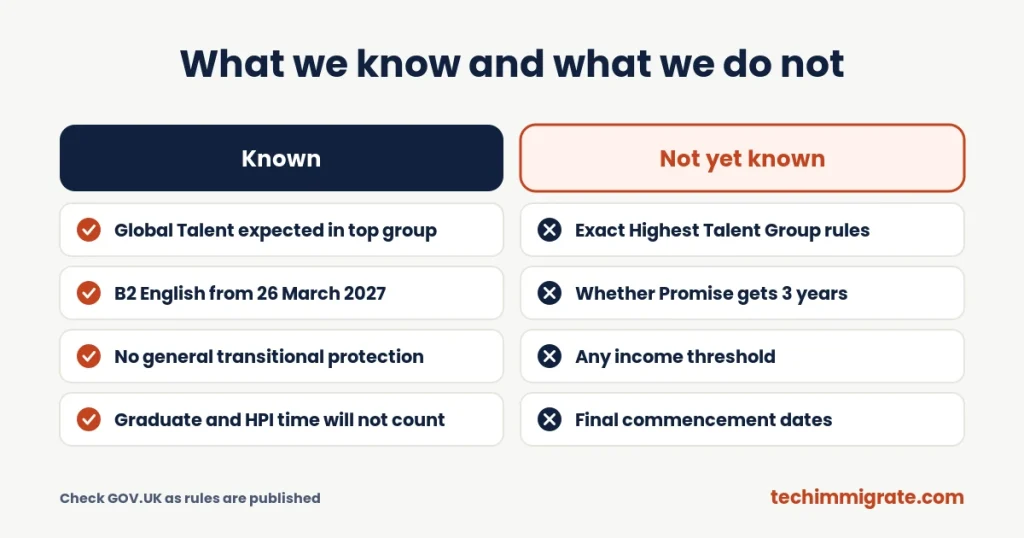
- New mandatory requirements are planned for everyone, including B2 English from 26 March 2027, no UK criminal record, no public debts and a sustained contribution requirement.
- There is no general transitional protection in the response, so people already on the route may be affected.
- Under the current rules, Exceptional Talent holders (and research-endorsed Promise holders) can still settle after 3 years, and Tech Nation Exceptional Promise holders after 5 years, until the changes take effect.
The Short Answer
The government intends Global Talent to stay one of the fastest routes to settlement. The earned settlement response creates a 3-year path for the Highest Talent Group, and Global Talent is named among the routes expected to fall into it. But the final rules for who is in that group, and on what conditions, have not yet been published. The Migration Advisory Committee's review of talent routes, published on 17 November 2026, has also recommended changes, including an income threshold at settlement for talent routes.
So the honest answer is: probably still 3 years for many Global Talent holders, but with new conditions, and with details still to come. Anyone planning around a specific date should check GOV.UK as the rules are published.
How Settlement Works for Global Talent Now
Until the new rules take effect, the current Global Talent settlement rules apply.
| Endorsement | Current qualifying period |
|---|---|
| Exceptional Talent (any endorsing body) | 3 years |
| Exceptional Promise (Royal Society, British Academy, Royal Academy of Engineering, UKRI) | 3 years |
| Exceptional Promise (Tech Nation, Arts Council England) | 5 years |
| Prize route | 3 years |
You must also have earned money in your field (on most routes, including digital technology), meet the continuous residence rule of no more than 180 days outside the UK in any 12-month period, pass the Life in the UK test and meet the English requirement, currently B1.
Our article on Global Talent visa to ILR in 3 years explains the current process in full.
What the Earned Settlement Response Changes
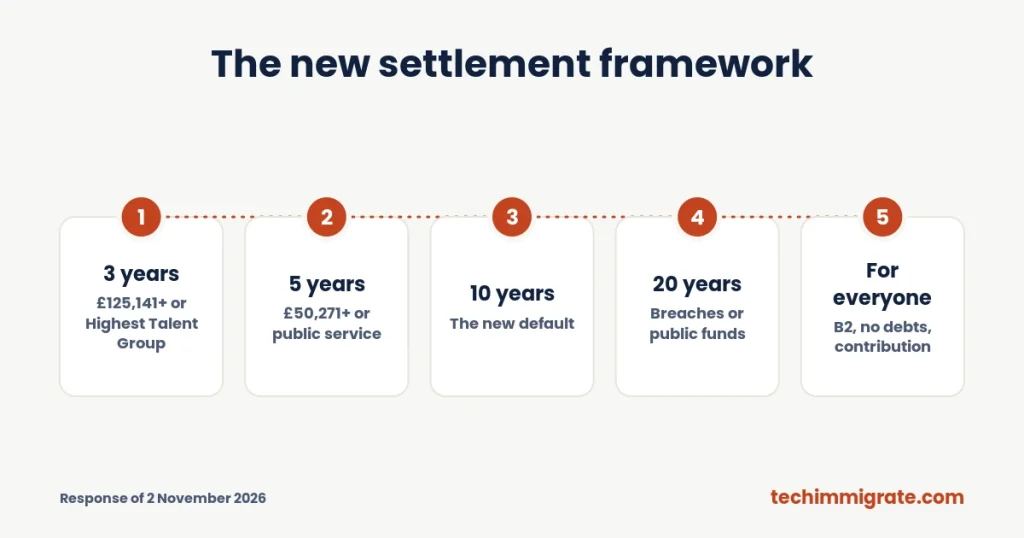
The consultation response, titled "A Fairer Pathway to Settlement", sets out a new framework. Rules are due to be laid from December 2026, with implementation over 2027. The key features are:
A new default of 10 years
Most migrants will need 10 years of qualifying residence before they can settle, unless they qualify for a shorter path.
Shorter paths for higher contributions
- 3 years: for people earning £125,141 or more in 3 of the last 4 years, or in the Highest Talent Group.
- 5 years: for people earning £50,271 or more in 3 of the last 5 years, people in specified public service occupations for 5 years, and people with certain British connections.
- 10 years: the default, with a requirement to earn at least £12,571 in 5 of the last 7 years.
Longer paths for some
A 20-year path applies to people who have committed a qualifying breach of the rules or received public funds. A proposed 15-year path was dropped.
Time that will not count
Time on some routes will not count towards settlement, including Visit, Student, Graduate, High Potential Individual and some temporary routes. This matters for Global Talent holders who switched from a Graduate or HPI visa.
Where Global Talent Fits: The Highest Talent Group
The 3-year path has two doors: the income door (£125,141 in 3 of the last 4 years) and the talent door (the Highest Talent Group). Global Talent and Innovator Founder are named as routes expected to fall into the Highest Talent Group.
The important point is that the group's exact definition is due to be set after advice from the Migration Advisory Committee. Open questions include:
- Will every Global Talent holder be in the group, or only some?
- Will Exceptional Talent and Exceptional Promise be treated the same?
- Will the endorsing body matter, as it does now?
- Will there be extra conditions, such as an income threshold?
What the MAC review suggested
The Migration Advisory Committee's review of talent routes, published on 17 November 2026, looked closely at Global Talent. It found that endorsement rates on the standard routes fell from 74% in 2021 to 44% in 2025, and that Tech Nation endorsed around 900 applicants between October 2024 and September 2025. Among its recommendations were an income threshold at settlement for talent routes, referee letters sent directly to endorsing bodies, and stronger conflict-of-interest rules.
The government does not have to accept every MAC recommendation. But if an income threshold at settlement is introduced for talent routes, Global Talent holders could need to show a certain level of earnings to use the 3-year path, rather than simply having earned money in their field.
The New Mandatory Requirements
Whatever your qualifying period, the response sets out requirements that everyone must meet to settle.
- English at B2. From 26 March 2027, the English requirement rises from B1 to B2, which is upper intermediate.
- Life in the UK test. You must still pass it.
- No UK criminal record.
- No public debts, including NHS debts, tax and National Insurance debts, and debts to the Home Office.
- Sustained contribution. You must have earned at least £12,571 a year. Couples can combine their income to meet £25,142.
For most Global Talent holders, the earnings requirement is unlikely to be a problem. The B2 English requirement is the change most likely to need planning.
B2 English: what it means for you
B2 is a higher level than the current B1 requirement. If you are a national of a majority English-speaking country, or have a degree taught in English, you may already meet the requirement. Otherwise, you may need to take an approved test at B2 level. If you plan to settle after 26 March 2027, check whether you will need a new test. Our guide to the English test for indefinite leave to remain explains the options.
Is There Transitional Protection?
This is one of the most important questions for people already on the route. The response does not include general transitional protection. The cut-off date of 12 May 2025 applies only to specific groups, such as care workers and some health and education roles below degree level, and lower thresholds for some pre-April 2024 Skilled Worker visa holders have been extended to 2035.
For Global Talent holders, this means the new rules could apply to you even if you arrived under the old ones. In practice, if you can settle under the current rules before the changes take effect, that is likely to be the safest option. If you cannot, the new rules will probably apply when you settle.
The exact commencement dates for each part of the new system are still being confirmed, so keep an eye on GOV.UK and the Statement of Changes to the Immigration Rules.
Scenarios for Global Talent Holders
These scenarios show how the changes could play out. They are illustrative, because the final rules are not yet published.
You can settle before the new rules take effect
If you will complete your current qualifying period, 3 or 5 years, before the relevant changes start, you can probably settle under the current rules. Prepare early, make sure your evidence of earnings in your field is ready, and apply as soon as you are eligible.
You are an Exceptional Talent holder settling after the changes
If you settle after the changes, you will probably need to qualify for the 3-year path through the Highest Talent Group or the income door, and meet the new mandatory requirements, including B2 English. If Global Talent is confirmed in the Highest Talent Group without further conditions, your timeline may not change much.
You are a Tech Nation Exceptional Promise holder
Under the current rules, you settle after 5 years. Under the new framework, the outcome depends on whether Exceptional Promise is included in the Highest Talent Group. If it is, you might settle sooner. If it is not, you may need the 5-year income path (£50,271 in 3 of the last 5 years) or face a longer route. This is one of the biggest open questions.
You switched from a Graduate or HPI visa
Time on the Graduate and HPI visas is not expected to count towards settlement under the new framework. Your Global Talent time will be what counts.
What About Your Partner and Children?
The response says partners who are with the main applicant will settle at the same time as the main applicant. Partners who join later will need to complete the same qualifying period themselves. Children are exempt from the income, English and Life in the UK requirements.
This could be good news for some Global Talent families. Under the current rules, partners of Global Talent holders usually need 5 years before they can settle, even when the main applicant settles after 3. If partners can settle alongside the main applicant, families could settle together. Check how this is implemented for Global Talent when the rules are published. Our guide to ILR for dependants explains the current position.
What You Can Do Now
You cannot control the final rules, but you can put yourself in the best position.
- Work out your current settlement date. Count from the start of your Global Talent permission, plus any time on other routes that may count.
- Track your absences. Keep a record of every trip and make sure you stay within 180 days in any 12-month period.
- Keep earnings evidence. Payslips, contracts, invoices and tax returns that show you earned money in your field, and how much.
- Plan for B2 English. If you will settle after 26 March 2027 and need a test, consider booking a B2 test in good time.
- Book the Life in the UK test. It costs £50 and must be booked at least 3 days ahead.
- Avoid debts and breaches. Pay NHS, tax and Home Office bills on time, and keep your immigration status valid.
- Choose your visa length carefully. Our guide to Global Talent visa duration explains how visa length interacts with settlement.
- Watch for official updates. The Statement of Changes and GOV.UK guidance will set out the details.
What It Means for New Applicants
If you are thinking about applying for the Global Talent visa, the reforms make it more attractive relative to other routes, not less. Most sponsored workers face a 10-year default or need high earnings for a shorter path. Global Talent is expected to keep a short path. But the gap between Exceptional Talent and Exceptional Promise may matter more in the future, depending on how the Highest Talent Group is defined.
If you are choosing between levels, apply at the level your evidence genuinely supports. If you are on the border, the potential settlement advantage of Exceptional Talent is a reason to build your evidence further before applying, rather than a reason to overstate your case.
The Income Door: A Back-Up Path for High Earners
Even if the Highest Talent Group turns out to be narrower than expected, many Global Talent holders could still reach the 3-year path through the income door. The response sets the threshold at £125,141 or more in 3 of the last 4 years.
This is a high bar, but it is within reach for some senior engineers, engineering managers, product leaders and founders, especially in London. If you are close to it, keep detailed records of your income, including salary, bonuses and, where relevant, income from self-employment or your own company. It is not yet clear exactly which types of income will count, for example how dividends or equity will be treated, so watch for the detailed rules.
For people earning £50,271 or more in 3 of the last 5 years, the 5-year path offers another route. That threshold is within reach for many mid-level tech professionals, and could matter for Exceptional Promise holders if they are not included in the Highest Talent Group.
How Global Talent Compares With Other Routes Under the New Rules
| Route | Expected path under the new framework |
|---|---|
| Global Talent | 3 years via Highest Talent Group (details to be confirmed) |
| Innovator Founder | 3 years via Highest Talent Group (details to be confirmed) |
| Skilled Worker, earning £125,141+ | 3 years via income |
| Skilled Worker, earning £50,271+ | 5 years via income |
| Skilled Worker, other | 10 years by default |
| Graduate and HPI | Time not expected to count |
For many tech professionals, this widens the gap between Global Talent and sponsored routes. A mid-level engineer on a Skilled Worker visa earning £60,000 might need 5 years, and one earning less than £50,271 might need 10. A Global Talent holder in the Highest Talent Group could settle in 3. Our comparison of Global Talent and Skilled Worker visas explains the wider differences.
Evidence to Start Collecting Now
Whatever the final rules say, settlement applications will need evidence. Starting now makes the application much easier later.
- Earnings: payslips, P60s, tax returns and, for self-employed people, invoices and accounts.
- Work in your field: contracts, offer letters and descriptions of your roles, showing that your work is in digital technology.
- Absences: a simple spreadsheet of every trip abroad, with dates and reasons.
- Debts: confirmation that tax, National Insurance and NHS charges are paid.
- English: your existing English test certificate or degree evidence, and a plan for B2 if needed.
- Life in the UK: your pass notification once you have taken the test.
Keeping these records in one folder from your first year in the UK can save weeks of work when you apply.
Why the Government Is Making These Changes
The earned settlement reforms follow the immigration white paper of May 2025, which set out the government's aim to make settlement something people earn through contribution, rather than an automatic result of time spent in the UK. The response describes a system where the qualifying period depends on what people contribute, through earnings, public service, integration and compliance with the rules.
For Global Talent, this logic largely works in your favour. The route is designed for people who make an exceptional contribution, so it fits naturally into the fastest path. The open questions are about how tightly the government defines that contribution, and whether it adds an earnings test on top of endorsement. The MAC's recommendation of an income threshold at settlement suggests that some form of earnings check is being considered seriously.
Should You Change Your Plans Now?
For most Global Talent holders, the answer is no major change, but more careful preparation. If you are close to your current settlement date, prioritise applying as soon as you are eligible. If you are earlier in your visa, focus on the things that will matter under any version of the rules: staying within the absence limits, keeping earnings records, avoiding debts and preparing for B2 English.
If you are an Exceptional Promise holder through Tech Nation, it may be worth keeping an eye on the definition of the Highest Talent Group, and considering whether your career could support a future Exceptional Talent endorsement or the 5-year income path.
Common Misunderstandings
- "Global Talent is now 10 years." The default is 10 years, but Global Talent is expected to fall into the 3-year Highest Talent Group.
- "Nothing changes for Global Talent." New mandatory requirements, such as B2 English and the debt rules, are expected to apply to everyone.
- "I arrived under the old rules, so I am protected." The response does not include general transitional protection.
- "Exceptional Promise will definitely be 3 years." This depends on how the Highest Talent Group is defined.
- "My Graduate visa time counts." Under the new framework, Graduate visa time is not expected to count.
Timeline of Key Dates
| Date | What happens |
|---|---|
| 2 November 2026 | Earned settlement consultation response published |
| 17 November 2026 | Migration Advisory Committee review of talent routes published |
| From December 2026 | Rules due to be laid |
| 26 March 2027 | B2 English requirement for settlement due to start |
| Over 2027 | Wider implementation of the new framework |
Dates may change. Check GOV.UK for confirmed commencement dates.
Under the current rules, yes for Exceptional Talent. The new framework plans a 3-year path for the Highest Talent Group, which Global Talent is expected to be in, but the details are not yet final.
A group of routes, expected to include Global Talent and Innovator Founder, that can settle after 3 years. Its exact definition is due after Migration Advisory Committee advice.
It is not yet clear. It depends on how the Highest Talent Group is defined.
The response says B2 English will be required from 26 March 2027.
The response does not include general transitional protection.
The response says partners with the main applicant will settle at the same time. Check how this is applied to Global Talent when the rules are published.
Your Next Step
The surest way to benefit from the fastest settlement path is to be endorsed at the highest level your evidence supports. Our role-specific Global Talent guides show what Tech Nation looks for in software developers, data and AI specialists, product managers, designers, founders and more, so you can build an Exceptional Talent or Exceptional Promise case that stands up.
How We Checked This Article
We checked the current settlement rules against GOV.UK's Global Talent settlement page and law firm guidance on settlement periods by endorsing body, in November 2026. The earned settlement framework is from summaries of the government's response of 2 November 2026, and the talent route findings are from the Migration Advisory Committee's review published on 17 November 2026. Rules and dates may change before they take effect.
Tech Immigrate is independent of the Home Office and Tech Nation. This article is general information, not legal advice. Check GOV.UK before you apply.
We write practical guides for tech professionals applying for the UK Global Talent visa. Tech Immigrate is independent of Tech Nation and the Home Office, and our articles are general information, not legal advice. Rules and fees change, so always check gov.uk before you apply.