Indefinite Leave to Remain New Rules: The 10-Year Change Explained
The new ILR rules explained: the 10-year default, 5 and 3-year paths, B2 English, which visas count, and what people already in the UK should do.


In this article
- What Is Changing and Why
- The New Qualifying Periods
- The Mandatory Requirements
- Which Visa Routes Count?
- People Already in the UK
- What This Means for Skilled Workers
- What This Means for Global Talent Holders
- Partners and Children
- Routes Outside the New Framework
- What Is Still Unclear
- Worked Examples
- Common Misunderstandings
- The Reform Timeline So Far
- Qualifying Breaches and the 20-Year Path
- How Earnings Might Be Assessed
- What to Do Now
- Current ILR Rules, for Comparison
- Frequently Asked Questions
- Plan Your Route to Settlement
- How We Checked This Article
The UK is changing how people qualify for indefinite leave to remain (ILR), the permanent status most migrants work towards. On 2 November 2026, the government published its response to the consultation "A Fairer Pathway to Settlement", confirming a new "earned settlement" framework. The headline is that the standard qualifying period will rise from 5 years to 10 years for most people, with shorter paths for those who earn more or work in certain roles, and longer paths for people who breach immigration rules or rely on public funds.
This guide explains the new ILR rules in plain English: what is changing, what is staying the same, who qualifies for 3, 5, 10 and 20-year paths, the new requirements everyone must meet, which visa routes count, what happens to people already in the UK, and what to do now. It is written for people on work routes, especially in tech, but covers the framework as a whole.
Key takeaways
- The government's response to the earned settlement consultation was published on 2 November 2026. Changes will start to be laid from the December immigration rules and be implemented over 2027.
- The default qualifying period for settlement becomes 10 years, with earnings of at least £12,571 in five of the previous seven years.
- A 5-year path applies to people earning at least £50,271 in three of the last five years, people in eligible public service occupations for five years, and some people with a British connection.
- A 3-year path applies to people earning at least £125,141 in three of the last four years, and to a "Highest Talent Group" expected to include Global Talent and Innovator Founder holders, subject to Migration Advisory Committee advice.
- A 20-year path applies after a qualifying breach of immigration rules or recent use of public funds.
- New mandatory requirements include English at B2, the Life in the UK test, no UK criminal record, no debts to public bodies, and sustained earnings.
- There is no general protection for people already in the UK. Applications are normally decided under the rules in force on the decision date, unless transitional rules apply.
What Is Changing and Why
Under the current system, most people on work routes, such as Skilled Worker, qualify for ILR after 5 years. Some routes are faster: Global Talent Exceptional Talent and Innovator Founder holders can settle after 3 years. The long residence route allows settlement after 10 years' continuous lawful residence on almost any route.
The government's May 2025 Immigration White Paper proposed making settlement something that is "earned" through contribution rather than simply time spent in the UK. A consultation followed in November 2025 and received 204,667 responses. The government's response, published on 2 November 2026, confirms the new framework, with several changes from the original proposals, most notably dropping a proposed 15-year path for roles below degree level.
The Home Secretary told Parliament that changes will begin to be laid from the December immigration rules, with implementation over the course of 2027. Some details, including the exact definition of earnings and the Highest Talent Group, are still to be set.
The New Qualifying Periods
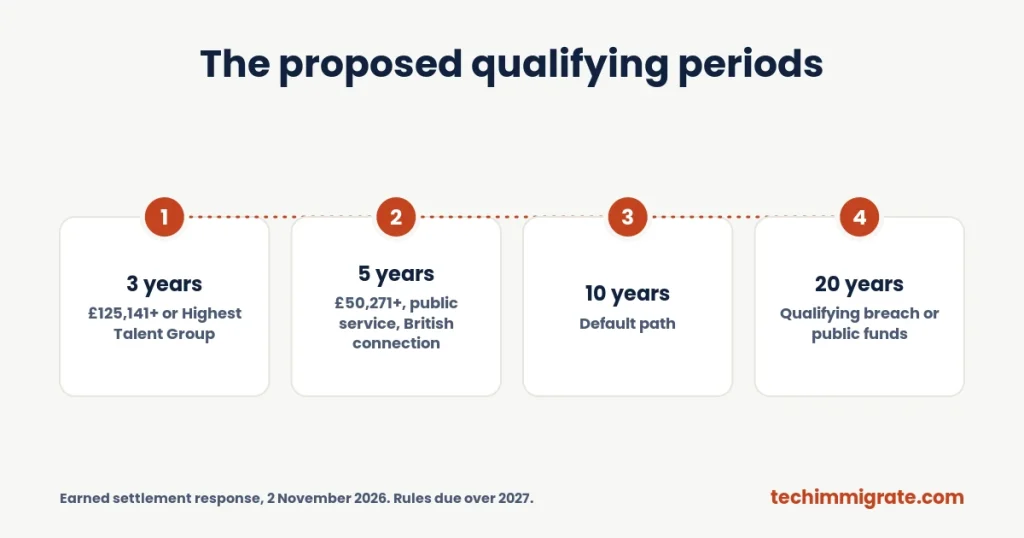
| Path | Who qualifies | Key conditions |
|---|---|---|
| 3 years | Earnings of at least £125,141 in three of the last four years, or the Highest Talent Group | No public funds in the last five years, no qualifying breach |
| 5 years | Earnings of at least £50,271 in three of the last five years, or five years in an eligible public service occupation, or a British connection | No public funds in the last five years, no qualifying breach |
| 10 years | Default path: earnings of at least £12,571 in five of the previous seven years | No public funds in the last five years, no qualifying breach |
| 20 years | After a qualifying breach or recent public funds use | Earnings of at least £12,571 in five of the previous seven years |
The earnings thresholds track UK income tax and National Insurance thresholds, so they are expected to move if those thresholds change.
The "best years" approach
The response describes a "best years" approach, where you need to meet the threshold in a set number of years within a longer window. That allows for dips in earnings, for example during parental leave, caring responsibilities or illness, to be offset.
What does not reduce your period
The response says volunteering and English at C1 level will not reduce the qualifying period, although both were floated in the original consultation.
The Mandatory Requirements
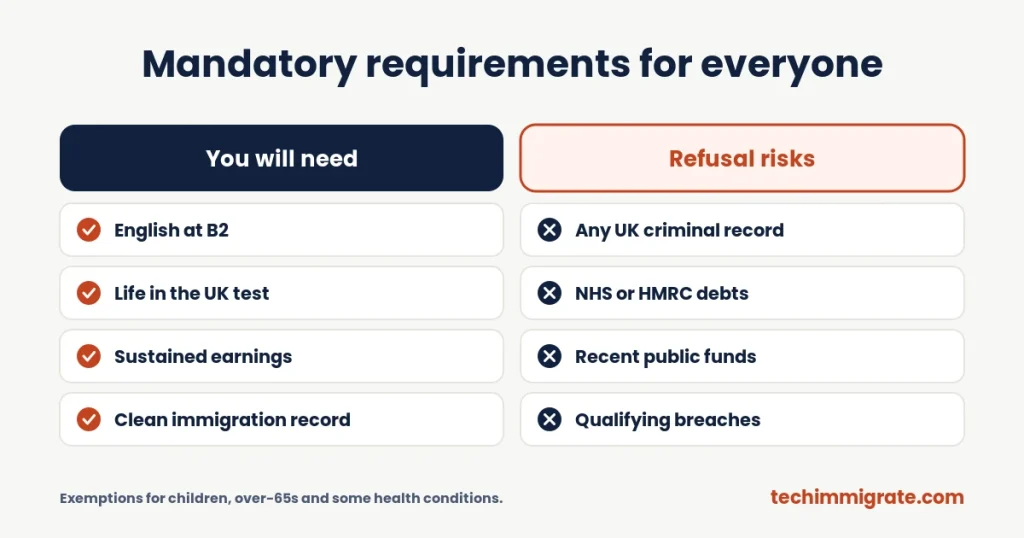
Whichever path you are on, you will need to meet a set of mandatory requirements:
- Good character. Any adult with a UK criminal record will be refused. This covers custodial and suspended sentences, discharges, conditional cautions, fines, community sentences and some civil orders. Overseas convictions for conduct that would be a crime in the UK can also lead to refusal, with some discretion.
- No outstanding debts to public bodies, including NHS debt, unpaid tax and National Insurance, and litigation debts owed to the Home Office.
- English at B2 on the Common European Framework of Reference, up from B1. For several routes, including Global Talent, the rules already set B2 for settlement applications from 26 March 2027.
- The Life in the UK test.
- Sustained contribution, normally earnings of at least £12,571 a year for the required period.
Children, people aged 65 or over, and people with a physical or mental condition that prevents them from complying are exempt from the English, Life in the UK and earnings requirements.
Household income
Couples can combine earnings to reach £25,142, twice the individual threshold, with one partner able to rely on the other's income. The couple must be in a genuine and subsisting relationship.
Which Visa Routes Count?
The response sets out which periods of permission count towards settlement under the new framework.
Count: longer-term work, talent and family routes, the Highest Talent Group, family and private life routes, and certain protection and resettlement routes. Not every route qualifies for every path; for example, family and private life permission does not qualify for the 3 or 5-year paths.
Do not count: Visit, Student, Graduate, High Potential Individual, Global Business Mobility, Temporary Worker, Youth Mobility, Seasonal Worker, Overseas Domestic Worker and Ukraine schemes. Leave outside the rules is still being considered.
Switching between fundamentally different routes, for example from work to protection, restarts the settlement clock. Which routes can be combined will be set out in the rules.
The long residence route will close
The long residence route, which lets people settle after 10 years' continuous lawful residence on almost any route, will close. Time on temporary routes, including Student and Graduate, will no longer count, even if someone reaches 10 years' lawful residence. No closure date has been given.
People Already in the UK
This is the question most people ask: does the change apply to me?
The response says there is no general exemption for people already in the UK. Applications are normally decided under the rules in force on the date of decision, unless transitional provisions apply.
Targeted arrangements use a cut-off of 12 May 2025, the date the Immigration White Paper was published:
- Care workers who entered or switched to the care worker route before 12 May 2025, and meet salary, sponsorship and employment requirements, keep a 5-year path.
- Health and education workers below degree level who arrived before May 2025 keep a 5-year route as a one-off.
- Skilled Workers on transitional lower salary thresholds from before April 2024 can extend on their current terms until 2035, previously 2030.
Everyone else moves to the new framework. That means many people currently planning to settle after 5 years will need to check whether their earnings put them on the 5-year path or the 10-year default.
What This Means for Skilled Workers
For a Skilled Worker, the key question becomes earnings:
- Earning at least £50,271 in three of the last five years: likely 5-year path.
- Earning at least £125,141 in three of the last four years: likely 3-year path.
- Earning less: likely 10-year default.
Many tech roles pay well above £50,271, so many tech Skilled Workers may stay on a 5-year path, but those in lower-paid roles, or with gaps in earnings, could face 10 years.
What This Means for Global Talent Holders
Under the current rules, Global Talent Exceptional Talent holders settle after 3 years, and Exceptional Promise holders after 5. The response keeps a 3-year path for a Highest Talent Group, which commentators expect to include Global Talent and Innovator Founder holders. But the definition depends on the Migration Advisory Committee's advice, and it should not be assumed that every Global Talent holder will be included.
The Migration Advisory Committee's Review of Talent Routes, published on 17 November 2026, also recommended considering an income threshold at settlement for talent routes. Our Global Talent ILR guide explains how this might affect you.
Partners and Children
The response proposes:
- Partners who arrive with the main applicant can settle at the same time, if they meet the requirements.
- Partners who join later must complete the same qualifying period as the main applicant. Partners of people on a 3-year path could therefore have a 3-year period, shorter than the current position on some routes.
- Children under 18 can settle with their parents and are exempt from the income, debt, English and Life in the UK requirements.
- Young people aged 18 to 24 with child dependant status can settle without the income requirement but must meet other adult requirements.
- People aged 25 and over must qualify independently.
Routes Outside the New Framework
Some routes keep their existing arrangements, including the Hong Kong British National (Overseas) route (5 years), HM Armed Forces personnel and their families, bereaved partners, victims of domestic abuse, and certain children and young people. Windrush commitments are honoured. The EU Settlement Scheme and some closed legacy routes are unaffected, although holders of those routes generally still need to meet stronger criminality and B2 English requirements unless exempt.
What Is Still Unclear
Several important details are still to come:
- how earnings will be defined and assessed, for example taxable earnings or gross pay;
- the definition of the Highest Talent Group;
- the closure date and transitional arrangements for long residence;
- the full list of qualifying breaches, and whether short overstays will be disregarded;
- how receipt of public funds will be treated;
- safeguards for vulnerable groups;
- fee changes;
- a full impact assessment, expected with implementation.
Worked Examples
These illustrative examples show how the proposed framework could apply. They are simplified, and the final rules may differ.
A software engineer on a Skilled Worker visa, earning £65,000 a year for four years. Earnings are above £50,271 in three of the last five years, so the engineer would be on the 5-year path, provided they meet the mandatory requirements, including B2 English and no debts to public bodies.
A data analyst on a Skilled Worker visa, earning £42,000. Earnings are below £50,271, so the default 10-year path would apply unless earnings rise. A promotion that lifts pay above the threshold for three of the last five years could move them to the 5-year path.
A Global Talent holder endorsed as Exceptional Talent. If Global Talent is included in the Highest Talent Group, the 3-year path would apply regardless of salary, subject to the mandatory requirements. If it is not, earnings would decide the path.
A founder who paid themselves very little for three years. On a route outside the Highest Talent Group, low personal earnings could mean the 10-year default. Founders should watch how earnings are defined, including whether dividends count, and keep careful records.
A couple where one partner earns £60,000 and the other is a carer at home. For the household income requirement, couples can combine earnings to reach £25,142, and one partner can rely on the other's income.
Common Misunderstandings
"I already have a visa, so the old rules apply to me." Not necessarily. The response says there is no general exemption. Unless transitional rules cover you, the rules in force when your application is decided normally apply.
"Everyone now needs 10 years." No. Ten years is the default, but higher earners, some public service workers, people with a British connection and the Highest Talent Group have shorter paths.
"Global Talent is guaranteed 3 years." Not yet. The Highest Talent Group is expected to include Global Talent, but its definition depends on Migration Advisory Committee advice.
"Graduate visa time will count towards 10 years." No. Graduate time does not count under the new framework.
"Volunteering or excellent English will shorten my path." The response says volunteering and C1 English will not reduce the qualifying period.
The Reform Timeline So Far
| Date | Step |
|---|---|
| 12 May 2025 | Immigration White Paper published; later used as a cut-off for some transitional arrangements |
| 20 November 2025 | Consultation "A Fairer Pathway to Settlement" launched |
| 2 November 2026 | Government response published |
| 17 November 2026 | Migration Advisory Committee Review of Talent Routes published |
| From December 2026 | Changes begin to be laid in the immigration rules |
| 26 March 2027 | B2 English for settlement on routes where already scheduled, such as Global Talent |
| During 2027 | Implementation of the new framework |
Qualifying Breaches and the 20-Year Path
One of the toughest parts of the new framework is the 20-year path for people who have committed a qualifying breach as an adult, or used public funds recently. The response describes qualifying breaches as including overstaying, breaching visa conditions, such as working in breach of restrictions, deception, and frustrating immigration controls. Breaches committed as a child do not trigger the 20-year path.
The full list, and whether short overstays will be disregarded, is still to be set out. In practice, the message is clear: protect your immigration record. Apply to extend or switch before your permission expires, keep within your visa conditions, and take advice quickly if something goes wrong.
How Earnings Might Be Assessed
The response does not define earnings precisely. Commentators suggest taxable earnings are more likely than gross pay, because the thresholds track income tax and National Insurance thresholds. Until the rules are published, the safest approach is to keep complete records of everything that might be relevant:
- payslips and P60s for employment;
- Self Assessment tax calculations and tax year overviews for self-employment;
- payroll and dividend records and company accounts if you run a company;
- evidence of any periods of parental leave, illness or caring, in case the best years approach applies.
People who use salary sacrifice for pensions or other benefits should watch the detail, because taxable earnings may be lower than headline salary.
What to Do Now
Whatever your route, a few steps make sense now:
- If you are already eligible for ILR under the current rules, consider applying soon. Applications are normally decided under the rules in force on the decision date, so the earlier you apply, the more likely you are to be decided under today's rules.
- Keep records of your earnings, including payslips, P60s and tax returns for every year.
- Avoid any debts to public bodies, such as NHS charges or HMRC liabilities. Pay them off now.
- Check your English level. If you are not exempt and do not have B2, consider taking a test in good time.
- Pass the Life in the UK test early if you are close to applying.
- Avoid any breach of immigration conditions. A qualifying breach could move you to the 20-year path.
- Think about switching routes if a faster route, such as Global Talent, is open to you. Our article on switching to Global Talent explains how.
Current ILR Rules, for Comparison
Until the new rules are in force, the current rules apply. Common qualifying periods today:
| Route | Current qualifying period |
|---|---|
| Skilled Worker | 5 years |
| Global Talent (Exceptional Talent, research bodies, prize) | 3 years |
| Global Talent (Exceptional Promise) | 5 years |
| Innovator Founder | 3 years, if business criteria met |
| Partner of a British citizen or settled person (family route) | 5 years |
| Long residence | 10 years |
The ILR fee is £3,226 per person from 8 April 2026, with optional priority (£500) and super priority (£1,000) services.
Frequently Asked Questions
Under the earned settlement response, 10 years becomes the default qualifying period, with shorter 5 and 3-year paths for higher earners, some public service workers and a Highest Talent Group. Changes will be implemented over 2027.
The Home Secretary said changes will start to be laid from the December immigration rules and be implemented over 2027. Check GOV.UK for the exact dates that apply to you.
There is no general exemption. Applications are normally decided under the rules in force on the decision date, unless transitional rules apply, such as for some care workers who arrived before 12 May 2025.
At least £50,271 in three of the last five years, under the response. Some public service occupations and people with a British connection can also qualify.
B2, up from B1, unless you are exempt.
Not under the new framework, and not under the current rules for most work routes.
Yes. The response says it will close, and time on temporary routes such as Student and Graduate will no longer count. No closure date has been given yet.
Plan Your Route to Settlement
The new framework is a big change, but it is not a reason to panic. Most of the actions that protect you are simple: keep good records, protect your immigration history, avoid debts to public bodies, get your English and Life in the UK test sorted, and apply as soon as you are eligible. The details will become clearer as the rules are laid during 2027, and we will update our guides as they do. For tech professionals, the new framework rewards high earnings and recognised talent. If you might qualify for Global Talent, it could be your fastest path to settlement under both the current and proposed rules. Our role-specific Global Talent guides explain what Tech Nation looks for.
Related reading: How to Apply for Indefinite Leave to Remain: Step by Step, New ILR Rules for Skilled Worker Visa Holders: What Changes and Your Options and ILR Requirements: The Complete Checklist.
How We Checked This Article
We based this article on the government's response to the earned settlement consultation, "A Fairer Pathway to Settlement" (2 November 2026), as summarised by law firms including Lewis Silkin, Fragomen and Macfarlanes, and checked current rules against GOV.UK's settlement pages in November 2026. Fees come from the Home Office fee schedule in force from 8 April 2026. Many details are still to be confirmed in the immigration rules.
Tech Immigrate is independent of the Home Office. This article is general information, not legal advice. Settlement rules are changing; check GOV.UK or take regulated advice before you apply.
We write practical guides for tech professionals applying for the UK Global Talent visa. Tech Immigrate is independent of Tech Nation and the Home Office, and our articles are general information, not legal advice. Rules and fees change, so always check gov.uk before you apply.