ILR Through Long Residence: The 10-Year Rule Explained
ILR through long residence explained: 10 years lawful residence, what counts, the 180-day absence rule, fees, and the planned closure under the reforms.


In this article
- What the Long Residence Route Is
- Who Uses the Long Residence Route
- What Counts as Lawful Residence
- The Absence Rule
- Other Requirements
- Fees and Processing
- If You Are Not Yet Eligible for ILR
- The Planned Closure Under Earned Settlement
- Long Residence vs Work-Route Settlement
- A Worked Example: Student to Skilled Worker
- A Worked Example: A Gap in Lawful Residence
- What to Do if You Are 7 to 9 Years In
- Partners and Children
- From Long Residence to Citizenship
- Why the Government Is Closing the Route
- Gaps, Overstays and Section 3C Leave
- Building Your Evidence
- Common Mistakes
- Act Before the Door Closes
- How We Checked This Article
For many people who have spent a long time in the UK on a mix of visas, the long residence route has been the safety net. If you have lived in the UK lawfully for 10 continuous years, you can apply for indefinite leave to remain (ILR), even if none of your individual visas led to settlement on its own. For international students who stayed on to work, or tech workers who moved between Student, Graduate, Skilled Worker and other routes, it has often been the most realistic path to settlement.
That safety net is about to change. The government's response to the earned settlement consultation, published on 2 November 2026, says the long residence route will close. This guide explains how the 10-year rule works now, what counts as lawful residence, the absence rules, the requirements and costs, and what the planned closure means for people who are relying on it. If you are close to 10 years, timing has never mattered more.
Key takeaways
- The long residence route lets you apply for ILR after 10 continuous years of lawful residence in the UK.
- Time on most visas counts, including Student and Graduate visas, but time as a visitor does not.
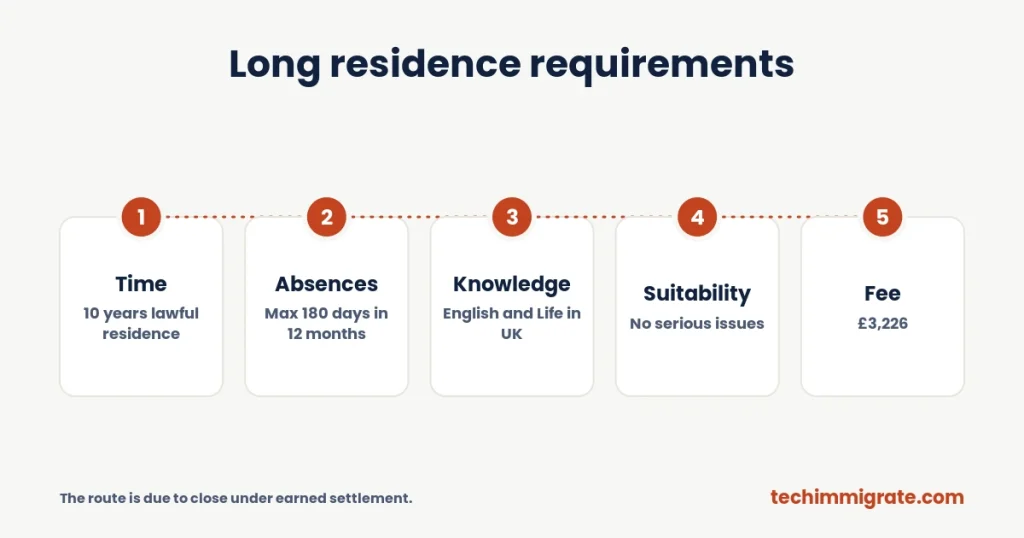
- Under the current Appendix Long Residence, you must not have spent more than 180 days outside the UK in any 12-month period.
- You must meet the English and Life in the UK requirements, and the suitability rules.
- The ILR fee is £3,226. If you are not eligible for ILR, you may be able to extend your stay for 2 years for £1,407.
- Decisions usually take up to 6 months after biometrics, and a £1,000 priority service may be available.
- The earned settlement response says the long residence route will close. No closing date has been confirmed, so people near 10 years should plan carefully.
What the Long Residence Route Is
The long residence route recognises people who have built their lives in the UK over a long period with lawful status. GOV.UK says you may qualify for ILR if you have been in the UK legally for 10 continuous years.
The route is set out in Appendix Long Residence of the Immigration Rules. It is separate from the work routes, family routes and private life routes. Its key feature is flexibility: you can combine time on different visas, as long as your residence was lawful and continuous throughout.
Who Uses the Long Residence Route
Common examples include:
- Former international students who studied for several years, moved to a Graduate visa, then to Skilled Worker, and reached 10 years before reaching 5 years on Skilled Worker.
- People who changed routes several times, for example from Student to Tier 2, to a dependant visa, and back to Skilled Worker.
- People whose work-route time does not lead to settlement, such as time on certain temporary routes, but whose total lawful residence reaches 10 years.
For tech workers, the most common pattern is a long period of study, followed by a Graduate visa and then sponsored work. Another is a person who came as a child dependant, studied at a UK school and university, and then started work, building up 10 years of residence without ever completing 5 years on a single work route.
What Counts as Lawful Residence
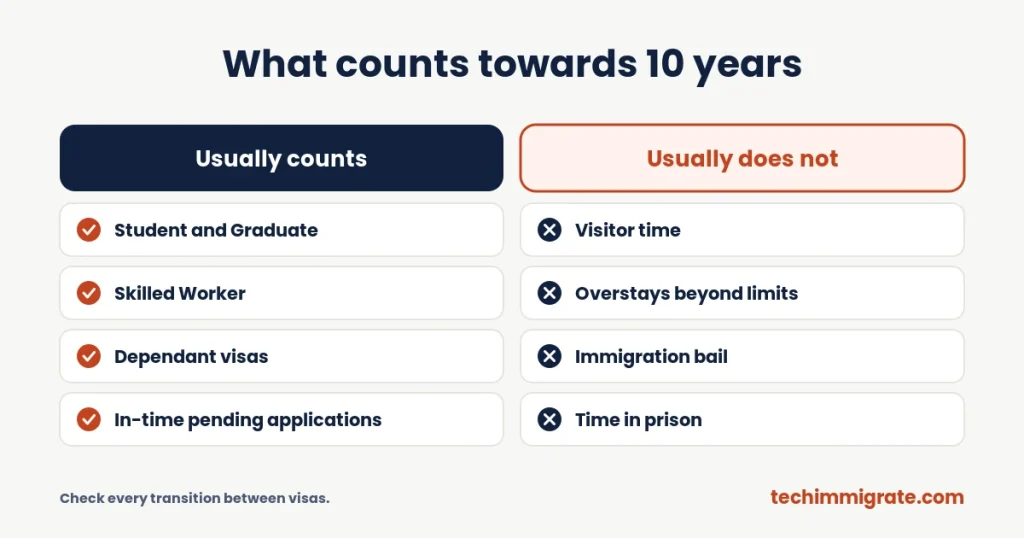
Lawful residence generally means time spent in the UK with valid permission to be here. This usually includes time on:
- Student visas;
- Graduate visas;
- Skilled Worker and other work visas;
- dependant visas;
- family visas;
- time when your permission was extended by law while an in-time application or appeal was pending.
Time that usually does not count includes:
- time as a visitor;
- time spent in the UK without permission, such as overstaying;
- time on immigration bail;
- time in prison or detention following a conviction.
The rules allow some short gaps in lawful residence to be disregarded in limited circumstances, for example where an application was made within a short period after permission expired and was later granted. These rules are technical, so check them carefully if you have any gap in your history.
The Absence Rule
Continuous residence can be broken by long absences from the UK. Under the current Appendix Long Residence, you must not have been outside the UK for more than 180 days in any 12-month period during your 10 years.
This replaced an older rule, which allowed no more than 540 days outside the UK in total over the 10 years, and no single absence of more than 184 days. People who first read about long residence some years ago may still have the old rule in mind, so check which version applies to your application.
As with other routes, the 180-day test applies to every rolling 12-month window, not just calendar years. A long trip that straddles two calendar years can still break continuity.
Continuous residence can also be broken if you leave the UK with no valid permission to return, or if you are removed or deported.
Other Requirements
To get ILR through long residence, you must usually also:
- Pass the Life in the UK test, unless you are exempt because of age or a long-term condition.
- Meet the English requirement at B1 or above, unless exempt.
- Meet the suitability requirements, including no serious criminality, no significant immigration breaches outside the permitted gaps, and no NHS debts of £500 or more.
Our guides to the Life in the UK test and the ILR English test explain the knowledge requirements.
Fees and Processing
| Item | Cost |
|---|---|
| ILR application through long residence | £3,226 |
| Extension of stay (if not yet eligible for ILR) | £1,407 |
| Biometrics | No fee |
| Priority service for settlement (where available) | £1,000 |
GOV.UK says decisions are usually made within 6 months of providing biometrics. With the £1,000 priority service, you can get a decision by the end of the next working day after a weekday appointment, or within 2 working days after a weekend appointment.
You must not leave the UK, Ireland, the Channel Islands or the Isle of Man until you get a decision. Travelling outside those areas withdraws your application, and the fee is not refunded.
If You Are Not Yet Eligible for ILR
GOV.UK notes that if you have 10 years of continuous lawful residence but are not eligible for ILR, for example because you have not yet met the knowledge requirements, you may be able to extend your stay by 2 years. The fee is £1,407. This gives you time to meet the remaining requirements and then apply for ILR.
The Planned Closure Under Earned Settlement
The government's response to the earned settlement consultation, published on 2 November 2026, sets out a new framework for settlement:
- a 10-year default qualifying period for most migrants;
- a 5-year path for people earning at least £50,271;
- a 3-year path for people earning at least £125,141, or in the highest talent group;
- a 20-year path in some cases;
- mandatory requirements including English at B2, the Life in the UK test, no criminal record and no debts to public bodies.
As part of this, the response says the long residence route will close. It also says time on some routes, including Student, Graduate, High Potential Individual and Global Business Mobility, will not count towards settlement under the new framework. No closing date for long residence has been confirmed in the material published so far.
This has major implications for people who have been relying on long residence:
- If you already have 10 years and meet the requirements, applying as soon as possible may let your application be decided before the route closes.
- If you are close to 10 years, you may be in a race against the closing date. Keep a close eye on announcements.
- If your path depends on time as a student or graduate, that time may not count under the new framework, so long residence may be your only chance to use it.
The response says there is no general transitional protection for people already on a route, although targeted protections apply to some groups. Whether people on the path to long residence will receive any protection is one of the most important details to watch. Our guide to the new indefinite leave to remain rules tracks the reforms.
Long Residence vs Work-Route Settlement
For tech workers, long residence often competes with the Skilled Worker or Global Talent route to ILR. The right choice depends on your history:
| Situation | Likely best route |
|---|---|
| 5 years on Skilled Worker, total UK time 8 years | Skilled Worker ILR at 5 years |
| 3 years on Global Talent (exceptional talent), total UK time 6 years | Global Talent ILR at 3 years |
| 3 years on Skilled Worker after 7 years as a student and graduate | Long residence at 10 years, if still open |
| Mixed routes with gaps in lawful status | Take advice before applying |
If you could qualify under more than one route, choose the one that gives you the most secure and earliest settlement. Under the current rules, ILR through any route gives you the same status.
A Worked Example: Student to Skilled Worker
A software engineer arrived in the UK in September 2016 to study a bachelor's degree, followed by a master's. He then held a Graduate visa for 2 years and moved to a Skilled Worker visa in 2023.
- September 2026: he reaches 10 years of continuous lawful residence.
- Skilled Worker time: only 3 years by then, so he is not yet eligible for ILR on that route.
- Absences: he checks every rolling 12-month window and finds he has never exceeded 180 days.
- Knowledge requirements: his UK degree meets the English requirement, and he passed the Life in the UK test in 2025.
He applies for ILR through long residence in late 2026, using the priority service to get a quick decision. Because the long residence route is due to close, waiting for his Skilled Worker 5-year point in 2028 could have left him exposed to the new framework, under which his student and graduate time would not count.
A Worked Example: A Gap in Lawful Residence
A data analyst has lived in the UK for 10 years on Student, Graduate and Skilled Worker visas. In 2019, her Student visa expired 10 days before she applied for a new one, which was granted.
- The 10-day gap may be disregarded under the rules for short gaps, depending on the circumstances and the rules in force at the time.
- She gathers evidence of the dates, the reasons for the late application and the grant that followed.
- Because the rules on gaps are technical, she takes advice before applying.
This example shows why people with any gap in their history should check the rules carefully rather than assuming their time counts.
What to Do if You Are 7 to 9 Years In
People who are a few years short of 10 years face the hardest choices, because they may not reach the threshold before the route closes. Practical steps include:
- Map your full timeline now. Note every grant of permission, every gap and every long trip abroad.
- Check your work-route options. If you are on Skilled Worker, work out when you will reach 5 years. Under the current rules, that may come sooner or later than 10 years of total residence.
- Consider whether Global Talent fits. If you are in tech with a strong track record, a Global Talent endorsement under exceptional talent could lead to ILR after 3 years under the current rules, and recognised talent is expected to keep a shorter path under the reforms.
- Keep your absences low. Whatever route you end up using, continuous residence will matter.
- Prepare the knowledge requirements early. Pass the Life in the UK test and get English evidence at B2, so you are ready whichever route stays open.
- Watch for announcements. The closing date and any transitional arrangements will decide your options.
Partners and Children
The long residence route is personal to each applicant. Each family member needs their own 10 years of continuous lawful residence to apply in their own right. A partner who arrived later than you will not reach 10 years at the same time.
In practice, families often use different routes for different members. For example, the main applicant may settle through long residence, while their partner, who has been their dependant on a work route, settles as the partner of a settled person under the family rules, or through their own route. Children may be able to settle with a parent, or, if born in the UK, register as British citizens once a parent is settled.
When planning, list every family member's dates separately and check the best route for each.
From Long Residence to Citizenship
ILR through long residence is the same status as ILR through any other route. You can usually apply for British citizenship 12 months after getting ILR, as long as you meet the other requirements, such as good character and the absence limits for naturalisation. If you are married to a British citizen, you may be able to apply straight away. Because you will already have spent at least 10 years in the UK, the residence requirement for citizenship is usually easy to meet.
Our guide to moving from ILR to British citizenship explains the next step.
Why the Government Is Closing the Route
The earned settlement reforms aim to link settlement more closely to economic contribution, integration and compliance. A route based only on time spent in the UK does not fit that model. Under the new framework, the length of the path to settlement will depend mainly on earnings, recognised talent and other contribution factors, rather than on years of residence alone.
For people who built up their time through study and early-career work, this is a significant shift. Time that would once have counted towards a 10-year path may now count for nothing. That is why understanding your position now, while long residence is still available, is so important.
Gaps, Overstays and Section 3C Leave
The hardest part of many long residence applications is proving that residence was lawful throughout. Three situations come up often:
- In-time applications. If you applied for a new visa before your old one expired, your permission was extended by law while the application was pending. This time usually counts as lawful residence, even if the application took months.
- Short overstays. If your permission expired and you applied late, the rules may allow a short gap to be disregarded if the later application was granted and the delay falls within the permitted limits. Longer gaps usually break continuity.
- Refusals and appeals. If an application was refused and you appealed or sought administrative review in time, your permission may have continued during that process. If you did not, and stayed without permission, the time usually does not count.
Because these rules are technical, check every transition between visas. For each one, note the date your old permission expired, the date you applied for the next one, and the date it was granted.
Building Your Evidence
A long residence application covers a whole decade, so evidence takes time to gather. Most applicants need:
- every passport held during the 10 years, including expired ones;
- details of every visa or grant of permission, with dates;
- evidence of any in-time applications that extended your permission while pending;
- a full travel history, with dates of every trip outside the UK;
- Life in the UK test reference number and English evidence;
- evidence of residence, such as tenancy agreements, council tax bills or bank statements, if requested.
Start building a timeline early. List every grant of permission, from your first entry to today, and mark any periods where you are unsure whether you had valid permission. If you have lost old passports or decision letters, you can request copies of your immigration records from the Home Office through a subject access request, although this can take time. Old university letters, payslips, tenancy agreements and bank statements can also help prove you were in the UK at particular times.
Common Mistakes
- Counting visitor time. Time as a visitor does not count towards long residence.
- Using the old absence rule. The current rule is no more than 180 days outside the UK in any 12-month period.
- Ignoring gaps. Even short gaps in permission can break continuity unless they fall within the permitted exceptions.
- Travelling while the application is pending. Leaving the Common Travel Area withdraws the application.
- Waiting too long. With the route due to close, delay could mean losing the option.
- Not checking other routes. A work-route ILR may be available sooner.
A route to ILR for people who have lived in the UK lawfully for 10 continuous years.
Under the current rules, yes, as long as it was lawful and continuous. Under the earned settlement proposals, time on those routes would not count towards settlement.
Under the current rules, no more than 180 days in any 12-month period.
£3,226. Extending your stay instead costs £1,407.
Usually up to 6 months after biometrics, or faster with the £1,000 priority service.
The earned settlement response says it will close. No closing date has been confirmed in the material published so far.
Yes, unless you are exempt because of age or a long-term condition.
Act Before the Door Closes
If you have spent close to 10 years in the UK on a mix of visas, long residence may be your fastest route to settlement, but it may not be available for much longer. Check your timeline, your absences and your knowledge requirements now, and apply as soon as you are eligible. If you are earlier in your journey and work in tech, Global Talent may give you a faster, more secure path. Our role-specific Global Talent guides explain what Tech Nation looks for.
How We Checked This Article
We checked fees, decision times and the basic eligibility rule against GOV.UK's long residence page in November 2026. The absence rule is from Appendix Long Residence of the Immigration Rules. The planned closure and wider reforms are from law firm summaries of the earned settlement response of 2 November 2026.
Tech Immigrate is independent of the Home Office. This article is general information, not legal advice. Long residence rules are technical, especially on gaps in residence; take regulated advice if your history is complex.
We write practical guides for tech professionals applying for the UK Global Talent visa. Tech Immigrate is independent of Tech Nation and the Home Office, and our articles are general information, not legal advice. Rules and fees change, so always check gov.uk before you apply.