B2 English for ILR? What the New Rules Require
B2 English test for indefinite leave to remain: the planned rise from B1 to B2 from 26 March 2027, who it affects, exemptions and how to prepare.


In this article
- What Is Changing
- What B2 Means
- Who Is Likely to Be Affected
- How It Fits With the Other Reforms
- Timing: Before or After 26 March 2027?
- How to Prove B2
- Skilled Workers Who Already Took B2
- Why the Government Is Raising the Level
- How Much Harder Is B2?
- A Preparation Plan
- For Tech Professionals
- For Adult Dependants
- If You Do Not Reach B2 in Time
- B2 and British Citizenship
- Common Mistakes
- What We Still Do Not Know
- The Bottom Line
- Getting Help
- Combining B2 Preparation With the Life in the UK Test
- Worked Examples
- Learning Resources
- Planning Settlement Around the Change
- How Employers Can Help
- Exemptions for Medical Conditions
- Choosing a B2 Test
- Checking Your Degree Early
- Questions to Ask Yourself
- The Cost of Getting It Wrong
- What to Do This Month
- A Note on Booking B1 Tests Now
- Further Reading
- Your Next Step
- How We Checked This Article
For years, the English requirement for indefinite leave to remain has been set at B1, an intermediate level. Under the government's earned settlement reforms, that is planned to change. The response to the earned settlement consultation, published on 2 November 2026, says the English requirement for settlement will rise to B2, upper intermediate, from 26 March 2027.
For many people, that will make little difference: they already have a degree taught in English, are nationals of majority English-speaking countries, or already speak English well. For others, it could mean a new test, more study time and a later settlement date than planned. This guide explains what B2 means, who the change is expected to affect, how it fits with the other settlement reforms, and how to prepare.
Key takeaways
- The English requirement for ILR is currently usually B1. Under the earned settlement reforms, it is planned to rise to B2 from 26 March 2027.
- B2 is upper intermediate on the Common European Framework of Reference, one level above B1.
- People who are exempt, such as nationals of majority English-speaking countries, those with an accepted degree taught in English, and those aged 65 or over, are expected to remain exempt.
- If you will apply for ILR on or after 26 March 2027 and rely on a test, you are likely to need a B2 result.
- New Skilled Worker main applicants have needed B2 since 8 January 2026, so some people may already hold a B2 result.
- Check GOV.UK for the final rules, including which tests and skills will be required.
What Is Changing
| Current rules | Planned from 26 March 2027 | |
|---|---|---|
| Level for ILR | B1 | B2 |
| Skills | Usually speaking and listening | To be confirmed in the final rules |
| Exemptions | Nationality, degree, age 65+, some conditions | Expected to continue |
The change is part of the wider earned settlement framework, which also sets new qualifying periods, a sustained contribution requirement and rules on criminality and debt.
What B2 Means
The Common European Framework of Reference for Languages (CEFR) has six levels, from A1 to C2. B1 is intermediate and B2 is upper intermediate. At B2, you can typically:
- Understand the main ideas of complex text on both concrete and abstract topics, including technical discussions in your field.
- Interact with a degree of fluency and spontaneity that makes regular interaction with native speakers quite possible without strain for either side.
- Produce clear, detailed text on a wide range of subjects and explain a viewpoint on a topical issue.
For many tech professionals who work in English every day, B2 is a level they already meet in practice. The question is whether they can prove it in a way the Home Office accepts.
Who Is Likely to Be Affected
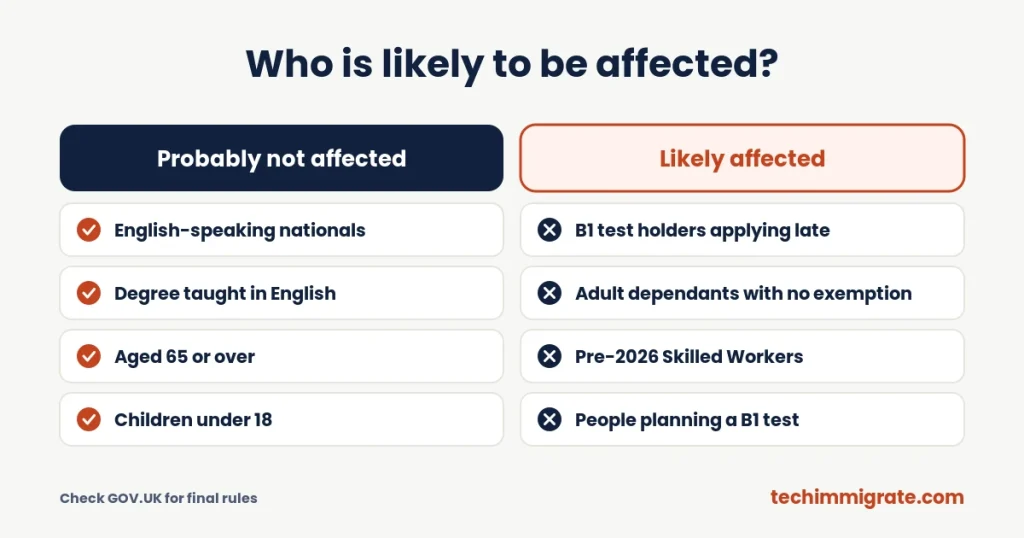
Probably not affected
- Nationals of majority English-speaking countries, who are usually exempt.
- People with a degree taught in English, accepted by the Home Office and, for degrees from outside the UK, confirmed by Ecctis.
- People aged 65 or over, who are usually exempt.
- Children under 18, who are usually exempt.
- People who already hold an accepted B2 or higher result, depending on the rules for reusing results.
Likely to be affected
- People who would have relied on a B1 test and will apply on or after 26 March 2027.
- Adult dependants who do not have an exemption or degree.
- People who planned to take a B1 speaking-and-listening test shortly before applying.
How It Fits With the Other Reforms
The B2 requirement is one of several mandatory requirements planned for everyone under the earned settlement framework:
- English at B2 from 26 March 2027.
- The Life in the UK test.
- No UK criminal record.
- No public debts, including NHS, tax, National Insurance and Home Office debts.
- A sustained contribution of at least £12,571 a year, with couples able to combine income to £25,142.
These apply whatever your qualifying period, whether 3, 5, 10 or 20 years. Our article on ILR new rules explains the full framework.
Timing: Before or After 26 March 2027?
The date you apply is likely to decide which level you need.
- If you will apply before 26 March 2027, B1 is likely to be enough under the current rules, as long as you meet the other requirements.
- If you will apply on or after 26 March 2027, plan for B2.
- If you are not sure, consider taking a test that can certify B2 now. A B2 result also meets a B1 requirement.
Remember that you can usually apply for settlement up to 28 days before you complete your qualifying period. If you are close to the line, work out your exact earliest date.
How to Prove B2
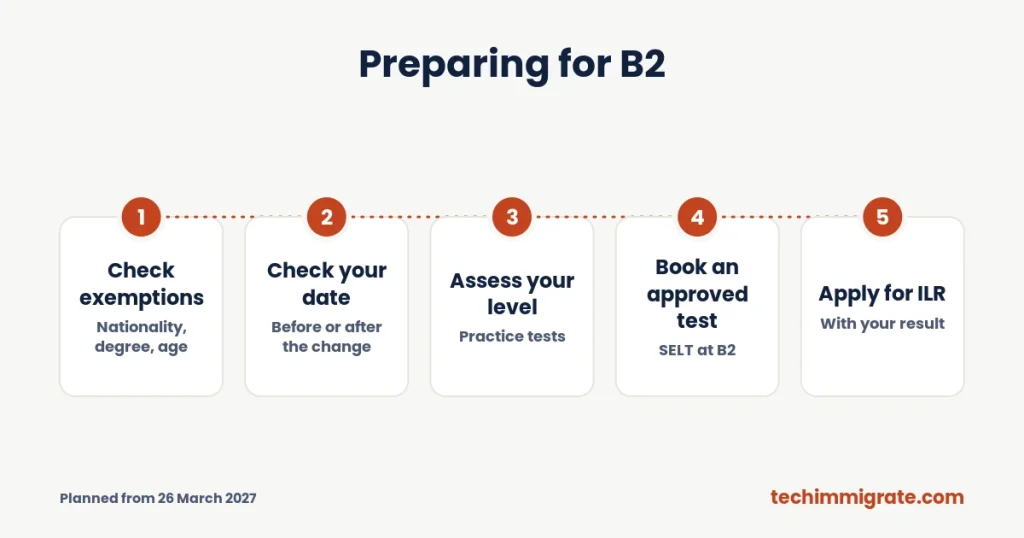
The final rules will set out exactly how to prove B2 for settlement. Based on how the requirement works now, likely options include:
- An approved Secure English Language Test (SELT) at B2, from a Home Office approved provider at an approved centre.
- A degree taught in English, accepted by the Home Office.
- An exemption, for example through nationality or age.
Check GOV.UK's approved list of tests and the final settlement rules before you book.
Skilled Workers Who Already Took B2
Since 8 January 2026, new Skilled Worker main applicants, including people switching into the route, have needed English at B2. If you took a B2 test for your Skilled Worker visa, check whether it can be reused for settlement under the final rules. Workers who joined the route before 8 January 2026 and extend or update their visa may only have needed B1, and may need a new test for settlement after 26 March 2027. Our article on the English requirement for Skilled Worker visas explains the work visa requirement.
Under the earned settlement reforms, B2 is planned from 26 March 2027. If you apply on or after that date and need to prove your English, you are likely to need B2.
B1 is intermediate and B2 is upper intermediate. B2 requires more fluent and detailed use of English.
Exemptions such as nationality of a majority English-speaking country, an accepted degree taught in English and being 65 or over are expected to continue.
Possibly, depending on the final rules on reusing results. Check GOV.UK.
Children are expected to be exempt from the English requirement.
Why the Government Is Raising the Level
The government has said that English is central to integration, and that people who settle permanently should be able to take a full part in work and community life. Raising the requirement to B2 is part of the wider earned settlement approach, which links settlement to contribution and integration. Supporters argue that a higher level helps people progress at work and in society. Critics argue that it could make settlement harder for people in lower-paid roles or with less time to study, and could delay settlement for families. The final rules will show how the change is applied.
How Much Harder Is B2?
Moving from B1 to B2 is a significant step. Language providers often estimate that it takes several hundred hours of guided learning to move up one CEFR level, although the time varies widely from person to person. If you already use English daily at work, you may be closer to B2 than you think. If you mainly use another language at home and at work, the step may take longer. Taking a practice test early is the best way to find out where you stand.
A Preparation Plan
- Twelve months before you plan to apply: check whether you are exempt, and take a practice test to see whether you are at B2.
- Nine months before: if you are below B2, start a structured course or regular practice, focusing on speaking and listening, and on reading and writing if the final rules require them.
- Six months before: take another practice test and book an approved B2 test.
- Four months before: take the test, leaving time for a retake.
- One month before: gather your result reference and other documents for your ILR application.
For Tech Professionals
Most tech professionals in the UK work in English every day, write documentation, attend meetings and present to colleagues. Many will already be at B2 or above in practice. The main risks are not knowing whether you are exempt, assuming a degree counts without checking, or leaving the test too late. If you hold a computer science or engineering degree taught in English, check whether it is accepted, and if it is from outside the UK, apply for Ecctis confirmation early.
For Adult Dependants
Adult dependants are often the people most affected by the change. Partners who do not work in English, or who spend much of their time caring for children, may find B2 more challenging. If your partner will need to prove English for settlement after 26 March 2027, start planning early. Local colleges, community courses and online programmes can help. Under the reforms, couples can combine income towards the sustained contribution requirement, but the English requirement is expected to apply to each adult individually.
If You Do Not Reach B2 in Time
If you need B2 and have not reached it by the time you would otherwise apply for settlement, you may need to delay your application. That usually means extending your current visa, paying another visa fee and surcharge, and applying for settlement later. Make sure your visa does not expire while you prepare. The cost of an extension is a strong reason to start preparing for B2 early.
B2 and British Citizenship
If you plan to apply for British citizenship after settling, you will also need to meet the English requirement for citizenship. Check whether the citizenship requirement changes too. A B2 result used for settlement is likely to meet a B1 citizenship requirement, but always check the rules in force when you apply.
Common Mistakes
- Assuming B1 will always be enough. It may not be after 26 March 2027.
- Assuming a degree counts without checking. It must be accepted, and degrees from outside the UK usually need Ecctis confirmation.
- Leaving the test until the last minute. B2 may need more preparation and a retake.
- Booking a non-approved test. Only approved SELTs at approved centres count.
- Forgetting adult dependants. Each adult usually needs to meet the requirement.
What We Still Do Not Know
Some details are still to be confirmed in the final rules. These include exactly which skills will need to be assessed at B2, whether existing B1 results will be accepted in any transitional cases, how results used for earlier visas will be treated, and whether any new exemptions will be added. Watch for the Statement of Changes to the Immigration Rules and updated GOV.UK guidance, and check them before you book a test.
The Bottom Line
The planned move from B1 to B2 from 26 March 2027 is one of the most practical changes in the earned settlement reforms. If you are exempt or have an accepted degree, it may not affect you. If you rely on a test, plan for B2, check your level early and book an approved test in good time. And if you can apply for settlement before the change, consider whether doing so makes sense for you.
Getting Help
If you are unsure whether you are exempt, whether your degree counts or which test to take, check GOV.UK's English language pages and the final rules once published. For complex cases, a regulated immigration adviser can help you plan.
Combining B2 Preparation With the Life in the UK Test
The Life in the UK test is separate from the English requirement but needs a good level of reading comprehension. Preparing for both at once can be efficient. The test costs £50, has 24 questions and lasts 45 minutes. Our guide to the Life in the UK test for ILR explains what to expect.
Worked Examples
Maria: applying before the change
Maria, a Skilled Worker from a non-English-speaking country, completes 5 years in January 2027. She passed a B1 speaking-and-listening test and applies for ILR in December, 28 days before her 5-year date. Under the current rules, B1 is likely to be enough.
Jun: applying after the change
Jun completes 5 years in June 2027. He has a B1 result from years ago. Because he will apply after 26 March 2027, he plans for B2, takes a practice test, enrols on a short course and books an approved B2 test for early 2027.
Ahmed: degree taught in English
Ahmed has a computer science degree taught in English from a university outside the UK. He gets Ecctis confirmation and does not need a test, whatever level applies.
These examples are fictional and based on the planned framework, which may change.
Learning Resources
If you need to improve your English to B2, there are many options. Local further education colleges often run English courses for adults, sometimes at reduced cost. Libraries may host conversation groups. Online platforms offer structured courses and practice tests aligned to the CEFR levels. Test providers publish official preparation materials. Many employers also support language learning for staff, especially where it helps with work. A mix of structured study and everyday practice, such as joining meetings, reading news and talking with colleagues, tends to work best.
Planning Settlement Around the Change
The move to B2 is only one part of the timing question. Under the earned settlement reforms, your qualifying period may also change, depending on your route and earnings. For some people, applying before the relevant changes take effect may mean both a shorter qualifying period and a lower English level. For others, the new framework may offer a 3- or 5-year path anyway. Work out your options carefully, and check GOV.UK for the confirmed commencement dates of each part of the reforms. Our article on when you can apply for ILR explains how to work out your date.
How Employers Can Help
Employers have a strong interest in helping their international staff settle, because settled employees are no longer tied to sponsorship. Some employers offer language training, study leave or reimbursement for test fees. If you work for a sponsor, ask HR whether support is available. A small investment from your employer could save you the cost of an extension if you would otherwise need more time to reach B2.
Exemptions for Medical Conditions
If a long-term physical or mental condition prevents you from meeting the English requirement, you may be exempt. You will usually need medical evidence from a doctor explaining your condition and why it prevents you from meeting the requirement. This exemption is expected to continue under the new rules, but check the final guidance for the evidence needed.
Choosing a B2 Test
When you choose a test, look at GOV.UK's list of approved SELTs and check which ones can certify B2 for the skills the final rules require. Consider the format, whether you prefer a face-to-face conversation or a computer-based test, how quickly results are issued, where centres are located and how much the test costs. If you are not sure which skills will be required, a four-skill test at B2 covers the widest range of possibilities, although it may be more demanding and more expensive than a speaking-and-listening test.
Checking Your Degree Early
If you plan to rely on a degree taught in English, check it well before you apply. For UK degrees, your certificate is usually enough. For degrees from outside the UK, apply to Ecctis for confirmation that the degree is equivalent to a UK bachelor's degree or above and was taught in English. This can take several weeks. Ecctis confirmations used in earlier visa applications may sometimes be reused, but check the rules for settlement.
Questions to Ask Yourself
- Am I exempt from the English requirement?
- Do I have an accepted degree taught in English?
- When will I apply for ILR: before or after 26 March 2027?
- Do I already hold a B2 result, and can it be reused?
- How confident am I that I would pass a B2 test today?
- Does my partner need to meet the requirement too?
The Cost of Getting It Wrong
If you apply for ILR without meeting the English requirement, your application is likely to be refused, and the fee of £3,226 per person is usually not refunded. If your visa has expired by then, you could also face a gap in lawful status, which under the reforms might lead to a longer path to settlement. By comparison, the cost of an extra test or a short course is small. Checking your English position early is one of the cheapest ways to protect your settlement plans.
What to Do This Month
If you expect to apply for ILR in the next two years, a few simple actions now can prevent problems later. Check whether you are exempt. If not, find your previous English test certificates and degree documents. Take a free or low-cost practice test to see whether you are at B2. If you are close, book an approved test. If you are not, start a course. And put the date of 26 March 2027 in your calendar alongside your own earliest settlement date, so that you can see clearly which rules are likely to apply to you.
A Note on Booking B1 Tests Now
If you are booking an English test now for an application you expect to make after 26 March 2027, think twice before booking a B1-only test. It may meet today's rules but not the rules in force when you apply. A test that certifies B2 avoids that risk.
Further Reading
Our guide to the B1 English test for ILR explains approved tests and booking in detail.
Your Next Step
If you are a tech professional planning for settlement, the Global Talent visa offers one of the shortest paths. Our role-specific Global Talent guides explain what Tech Nation looks for in software developers, data and AI specialists, product managers, designers, founders and more.
How We Checked This Article
We based the planned changes on summaries of the government's response to the earned settlement consultation, published on 2 November 2026, and checked the current English requirement for settlement against GOV.UK's English language pages, in November 2026. Details may change before the new rules take effect.
Tech Immigrate is independent of the Home Office. This article is general information, not legal advice. Check GOV.UK before you book a test or apply.
We write practical guides for tech professionals applying for the UK Global Talent visa. Tech Immigrate is independent of Tech Nation and the Home Office, and our articles are general information, not legal advice. Rules and fees change, so always check gov.uk before you apply.