Global Talent Visa Letters: Why Recommendation Letters Get Applications Refused (and How to Fix Them)
Why Global Talent visa recommendation letters get applications refused, the refusal wording applicants report, and how to fix your letters before reapplying.


In this article
- Why Do Letters Matter So Much in a Global Talent Application?
- What Do Refusals Actually Say About Letters?
- The Seven Letter Problems That Lead to Refusals
- How Do You Tell If Letters Were the Main Reason You Were Refused?
- Can a Review Fix a Letters Refusal?
- How Do You Fix Your Letters Before You Reapply?
- Who Makes a Strong Referee, and Who Usually Doesn't?
- What About Reference Letters Among Your 10 Documents?
- Is the Way Letters Work About to Change?
- A Fictional Example: Two Versions of the Same Referee
- How Do Letters Fit With the Rest of the Refusal Reasons?
- Get the Guide Written for Your Role
- Frequently Asked Questions
- How We Checked This Article
Recommendation letters get Global Talent applications refused when they read like a reference for a good employee rather than proof that you are recognised as a leader, or a potential leader, in digital technology. The most common problems applicants report are letters from colleagues or managers, letters that repeat the CV, letters that sound templated or AI-written, and letters that praise you without giving specific, checkable examples. A refusal on letters is usually fixable, but almost never by a review: it normally needs new letters and a new application.
This article is for tech professionals who have been refused Global Talent endorsement and want to know whether their letters were part of the reason, and for anyone about to ask referees for letters who wants to avoid the same outcome. It draws on Tech Nation's application guide, GOV.UK, and refusal wording that applicants have shared on the Tech Nation Visa Forum. If you want the rules for writing a letter from scratch, read our recommendation letter for the Global Talent visa guide; this article is about what goes wrong.
Key takeaways
- Every Global Talent application needs three letters of recommendation from three different established experts who have known your work for at least 12 months.
- Assessors routinely say letters describe a "capable employee" rather than recognition beyond your job. That one phrase sits behind many refusals.
- Letters from colleagues at the same employer, including co-founders, are often discounted as recognition, according to applicants.
- Letters cannot carry a criterion on their own. Tech Nation's guide says other evidence must back them up.
- Templates and AI-written letters are banned by the Tech Nation guide and can be treated as fraud.
- A review cannot add new letters. If your letters were the problem, you usually need to reapply with stronger ones.
Why Do Letters Matter So Much in a Global Talent Application?
The three letters are the only part of your application written by other people about you. Everything else, your CV, personal statement and evidence documents, comes from you. Assessors therefore treat the letters as the independent check on your story: are recognised experts willing to say, in their own words, that you stand out in the field?
That makes letters double-edged. Strong letters confirm your evidence. Weak letters do more than fail to help: they can make an assessor doubt the rest of the application. A refusal that criticises the letters often criticises the mandatory criterion too, because both turn on the same question of outside recognition.
The rules come from Tech Nation's application guide (last updated 27 February 2026) and GOV.UK. In short, each letter must:
- come from an established expert in digital technology who has known your work for at least 12 months;
- be written for your Global Talent application, not reused from something else;
- give different examples from the other two letters;
- explain how the author knows you, your achievements, why you are exceptional, your likely contribution to the UK and your future plans;
- be typed, dated, signed, up to 3 sides of A4, with contact details and the author's CV or proof of credentials in the same file.
We walk through these rules in our Tech Nation guide explainer. The rest of this article is about how letters that follow the rules on paper still get applications refused.
What Do Refusals Actually Say About Letters?
The clearest way to understand letter refusals is to read the wording assessors use. These examples come from refusal feedback that applicants posted on the Tech Nation Visa Forum between 2025 and 2026. They are applicant-reported, paraphrased, and anonymised.
| What the refusal said (paraphrased) | What it usually means |
|---|---|
| The letters describe a capable employee but not contributions beyond the role (Exceptional Promise, January 2026) | The letters praise your job performance, not recognition by the wider field |
| The letters contained nothing unique and summarised the applicant's work (Exceptional Talent, August 2025) | The letters repeat your CV and add no new insight or examples |
| The letters repeat the CV and personal statement or summarise projects (2026) | The referee is restating what you said, not giving their own view |
| Letters are kind and positive about internal praise but show no national or international acclaim (December 2025) | Internal recognition does not count as field recognition |
| Additional letters from colleagues at the same employer cannot be accepted (December 2025) | Colleague letters do not show outside recognition |
| The letters were supplied as links and were not viewed (2025 to 2026) | Letters must be in the application, not on a cloud drive |
One applicant who requested a review after the "nothing unique" refusal reported that the reviewer took the same view: the letters were complimentary but described duties expected in a senior role, not exceptional work (applicant-reported, September 2025). The review did not change the outcome.
The pattern is consistent. Assessors are not looking for kinder letters. They are looking for letters that prove something the rest of the application cannot prove on its own.
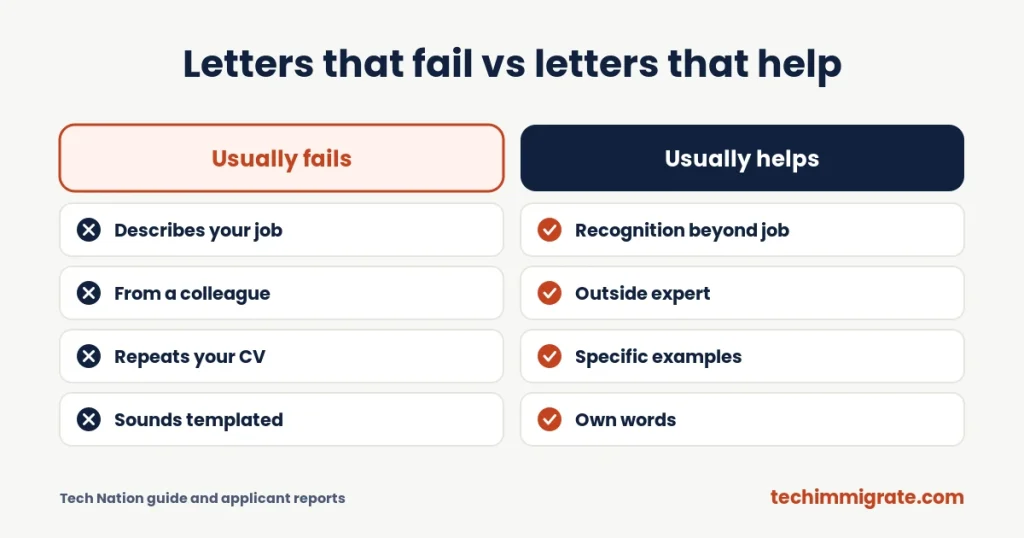
The Seven Letter Problems That Lead to Refusals
Across the refusals applicants share, the same seven problems come up again and again.
1. The letter describes your job, not your standing
This is the most common problem by some distance. A letter that says you delivered projects on time, led a team well and are a pleasure to work with describes a good employee. The Global Talent test is different: it asks whether you are recognised as a leader in digital technology, or have the potential to be one.
A letter that helps names something outside your day job: your open-source project adopted by other companies, a talk the referee saw you give, a product decision that changed an industry practice, people in the field who now follow your work.
2. The referee is a colleague, manager or co-founder
Tech Nation's guide says evidence of recognition from an immediate colleague, manager or friend is not sufficient. Applicants report that this is applied widely, including to co-founders, whose letters may be read as colleague letters (applicant-reported, April 2026).
You can still use someone you worked with, but the strongest letters usually come from people who know your work without being paid alongside you: a client's CTO, an investor, a conference organiser, an open-source maintainer, a professor who supervised you, or a senior figure at a partner company. Our guide to letter of recommendation authors covers who to approach.
3. The letter repeats your CV
If a letter lists your job titles and the projects you worked on, the assessor learns nothing new. Applicants report refusals that say exactly this. A letter should give the referee's own account: what they saw, why it was unusual, and how it compares with others in the field.
4. The three letters say the same thing
The guide requires each letter to give different examples. Three letters that all praise the same product launch waste two-thirds of your space. Assessors also read similarity as a sign that the applicant wrote all three.
5. The letter sounds templated or AI-written
The Tech Nation guide bans templates and AI-written content in letters, and warns that letters which look like duplicates, templates or close matches to other applicants' evidence may be treated as fraudulent. Refusals in 2025 and 2026 have cited AI-written content, according to applicants. Generic phrases such as "a true visionary" or "an invaluable asset to any organisation" are a warning sign.
This is also why the guide encourages digital signatures. Letters can be signed through a service such as DocuSign, so the log shows the author signed from a different IP address to you.
6. Big claims with no proof
"She transformed our business" means little without a number, a date or something the assessor can check. The guide says letters alone are never enough to meet a criterion: other evidence must back them up. The best letters point to things in your evidence documents, so the two support each other.
7. Format and credential problems
Some refusals turn on avoidable details: letters over 3 pages, no date or signature, no contact details, the author's CV missing, low-quality logos, or letters supplied as links instead of documents. One reviewer comment that applicants have shared even mentioned low-resolution company logos (applicant-reported, September 2025). None of these alone usually decides a case, but together they weaken trust.
How Do You Tell If Letters Were the Main Reason You Were Refused?
Your decision letter (often called the refusal proforma) comments on each part of your application. Read the section on letters, then check whether the same theme appears in the mandatory criterion and optional criteria sections. Our guide to the Global Talent visa rejection proforma explains how to read the whole document.
| If your refusal says… | Letters were probably… |
|---|---|
| Letters are positive but show no recognition beyond your role, and the MC is not met | A main reason |
| Letters are fine, but evidence shows team results rather than yours | A minor factor |
| Colleague letters cannot count, and no other outside recognition was found | A main reason, together with weak evidence |
| Letters not mentioned, or described as supportive, but a criterion failed on evidence | Not the problem |
| Letters were not viewed (links) or missing credentials | A procedural problem you must fix |
As a rule of thumb: if the assessor calls you a capable or respected professional, the letters and evidence did not show recognition. That is a content problem, not an assessor mistake.
Can a Review Fix a Letters Refusal?
Rarely. An endorsement review only checks whether a mistake was made in processing your original application. GOV.UK says you cannot add new evidence, and new letters count as new evidence. If you think additional evidence would make the difference, GOV.UK says to make a new Stage 1 application with the fee.
A review might help with letters in narrow cases:
- the decision says a letter was missing, but it was in your application;
- the decision misreads what a letter says, for example claiming no referee mentioned external recognition when one clearly did;
- the decision says the author lacked credentials, but their CV was included in the same file.
If the problem is that your letters came from colleagues, described your job, or repeated your CV, a review cannot fix it. Home Office figures released under a Freedom of Information request (FOI2026/10735) and published by Edgewater Legal suggest only about 4 in 100 decided Tech Nation reviews succeeded. Our Global Talent endorsement review form guide explains how to frame a review if you do have one of the narrow cases.
Some forum members suggest requesting a review anyway, because it is free and the reviewer's reply can give more detail for a reapplication. That is a fair point, but weigh it against the time: the review takes up to 28 days, and that time could go into building new letters.
How Do You Fix Your Letters Before You Reapply?
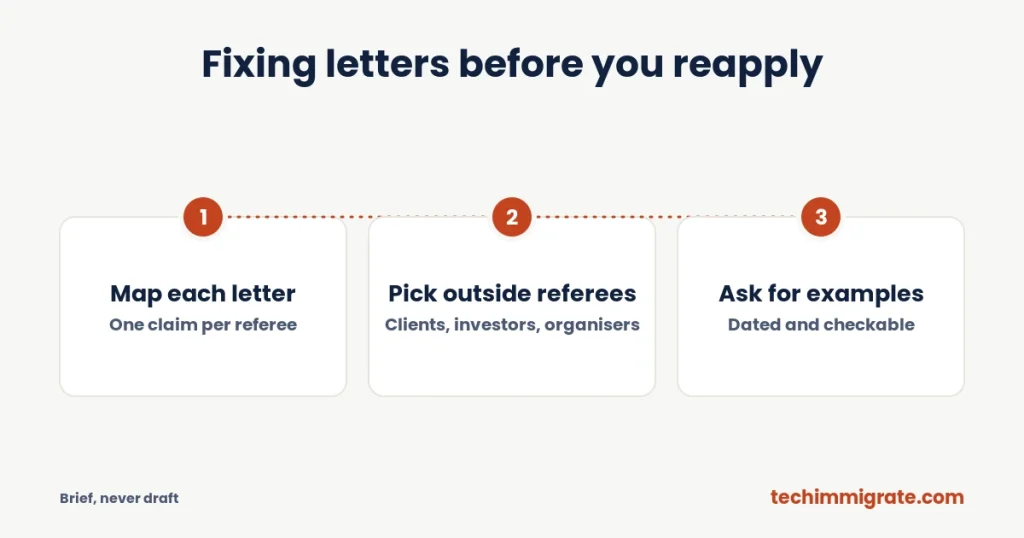
Fixing letters is mostly about choosing better referees and briefing them better. In outline:
- Map each letter to one claim. Decide what each referee can prove that the others cannot: one for your impact at a product-led company, one for recognition outside your job, one for your future contribution to the UK.
- Replace colleague referees with outside experts where you can. Think about who has seen your work from outside your employer: clients, investors, partners, event organisers, maintainers, academics.
- Brief, don't draft. Give each referee the facts and the criteria, then let them write in their own words. Never send a filled-in template.
- Ask for specific examples. Each letter should include at least one concrete, dated example with a number or outcome the assessor can check against your evidence.
- Check the format. Typed, dated, signed (ideally digitally), up to 3 pages, contact details, the author's CV in the same file.
- Read all three together. If two letters tell the same story, change one referee or one example.
Our guides include a referee briefing method and what every letter must cover for your role; this article stays with the principles.
Tip: A letter is strongest when it confirms something your evidence documents already show. Before you brief a referee, decide which document their letter will support.
Who Makes a Strong Referee, and Who Usually Doesn't?
| Usually strong | Usually weak |
|---|---|
| A CTO or founder at a client or partner company who saw your impact | Your current line manager |
| An investor who backed a product you led | A co-founder at your own start-up |
| A conference or community organiser who invited you to speak | A colleague on the same team |
| An open-source maintainer whose project you contributed to | A friend in the industry |
| A professor or research lead who supervised published work | A senior person at an outsourcing or consultancy firm |
| A recognised expert who judged your work in a competition | Someone who has known you for less than 12 months |
The guide also notes that "leading experts" cannot come from roles it lists as unsuitable, such as managers at outsourcing or consultancy firms. Seniority alone is not enough: what matters is the referee's standing in digital technology and their first-hand knowledge of your work.
What About Reference Letters Among Your 10 Documents?
These are different from your three mandatory letters, and they trip people up.
- They must be different letters. The guide says reference letters used as evidence should not repeat your three mandatory letters.
- They must meet the same standard: an established expert who has known your work for 12 months or more.
- They must be criterion-specific, supporting one criterion only.
- They cannot stand alone. Letters alone are not enough to meet any criterion; pair each one with documentary evidence.
A common mistake is using an extra letter as a substitute for missing evidence. Assessors notice, and applicants report refusals that say so.
Is the Way Letters Work About to Change?
Possibly. The Migration Advisory Committee's review of talent routes, published in November 2026, recommended that referees send letters directly and confidentially to endorsing bodies, with rules on conflicts of interest. This is advice to the government, not a rule yet. If it is adopted, applicants would no longer see or handle their own letters, which would make the quality of your referees matter even more.
For now, the rules in the Tech Nation guide still apply. Check GOV.UK and the guide's change log before you apply.
A Fictional Example: Two Versions of the Same Referee
Amara (a fictional applicant) is a senior data engineer refused for Exceptional Talent. Her refusal said her letters described strong performance but no recognition beyond her role.
| First application | Reapplication | |
|---|---|---|
| Referee | Her line manager | The CTO of a partner company that adopted her open-source tool |
| What the letter covered | Her projects, reliability and teamwork | Why his company chose her tool, what it replaced, and the talk where he first heard her speak |
| Proof offered | None beyond the letter | Pointed to her adoption figures and the conference listing in her evidence |
| How it reads to an assessor | A good employee | Recognition from outside her employer |
The second letter is not longer or more flattering. It simply proves something only an outsider can.
How Do Letters Fit With the Rest of the Refusal Reasons?
Letters are rarely the only problem. They usually appear alongside the patterns in our Tech Nation rejection reasons article: team results presented as personal wins, employers that are not product-led, and recognition that is internal rather than external. Fix the letters without fixing the evidence, and the next refusal may simply move the criticism elsewhere.
The practical order for a reapplication is: confirm your route (Talent or Promise), fix the evidence for your chosen criteria, then choose referees whose letters confirm that evidence.
Get the Guide Written for Your Role
Our endorsement guides cover recommendation letters for your specific role: who to ask, how to brief each referee so they write in their own words, what every letter must include, and the letter problems we see most often in refusals. Each guide also includes the 3-page evidence template, a 12-week planner and a pre-submission checklist, at £79 until 30 November, then £125. Choose the guide for your role.
Frequently Asked Questions
Yes. Applicants frequently report refusals that criticise letters for describing a capable employee rather than recognition beyond the job, repeating the CV, or coming from colleagues. There are no official figures ranking refusal reasons, but letter problems appear in many applicant-reported refusals.
They can, but Tech Nation's guide says recognition from an immediate colleague, manager or friend is not sufficient. A manager's letter may confirm your work, but you need referees from outside your employer to show recognition by the field.
Applicants report that co-founder letters may be read as colleague letters. If you are a founder, letters from investors, customers, partners or other recognised figures usually carry more weight.
No. The Tech Nation guide bans templates and AI-written content, and warns that letters that look templated or duplicated may be treated as fraudulent. Brief your referee with facts and let them write in their own words.
Usually not. A review cannot include new evidence, so you cannot submit new letters. It can only help if the decision misread or overlooked a letter you already sent. Weak letters normally need a new application.
Up to 3 sides of A4, not counting the author's credentials and contact details, according to Tech Nation's guide. The author's CV or proof of credentials should be included in the same file.
It is not mandatory. Tech Nation's guide says letters can be created with a digital signature service so the log shows the author signed from a different IP address. Many endorsed applicants report using one.
How We Checked This Article
We checked the letter rules against Tech Nation's Global Talent Visa Application Guide (last updated 27 February 2026, read on 21 November 2026) and GOV.UK's Global Talent digital technology pages and endorsement review guidance, on 22 November 2026. Review figures come from Home Office FOI figures (FOI2026/10735) published by Edgewater Legal in October 2026, which have not been independently verified. The referee proposal comes from the Migration Advisory Committee's review of talent routes (November 2026).
Refusal wording comes from threads on the Tech Nation Visa Forum, including an Exceptional Promise refusal from January 2026, an Exceptional Talent refusal and review from 2025, a December 2025 refusal and review and a 2026 refusal on letters repeating the CV. Forum material is applicant-reported and paraphrased, not official guidance. The named example is fictional.
Tech Immigrate is independent of Tech Nation and the Home Office. This article is general information, not legal advice.
We write practical guides for tech professionals applying for the UK Global Talent visa. Tech Immigrate is independent of Tech Nation and the Home Office, and our articles are general information, not legal advice. Rules and fees change, so always check gov.uk before you apply.