
For cybersecurity specialists applying to Tech Nation
I was refused the Global Talent visa. Here is how to avoid my mistake.
Read this before you pay the £561 endorsement fee, because that fee is not refunded if you are refused.
If you work in this field, you probably assume your security work speak for themselves. To a Tech Nation assessor, they only speak if you show them in the right format, with the right proof, against the right criteria.
I know this because it happened to me. Below is my story, the mistakes that cause most refusals, and how to avoid them. All of it is free to read. Keep going.
My story
I did it myself. I made a lot of mistakes. Then I got endorsed.
I applied for the Global Talent visa myself, and I was refused.
Looking back, I made a lot of mistakes, not just one. I chose the wrong criteria for my profile. I did not put my evidence together properly. And there were more small errors that added up, the kind you only spot once someone shows you what an assessor looks for.
A refusal is painful. The endorsement fee is not refunded, you lose months, and you start again from the beginning. It is also easy to take the wrong lesson from it, like deciding you are not good enough. That was not the lesson.
So I went back through the rules, found every place my application had gone wrong, and fixed each one. I applied again, and this time I was endorsed. I did the whole application myself.
That is why this guide exists. My goal is to help you avoid the mistakes I made, so you can get it right the first time.
The biggest mistake
The mistake that cost me: choosing the wrong criteria
To be endorsed on the Talent route, you must meet the Mandatory Criterion and two of the four Optional Criteria. In short, the four are innovation (OC1), recognition beyond your job (OC2), the impact of what you built or led (OC3), and research or academic work (OC4).
Here is the trap. You can have strong evidence and still be refused, because you lined it up against criteria it does not prove. The assessor does not rearrange your case for you. They check what you claimed.
As a rough guide, this is how strong evidence maps to the right criterion for cybersecurity specialists:
| If your strongest evidence is… | Lead with |
|---|---|
| Selective outside recognition: a ranked bug-bounty position, invited talks, awards | MC, recognition as a leader |
| Unpaid disclosures and open-source security tools | OC2, work beyond your job |
| Security results at a product-led company, such as losses cut, confirmed by your employer | OC3, impact |
| Peer-reviewed security research | OC4, research |
That table is the short version. Your own mix of evidence decides the best pair, and the wrong pair is the quickest way to a refusal. Criteria are only the first of the common mistakes. Here they are for cybersecurity specialists.
Why cybersecurity specialists get refused
Seven reasons security specialists get refused, and how the guide helps you avoid them.
01
Building your case on IT support, outsourced SOC or consultancy work
Only product-led tech companies count. Tech Nation lists IT support, infrastructure and consultancy as not suitable on their own, and managed security providers usually fail the test.
The guide explains why these roles struggle, gives the product-led test employer by employer, and a 12-month plan to build evidence at a product company or through public research.
02
Treating certifications and paid bounties as recognition
Certificates show training, and paid bug-bounty work is paid work, not recognition outside your job.
The guide shows what counts instead: a selective bug-bounty ranking under the Mandatory Criterion, and unpaid disclosures, tools, main-stage talks and in-person mentoring under Optional Criterion 2.
03
Sharing sensitive incident or client details
Security evidence often can’t be shared as it is, and leaking it is worse than leaving it out.
The guide shows how to redact incidents, get employer approval and stay within your NDA, while keeping every claim verifiable.
04
Listing CVEs with no context
A list of IDs doesn’t show severity, reach or who recognised the work.
The guide shows how to turn disclosures into one 3-page document with severity, affected users, vendor credit and fix dates.
05
Claiming team results as your own
Assessors reject outcomes described as a team effort, and ask what you personally built.
The guide shows how to build an evidence chain from your security controls to fewer losses, certifications, deals and funding, with proof for each link.
06
Relying on your own screenshots and incident write-ups
Assessors treat internal dashboards, ticket exports and self-written incident summaries as self-reported.
The guide lists 20 kinds of third-party proof, from CVE records and maintainer letters to approved metrics extracts, to back every number.
07
A CV that doesn’t match LinkedIn
Assessors cross-check dates and titles, and unexplained gaps, including a hidden SOC or consultancy job, are cited in refusals.
The guide gives a 3-page CV layout and a final check that every date, title and figure matches across your CV, letters, statement and LinkedIn.
How to avoid them
The five-step approach that avoids them
The guide recommends the Mandatory Criterion plus Optional Criteria 2 and 3, and shows how to turn CVEs, talks, tools and product security results into evidence an assessor can check, without breaking an NDA. Here is how to build a case on it.
Check your role against the product-led test. IT support, outsourced SOC and consultancy roles struggle. Security work at product-led companies, and public work such as CVEs, tools and talks, fits.
Choose your criteria on purpose. Pick the pair you can prove best, instead of trying to cover everything. This is the step that sank my first application.
Turn your work into short evidence documents. Each one is limited to 3 sides of A4 and ties to one criterion.
Back every claim with proof an assessor can check. Third-party proof beats your own screenshots, and your referees should write in their own words.
Run a final consistency check. Dates, titles and figures must match across your CV, letters, statement and LinkedIn before you submit.
That is the outline. Doing it well is where the detail matters, and the next section shows what that detail looks like.
A page from the guide
This is what an evidence document looks like
Here is one page from the guide, so you can see the level of detail before you decide. It shows the rules for deciding where each piece of security evidence belongs.
Mapping rules: which security evidence goes where
Rule 1. Put your strongest external recognition under the Mandatory Criterion. If it fails, nothing else is assessed in your favour.
Rule 2. Put day-job outcomes under OC3. “I built the fraud controls that cut losses by 86%” is a contribution, not recognition.
Rule 3. Put unpaid disclosures and open-source tools under OC2. A paid bug-bounty ranking goes under the Mandatory Criterion: bounties are paid, so they are not voluntary work, but a selective ranking is recognition.
Rule 4. Never split one achievement across two criteria. A talk about your disclosures and the disclosures themselves are two items. The same talk under two criteria is reuse.
Two more rules from the same page
- Each criterion needs at least 2 documents. 3 is safer, because assessors may reject one.
- Keep the criterion in the file name and on page 1, so the assessor never has to guess.
The guide has worked samples like this for every kind of evidence, with the proof pages listed, so you know what to gather before you write.
If you are refused
What an appeal looks like, decoded
A refusal is not always the end. The guide includes anonymised refusal cases as reported by applicants, plus a review method. Here is one of them.
The security expert whose pack was mostly letters
A senior cybersecurity analyst with two master’s degrees applied after six months of preparation. The Mandatory Criterion rested on reference letters and an employment contract, and the optional criteria were letters too. The application was refused.
Lesson: A letter confirms evidence. It is not evidence. Every letter needs a public page, a record or a number beside it.
Three refusal lines, decoded
| What the refusal said | What it really meant |
|---|---|
| The evidence was “mostly recommendation letters” | Letters alone are not sufficient. Put a public page, record or number beside every letter. |
| Reviewers asked what recognition existed outside work | Talks, media and publications. Build them into the pack. |
| In another case: 18 years of experience, a PhD and papers, refused within days | Volume is not recognition. Years, papers and trainees count only with selection, citations and traction attached. |
The guide gives you the full set of cases and the review method, so you know how to answer each kind of refusal if it happens to you.
Cases are anonymised and reported by applicants. They show how others have handled refusals, and no one can promise the same result. The guide is general information, not legal advice.
Want more?
The Endorsement Guide for Cybersecurity Specialists
The guide takes every step above and shows you how to do it, with Tech Nation’s own rules for each document. It is 126 pages in 7 parts, aligned with Tech Nation’s applicant guide, and you download it as a PDF straight after paying.
- 10-document mock evidence pack
- Evidence, letter, CV and statement templates
- 24 evidence checklists, a 12-week planner and final checks
What's inside
Everything you need to go from first draft to submitted.
PDF · 7 parts · 126 pages
The guide
- How the route works
- Are you eligible as a cybersecurity specialist? Why IT support, outsourced SOC and consultancy roles struggle
- The application pack at a glance, with Tech Nation’s rules for every document
- Choosing your criteria: why MC + OC2 + OC3
- Mandatory Criterion: recognised as a leader
- Optional Criterion 2: CVEs, tools, talks and mentoring beyond your job
- Optional Criterion 3: security products, the evidence chain and confidential incidents
- Optional Criteria 1 and 4: the alternatives
- The 3-page evidence template
- Recommendation letters
- Third-party verification of your impact
- Your CV
- Your personal statement
- No evidence yet? A 12-month plan
- Common mistakes
- The six rejection patterns and 18 fixes
- What real refusals say: 4 refusal cases and 12 more fixes
- How to request a review (appeal) and win, with a worked example
- Pre-submission checklist
- Evidence checklists for 24 kinds of evidence
- Your 12-week application planner and trackers
Worked example
10-document mock evidence pack
A complete fictional application with every document in the 3-page format, built from Tech Nation’s rules and publicly reported endorsed security cases, plus 4 swap-in documents for Optional Criteria 1 and 4.
Templates
Evidence, letter, CV and statement templates
A fill-in 3-page evidence template, what every recommendation letter must include, a 3-page CV layout and a personal statement plan, each with fictional samples.
Checklists
24 evidence checklists, a 12-week planner and final checks
A checklist for every kind of security evidence, a week-by-week planner with evidence and referee trackers, 30 refusal fixes, 4 applicant-reported refusal cases with the wording decoded, a worked review (appeal) and a pre-submission checklist.
If you are just starting
Planning your first application
Choose your criteria first, then follow the 12-week planner. Collect the right evidence while you still have time to get it, instead of finding gaps the week you submit.
If you were already refused
Planning to reapply or request a review
Use the refusal fixes and the review method to read what the decision really meant and decide your next move. I reapplied after a refusal, and it worked.
Success stories
From evidence pack to endorsement
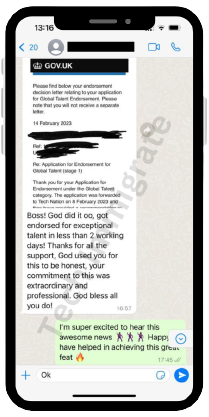
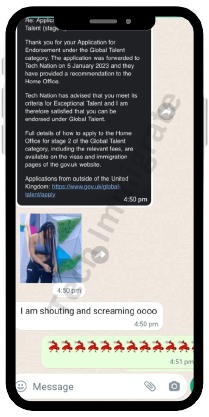
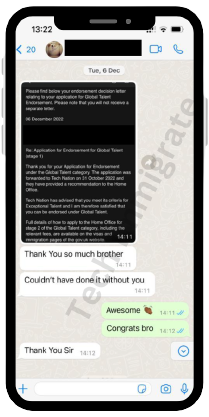
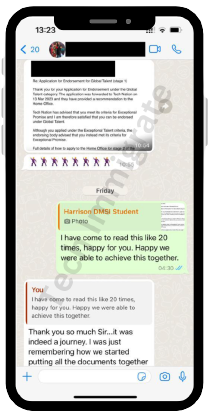
Real messages from people Tech Immigrate has helped. Names hidden for privacy.
Stop and think
You have two options
Option 1: work it out alone
Free, plus your time
- Read the official guidance and piece together what counts
- Guess which criteria and evidence an assessor will accept
- Submit, then wait for the decision
- If refused, pay the £561 fee again and wait again
Option 2: use the guide
$79$30 one-time
- Pick the right criteria before you write anything
- Copy the format from a full worked example
- Check everything before you pay the fee
- Instant PDF download
UK immigration solicitors typically quote £2,000 to £5,000 to help with a Global Talent application. One refusal costs the £561 fee. The guide costs less than a tenth of that.
Get your head start today
- Pick the right criteria before you write anything
- 10-document mock evidence pack
- 24 evidence checklists, a 12-week planner and final checks
- Evidence, letter, CV and statement templates
Limited-time offer ends 31 October.
Secure checkout by Stripe · Instant PDF download
The guide is general information, not legal advice, and no one can guarantee an endorsement.
Questions about this guide
Possibly, but it’s harder. Section 2 explains why IT support, outsourced SOC and consultancy roles struggle under the product-led test, and Section 13 gives a 12-month plan to build evidence from product security work, public research, disclosures and open-source tools.
Yes, if you present them well. Unpaid responsible disclosures made outside your job can support Optional Criterion 2. A sustained, selective bug-bounty ranking can support the Mandatory Criterion, because bounty payouts count as paid work. Section 6 and the checklists show how to present severity, reach and vendor credit, and how to avoid using one item for two criteria.
Section 7 explains how to present incidents and internal results safely: get your employer’s approval, redact secrets and client names, stay within your NDA, and let a signed letter confirm what you cannot show. Tech Nation says you should only share data if you have permission to do so.
Yes. This guide is written for Cybersecurity Specialists specifically, so it shows how to present your own kind of work, not engineering work, as evidence against the criteria. It does not assume you write code.
The route has two levels: Exceptional Talent for established leaders and Exceptional Promise for people earlier in their careers. The guide explains the difference and how to work out which one your record fits. It cannot promise either outcome. Whether you are endorsed is decided by the assessors.
The guide gives you evidence checklists and a planner, so you work through the application in order instead of facing everything at once. That is exactly where I lost time on my first attempt.
No. The samples follow a fictional applicant, Nia Wambugu, a product security engineer, and show the standard to aim for. Tech Nation says templated letters and anything written with AI tools are not acceptable, so your referees must write in their own words about work they saw.
Section 14C explains how to request a review within 28 days, how to write each point with a full worked example, and when to fix your pack and reapply instead. Section 14B decodes the refusal wording security specialists have reported.
Yes, briefly. Section 1 covers the visa fee, timings, the healthcare surcharge and dependants. The rest of the guide focuses on endorsement, where almost every refusal happens.
Yes. It follows Tech Nation’s Global Talent Visa Application Guide (last updated 27 February 2026), read in full in September 2026, including its rules on in-person mentoring, main-stage talks, salary evidence, confidential data, letters and AI tools. The mock pack was checked against the same rules. Rules can change, so check GOV.UK and Tech Nation’s guide on the day you apply.
Section 16 has a checklist for each of 24 kinds of evidence, showing what each document must have, what makes it stronger and the red flags that get it dismissed. Section 17 is a 12-week planner with key dates, tasks by stage and trackers for your evidence, referees and supporting letters.
Because the guides are digital downloads you can access straight away, sales are final once you’ve downloaded them. If a file is faulty or won’t open, email [email protected] and we’ll fix it or refund you.
Yes. It was checked against the rules in October 2026. If we update it, buyers get the new version in their downloads at no extra cost.
Straight after payment. You can download the PDF right away, and you can come back to your downloads page later using the email you paid with.
Checkout is by Stripe and takes major debit and credit cards. If a payment fails, email [email protected] and we will help you sort it out.
This one is written for cybersecurity specialists. Security engineers, researchers, red teamers and CISOs. Other roles have their own guides.
No, and nobody can. The guide shows you how to build the strongest case you can. The decision is Tech Nation’s.
Email [email protected] and we will reply.