
For tech investors applying to Tech Nation
I was refused the Global Talent visa. Here is how to avoid my mistake.
Read this before you pay the £561 endorsement fee, because that fee is not refunded if you are refused.
If you work in this field, you probably assume your deals speak for themselves. To a Tech Nation assessor, they only speak if you show them in the right format, with the right proof, against the right criteria.
I know this because it happened to me. Below is my story, the mistakes that cause most refusals, and how to avoid them. All of it is free to read. Keep going.
My story
I did it myself. I made a lot of mistakes. Then I got endorsed.
I applied for the Global Talent visa myself, and I was refused.
Looking back, I made a lot of mistakes, not just one. I chose the wrong criteria for my profile. I did not put my evidence together properly. And there were more small errors that added up, the kind you only spot once someone shows you what an assessor looks for.
A refusal is painful. The endorsement fee is not refunded, you lose months, and you start again from the beginning. It is also easy to take the wrong lesson from it, like deciding you are not good enough. That was not the lesson.
So I went back through the rules, found every place my application had gone wrong, and fixed each one. I applied again, and this time I was endorsed. I did the whole application myself.
That is why this guide exists. My goal is to help you avoid the mistakes I made, so you can get it right the first time.
The biggest mistake
The mistake that cost me: choosing the wrong criteria
To be endorsed on the Talent route, you must meet the Mandatory Criterion and two of the four Optional Criteria. In short, the four are innovation (OC1), recognition beyond your job (OC2), the impact of what you built or led (OC3), and research or academic work (OC4).
Here is the trap. You can have strong evidence and still be refused, because you lined it up against criteria it does not prove. The assessor does not rearrange your case for you. They check what you claimed.
As a rough guide, this is how strong evidence maps to the right criterion for tech investors:
| If your strongest evidence is… | Lead with |
|---|---|
| Press or peers naming you as the lead investor or expert | MC, recognition as a leader |
| Advising a regulator, agency or startup programme outside your fund | OC2, work beyond your job |
| Rounds you led and boards you sit on, itemised and confirmed | OC3, commercial impact |
| A fund model or product you created that independent sources call new | OC1, innovation |
That table is the short version. Your own mix of evidence decides the best pair, and the wrong pair is the quickest way to a refusal. Criteria are only the first of the common mistakes. Here they are for tech investors.
Why tech investors get refused
Seven avoidable mistakes, and how the guide helps you avoid them.
01
Applying as an analyst or associate
Tech Nation lists junior investors and analysts as unsuitable.
The guide shows how to evidence decision-making, and what to build first if you’re not there yet.
02
Claiming credit for deals you only supported
Assessors look for lead, co-lead and board roles, not deal support.
The guide shows how to prove your role in each deal with announcements, appointment letters and founder letters.
03
Breaking confidentiality with deal documents
Term sheets and memos can’t be shared as they are.
The guide shows how to redact deal data safely and still keep it verifiable.
04
Relying on investments outside digital tech
Only product-led digital technology companies count towards this route.
The guide helps you choose the portfolio evidence that fits the criteria.
05
Letters from LPs or friends, not established experts
Each referee must be recognised in digital tech and know your work for 12+ months.
The guide covers who to ask, how to brief them and what every letter must include, with a fictional sample for each kind of referee.
06
Evidence that isn't linked to the criteria
A strong document can still be ignored if it’s unclear which criterion it supports.
The guide gives you a 3-page layout for every document that names the criterion and what it proves.
07
Dates and details that don't line up
Different job titles, dates or figures across your CV, statement and letters raise doubts.
The guide includes a final check that every date, title and figure matches across your documents.
How to avoid them
The five-step approach that avoids them
The combination that works best for most investors is the Mandatory Criterion plus Optional Criteria 2 and 3: the recognition you have earned from founders and other investors, your work outside your fund, and the commercial impact of the rounds you led. Here is how to build a case on it.
Itemise every round you led. The size of the number does not matter if no document ties it to you. Replace “led over $47m of investments” with a table: company, round, date, round size, your cheque, your role and the proof page.
Choose your criteria on purpose. Pick the pair you can prove best, instead of trying to cover everything. This is the step that sank my first application.
Turn your work into short evidence documents. Each one is limited to 3 sides of A4 and ties to one criterion.
Back every claim with proof an assessor can check. Third-party proof beats your own screenshots, and your referees should write in their own words.
Run a final consistency check. Dates, titles and figures must match across your CV, letters, statement and LinkedIn before you submit.
That is the outline. Doing it well is where the detail matters, and the next section shows what that detail looks like.
A page from the guide
This is what an evidence document looks like
Here is one page from the guide, so you can see the level of detail before you decide. It is a fictional example of one Mandatory Criterion item.
Evidence 1: Recognised by a pan-African VC fund as one of the leading early-stage tech investors in West Africa
Savanna Capital is a pan-African venture fund with $210m under management and 70 portfolio companies. It has co-invested with Harmattan Ventures twice, in rounds I led: Mobo’s $9m Series A (2022) and Duka’s $10.5m Series A (2024).
Its Managing Partner writes: “Adaeze set the terms on both rounds and brought in two of the other investors. She is one of a handful of early-stage investors in West Africa whose lead we follow without re-running the full diligence.”
How to present each Mandatory Criterion item
- Title the claim in one line.
- Explain the source in 2 to 3 sentences: who they are, their scale and why their opinion counts. Assessors in London may not know your local fund or outlet.
- Quote the exact sentence that says why you were chosen.
- Show the proof: a letter, list page or invitation with your name highlighted.
- Add scale: fund size, portfolio count, entries judged or audience.
The guide has worked samples like this for every kind of evidence, with the proof pages listed, so you know what to gather before you write.
If you are refused
What an appeal looks like, decoded
A refusal is not always the end. The guide includes anonymised refusal cases as reported by applicants, plus a review method. Here is one of them.
The fintech co-founder who was endorsed after a review
A co-founder and CEO who had raised over £1m from institutional and angel investors was accepted on the Mandatory Criterion and OC3. OC1 was refused because the evidence “outlines the milestones the team has worked on”.
Lesson: Investment flows, properly documented, can support OC3. Team milestones do not prove your personal contribution.
Three refusal lines, decoded
| What the refusal said | What it really meant |
|---|---|
| Led venture investments “exceeding $500M”: assessors wanted proof the work was “solely related” to him | The size of the number does not matter if no document ties it to you. Itemise every round and prove each one. |
| Press was “of a founder or startup profile nature”, clustered in the 12 months before applying | A funding announcement is company news. Recognition needs to name you, and to build over time. |
| OC3 failed because the applicant was “a freelance contractor” | State your role and status plainly: general partner, board director, not an employee. |
The guide gives you the full set of cases and the review method, so you know how to answer each kind of refusal if it happens to you.
Cases are anonymised and reported by applicants. They show how others have handled refusals, and no one can promise the same result. The guide is general information, not legal advice.
Want more?
The Endorsement Guide for Tech Investors
The guide takes every step above and shows you how to do it, with Tech Nation’s own rules for each document. It is 108 pages in 7 parts, aligned with Tech Nation’s applicant guide, and you download it as a PDF straight after paying.
- 10-document mock evidence pack
- Evidence, letter, CV and statement templates
- 20 evidence checklists, a 12-week planner and final checks
What's inside
Everything you need to go from first draft to submitted.
PDF · 7 parts · 108 pages
The guide
- How the route works
- Are you eligible as a tech investor?
- The application pack at a glance, with Tech Nation’s rules for every document
- Choosing your criteria: why MC + OC2 + OC3
- Mandatory Criterion: recognised as a leader
- Optional Criterion 2: contributions outside your fund
- Optional Criterion 3: commercial impact at product-led companies, and the evidence chain
- Optional Criteria 1 and 4: the alternatives
- The 3-page evidence template
- Recommendation letters
- Third-party verification of your personal impact
- Your CV
- Your personal statement
- No evidence yet? A 12-month plan
- Common mistakes
- The six rejection patterns and 18 fixes
- What real refusals say: 4 refusal cases and 12 more fixes
- How to request a review (appeal) and win, with a worked example
- Pre-submission checklist
- Evidence checklists for 20 kinds of evidence
- Your 12-week application planner and trackers
Worked example
10-document mock evidence pack
A complete fictional application with every document in the 3-page format, modelled on a real endorsed investor’s pack and checked against Tech Nation’s rules, plus an Optional Criterion 1 version of one document.
Templates
Evidence, letter, CV and statement templates
A fill-in 3-page evidence template, what every recommendation letter must include, a 3-page CV layout and a personal statement plan, each with fictional samples.
Checklists
20 evidence checklists, a 12-week planner and final checks
A checklist for every kind of investor evidence, a week-by-week planner with evidence and referee trackers, 30 refusal fixes, 4 anonymised refusal cases with the wording decoded, a worked review (appeal) and a pre-submission checklist.
If you are just starting
Planning your first application
Choose your criteria first, then follow the 12-week planner. Collect the right evidence while you still have time to get it, instead of finding gaps the week you submit.
If you were already refused
Planning to reapply or request a review
Use the refusal fixes and the review method to read what the decision really meant and decide your next move. I reapplied after a refusal, and it worked.
Success stories
From evidence pack to endorsement
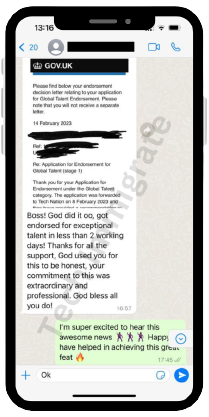
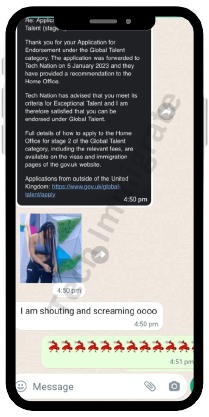
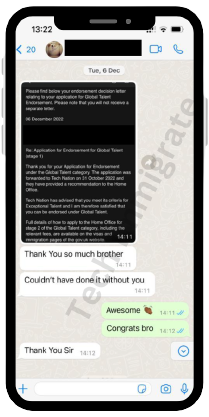
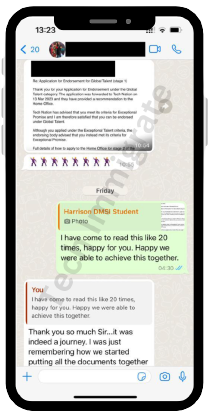
Real messages from people Tech Immigrate has helped. Names hidden for privacy.
Stop and think
You have two options
Option 1: work it out alone
Free, plus your time
- Read the official guidance and piece together what counts
- Guess which criteria and evidence an assessor will accept
- Submit, then wait for the decision
- If refused, pay the £561 fee again and wait again
Option 2: use the guide
$79$30 one-time
- Pick the right criteria before you write anything
- Copy the format from a full worked example
- Check everything before you pay the fee
- Instant PDF download
UK immigration solicitors typically quote £2,000 to £5,000 to help with a Global Talent application. One refusal costs the £561 fee. The guide costs less than a tenth of that.
Get your head start today
- Pick the right criteria before you write anything
- 10-document mock evidence pack
- 20 evidence checklists, a 12-week planner and final checks
- Evidence, letter, CV and statement templates
Limited-time offer ends 31 October.
Secure checkout by Stripe · Instant PDF download
The guide is general information, not legal advice, and no one can guarantee an endorsement.
Questions about this guide
No. This is the Global Talent visa through the business applicant route. You qualify through your track record in digital tech investing, not by investing money into the UK.
Possibly, if you led rounds in product-led digital tech companies, for example as lead angel with a board or advisory seat, and people outside your circle recognise it. Section 2 gives the test role by role. A list of small passive cheques will not pass.
No. The samples follow a fictional applicant, Adaeze Nwosu, a VC general partner, and show the standard to aim for. Tech Nation says templated letters and anything written with AI tools are not acceptable, so your referees must write in their own words about work they saw.
Yes, briefly. Section 1 covers the visa fee, timings, the healthcare surcharge and faster decisions. The rest of the guide focuses on endorsement, where almost every refusal happens.
Section 14C explains how to request a review within 28 days, how to write each point with a full worked example, and when to fix your pack and reapply instead. Section 14B decodes the refusal wording applicants have received.
Yes. This guide is written for Tech Investors specifically, so it shows how to present your own kind of work, not engineering work, as evidence against the criteria. It does not assume you write code.
The route has two levels: Exceptional Talent for established leaders and Exceptional Promise for people earlier in their careers. The guide explains the difference and how to work out which one your record fits. It cannot promise either outcome. Whether you are endorsed is decided by the assessors.
The guide gives you evidence checklists and a planner, so you work through the application in order instead of facing everything at once. That is exactly where I lost time on my first attempt.
Yes. It follows Tech Nation’s Global Talent Visa Application Guide (last updated 27 February 2026), read in full in September 2026, including its rules on in-person mentoring, main-stage talks, salary evidence, letters and AI tools. The mock pack was checked against the same rules. Rules can change, so check GOV.UK and Tech Nation’s guide on the day you apply.
Section 16 has a checklist for each of 20 kinds of evidence, showing what each document must have, what makes it stronger and the red flags that get it dismissed. Section 17 is a 12-week planner with key dates, tasks by stage and trackers for your evidence, referees and supporting letters.
Because the guides are digital downloads you can access straight away, sales are final once you’ve downloaded them. If a file is faulty or won’t open, email [email protected] and we’ll fix it or refund you.
Yes. It was checked against the rules in October 2026. If we update it, buyers get the new version in their downloads at no extra cost.
Straight after payment. You can download the PDF right away, and you can come back to your downloads page later using the email you paid with.
Checkout is by Stripe and takes major debit and credit cards. If a payment fails, email [email protected] and we will help you sort it out.
This one is written for tech investors. VC partners, principals, angels and fund managers. Other roles have their own guides.
No, and nobody can. The guide shows you how to build the strongest case you can. The decision is Tech Nation’s.
Email [email protected] and we will reply.