Global Talent Visa Rejection Reasons: Why UK Applications Get Refused (Stage 1 and Stage 2)
The top Global Talent visa rejection reasons at Stage 1 (endorsement) and Stage 2 (visa), how common refusals are, and what to do about each one.


In this article
- How Does the Two-Stage Global Talent Process Work?
- How Common Are Global Talent Rejections?
- Top Stage 1 Reasons: Why Endorsement Gets Refused
- Top Stage 2 Reasons: Why the Visa Gets Refused After Endorsement
- Do Rejection Reasons Differ for Other Endorsing Bodies?
- What Does Each Kind of Refusal Letter Look Like?
- How Do You Find the Real Reason in Your Refusal?
- What Should You Do After a Rejection?
- A Fictional Example: Two Applicants, Two Stages
- Which Rejection Reasons Apply to Your Role?
- What Do Successful Reapplicants Do Differently?
- How Can You Avoid Rejection in the First Place?
- Is It Worth Applying Given the Rejection Rate?
- Get the Guide Written for Your Role
- Frequently Asked Questions
- How We Checked This Article
Most UK Global Talent visa rejections happen at Stage 1, when the endorsing body refuses endorsement, not at Stage 2, when the Home Office decides the visa. For tech applicants, the top Stage 1 reasons are evidence that shows a good job rather than recognition in the field, work at companies that are not product-led, letters from colleagues, team results presented as personal ones, and breaking the document rules. Stage 2 refusals are much rarer and usually come down to suitability issues such as criminal records or immigration history, an expired endorsement, or missing documents.
This guide is for anyone planning a Global Talent application, or recovering from a refusal, who wants the main reasons in one place, across both stages. It explains how the two stages differ, ranks the common reasons for each, and says what to do about them. For the detail behind Tech Nation's endorsement decisions, see our deeper article on Tech Nation rejection reasons; this page is the overview.
Key takeaways
- A Global Talent application has two stages: endorsement (Stage 1) and the visa itself (Stage 2). Rejections at each stage happen for different reasons.
- Almost all rejections happen at Stage 1. For digital technology, Tech Nation refused a large majority of applications in 2025, according to Home Office figures published by Edgewater Legal (not independently verified).
- The biggest Stage 1 problem is evidence of a good job instead of recognition beyond the job.
- Stage 2 refusals are rare and usually involve suitability (criminality, immigration breaches, deception), an expired endorsement or documents.
- The challenge routes differ: a free endorsement review for Stage 1, and administrative review for Stage 2.
- Most Stage 1 problems need new evidence, so reapplying usually beats a review.
How Does the Two-Stage Global Talent Process Work?
Understanding where a rejection happened is the first step to fixing it.
| Stage 1: endorsement | Stage 2: visa | |
|---|---|---|
| Who decides | The endorsing body (Tech Nation for digital technology), via the Home Office | The Home Office |
| What is judged | Whether you are a leader or potential leader in your field | Whether you are eligible and suitable for the visa |
| Fee | £561 | £205, plus the Immigration Health Surcharge |
| Typical decision time (GOV.UK) | Usually 5 to 8 weeks | Usually about 3 weeks outside the UK, 8 weeks inside |
| If refused | Free endorsement review within 28 days | Usually administrative review |
If your rejection email talks about endorsement criteria, letters or evidence, it is a Stage 1 refusal. If it talks about suitability, documents, your immigration history or your endorsement being invalid, it is a Stage 2 refusal. Our Global Talent visa caseworker guidance article explains what the Home Office checks at each stage.
How Common Are Global Talent Rejections?
Rejection rates have risen sharply, particularly for digital technology.
- Across endorsing bodies: the Migration Advisory Committee's review of talent routes (November 2026) reported that the endorsement rate on standard routes fell from 74% in 2021 to 44% in 2025.
- Tech Nation: Home Office figures released under a Freedom of Information request (FOI2026/10735) and published by Edgewater Legal suggest Tech Nation refused about 63% of applications in 2023, about 82% in 2025 and about 91% in 2026 up to July. These figures have not been independently verified.
- Reviews: the same figures suggest only about 4 in 100 decided Tech Nation reviews succeeded.
- Stage 2: the same source reported very few Stage 2 refusals for endorsed applicants in early 2026.
The Migration Advisory Committee linked the falling endorsement rate partly to more poor-quality, premature and AI-generated applications, and some fraudulent ones. Our Global Talent visa success rate article covers the numbers in full.
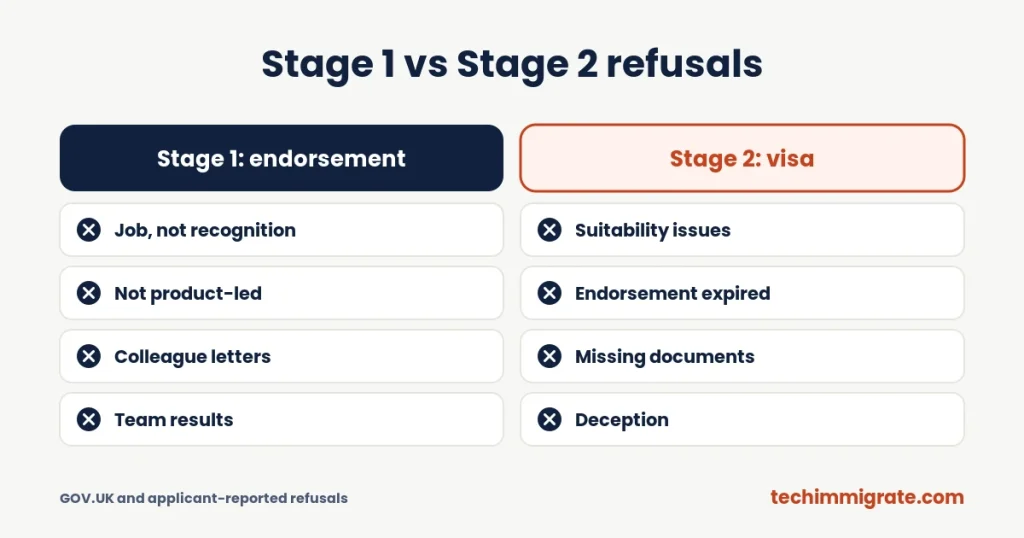
Top Stage 1 Reasons: Why Endorsement Gets Refused
These reasons are ranked by how often they appear in the refusal feedback applicants share and in the patterns described in official guidance. There are no official figures ranking refusal reasons, so treat the order as a guide.
1. Evidence of a good job, not recognition in the field
This is the most common reason by a wide margin. Applicants with solid careers are refused because their evidence shows they do their job well, not that people outside their employer recognise them as leaders. Refusals use phrases such as "capable employee", "respectable career" or "in line with a senior role" (applicant-reported). Tech Nation's guide says the mandatory criterion needs sustained or emerging national or international recognition.
What to do: build evidence from outside your employer, such as invited talks, judging, press about your work, awards for digital technology, or open-source adoption.
2. Working at a company that is not product-led
Several criteria require work at a product-led digital technology company: a business whose main revenue comes from its own technology product. Consultancies, outsourcers, IT services firms, agencies, banks and retailers often fail this test, according to applicants' refusals.
What to do: check each employer against the definition in Tech Nation's guide. Our Tech Nation guide article explains it.
3. Weak or wrong letters of recommendation
Letters from colleagues, managers or co-founders, letters that repeat the CV, and letters that sound templated are frequent refusal reasons. Read our article on why recommendation letters get Global Talent applications refused.
What to do: choose referees from outside your employer and brief them to write specific examples in their own words.
4. Team results presented as personal achievements
Assessors look for your individual contribution. Evidence that describes what the team or company achieved, without showing your part, is discounted.
What to do: make your role explicit in each document and have referees confirm it.
5. Self-reported evidence
Internal dashboards, Slack screenshots, company LinkedIn posts and your own descriptions are treated as weak or self-reported (applicant-reported). Tech Nation's guide asks for verifiable evidence.
What to do: back numbers with third-party proof, such as press, partner confirmations, accounts or independent data.
6. Breaking the document rules
More than 10 documents, documents over 3 sides of A4, the same evidence used for two criteria, shrunk pages, or documents that are just lists of links can all lead to evidence being ignored. Links to cloud drives are not viewed, according to applicants.
What to do: follow the evidence rules in Tech Nation's guide exactly.
7. The wrong route: Talent or Promise
Exceptional Promise is for people early in their career, usually with up to 5 years in tech. Applicants with longer careers report being told Promise was not available, and others report being judged against the wrong standard. See Exceptional Talent vs Exceptional Promise.
8. AI-written or templated content
Tech Nation's guide bans AI-written content and templates in letters, personal statements and evidence. Refusals in 2025 and 2026 have cited AI-generated content, according to applicants, and the guide warns that suspected fraud is reported to the Home Office. Read more in using AI in your Global Talent application.
9. Evidence that is too old or too recent
Mandatory criterion evidence must come from the last 5 years. Evidence created just before applying, such as a burst of open-source commits or a newly registered patent application, is treated as timed for the application.
10. Choosing criteria your evidence cannot prove
You need the mandatory criterion plus two of four optional criteria. Strong evidence filed under the wrong criterion can still fail, because assessors check what you claimed rather than rearranging your case.
Top Stage 2 Reasons: Why the Visa Gets Refused After Endorsement
Once you are endorsed, the Home Office checks that you are eligible and suitable. Refusals here are uncommon, but they are serious because the visa fee is not usually refunded.
| Reason | What it means | How to avoid it |
|---|---|---|
| Suitability concerns | Criminal convictions, past immigration breaches, or false or missing information in this or previous applications | Declare everything honestly; get advice if your history is complex |
| Endorsement no longer valid | The endorsement was withdrawn, or you applied after it could be used | Apply within the time allowed after endorsement (GOV.UK says within 3 months) |
| Wrong or missing documents | For example, no tuberculosis test certificate where one is required, or identity documents that do not match | Use GOV.UK's document checklist for your country |
| Deception | Any false document or statement, at either stage | Never submit anything you cannot verify |
| Applying from the wrong place or category | For example, trying to switch from a route that does not allow switching | Check GOV.UK's switching rules before applying |
These are general categories from GOV.UK and the Home Office's Global Talent guidance, not a complete list. If you have any immigration or criminal history, speak to an adviser registered with the Immigration Advice Authority or a solicitor before Stage 2.
Do Rejection Reasons Differ for Other Endorsing Bodies?
Yes. Each endorsing body has its own criteria:
- Digital technology: Tech Nation (the focus of this site).
- Science, engineering, humanities and medicine: the Royal Society, the Royal Academy of Engineering, the British Academy and UK Research and Innovation, often through peer review or fast-track routes.
- Arts and culture: Arts Council England.
- Design: a design industry route opened on 1 July 2026, assessed by the Design Business Association for Arts Council England.
The broad themes are similar, such as recognition, independent evidence and letters, but the details differ. If you are a designer or researcher refused by Tech Nation, another endorsing body may suit your profile better.
What Does Each Kind of Refusal Letter Look Like?
The two refusals look quite different, which is the quickest way to tell them apart.
A Stage 1 refusal arrives as a Home Office email saying your endorsement application was refused, with the endorsing body’s feedback. For digital technology, that feedback comes from Tech Nation and comments on your letters and each criterion you claimed. It tells you that you can request an endorsement review within 28 calendar days.
A Stage 2 refusal is a Home Office decision on the visa itself. It lists the paragraphs of the Immigration Rules you did not meet, such as suitability or eligibility requirements, and explains your options, usually administrative review. It does not comment on your talent or evidence, because the endorsement already settled that question.
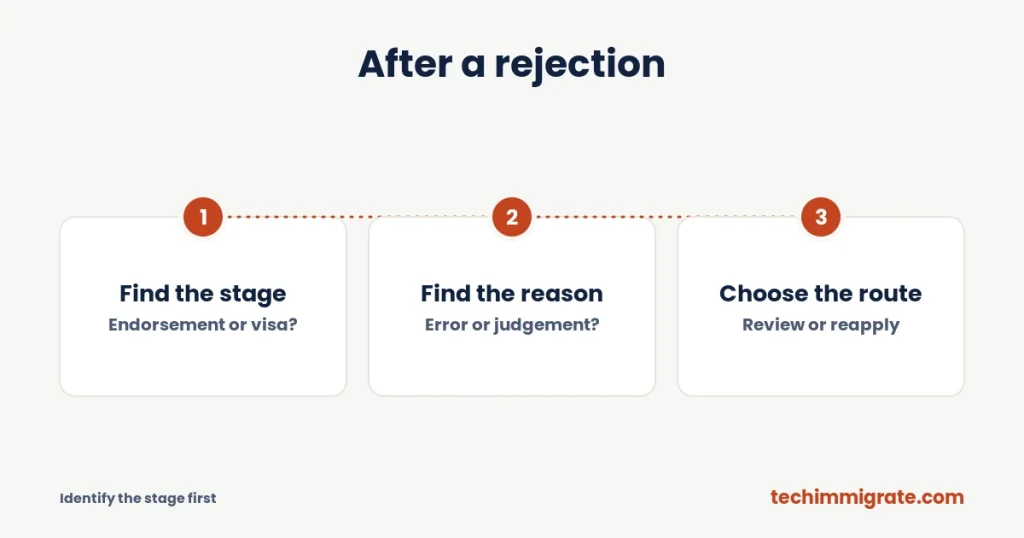
If your refusal mentions criteria, letters or evidence strength, it is Stage 1. If it mentions rule paragraphs, documents or your immigration history, it is Stage 2.
How Do You Find the Real Reason in Your Refusal?
At Stage 1, your refusal comes with written feedback, often called the proforma, that comments on your letters and each criterion you claimed. Read it for verdicts first (met or not met), then reasons, then compare each reason with what you actually submitted. Our guide to the Global Talent visa rejection proforma walks through it.
At Stage 2, the refusal letter cites the paragraphs of the Immigration Rules you did not meet. Note each paragraph number; it tells you whether the problem is suitability, eligibility or documents.
What Should You Do After a Rejection?
Your options depend on the stage.
| Stage | Option | When it makes sense |
|---|---|---|
| Stage 1 | Endorsement review (free, within 28 days, no new evidence) | The decision overlooked or misread evidence you actually sent |
| Stage 1 | New endorsement application (£561) | Your evidence was weak, your letters were the problem, or you chose the wrong route or criteria |
| Stage 2 | Administrative review | The Home Office made a caseworking error |
| Stage 2 | New visa application | The problem was documents or something you can fix |
| Either | Another visa route | Global Talent does not fit your profile right now |
For Stage 1, use the Global Talent endorsement review form only if you can point to a genuine error. For the full picture, read Global Talent visa rejection: 7 steps to take after a refusal.
A Fictional Example: Two Applicants, Two Stages
| Daniel (fictional) | Sofia (fictional) | |
|---|---|---|
| Where refused | Stage 1 | Stage 2 |
| Reason | Evidence showed a strong backend career, but recognition was internal and letters came from colleagues | Endorsed, but applied for the visa after her endorsement could no longer be used |
| Review likely to help? | No: the problem is evidence strength | No: an administrative review cannot extend an expired endorsement |
| Best next step | Build outside recognition, find external referees, reapply | Check whether she must apply for endorsement again, then reapply on time |
The same word, "rejected", hides two completely different problems. Identify the stage first.
Which Rejection Reasons Apply to Your Role?
The top reasons above apply to everyone, but each role has its own weak spots. These are the patterns that come up most in applicant-reported refusals for each role, with our detailed article for each.
| Role | Common role-specific problems (applicant-reported) |
|---|---|
| Software developers | Employers not product-led; team results; open source with little adoption |
| Product managers | Features shipped instead of outcomes; colleague letters; own dashboards |
| Data scientists and AI specialists | Recent papers with little citation; internal models with no external proof |
| Cybersecurity specialists | Confidential work with no verifiable proof; consultancy roles |
| UX and product designers | Agency or studio work; portfolios without measured impact |
| Digital marketers | Agency roles; marketing recognition rather than tech-sector recognition |
| Tech sales professionals | Big-company sales; quota numbers without independent proof |
| Startup founders | Business success without personal recognition; co-founder letters |
| Tech investors | Junior roles; fund reports treated as normal occupation |
| Tech researchers | Thesis work; venues of limited standing |
| Business analysts | Role not named on the skills list; self-authored impact |
If your role is not listed, start with the general reasons above and our Tech Nation rejection reasons article. The common thread across every role is the same: evidence must show recognition from outside your employer, at a product-led company where the criterion requires it, with your individual contribution clear.
What Do Successful Reapplicants Do Differently?
Applicants who are endorsed after a refusal tend to change the same few things, according to the stories they share on the Tech Nation Visa Forum (applicant-reported). The changes are rarely about writing better. They are about bringing different evidence.
First, they replace internal evidence with external evidence. Instead of dashboards, Slack messages and their own descriptions, they bring press coverage, invited talks with published attendance, judging roles, awards from recognised bodies, or open-source adoption that other companies can confirm. Each piece shows someone outside their employer choosing them.
Second, they change their referees. Letters from managers and co-founders give way to letters from clients, investors, partners, conference organisers and maintainers who know the work from the outside. The letters are shorter, more specific and point to evidence elsewhere in the pack.
Third, they narrow their claims. Rather than covering every criterion, they pick the mandatory criterion and the two optional criteria their evidence proves best, and make each document prove one thing clearly within 3 pages.
Fourth, they check the route. Applicants with long careers stop applying for Exceptional Promise, and early-career applicants stop stretching for Exceptional Talent.
Finally, they give themselves time. Building outside recognition usually takes months. Applicants who reapply within weeks with the same evidence usually report the same result, while those who spend a few months building new evidence report better outcomes. There are no official figures on reapplication success, so treat these as patterns, not promises.
How Can You Avoid Rejection in the First Place?
Most Stage 1 refusals are avoidable with preparation. Before you pay the £561 fee:
- Check your fit against GOV.UK's list of skills covered by Tech Nation and the product-led definition.
- Choose your route and criteria based on the evidence you can actually prove.
- Build outside recognition if you do not have it yet; this often takes months.
- Choose referees from outside your employer and brief them to write in their own words.
- Follow the document rules exactly: 10 documents, 3 pages each, one criterion each, no links-only pages.
- Write everything yourself, without templates or AI-written text.
- Run a consistency check so dates, titles and figures match across your CV, letters and evidence.
Our 9 Tech Nation endorsement mistakes article covers the avoidable errors in more depth.
Is It Worth Applying Given the Rejection Rate?
For the right candidate, yes. The Global Talent visa lets you work in the UK without a sponsor, change jobs freely, bring your family, and, for Exceptional Talent, settle after 3 years. But the high rejection rate means applying too early, with evidence that only shows a good job, is likely to cost you the fee and months of waiting.
The honest test is whether you can show recognition from people outside your employer. If you can, prepare carefully and apply. If you cannot yet, spend the time building it first.
Get the Guide Written for Your Role
Our endorsement guides cover the refusal reasons for your specific role, with applicant-reported cases, how to choose criteria and referees, and how to avoid each mistake. Each guide includes the 3-page evidence template, a 12-week planner and a pre-submission checklist, at £79 until 30 November, then £125. Choose the guide for your role.
Frequently Asked Questions
For tech applicants, the most common reason is evidence that shows strong job performance but not recognition by the wider field. There are no official rankings, but this pattern appears in many applicant-reported Tech Nation refusals.
Stage 1. Most refusals happen when the endorsing body refuses endorsement. Stage 2 visa refusals after endorsement are much rarer and usually involve suitability, documents or an expired endorsement.
Home Office figures published by Edgewater Legal (not independently verified) suggest Tech Nation refused about 82% of applications in 2025. The Migration Advisory Committee linked falling endorsement rates to more poor-quality, premature and AI-generated applications.
There is no tribunal appeal. A Stage 1 refusal can be challenged by a free endorsement review within 28 days, without new evidence. A Stage 2 refusal can usually be challenged by administrative review. Many applicants reapply instead.
It can, at Stage 2. The Home Office checks suitability, including criminality and immigration history. Declare everything honestly and get regulated advice if your history is complex.
There is no required waiting period. Reapply when you have new evidence for each criterion that failed. Reapplying quickly with the same evidence usually leads to the same result.
The themes are similar, such as recognition, independent evidence and letters, but each body has its own criteria. Researchers, artists and designers should check their own endorsing body's guidance.
How We Checked This Article
We checked process, fee and timing facts on GOV.UK's Global Talent digital technology pages and endorsement review guidance on 22 November 2026, and reviewed Tech Nation's application guide (last updated 27 February 2026). Endorsement rate figures come from the Migration Advisory Committee's review of talent routes (November 2026). Tech Nation refusal and review figures come from Home Office FOI figures (FOI2026/10735) published by Edgewater Legal in October 2026, which have not been independently verified. Stage 2 refusal categories are general summaries of GOV.UK and Home Office guidance, not a complete list.
Stage 1 reasons draw on refusal feedback shared on the Tech Nation Visa Forum, including a December 2025 refusal, a January 2026 Promise refusal and product-led refusals. Forum material is applicant-reported, not official guidance. The named examples are fictional.
Tech Immigrate is independent of Tech Nation and the Home Office. This article is general information, not legal advice.
We write practical guides for tech professionals applying for the UK Global Talent visa. Tech Immigrate is independent of Tech Nation and the Home Office, and our articles are general information, not legal advice. Rules and fees change, so always check gov.uk before you apply.