Global Talent Visa Changes: What Is New and What Stayed the Same
Every recent Global Talent visa change in one place: the new GOV.UK process, no fast track, design route, settlement reforms and MAC recommendations.


In this article
- The Changes at a Glance
- Changes to How You Apply
- Changes to Who Decides
- Changes to Fees
- Changes to Settlement
- The Migration Advisory Committee Review (November 2026)
- Applying Then and Now: A Comparison
- What Applicants Report About the New Process
- Government Plans to Expand Talent Routes
- Other Changes That Affect Global Talent Holders
- What to Watch Next
- Who Is Most Affected
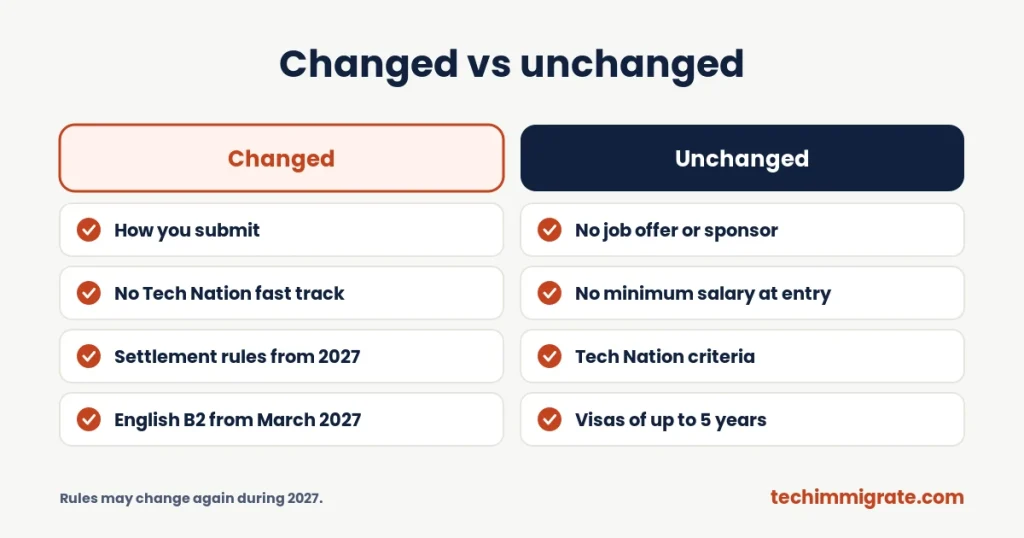
- What Has Not Changed
- What the Changes Mean for You
- How to Spot Out-of-Date Advice
- Frequently Asked Questions
- Apply Under the Rules as They Are Now
- How We Checked This Article
The Global Talent visa has changed more in the last two years than at any time since it replaced Tier 1 (Exceptional Talent) in 2020. Tech Nation's application platform closed, the tech fast track disappeared, the personal statement moved into the Home Office form, a new design field opened, the prize lists were refreshed, settlement policy was overhauled, and the Migration Advisory Committee published a major review of talent routes. Some of these changes are already in force. Others are proposals that will shape the route during 2027.
This article brings every important change together in one place, in plain English, for tech professionals planning an application or already holding the visa. It separates what has changed, what is proposed, and what has stayed the same, so you can tell which advice online is out of date.
Key takeaways
- Since 4 August 2025, tech applicants apply only through the GOV.UK form. Tech Nation's own platform closed and its fast track was removed.
- Since February 2026, the personal statement is typed into the GOV.UK form rather than uploaded.
- Tech Nation was confirmed as the digital technology endorsing body under a contract running from April 2025 to April 2028.
- Design became a new Global Talent field from 1 July 2026.
- The prestigious prize lists were updated on 21 April 2026.
- The English requirement for settlement rises from B1 to B2 for applications from 26 March 2027.
- The earned settlement response of 2 November 2026 keeps a 3-year settlement path for a "Highest Talent Group" expected to include Global Talent, with changes from 2027.
- The Migration Advisory Committee's Review of Talent Routes (17 November 2026) recommends stronger checks on letters and an income threshold at settlement. These are recommendations, not rules.
- What has not changed: no job offer, no sponsor, no minimum salary at entry, visas of up to 5 years, and the two-stage process.
The Changes at a Glance
| When | Change | Status |
|---|---|---|
| January 2025 | Tech Nation updated its applicant guidance, including rules on additional letters | In force |
| April 2025 | Tech Nation re-appointed as digital technology endorsing body, contract to April 2028 | In force |
| April 2025 | Fees set at £561 for endorsement and £205 for the visa | In force |
| May 2025 | Immigration White Paper promises to make talent routes more accessible | Policy |
| June 2025 | Global Talent Taskforce and £54 million Global Talent Fund announced | Launched |
| 4 August 2025 | Tech Nation platform closed; single GOV.UK form; fast track removed | In force |
| February 2026 | Personal statement typed into GOV.UK form | In force |
| March 2026 | Statement of changes adds a design field and English B2 for settlement from March 2027 | In force or scheduled |
| 21 April 2026 | Prestigious prize lists updated | In force |
| 1 July 2026 | Design field opens | In force |
| 3 August 2026 | Caseworker guidance version 19.0 published | In force |
| 2 November 2026 | Earned settlement response published | Changes from 2027 |
| 17 November 2026 | Migration Advisory Committee Review of Talent Routes | Recommendations |
| 26 March 2027 | B2 English for settlement applications | Scheduled |

Changes to How You Apply
One form instead of two (August 2025)
Until 3 August 2025, digital technology applicants completed two forms: the GOV.UK Stage 1 form and a separate application on Tech Nation's own platform. Both had to be submitted for the application to be valid.
From 4 August 2025, Tech Nation's platform closed. Applicants now complete only the GOV.UK form, pay £561, and email their documents to the Home Office, which refers the application to Tech Nation. The caseworker guidance says each email can be up to 25MB and web links are not accepted.
What this means for you: ignore any guide that tells you to register on Tech Nation's website or upload documents there. Our guide on how to apply for Global Talent endorsement explains the current process.
The fast track has gone (August 2025)
Tech Nation's fast-track section, which allowed some applicants to be assessed more quickly, was removed in August 2025. Tech Nation has said a replacement is under review. Every tech application is now assessed on its evidence at the standard pace. Applicants report most decisions within 5 to 8 weeks of paying.
The personal statement moved into the form (February 2026)
Since February 2026, you type or paste your personal statement into the GOV.UK form instead of uploading it as a document. Draft it offline in plain text first, and check the limit shown in the form. Our personal statement guide covers structure.
Tech Nation's guidance on letters and AI
Tech Nation's guidance update of January 2025 tightened rules on additional letters of recommendation used as evidence. Letters alone are not enough for any criterion, and any extra letters must come from different people, be specific to each criterion and meet the same standard as the three main letters.
Tech Nation's guidance also says the use of AI tools within the application is not acceptable, and that it may check for unacceptable AI use and contact referees. See our article on using AI in a Global Talent application.
Changes to Who Decides
Tech Nation stays as endorsing body
The Home Office re-tendered the digital technology endorsing body contract, and Tech Nation won it. The contract runs from 16 April 2025 to 15 April 2028, with two 12-month extension options. Tech Nation is named on GOV.UK and in the caseworker guidance as the endorsing body for digital technology.
A new design field (July 2026)
The March 2026 statement of changes added a design pathway to the Global Talent route, taking effect from 1 July 2026, with the Design Business Association assessing applicants in that area. This matters for designers who previously had to fit their careers into Tech Nation's digital technology criteria or Arts Council England's arts criteria. Product and UX designers should think carefully about which body fits their strongest recognition. Our UX and product designers guide explains the choice.
Updated prize lists (April 2026)
The Home Office refreshed the eligible prestigious prize lists on 21 April 2026. Named winners of listed prizes, such as the Turing Award and the ACM Prize in Computing in digital technology, can skip endorsement. Only prizes named exactly as on the list count. Our article on Global Talent visa routes explains the prize route.
Changes to Fees
The current government fees for Global Talent are:
| Fee | Amount |
|---|---|
| Endorsement | £561 |
| Visa (endorsed applicants) | £205 |
| Visa (prize route) and each dependant | £766 |
| Extension | £766 |
| Immigration Health Surcharge | £1,035 per year |
| Indefinite leave to remain (from 8 April 2026) | £3,226 |
The settlement fee rose from £3,029 to £3,226 on 8 April 2026. Fees usually change in April, so check GOV.UK before you pay. The earned settlement response says fee changes are still to be finalised. Our Global Talent cost breakdown has full totals.
Changes to Settlement
Settlement is where the biggest changes are coming.
English at B2 from March 2027
Appendix Global Talent says the English requirement for settlement rises from B1 to B2 for applications made on or after 26 March 2027. If you plan to settle after that date and are not exempt, consider taking a B2-level test in good time.
The earned settlement response (November 2026)
On 2 November 2026, the government published its response to the consultation "A Fairer Pathway to Settlement". The key points:
- The default qualifying period for settlement becomes 10 years.
- A 5-year path applies to people earning at least £50,271 in three of the last five years, and some others.
- A 3-year path applies to people earning at least £125,141 in three of the last four years, or in a "Highest Talent Group" expected to include Global Talent and Innovator Founder holders. The group's definition depends on Migration Advisory Committee advice.
- New mandatory requirements for everyone: no UK criminal record, no debts to the NHS, HMRC or the Home Office, English at B2, the Life in the UK test, and sustained earnings of at least £12,571 a year.
- Partners who arrive with the main applicant could settle at the same time.
- Time on some routes will not count, including Student, Graduate and High Potential Individual.
- Changes will be laid from the December immigration rules and implemented over 2027. There is no general protection for people already in the UK.
Our Global Talent ILR guide explains how these changes affect Global Talent holders.
The Migration Advisory Committee Review (November 2026)
The Migration Advisory Committee published its Review of Talent Routes on 17 November 2026, after a call for evidence that closed in May 2026. Its findings and recommendations are likely to shape the next round of changes. Among the points reported:
- Endorsement rates on the standard routes fell sharply, from 74% in 2021 to 44% in 2025.
- Tech Nation endorsed about 900 applicants between October 2024 and September 2025.
- Referees should send letters directly to endorsing bodies, rather than through applicants.
- Conflict-of-interest rules should apply to referees.
- An income threshold at settlement should be considered for talent routes.
These are recommendations. The government decides whether to accept them, and any changes would need new rules. But they point towards more checks on letters and on earnings at settlement.
Separately, Freedom of Information figures reported by Edgewater Legal suggest Tech Nation refused about 82% of decided cases in 2025 and about 91% in 2026 up to July. Our article on the Global Talent success rate explains the numbers.
Applying Then and Now: A Comparison
To see how much has changed, compare an application made in early 2024 with one made today.
| Step | Early 2024 | Now |
|---|---|---|
| Where you apply | GOV.UK form plus Tech Nation's platform | GOV.UK form only |
| Personal statement | Entered on Tech Nation's platform | Typed into the GOV.UK form |
| Documents | Uploaded to Tech Nation | Emailed to the Home Office, no links |
| Fast track | Available in some cases | Not available |
| Endorsement fee | £524 | £561 |
| Visa fee | £192 | £205 |
| Residence document | Biometric residence permit card | eVisa |
| Settlement English | B1 | B1, rising to B2 from 26 March 2027 |
The criteria themselves have changed far less than the mechanics. Tech Nation still looks for a mandatory criterion and at least two optional criteria, assessed on your evidence and letters.
What Applicants Report About the New Process
Applicants on the Tech Nation Visa Forum have shared their experiences since the August 2025 changes. These reports are applicant-reported, not official, but some patterns stand out:
- Referral takes a little time. Many report an email from the Home Office referring their case to Tech Nation one to three weeks after paying.
- Decision speed varies. Reported timelines range from about 3.5 weeks to over 9 weeks, with most within 5 to 8 weeks.
- Document problems cause delays. Some applicants were asked to resend documents in a different format, such as each letter combined with the referee's CV in one file.
- Fast decisions say nothing about the outcome. Endorsements and refusals arrive at similar speeds.
- Refusals remain common, and many successful applicants report being refused at least once before.
Our Global Talent timeline collects reported timelines in more detail.
Government Plans to Expand Talent Routes
Alongside tighter checks, the government has said it wants to attract more top talent.
- The May 2025 Immigration White Paper named Global Talent among the routes to be improved and promised to make them more accessible.
- In June 2025, the government launched a Global Talent Taskforce and a £54 million Global Talent Fund, run through UK Research and Innovation, to cover relocation and research costs for world-class researchers and their teams over five years.
- The design field opened in July 2026, partly in response to the white paper's commitment to top design talent.
The fund is aimed mainly at researchers recruited by UK institutions, not individual tech applicants. But the direction is clear: the government wants the route to work for genuine leaders while tightening checks against weak or fraudulent applications.
Other Changes That Affect Global Talent Holders
- eVisas. Physical biometric residence permits have been replaced by eVisas held in a UKVI account. You use share codes to prove your rights.
- Electronic Travel Authorisations. Visitors from many countries now need an ETA to come to the UK. This does not apply if you hold a Global Talent visa, but family members visiting you may need one.
- Caseworker guidance version 19.0. Published on 3 August 2026, it clarifies how caseworkers handle Stage 1 documents, extensions and settlement, including that earned money in your field has no minimum amount. Our article on the caseworker guidance explains it.
What to Watch Next
Several decisions still to come will shape the route during 2027. If you are planning an application or settlement, keep an eye on these:
- The December immigration rules. The Home Secretary said earned settlement changes would start to be laid from the December rules. The detail will show exactly who keeps the 3-year path and from when.
- The definition of the Highest Talent Group. It depends on the Migration Advisory Committee's advice. The key question for tech professionals is whether all Global Talent holders are included, or only some, for example Exceptional Talent but not Exceptional Promise.
- The government's response to the talent routes review. Whether ministers accept the recommendations on direct referee letters, conflict-of-interest rules and an income threshold at settlement.
- Transitional arrangements. The earned settlement response says there is no general exemption for people already in the UK, but specific transitional rules may still appear for some groups.
- A replacement fast track. Tech Nation has said a replacement for its removed fast track is under review. There is no date.
- April fee changes. Visa and settlement fees usually change each April.
- Caseworker guidance updates. New versions often follow rule changes. Check the version number and date on GOV.UK before you rely on it.
When any of these changes, older articles and forum posts can quickly become misleading. Check the date of anything you read, and prefer GOV.UK and the current Tech Nation guidance.
Who Is Most Affected
The changes do not hit everyone equally.
- First-time tech applicants are affected most by the process changes: one form, no links, a typed statement and no fast track. The criteria are the same, but preparation must be more careful.
- Exceptional Promise holders have the most uncertainty about settlement, because it is not yet clear whether they will fall inside the Highest Talent Group or need to meet earnings thresholds.
- Families may benefit from the proposal that partners arriving with the main applicant can settle at the same time.
- Graduate and High Potential Individual visa holders planning to switch should note that their time on those routes is not expected to count towards settlement under the new framework.
- Designers gain a new, more specialised route.
What Has Not Changed
For all the change, the core of the route is the same:
- No job offer and no sponsor are needed.
- No minimum salary at entry or, under current rules, at extension and settlement.
- Visas of 1 to 5 years, with unlimited extensions.
- Freedom to work for any employer, be self-employed or start a business.
- Two stages: endorsement, then visa.
- Exceptional Talent and Exceptional Promise levels, with settlement at 3 or 5 years under the current rules.
- Dependants can come, work and study.
- Tech Nation's criteria: a mandatory criterion plus at least two of four optional criteria, with up to 10 pieces of evidence.
What the Changes Mean for You
If you are preparing an application now: follow the current process, write everything yourself, make sure your referees write their own letters, and prepare documents as files rather than links. Expect assessment to be rigorous.
If you hold Global Talent and are close to settlement: apply as soon as you are eligible under the current rules, keep clear earnings and tax records, and check whether you need a B2 English test if you will apply after 26 March 2027.
If you are earlier in your visa: keep travel logs and earnings evidence, avoid any debts to public bodies, and watch for the settlement rules in 2027.
If you are a designer: compare the new design field with Tech Nation before you apply.
How to Spot Out-of-Date Advice
Advice is probably out of date if it tells you to:
- register or upload documents on Tech Nation's website;
- tick a fast-track box or use an accelerator fast track;
- upload your personal statement as a PDF;
- send links to your work;
- expect a biometric residence permit card;
- quote endorsement fees other than £561;
- assume settlement rules will stay exactly as they are.
Frequently Asked Questions
Yes. It remains open, uncapped and endorsement-based, with Tech Nation as the endorsing body for digital technology.
Tech Nation's own application platform closed, applicants now use only the GOV.UK form and email documents to the Home Office, and Tech Nation's fast track was removed.
Since February 2026, you type or paste it into the GOV.UK Stage 1 form.
Under the earned settlement response, a 3-year path is kept for a Highest Talent Group expected to include Global Talent, subject to Migration Advisory Committee advice and rules due over 2027.
B1 now, rising to B2 for settlement applications made on or after 26 March 2027, unless you are exempt.
No. It made recommendations, including that referees send letters directly to endorsing bodies and that an income threshold at settlement be considered. The government decides whether to adopt them.
Yes. A design field opened on 1 July 2026, with the Design Business Association assessing applicants.
Apply Under the Rules as They Are Now
It is tempting to wait until every change settles, but waiting has its own cost: your current visa keeps running, and the settlement clock only starts once you hold permission on a route that counts. If your evidence is ready, the current rules are clear enough to apply under. The rules will keep evolving, but the fundamentals of a strong application have not changed: real, documented, externally recognised impact, presented clearly in your own words. Our role-specific Global Talent guides are kept up to date with the current process, so you can prepare with confidence.
How We Checked This Article
We checked these changes against GOV.UK's Global Talent visa pages, Appendix Global Talent, the Home Office Global Talent caseworker guidance (version 19.0), the eligible prestigious prize lists and the government's Global Talent Taskforce announcement, in November 2026. Process changes are also based on reporting of the August 2025 changes. The settlement section draws on the government's earned settlement response (2 November 2026) as summarised by Lewis Silkin, and the review findings on the Migration Advisory Committee's Review of Talent Routes. The refusal figures come from a Freedom of Information response published by Edgewater Legal.
Tech Immigrate is independent of Tech Nation and the Home Office. This article is general information, not legal advice. Rules change, so check GOV.UK before you apply.
We write practical guides for tech professionals applying for the UK Global Talent visa. Tech Immigrate is independent of Tech Nation and the Home Office, and our articles are general information, not legal advice. Rules and fees change, so always check gov.uk before you apply.