
Does the Graduate Visa Count Towards ILR?
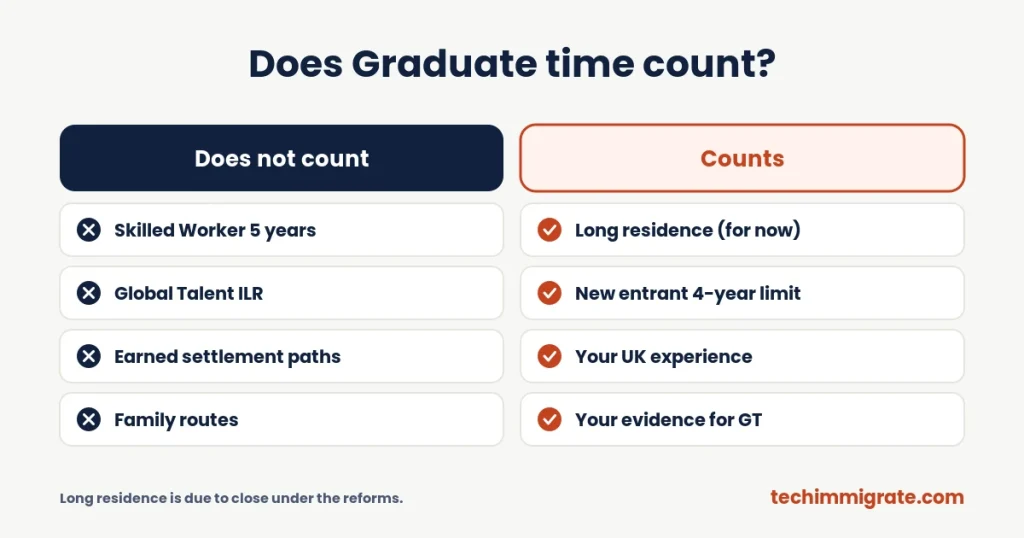
Does Graduate visa time count towards ILR? Not on Skilled Worker or Global Talent, only for long residence for now, and not under the proposed reforms.


In this article
- The Short Answer
- Why the Graduate Visa Does Not Count on Work Routes
- The Long Residence Exception
- What the Earned Settlement Reforms Say
- Where Graduate Visa Time Does Count: New Entrant Salaries
- Why This Matters for Tech Graduates
- Strategies to Start Your Settlement Clock Early
- Is It Worth Using the Full Graduate Visa?
- From Graduate Visa to Global Talent
- Continuous Residence Starts to Matter When You Switch
- Your Partner and Graduate Visa Time
- A Planning Timeline for Graduates
- A Worked Example: Switching Early
- A Worked Example: Counting on Long Residence
- A Worked Example: A Graduate Founder
- A Worked Example: A Late Switch
- Questions to Ask Yourself
- How Other Temporary Routes Compare
- What the Reforms Mean for International Students
- Getting the Most From Your Graduate Years
- Common Misunderstandings
- Make Your Time Count
- How We Checked This Article
If you are on a Graduate visa, one of the most important questions for your future is whether the time counts towards indefinite leave to remain (ILR). The short answer is that, for the routes most tech graduates use, it does not. Time on the Graduate visa does not count towards the 5-year qualifying period on Skilled Worker, and it does not count towards the Global Talent qualifying period either. Under the government's earned settlement proposals, it would not count towards settlement at all.
There is one exception under the current rules: the 10-year long residence route, which counts lawful residence on almost any visa, including Graduate. But the government has said that route will close. This guide explains exactly how Graduate visa time is treated for settlement, why it matters, how the reforms change the picture, and what tech graduates can do to start their settlement clock as early as possible.
Key takeaways
- Time on the Graduate visa does not count towards the 5-year qualifying period for ILR on the Skilled Worker route.
- It does not count towards the qualifying period for ILR on the Global Talent route.
- Under the current rules, it can count towards the 10-year long residence route, as lawful residence, but the earned settlement response says that route will close.
- Under the earned settlement proposals published on 2 November 2026, time on the Graduate route would not count towards settlement.
- Graduate visa time does count towards the 4-year limit on new entrant salaries for Skilled Worker.
- The way to start your settlement clock is to switch to a route that leads to settlement, such as Skilled Worker or Global Talent, as early as you can.
The Short Answer
| Settlement route | Does Graduate visa time count? |
|---|---|
| Skilled Worker (5 years under current rules) | No |
| Global Talent (3 or 5 years under current rules) | No |
| Innovator Founder | No |
| Family routes | No |
| Long residence (10 years, current rules) | Yes, as lawful residence, but the route is due to close |
| New earned settlement framework (proposed) | No |
Why the Graduate Visa Does Not Count on Work Routes
The Graduate visa was designed as a short, post-study period to let international graduates gain work experience. It is not a settlement route. The Immigration Rules for work routes such as Skilled Worker and Global Talent specify which routes count towards their qualifying periods, and the Graduate route is not one of them.
The same applies to other non-settlement routes, such as the Student visa, the High Potential Individual visa and visitor visas.
This means that if you spend 2 years on a Graduate visa and then 5 years on a Skilled Worker visa, you will usually reach ILR after the 5 years on Skilled Worker, not after 5 years in total. Your total time in the UK will be 7 years plus your study period.
The Long Residence Exception
Under the current rules, the long residence route lets people apply for ILR after 10 years of continuous lawful residence in the UK. Lawful residence includes time on almost any visa, including Student and Graduate visas. For international students who stayed on to work, this has often been the fastest route to settlement, because it counts their study and Graduate years.
For example, someone who spent 4 years studying, 2 years on a Graduate visa and 4 years on Skilled Worker would have 10 years of lawful residence, even though they only had 4 years on Skilled Worker.
However, the government's response to the earned settlement consultation, published on 2 November 2026, says the long residence route will close. No closing date has been confirmed in the material published so far. Our guide to ILR through long residence explains the current rules and what the closure means.
What the Earned Settlement Reforms Say
Under the earned settlement proposals, a new framework will replace the current qualifying periods:
- a 10-year default qualifying period;
- a 5-year path for people earning at least £50,271 in three of the last five years;
- a 3-year path for people earning at least £125,141 in three of the last four years, or in the highest talent group;
- a 20-year path in some cases.
The response lists routes whose time will not count towards settlement under the new framework, including Graduate, High Potential Individual, Student, visitor, Global Business Mobility, temporary worker and youth mobility routes. So under the proposals, Graduate visa time would not count at all, and the long residence route that currently counts it would close.
The changes are expected to be implemented over 2027. Our guide to the new indefinite leave to remain rules explains the full package.
Where Graduate Visa Time Does Count: New Entrant Salaries
There is one area where Graduate visa time is counted, and it can work against you. If you switch to Skilled Worker as a new entrant, you can be paid 70% of the going rate, with a minimum of £33,400. But your total stay on the new entrant basis cannot be more than 4 years, including any time on a Graduate visa.
So if you spend 2 years on a Graduate visa, you only have 2 more years on new entrant rates before you must meet the full going rate, such as £54,700 for software developers. Our guide to the new entrant Skilled Worker rules explains the details.
Why This Matters for Tech Graduates
Because Graduate visa time does not count towards settlement on work routes, every month you spend on it is a month that does not move you closer to ILR. For tech graduates who want to settle in the UK, this has practical consequences:
- Switching early starts your clock sooner. A graduate who switches to Skilled Worker after 6 months on a Graduate visa starts their settlement clock 18 months earlier than one who waits the full 2 years.
- Using the full Graduate visa has trade-offs. It gives you flexibility to try different roles or build a start-up, but delays your settlement.
- The long residence safety net is going. Graduates who were counting on reaching 10 years of lawful residence may need a new plan.
Strategies to Start Your Settlement Clock Early
Switch to Skilled Worker as soon as you have a suitable offer
If you find a sponsored role you are happy with, switching early starts your 5-year clock under the current rules, or your earnings-based path under the reforms. You can switch from inside the UK at any time while your Graduate visa is valid. Our guide to switching to a Skilled Worker visa explains the process.
Build towards Global Talent
If you are building a strong profile, through a start-up, open-source work or recognised achievements, Global Talent under exceptional promise could give you a settlement route without a sponsor. Under the current rules, exceptional promise leads to ILR after 5 years, and exceptional talent after 3. Under the reforms, recognised talent is expected to keep a shorter path. Our guide to switching to the Global Talent visa explains how.
Check whether long residence still works for you
If you have already spent many years in the UK on Student and Graduate visas, check whether you could reach 10 years of lawful residence before the long residence route closes. This depends on your exact history and the closing date, which has not yet been confirmed.
Keep your earnings in mind
Under the reforms, earnings will decide the length of most settlement paths. If you switch to Skilled Worker on a new entrant salary, plan for salary growth towards £50,271, which could mean a 5-year path rather than 10.

Is It Worth Using the Full Graduate Visa?
Switching early is not always the right answer. The Graduate visa offers freedoms that Skilled Worker does not: you can work for any employer, at any salary, be self-employed and start a business. Using it fully can make sense if:
- you want to try different roles or companies before committing to a sponsor;
- you are building a start-up that cannot yet sponsor you;
- you are building evidence for Global Talent, which could give you a better long-term route;
- you have not yet found an employer willing to sponsor you at a salary you are happy with.
The trade-off is time. Every month on the Graduate visa delays your settlement clock and uses up new entrant time. Weigh the freedom against the delay, and make a deliberate choice rather than drifting.
From Graduate Visa to Global Talent
For tech graduates with standout achievements, the Graduate visa can be a launchpad for Global Talent. Exceptional promise is designed for people early in their careers who show potential to become leaders in digital technology. Evidence might include:
- founding a start-up that has gained users, revenue or investment;
- open-source work with real adoption;
- winning recognised competitions or hackathons;
- publishing research or speaking at recognised events;
- recognition from experts in the field, through strong recommendation letters.
If you are building towards Global Talent, start gathering evidence from the first month of your Graduate visa, and apply well before it expires. Global Talent time counts towards settlement under the current rules, and recognised talent is expected to keep a shorter path under the reforms.
Continuous Residence Starts to Matter When You Switch
Once you switch to a settlement route, your absences from the UK start to matter. On most work routes, you must not spend more than 180 days outside the UK in any 12-month period during your qualifying period. Absences during your Graduate visa do not usually affect work-route settlement, but they may matter for long residence while that route remains open. Keep a record of your travel from the start, just in case.
Your Partner and Graduate Visa Time
If your partner is with you as a dependant on your Graduate visa, their time does not count towards settlement on work routes either. When you switch to Skilled Worker, they can switch to being your dependant on that route, and their qualifying period usually starts from their grant as a Skilled Worker dependant. Under the reforms, partners who arrive with the main applicant on a settlement route are expected to be able to settle at the same time.
A Planning Timeline for Graduates
- Month 0: Graduate visa granted. Note the end date and how much new entrant time you will have left.
- Months 1 to 3: decide your target route: Skilled Worker, Global Talent or another.
- Months 3 to 9: gain experience, build your profile, and apply for sponsored roles if Skilled Worker is your goal.
- Month 12 at the latest: aim to switch, especially if you have an 18-month visa.
- At least 3 months before expiry: apply to switch, allowing up to 8 weeks for a decision.
A Worked Example: Switching Early
A software engineering master's graduate gets a 2-year Graduate visa in late 2026.
- Option A: she uses the full 2 years, then switches to Skilled Worker in late 2028. Under the current rules, she could settle in late 2033.
- Option B: she switches to Skilled Worker after 6 months, in mid-2027. Under the current rules, she could settle in mid-2032.
Switching early brings her potential settlement date forward by 18 months. Under the reforms, if her salary rises above £50,271, she could still be on a 5-year path from her Skilled Worker start date.
A Worked Example: Counting on Long Residence
A data scientist arrived as an undergraduate in 2018, completed a master's and PhD, spent time on a Graduate visa, and moved to Skilled Worker in 2025.
- By 2028, he will have 10 years of lawful residence.
- Under the current rules, he could apply for ILR through long residence in 2028, even though he has only 3 years on Skilled Worker.
- If the long residence route closes before 2028, he would need to rely on Skilled Worker settlement under the new framework, which would not count his Student or Graduate years.
He keeps a close eye on the closing date, keeps his absences low, and also explores whether his research record could support a Global Talent application.
A Worked Example: A Graduate Founder
A computer science graduate gets an 18-month Graduate visa in early 2027 and co-founds a developer tools start-up.
- In the first 9 months, the product gains thousands of active users and the company raises a pre-seed round.
- He speaks at two recognised developer conferences and gets strong letters from a well-known founder and an investor.
- In month 12, he applies for Global Talent under exceptional promise and is endorsed.
- He switches from his Graduate visa to Global Talent before it expires.
His Graduate visa time does not count towards settlement, but his Global Talent time does. Under the current rules, exceptional promise leads to ILR after 5 years, and under the reforms, recognised talent is expected to keep a shorter path.
A Worked Example: A Late Switch
A UX designer uses her full 2-year Graduate visa, working for two small agencies and freelancing. In the final 3 months, she looks for a sponsor.
- She finds an employer willing to sponsor her, but her new entrant time is nearly used up, because her 2 years on the Graduate visa count towards the 4-year limit.
- She has only 2 years left at the new entrant rate before she must meet the full going rate of £43,800 for her occupation.
- Her settlement clock only starts when she switches.
With hindsight, switching earlier would have given her more new entrant time and an earlier settlement date. But the freelance experience helped her build a portfolio, which she plans to use for a future Global Talent application.
Questions to Ask Yourself
- Is settling in the UK a priority for me, or am I still deciding?
- If settling is a priority, what is the earliest point I could switch to a settlement route?
- Am I building evidence for Global Talent, and how long will that take?
- How much new entrant time will I have left if I switch at different points?
- Could long residence still work for me before it closes, given my history?
How Other Temporary Routes Compare
The Graduate visa is not alone. Several UK routes give permission to live and work for a period without counting towards work-route settlement:
- High Potential Individual: 2 years, or 3 for PhD graduates, with no sponsor. It does not count towards work-route settlement and, under the proposals, would not count under the new framework.
- Student visa: study time does not count towards work-route settlement, though it currently counts as lawful residence for long residence.
- Global Business Mobility: intra-company transfers do not lead to settlement on their own.
- Youth Mobility Scheme, including the India Young Professionals Scheme: up to 2 or 3 years, with no settlement.
If you are on any of these routes and want to settle, the principle is the same: move to a settlement route as early as makes sense for you.
What the Reforms Mean for International Students
For international students planning a UK career, the earned settlement proposals change the calculation. Under the current rules, a student who stayed long enough on a mix of visas could rely on long residence. Under the proposals, only time on settlement routes would count, and the length of the path would depend on earnings. In practice, this means:
- the years you spend studying and on the Graduate visa are best seen as preparation, not progress towards settlement;
- the route you move to after graduating, and your salary on that route, will decide how long it takes to settle;
- recognised talent routes, such as Global Talent, may offer the shortest path for those who qualify.
The changes are expected to be implemented over 2027, so check the final rules as they are published.
Getting the Most From Your Graduate Years
Even though Graduate visa time does not count towards work-route settlement, it can still move you forward in other ways. Use it to:
- gain UK work experience and references that make you more attractive to sponsors;
- build a public track record, such as open-source contributions, talks and writing, that could support a Global Talent application;
- try different types of company, from start-ups to large employers, before choosing where to settle;
- build savings for future visa fees, health surcharge and, eventually, the ILR fee;
- pass the Life in the UK test early, because the pass does not expire.
Graduates who treat these years as an investment usually find the later stages of their immigration journey much smoother.
Common Misunderstandings
- "My Graduate visa time counts towards my 5 years on Skilled Worker." It does not.
- "Total time in the UK is what matters." For work routes, only time on qualifying routes counts. Total lawful residence matters only for long residence.
- "Long residence will always be available." The government has said it will close.
- "The reforms will count all my time." Under the proposals, Graduate visa time would not count.
- "Graduate time does not affect anything else." It counts towards the 4-year new entrant limit.
Not towards work-route settlement, such as Skilled Worker or Global Talent. Under the current rules, it can count towards the 10-year long residence route, but that route is due to close.
No. Only time on Skilled Worker and certain other qualifying routes counts.
Under the proposals, time on the Graduate route would not count towards settlement.
Under the current rules, yes, as lawful residence. But the earned settlement response says the long residence route will close.
Yes. It counts towards the 4-year limit on new entrant salaries.
Switch to a settlement route, such as Skilled Worker or Global Talent, as early as you can.
Make Your Time Count
The Graduate visa is a valuable bridge, but it does not move you towards settlement on the routes most tech graduates use, and under the reforms it would not count at all. If settling in the UK is your goal, plan your switch early. If you are building a strong profile in tech, our role-specific Global Talent guides explain how to build an application Tech Nation will endorse.
How We Checked This Article
We checked the treatment of Graduate visa time against GOV.UK's Graduate visa pages, Skilled Worker settlement page and long residence page in November 2026. Earned settlement proposals, including the list of routes that would not count, are from law firm summaries of the government's response of 2 November 2026.
Tech Immigrate is independent of the Home Office. This article is general information, not legal advice. Check GOV.UK before you apply.
We write practical guides for tech professionals applying for the UK Global Talent visa. Tech Immigrate is independent of Tech Nation and the Home Office, and our articles are general information, not legal advice. Rules and fees change, so always check gov.uk before you apply.


