Innovator Founder vs Global Talent: Which Visa for Startup Founders?
Innovator Founder or Global Talent visa? A comparison for tech founders: what is assessed, costs, freedom if your startup fails, and settlement.

In this article
- The Core Difference
- Innovator Founder: How It Works
- Global Talent: How It Works for Founders
- Which Founders Fit Which Route?
- What Happens If Your Startup Fails?
- Pivots and Co-Founders
- Fundraising and Hiring
- Using Both Routes
- Three Founder Profiles
- Preparing a Tech Nation Application as a Founder
- Your Family on Each Route
- Taking Other Work Alongside Your Startup
- Settlement Reforms and Founders
- Side-by-Side Cost Example: Three Years
- How Long Each Route Takes
- Questions to Ask Yourself
- Raising Investment on Each Route
- Common Mistakes Founders Make
- Frequently Asked Questions
- Build the Case for You, Not Just Your Business
- How We Checked This Article
If you are a startup founder planning to build a company in the UK, two visas are designed with people like you in mind: the Innovator Founder visa and the Global Talent visa. Both avoid employer sponsorship, both can lead to settlement in 3 years, and both involve an endorsing body judging you before the Home Office grants a visa. But they judge very different things. Innovator Founder judges your business. Global Talent judges you.
This guide compares the two routes for tech founders: what each endorsing body assesses, what each costs, how much freedom each gives you, what happens if your startup fails or pivots, and how settlement works. It ends with a practical way to decide, and with the option many founders overlook: using both routes at different stages.
Key takeaways
- Innovator Founder is a business visa. An approved endorsing body must judge your business idea innovative, viable and scalable, and you must stay focused on that business.
- Global Talent is a talent visa. Tech Nation judges whether you are a leader or emerging leader in digital technology. Your business is evidence, not a condition.
- Innovator Founder costs £1,357 from outside the UK, plus a £1,000 endorsement fee and £500 for each of at least two contact point meetings. Global Talent costs £561 plus £205. Both pay the health surcharge.
- Innovator Founder grants are for 3 years. Global Talent grants are 1 to 5 years, your choice.
- Both can lead to settlement after 3 years, but Innovator Founder settlement depends on your business meeting performance criteria, while Global Talent depends on your endorsement level and earnings in your field.
- If your startup fails or you want to change direction, Global Talent gives far more security.
The Core Difference
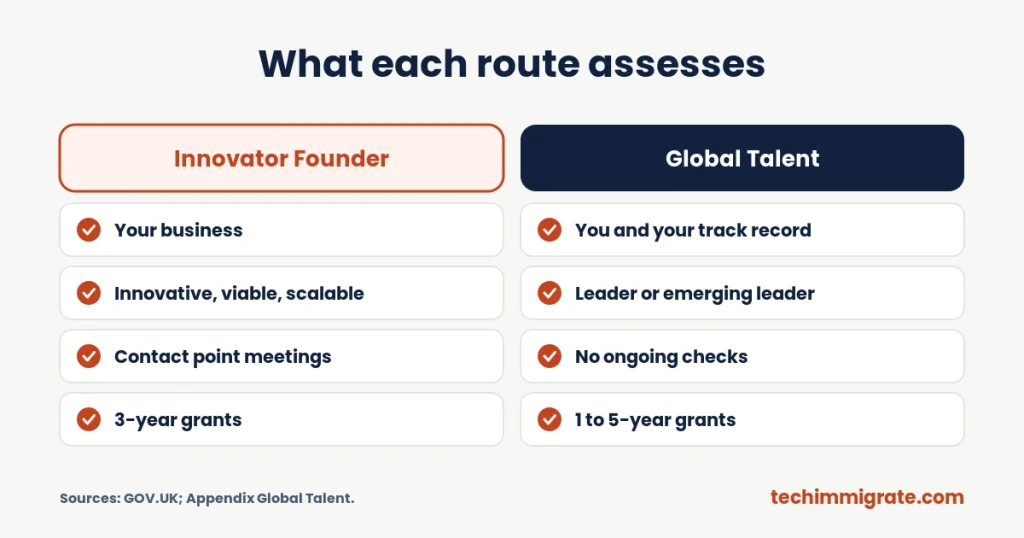
| Innovator Founder | Global Talent | |
|---|---|---|
| Who is assessed | Your business | You |
| Endorsing body | An approved Innovator Founder endorsing body | Tech Nation (for digital technology) |
| Main test | Innovative, viable, scalable business | Leader or emerging leader in digital technology |
| Can you have an existing track record? | Not required; new ideas welcome | Required; recognition is the core of the test |
| Tied to the business | Yes | No |
| Ongoing checks | Contact point meetings with your endorsing body | None |
| Visa length | 3 years per grant | 1 to 5 years per grant |
| Settlement | After 3 years, if business criteria met | After 3 years (Exceptional Talent) or 5 years (Exceptional Promise) |
Innovator Founder: How It Works
The Innovator Founder visa replaced the earlier Innovator and Start-up routes in 2023. To get it, you need an endorsement from an approved endorsing body. The list of approved bodies changes from time to time; check GOV.UK before you choose one.
The endorsing body assesses whether your business is:
- innovative: a genuine, original business plan that meets new or existing market needs and creates a competitive advantage;
- viable: with realistic plans, based on your skills, experience and market awareness;
- scalable: with potential for job creation and growth into national and international markets.
There is no fixed minimum investment requirement for new applicants under the current rules, but you must show you can support the business plan and meet the maintenance requirement. English at B2 is required.
Once endorsed and granted, you must focus on the business. You meet your endorsing body at contact points, at least twice during your visa, to show progress. Each meeting costs £500. If the business stops being viable, or you lose your endorsement, your permission can be at risk.
Innovator Founder settlement
You can apply for settlement after 3 years if the business meets settlement criteria and your endorsing body confirms it. Advisers describe this as needing to meet at least two of a set of defined business achievements, covering things like investment, revenue, jobs created and growth. Settlement on this route is therefore tied to the success of one business.
Innovator Founder costs
| Cost | Amount |
|---|---|
| Endorsement (paid to endorsing body) | £1,000 |
| Contact point meetings | £500 each, at least two |
| Visa application (outside the UK) | £1,357 |
| Visa application (switch or extend in the UK) | £1,693 |
| Immigration Health Surcharge | £1,035 per year |
Over a 3-year visa from outside the UK, one founder pays about £1,000 + £1,000 + £1,357 + £3,105 = £6,462, before any settlement endorsement costs. Endorsing body fees may attract VAT.
Global Talent: How It Works for Founders
For founders in digital technology, Global Talent endorsement comes from Tech Nation. Tech Nation assesses you, not your business plan. Your company is evidence of your talent: its growth, funding, customers, product and the role you played.
Tech Nation looks for:
- the mandatory criterion: recognition as a leading talent or emerging leader in digital technology;
- at least two of four optional criteria, of which two are especially relevant to founders: innovation as a founder of a product-led company, and significant technical, commercial or entrepreneurial contributions.
Once you hold Global Talent, there are no contact points, no business plan to follow and no obligation to stay with any company. You can run your startup, close it, start another, take a job, or do several things at once.
Global Talent costs
| Cost | Amount |
|---|---|
| Endorsement (Stage 1) | £561 |
| Visa (Stage 2) | £205 |
| Immigration Health Surcharge | £1,035 per year |
Over a 3-year visa, one founder pays £561 + £205 + £3,105 = £3,871.
Global Talent settlement
Under the current rules, Exceptional Talent holders can settle after 3 years and Exceptional Promise holders after 5. You must show you earned money in your field, meet the 180-day absence limit, pass the Life in the UK test and meet the English requirement. Your company does not have to hit growth targets. Our Global Talent ILR guide explains the requirements.
Which Founders Fit Which Route?
Innovator Founder suits you if
- you are starting a genuinely innovative business and do not yet have a strong personal track record;
- your idea is the strongest thing about your application;
- you are comfortable committing to one business and reporting progress;
- you can meet the B2 English requirement and maintenance funds.
Global Talent suits you if
- you have already built something with traction: a product with users, funding, revenue or a team;
- you have personal recognition beyond your company: press, talks, awards, accelerator selection, respected investors or advisers;
- you want freedom to pivot, close or start another venture without visa consequences;
- you want visa grants longer than 3 years.
Our article on the Global Talent visa for startup founders explains the evidence Tech Nation looks for, and our startup founders guide goes deeper.
What Happens If Your Startup Fails?
This is the question that separates the two routes most clearly. Most startups fail or change direction.
On Innovator Founder, your permission is linked to your endorsed business. If it fails, you may need a new endorsement for a new business, or switch to another route. If your endorsement is withdrawn, the Home Office can cut your permission short. Your settlement depends on your business meeting performance criteria, so a failed venture usually resets your settlement plans.
On Global Talent, a failed startup has no direct effect on your visa. You can take a job, consult, or start again. Your settlement depends on your endorsement level, continuous residence and earnings in your field, not on any one company succeeding.
For founders who know how risky startups are, this is often decisive.
Pivots and Co-Founders
Pivots. On Innovator Founder, significant changes to your business may need to be agreed with your endorsing body. On Global Talent, you can pivot as often as you like.
Co-founders. On Innovator Founder, each founder needs their own endorsement and visa. On Global Talent, each founder also needs their own endorsement, but they are assessed on their own talent. A technical co-founder with strong engineering recognition might qualify for Global Talent while a business co-founder uses Innovator Founder, or the reverse.
Fundraising and Hiring
Investors care about founder visas because they affect risk. A founder on Global Talent can stay in the UK whatever happens to the company, which some investors see as lower risk. A founder on Innovator Founder must keep the endorsed business on track.
For hiring, both routes let you build a team. If you want to sponsor international hires on Skilled Worker visas, your company will need its own sponsor licence either way.
Using Both Routes
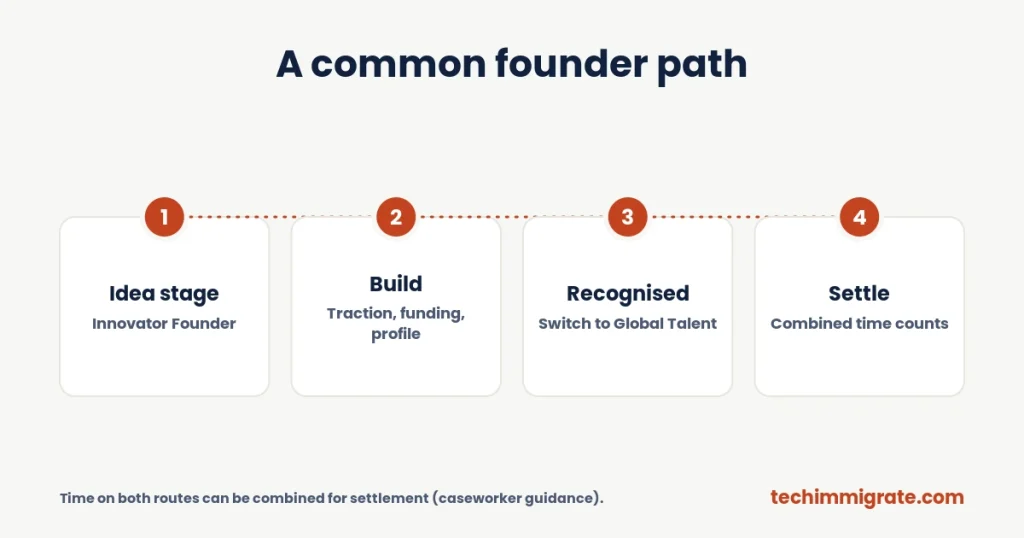
Many founders use the two routes in sequence:
- Start on Innovator Founder with a strong business idea but limited personal recognition.
- Build the company and your profile: raise funding, win customers, speak at events, get press.
- Apply for Global Talent once you have recognised impact, switching from inside the UK.
The Home Office caseworker guidance confirms that time on certain routes, including Innovator Founder, can be combined with Global Talent towards settlement. That means switching does not necessarily reset your settlement clock. Our guide to switching to Global Talent inside the UK explains how.
The reverse also happens: some Global Talent holders never need Innovator Founder at all, because Global Talent already allows them to start companies.
Three Founder Profiles
These illustrative profiles show how the decision usually plays out.
A first-time founder with a novel climate-tech idea and a prototype. Strong idea, early technical work, no funding yet and little public profile. Tech Nation would struggle to see recognition as a leader. Innovator Founder fits: the endorsing body assesses the idea, viability and scalability. Plan to build traction and personal profile, then consider Global Talent later.
A second-time founder whose first startup was acquired. The founder has a track record of building and selling a company, press coverage and respected investors willing to write letters. Global Talent as Exceptional Talent fits well: no business plan to follow, freedom to explore several ideas, and settlement after 3 years under the current rules.
A technical co-founder at a funded seed-stage startup. The co-founder built the product, which has thousands of users, has spoken at engineering conferences and maintains an open-source library. The business co-founder has less public profile. The technical co-founder may qualify for Global Talent, while the business co-founder considers Innovator Founder or builds evidence first. Each is assessed on their own case.
Preparing a Tech Nation Application as a Founder
Founders often struggle with Tech Nation not because they lack achievements, but because they present them as company achievements. Tech Nation needs to see your personal role. Approaches applicants report working well:
- Lead with traction you drove. Revenue, users, funding and growth, with your role made explicit: you built the product, closed the round, or led the go-to-market.
- Use external validation. Investors, accelerators, awards, press, enterprise customers and partners are all forms of recognition outside your own company.
- Choose referees outside the company. Investors, board members, respected founders or customers who know your work make stronger letters than your own employees.
- Show the product. Screenshots, metrics dashboards with dates, app store listings and customer case studies, as documents rather than links.
- Explain the innovation. What is new about what you built, and how it changed things for users or the market.
Our article on why startup founders get refused Global Talent endorsement covers the common pitfalls, and our article on the Tech Nation startup founder route explains why a successful business alone is not enough.
Your Family on Each Route
Both routes let your partner and children join you as dependants, and partners can work. On both, dependants pay visa fees and the health surcharge. On Global Talent, GOV.UK lists no financial requirement for dependants, while Innovator Founder applicants must show maintenance funds for themselves and their family when applying from outside the UK or within their first year. Under the current Global Talent rules, dependants usually need 5 years to settle even if the main applicant settles at 3. Our article on Global Talent dependants explains the details.
Taking Other Work Alongside Your Startup
Founders often need income while the startup grows. On Global Talent, you can take any job, contract or consulting work alongside your company. On Innovator Founder, your main focus must be your endorsed business; other employment is more limited. If you expect to need a part-time job or consulting income, check the Innovator Founder conditions carefully before choosing it.
Settlement Reforms and Founders
The government's earned settlement response of 2 November 2026 keeps a 3-year settlement path for a "Highest Talent Group" that commentators expect to include Global Talent and Innovator Founder holders, subject to Migration Advisory Committee advice. It also proposes new requirements for everyone, such as no debts to public bodies and sustained earnings. Founders who pay themselves little in the early years should watch how earnings tests develop during 2027.
Side-by-Side Cost Example: Three Years
| Cost for one founder, 3-year visa from outside the UK | Innovator Founder | Global Talent |
|---|---|---|
| Endorsement | £1,000 | £561 |
| Contact point meetings | £1,000 (two) | £0 |
| Visa fee | £1,357 | £205 |
| Health surcharge | £3,105 | £3,105 |
| Total | £6,462 | £3,871 |
Endorsing body fees may also attract VAT. Partners and children add visa fees and health surcharge on both routes.
How Long Each Route Takes
| Stage | Innovator Founder | Global Talent |
|---|---|---|
| Preparation | Business plan, financial model, market research | CV, statement, 3 letters, up to 10 evidence documents |
| Endorsement | Depends on the endorsing body; check its published timescales | Applicants report 5 to 8 weeks with Tech Nation |
| Visa decision from outside the UK | Usually about 3 weeks | Usually about 3 weeks |
| Visa decision inside the UK | Usually about 8 weeks | Usually about 8 weeks |
| Ongoing obligations | Contact point meetings during your visa | None |
| Typical grant | 3 years | 1 to 5 years |
The preparation is very different in character. Innovator Founder rewards a strong, credible business plan. Global Talent rewards a strong record of what you have already done.
Questions to Ask Yourself
Before choosing, answer these honestly:
- Is my strongest asset my idea or my track record? Idea points to Innovator Founder; track record points to Global Talent.
- Would respected people outside my company write detailed letters about my leadership? If yes, Global Talent is realistic.
- How likely is it that this specific business will change significantly in the next three years? The more likely, the more Global Talent's flexibility matters.
- Will I need income from other work? If yes, Global Talent is more flexible.
- How important is a long visa grant? Global Talent allows up to 5 years at once.
- Am I willing to report to an endorsing body? Innovator Founder requires contact point meetings.
- What happens to my family if the business fails? On Global Talent, nothing changes for your visa.
If most answers point the same way, the choice is usually clear. If they are mixed, starting on Innovator Founder and switching later is a common and sensible plan.
Raising Investment on Each Route
Neither route requires you to raise a set amount of investment to get your visa under the current rules. But investment plays a different role on each.
On Innovator Founder, funding is part of showing your business is viable and scalable, and investment raised can count towards the business achievements used at settlement. Your endorsing body will look at your funding progress at contact points.
On Global Talent, funding from respected investors is evidence of recognition. A round led by a well-known fund, or selection into a competitive accelerator, can support both the mandatory criterion and the optional criteria about innovation and commercial contribution. Letters from investors who know your work can be strong referees.
On both routes, be careful with how you describe funding. State amounts, dates and investors accurately, and include documents such as term sheets, announcements or Companies House filings, rather than claims alone.
Common Mistakes Founders Make
- Choosing Innovator Founder by default when your personal track record would qualify for Global Talent.
- Applying to Tech Nation with a business plan instead of evidence of what you have already achieved.
- Relying on company success without showing your personal role in it.
- Underestimating how tied Innovator Founder is to one business.
- Not planning for failure or pivots.
- Ignoring the switch: starting on Innovator Founder and never revisiting Global Talent once the company has traction.
Frequently Asked Questions
Global Talent gives more freedom and costs less, but requires personal recognition. Innovator Founder suits founders with a strong new idea but limited track record. Many founders use Innovator Founder first and switch to Global Talent later.
Yes. You can found, run and close companies without any endorsing body approval.
Your permission is linked to the endorsed business, so you may need a new endorsement or another route. On Global Talent, a failed startup has no direct effect on your visa.
£1,357 from outside the UK, plus £1,000 for endorsement and £500 for each of at least two contact point meetings, plus the health surcharge.
Yes, under the current rules. Innovator Founder settlement depends on your business meeting performance criteria; Global Talent depends on your endorsement level and earnings in your field.
Yes, once endorsed by Tech Nation. Time on both routes can be combined towards settlement, according to the caseworker guidance.
Neither route sets a fixed investment requirement for new applicants under the current rules. Funding can help show viability for Innovator Founder and recognition for Global Talent.
Yes. Each founder needs their own visa and is assessed separately, so co-founders sometimes use different routes.
No. Tech Nation assesses you and your track record. Your company is evidence of your talent.
Build the Case for You, Not Just Your Business
If your startup already has traction, the question is whether your personal role and recognition are strong enough for Tech Nation. Our startup founders guide shows how founders present company evidence as personal leadership, so you can choose the route that gives you the most freedom.
Whichever route you choose, give yourself enough time to prepare properly. Both Innovator Founder and Global Talent reward careful, well-evidenced applications, and both are harder to fix after a refusal than to get right the first time.
How We Checked This Article
We checked the rules against GOV.UK's Innovator Founder visa and Global Talent visa pages, Appendix Global Talent and the Home Office Global Talent caseworker guidance, in November 2026. Innovator Founder fees reflect the Home Office fee schedule from 8 April 2026 and published endorsing body charges reported by law firms. Settlement criteria for Innovator Founder are summarised from adviser commentary; check the current rules before relying on them. The settlement reform section draws on the government's earned settlement response (2 November 2026).
Tech Immigrate is independent of Tech Nation, the Innovator Founder endorsing bodies and the Home Office. This article is general information, not legal advice.
We write practical guides for tech professionals applying for the UK Global Talent visa. Tech Immigrate is independent of Tech Nation and the Home Office, and our articles are general information, not legal advice. Rules and fees change, so always check gov.uk before you apply.