Global Talent Visa From Kenya: A Guide for Kenya-Based Tech Professionals
Applying for the UK Global Talent visa from Kenya: what Tech Nation needs, presenting mobile-first innovation, outsourcing roles, the TB test and fees.


In this article
- What Tech Nation Needs to See
- Why Global Talent Rather Than a Sponsored Visa?
- The Process From Kenya
- Presenting Innovation From Kenya
- Product Roles, Outsourcing and Remote Work
- Communities and Ecosystem Leadership
- Examples of Strong Evidence by Role
- Open Source and Technical Writing
- Letters of Recommendation
- Exceptional Talent or Exceptional Promise?
- Writing Your Personal Statement
- Costs
- Research and Academia
- Choosing Your Strongest 10 Documents
- A Six-Month Plan if You Are Not Ready
- Helping Assessors Understand Kenyan Companies
- Talking to UK Employers
- Applying From Outside Kenya
- Common Mistakes Applicants Report
- A Realistic Timeline
- Bringing Your Family and Settling In
- Frequently Asked Questions
- Turn Innovation Into Evidence
- How We Checked This Article
Kenya's reputation as a tech hub is well earned. Nairobi's ecosystem helped pioneer mobile money, built some of Africa's best-known startups, and developed strong communities of engineers, product people, designers and data scientists. For Kenya-based tech professionals who want to work in the UK, the Global Talent visa is often the most flexible option, because it depends on your track record rather than a UK employer's sponsorship.
This guide is for tech professionals applying for the UK Global Talent visa from Kenya, whatever passport they hold. It covers what Tech Nation needs to see, how to present innovation from Kenya's mobile-first and infrastructure-heavy tech scene, how outsourcing and remote roles fit in, and the practical steps of applying from Kenya, including the tuberculosis test.
Key takeaways
- You can complete both Global Talent stages from Kenya: endorsement by Tech Nation through GOV.UK, then the visa within 3 months.
- Tech Nation looks for recognition as a leader or emerging leader in digital technology, plus at least two of four optional criteria. Where you worked does not matter; what you achieved and who recognised it does.
- Kenya's strengths, such as mobile money, mobile-first products, connectivity and logistics solutions, can be powerful evidence of innovation when your personal role is clear.
- Outsourcing and business process roles are harder to present than product roles, according to applicant reports.
- People who have lived in Kenya for 6 months or more and are applying for a UK visa of more than 6 months need a tuberculosis test certificate from an approved clinic.
- Government fees are £561 for endorsement, £205 for the visa and £1,035 a year for the health surcharge.
What Tech Nation Needs to See
Before looking at anything specific to Kenya, it helps to be clear about the test. Tech Nation assesses whether you are:
- a leader in digital technology (Exceptional Talent), usually with sustained recognition over recent years; or
- an emerging leader (Exceptional Promise), earlier in your career but already showing clear potential.
You must meet the mandatory criterion, recognition as a leading or emerging talent, and at least two optional criteria:
- innovation, for example in a product-led company or a new product;
- recognition for work beyond your occupation that advances the field;
- significant technical, commercial or entrepreneurial contributions;
- academic contributions through research endorsed by experts.
You submit a CV, a personal statement, three letters of recommendation and up to 10 pieces of evidence. Each optional criterion needs its own evidence. Our article on Global Talent visa criteria explains each one in detail.
Why Global Talent Rather Than a Sponsored Visa?
The main alternative for most tech professionals is the Skilled Worker visa. It needs a job offer from a UK employer with a sponsor licence, at a salary of at least £41,700 or the going rate for your occupation if higher. For software developers, the going rate is £54,700. You must also show English at B2 as a new applicant, and your visa is tied to that employer.
Global Talent avoids all of that. There is no job offer, no sponsor, no salary threshold and no English test at entry. You can work for any employer, start a company, freelance or keep working remotely for an international company. Under the current rules, Exceptional Talent holders can settle after 3 years. The catch is the endorsement: Tech Nation refused most applications it decided in 2025, according to Freedom of Information figures reported by Edgewater Legal. Our Global Talent vs Skilled Worker comparison explains the trade-offs.
The Process From Kenya
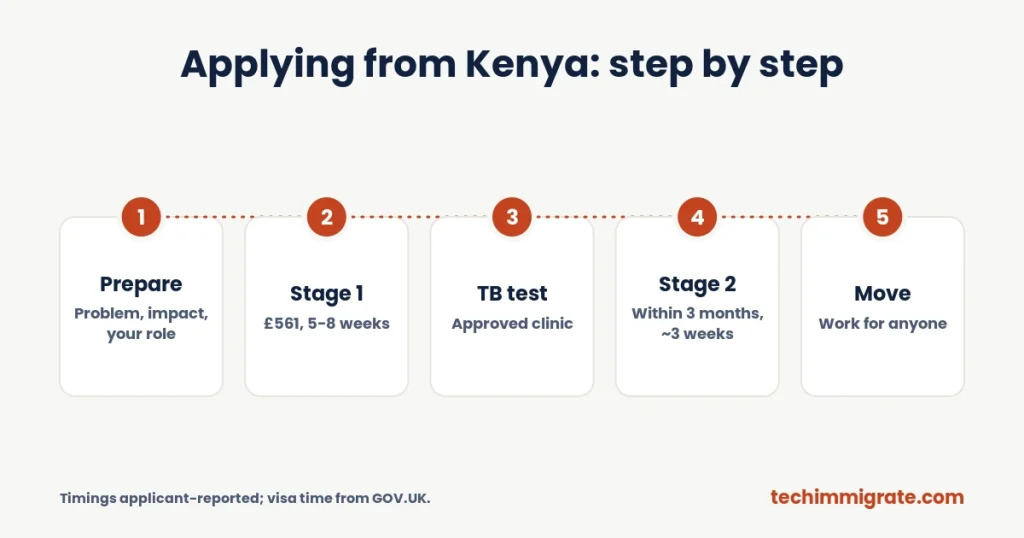
Stage 1. Apply on GOV.UK, type your personal statement into the form, pay £561, and email your documents to the Home Office for referral to Tech Nation. Applicants report most decisions within 5 to 8 weeks.
Stage 2. Within 3 months of endorsement, apply for the visa online, pay £205 and the health surcharge, prove your identity, and provide documents including your tuberculosis certificate. Decisions from outside the UK usually take about 3 weeks.
Tuberculosis test
Kenya is on the Home Office list of countries where a tuberculosis test is required for visas of more than 6 months. If you have lived in Kenya for 6 months or more, you need a certificate from a Home Office-approved clinic. Approved testing has been available in Nairobi, and Kenya also serves as a testing location for residents of some neighbouring countries. Check the current clinic list on GOV.UK, book early, and make sure the certificate is still valid when you apply.
Identity and visa application centre
You will either use the UK Immigration: ID Check app or attend a visa application centre for fingerprints and a photo, depending on your passport. A visa application centre has operated in Nairobi. Check the current details before booking.
Payments and documents
Fees are charged in pounds; check your card's international payment limits in advance, because the health surcharge for a 5-year visa is £5,175 on its own. Prepare all Stage 1 evidence as clear PDFs without web links, keeping each email under 25MB.
Presenting Innovation From Kenya
Kenya's tech scene is known for solving problems that larger markets had not faced in the same way: payments without traditional banking, services designed for basic phones, last-mile logistics, off-grid energy, agriculture, health access and identity. That is exactly the kind of innovation Tech Nation's first optional criterion is designed to recognise. To make it count:
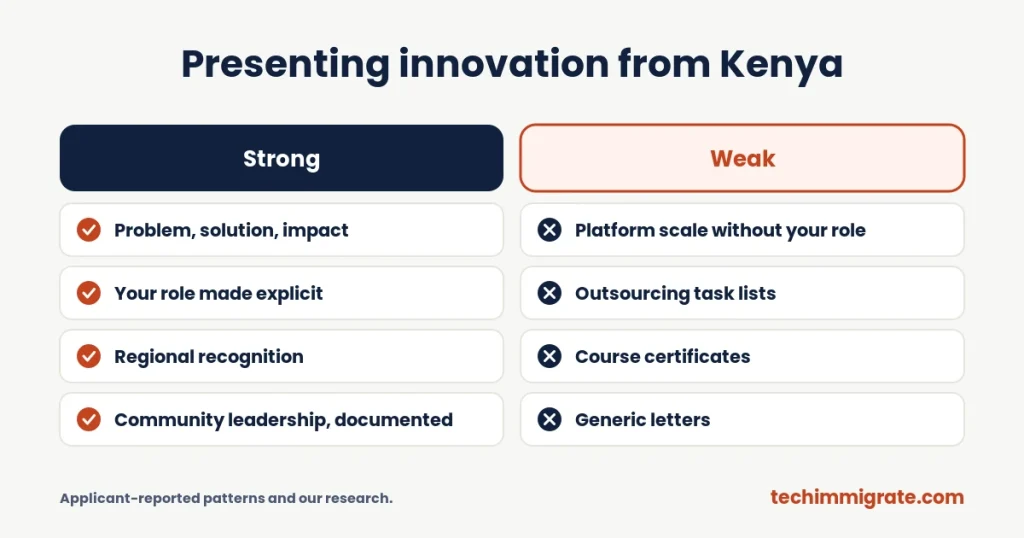
Explain the problem
Assessors may not know the context. Explain in one or two sentences what problem existed, who it affected and why existing solutions did not work.
Show what changed
Use numbers with sources: users served, transactions processed, cost or time saved, reliability improvements, expansion to new markets. A before-and-after comparison is often the clearest way to show impact.
Make your role explicit
Mobile money and other large platforms involve many people. Show what you personally designed, built, led or changed. Release notes, patents, internal-to-external launch announcements and letters from senior leaders help.
Show recognition
Coverage in recognised African and international technology and business media, awards, invitations to speak at major events, and adoption by other companies or countries are all recognition beyond your job.
Product Roles, Outsourcing and Remote Work
Kenya has a large and growing workforce in outsourcing, business process services and remote work for international companies. These roles can be a great career path, but applicants report that they are harder to present to Tech Nation than product roles, because the work is often confidential, team-based and owned by a client.
If your experience is in these areas:
- Find the innovation. Did you build tools, automation or platforms that changed how work was done? Did you lead a team that delivered something new?
- Get permission to share, or ask for letters confirming your role from senior people who saw your work.
- Build external recognition through talks, writing, open source and community leadership.
- Choose referees carefully, including senior people at client companies who used your work.
Remote work for international product companies can be very strong evidence if you show ownership of features, systems or products, and if your contribution is visible in public releases or announcements.
Communities and Ecosystem Leadership
Nairobi's tech ecosystem grew through innovation hubs, developer communities, incubators and training programmes. Leadership in these spaces, such as running a community, organising major events, mentoring founders or training developers at scale, can support both the mandatory criterion and the optional criterion about recognition beyond your occupation.
Keep evidence of:
- programmes you ran, with participant numbers and outcomes;
- events you organised or spoke at, with programmes and attendance;
- mentoring roles in recognised accelerators or initiatives;
- letters from partner organisations, sponsors or hub leaders.
Examples of Strong Evidence by Role
These illustrative examples show how common Kenyan career paths can become strong evidence.
- Backend engineer at a mobile money or fintech company. You designed a service that improved reliability or reduced transaction failures at scale. Evidence: documented results, a technical talk, a letter from the head of engineering, and press coverage of the product.
- Product manager for a mobile-first product. You launched a service for basic-phone users that reached a large audience. Evidence: launch announcements, adoption data, user research outcomes, recognition such as awards, and letters from leadership.
- Data scientist in agritech or health tech. You built models used to improve outcomes such as crop yields, credit access or diagnosis. Evidence: measurable impact, papers or technical reports, partnerships with recognised organisations, and expert letters.
- IoT or hardware engineer. You built connected devices for energy, water or logistics. Evidence: deployments, patents, awards, and coverage.
- Founder. Your company raised funding from recognised investors and serves customers in several markets. Evidence: funding announcements, revenue and customer data, press, and letters from investors. See our startup founders guide.
- Security specialist. You led security for a major platform or disclosed vulnerabilities responsibly. Evidence: talks at security events, acknowledgements, tools adopted by others. See our cybersecurity guide.
Open Source and Technical Writing
Open-source work and technical writing are two of the most effective ways to make Kenyan tech work visible internationally. For Global Talent, what matters is recognition: projects other people use, maintainers' roles, citations of your writing, and invitations that followed. Show adoption with screenshots of stars, downloads, dependent projects and contributors, rather than links. If your articles or tutorials are widely read or used in training programmes, include evidence of reach and any republication by respected outlets. Our guide on turning GitHub into Global Talent evidence explains how to present open-source work.
Letters of Recommendation
You need three letters from established experts in digital technology who know your work. Referees can be in Kenya, elsewhere in Africa, the UK or anywhere else. Strong options include founders and senior leaders of respected tech companies, investors, leaders of established hubs and communities, and senior academics for research-focused applicants.
Each letter must be written by the referee in their own words, with different, specific examples. Tech Nation's guidance says AI-written content within the application is not acceptable and that it may contact referees. See our guides on recommendation letters and choosing referees.
Exceptional Talent or Exceptional Promise?
If your recognition is recent and growing, Exceptional Promise is usually the right level; it leads to settlement after 5 years under the current rules. If you have sustained leadership recognised well beyond your company, such as founding or leading a major platform, Exceptional Talent may fit and leads to settlement after 3 years. Our comparison of Exceptional Talent and Exceptional Promise explains how to choose.
Writing Your Personal Statement
Your statement is typed into the GOV.UK form, in your own words. A structure that works well for applicants from Kenya:
- Who you are and your area of digital technology.
- The problems your work addresses, in brief.
- Your strongest achievements, each linked to numbered evidence.
- How you meet the mandatory criterion and each optional criterion you claim.
- What you plan to do in the UK.
Use specific facts and numbers rather than adjectives. Avoid long descriptions of your employer; the statement is about you. If your work spans several countries, say so clearly, because regional reach is a sign of influence beyond a single market. Tech Nation's guidance says AI-generated content within the application is not acceptable, so write it yourself. Our personal statement guide has more detail.
Costs
| Cost | Single applicant, 5-year visa | Family of four, 5-year visas |
|---|---|---|
| Endorsement | £561 | £561 |
| Main applicant's visa | £205 | £205 |
| Dependants' visas (£766 each) | £0 | £2,298 |
| Health surcharge | £5,175 | £20,700 |
| Total government fees | £5,941 | £23,764 |
Tuberculosis test fees are extra. See our Global Talent cost breakdown.
Research and Academia
Kenya has active research communities in computer science, data science and AI, often focused on problems in health, agriculture, finance and language technology. If your recognition is mainly academic, such as publications, citations and research positions, compare Tech Nation with the research endorsing bodies. If your research is used by companies, governments or international organisations, Tech Nation may fit better. Our article on Global Talent for PhD students and researchers explains the choice.
Choosing Your Strongest 10 Documents
You can send up to 10 pieces of evidence. Each should clearly support one criterion, show impact or recognition beyond your job, and be verifiable from the document alone. Make sure the mandatory criterion and at least two optional criteria each have their own documents, and leave out weak items such as course certificates and internal awards. Our guide on choosing your 10 evidence documents explains how.
A Six-Month Plan if You Are Not Ready
- Audit your evidence against each criterion and find the gaps.
- Document your impact, with employer permission to share key metrics or letters confirming your role.
- Speak and write. Submit talks to recognised regional and international events, and publish technical writing.
- Contribute to open source with real adoption.
- Lead in the community, through mentoring programmes, events or training.
- Line up senior referees outside your immediate team, then reassess before paying for Stage 1.
Our guide on evidence strategy by career stage suggests what to prioritise.
Helping Assessors Understand Kenyan Companies
Tech Nation's assessors may not know every company, product or publication in Kenya. A short line of context for each one makes a big difference:
- What the company does, and its scale, for example its users, markets or funding stage, with a source.
- What a product means locally, if its name would not mean anything to a UK reader.
- Why a publication or event matters, for example that it is a leading regional technology conference or a respected business publication.
- Local terms and acronyms, spelled out.
The aim is that an assessor who has never been to Nairobi can understand, in seconds, what you achieved and why it matters.
Talking to UK Employers
Once endorsed, you can tell UK employers that you do not need sponsorship. That makes you a simpler and cheaper hire, and opens up startups and smaller companies that cannot sponsor visas. Many people interview while waiting for the visa decision; others move first and look for the right role without visa pressure.
Applying From Outside Kenya
If you are temporarily living in another country, for example on a regional assignment, you can usually apply from there using the local visa application centre. Whether you need a tuberculosis test depends on where you have lived in the last 6 months. Check that the visa application centre accepts applications from non-residents before you book.
Common Mistakes Applicants Report
These come from the Tech Nation Visa Forum and our research, and are applicant-reported, not official guidance.
- Describing innovation without explaining the problem or the impact.
- Large platform numbers with no clear personal role.
- Outsourcing or support roles presented as lists of tasks.
- Certificates and course completions used as evidence of leadership.
- Internal awards and performance ratings as main evidence.
- Letters that are generic or read as if written by one person.
- Applying for Exceptional Talent too early.
- Leaving the tuberculosis test and payments too late.
- Using unregulated agents who promise outcomes; see our article on Global Talent lawyers and advisers.
A Realistic Timeline
| Phase | Typical time |
|---|---|
| Preparing evidence, statement and CV | 4 to 12 weeks |
| Referees writing letters | 4 to 6 weeks, in parallel |
| Stage 1 decision after paying | Applicants report 5 to 8 weeks |
| Tuberculosis test | Book while waiting for Stage 1 |
| Stage 2 visa decision | About 3 weeks after identity and documents |
Bringing Your Family and Settling In
Moving a family takes planning, so start early. Your partner and children under 18 can apply as dependants, each paying £766 plus the health surcharge, and each usually needing a tuberculosis certificate. GOV.UK lists no financial requirement for Global Talent dependants. Partners can work for any employer, and children can attend state schools free of charge. Under the current rules, dependants usually need 5 years to settle.
Once in the UK, you can work for any employer, freelance, start a company or keep working remotely for a Kenyan or international employer, subject to UK tax rules. Keep payslips, tax records and a travel log from day one, because extension and settlement depend on earnings in your field and on the 180-day absence limit. Our articles on Global Talent dependants and what you can do on a Global Talent visa explain more.
Frequently Asked Questions
Yes. You can apply for endorsement and the visa from Kenya. After endorsement, you have 3 months to apply for the visa.
Yes. Tech Nation assesses your contribution to digital technology wherever it happened. Explain the context and your personal impact.
If you have lived in Kenya for 6 months or more and are applying for a visa of more than 6 months, yes, from a Home Office-approved clinic.
It can, but applicants report it is harder to present. Focus on innovation you drove, recognition outside your employer and referees who saw your impact.
No. Global Talent needs no job offer, sponsor or salary threshold.
Yes, if it is substantial, recognised and documented, such as running major programmes or communities.
Many applicants do, but check your card's international payment limits first, because the total can be several thousand pounds.
Applicants report endorsement within 5 to 8 weeks of paying; the visa usually takes about 3 weeks from outside the UK.
Turn Innovation Into Evidence
You do not need to come from the biggest market to be endorsed. You need to show leadership and recognition in digital technology, clearly and with evidence. Kenya's tech story is one of practical innovation. The applicants who succeed show that story clearly: the problem, the solution, their role, and the recognition it earned. Our role-specific Global Talent guides explain how to present it in the way Tech Nation assesses.
How We Checked This Article
We checked the process against GOV.UK's Global Talent visa pages, applying from outside the UK, the tuberculosis test guidance and the Home Office Global Talent caseworker guidance (version 19.0), in November 2026. Fees come from the Home Office fee schedule in force from 8 April 2026. Clinic and visa application centre locations can change, so check the current lists. Evidence patterns and common mistakes come from the Tech Nation Visa Forum and are applicant-reported, not official guidance.
Tech Immigrate is independent of Tech Nation and the Home Office. This article is general information, not legal advice.
We write practical guides for tech professionals applying for the UK Global Talent visa. Tech Immigrate is independent of Tech Nation and the Home Office, and our articles are general information, not legal advice. Rules and fees change, so always check gov.uk before you apply.