Global Talent Visa Criteria: What Tech Nation Actually Checks
The Global Talent Visa criteria in plain words: one mandatory test, two of four optional criteria, the evidence Tech Nation accepts and rejects, and a simple rule for when you are ready to apply.

In this article
- What Most Global Talent Visa Criteria Summaries Leave Out
- How the Global Talent Visa Criteria Work: One Must, Two Of Four
- Who the Criteria Are Written For
- The Mandatory Global Talent Visa Criterion: Recognition Beyond Your Employer
- The Four Optional Criteria, and Who Each One Is Built For
- How to Meet Each Optional Criterion: The Evidence That Leads
- Exceptional Talent vs Exceptional Promise: Same Tests, Different Bar
- Small-Print Rules Around the Global Talent Visa Criteria
- How to Measure Your Case Against the Global Talent Visa Criteria
- The Decision Rule: Two Strong Documents Per Criterion, or Wait
- What a Successful Case Looks Like, and Its Limits
- Frequently Asked Questions About the Global Talent Visa Criteria
- Your Next Step
- How We Checked This Article
The Global Talent Visa criteria for digital technology come down to one mandatory test and two optional tests out of four. You must show recognition as a leading or emerging talent in the last five years, then prove two further strengths with at least two documents each. Tech Nation assesses the evidence, and its panel still has the final say.
Key takeaways
- You need 1 mandatory criterion plus 2 of 4 optional criteria, backed by no more than 10 documents of up to 3 A4 sides each, according to Tech Nation’s application guide.
- At least 2 documents must prove the mandatory criterion and at least 4 must cover your two optional criteria, and gov.uk says one document cannot count for two criteria.
- Meeting the criteria is necessary but not sufficient, because Tech Nation’s independent panel decides “overall” whether to endorse you.
- Recognition must come from outside your employer. Tech Nation rules out LinkedIn or Medium posts, internal awards and letters used on their own.
- The route you choose changes your settlement clock: gov.uk lists 3 years for Exceptional Talent and 5 years for Exceptional Promise.
What Most Global Talent Visa Criteria Summaries Leave Out
Most summaries list the Global Talent Visa criteria and stop there. That is the easy part, because the list fits on one page. What they miss is how Tech Nation reads each test. They also skip the evidence it rejects, and why two people with similar careers get different results.
This guide fills that gap. It explains what each test means and how the tests differ. Then it shows the evidence that works best for each one, and how to check your case before you pay the £561 endorsement fee listed on gov.uk.
Some ground rules first. Everything below comes from two official sources. The first is the gov.uk eligibility page for digital technology. The second is Tech Nation’s own application guide. When we interpret how assessors weigh evidence, we say so. Treat those parts as an informed inference, not a settled fact, because Tech Nation does not publish its scoring.
How the Global Talent Visa Criteria Work: One Must, Two Of Four
The Global Talent Visa criteria are simple once you see the structure. Every applicant must meet one mandatory criterion. Then you choose two optional criteria from a list of four and prove each one separately.
Tech Nation’s guide sets the evidence budget. You can submit up to 10 documents, and each document can run to 3 sides of A4. At least 2 documents must support the mandatory criterion. At least 4 more must cover your two optional criteria, with 2 for each.
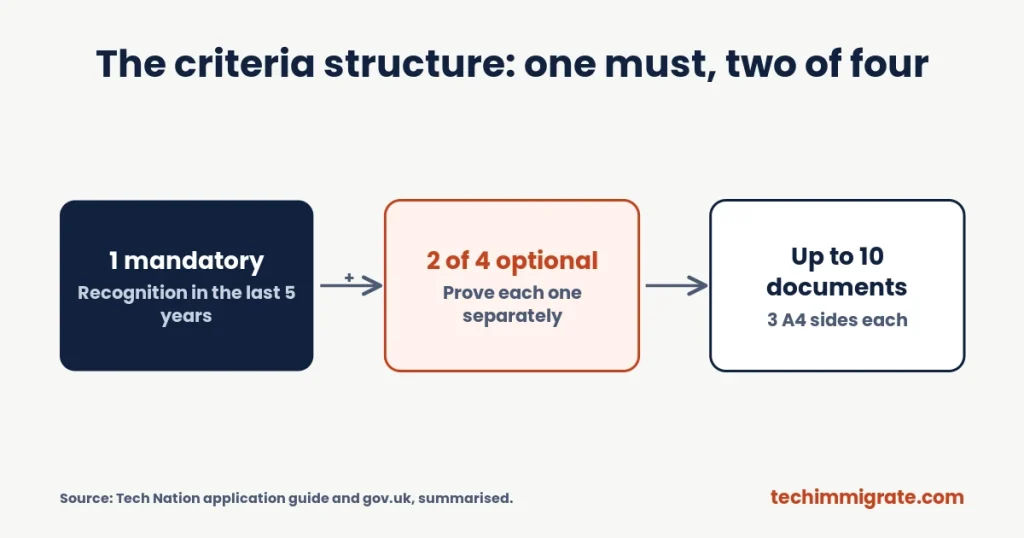
That leaves up to 4 spare slots. Strong applications use them to back up the weakest criterion. They do not add a third optional criterion that nobody asked for.
Your CV and your three recommendation letters sit outside the 10-document limit, according to the gov.uk document list. So do not waste an evidence slot on either of them.
The criteria are only the entry test, though. Tech Nation says its panel also weighs five wider factors.
These are your career history, the strength of your letters and how you will help UK digital technology. They also include personal factors, such as salary or money raised, and the commercial impact of your work. In practice, meeting the Global Talent Visa criteria gets you considered, while the overall picture gets you endorsed.
Who the Criteria Are Written For
Before you read a single criterion, check that your role fits the route. Tech Nation’s guide says the Global Talent Visa criteria are written for technical and business people in digital technology. It also draws a clear line.
Technical people from non-technical organisations are eligible, and so are business people from technical organisations. However, business people from non-technical organisations are generally not eligible.
Technical Applicants: Judged on the Stack You Built
For a technical applicant, the guide asks for proven expertise in building, using, deploying or exploiting a technology stack. Its examples include principal engineers, DevOps engineers, data scientists, machine learning experts, cybersecurity experts and experienced UX/UI designers.
The word “experienced” appears again and again in that list. That is a signal: a competent engineer is not the target, while an engineer whose work others can see and verify is.
Business Applicants: Judged on the Product Business You Grew
For a business applicant, the guide asks for commercial, investment or product expertise in building digital products. Its examples include product managers, in-house performance marketers and SaaS sales leaders. It also lists investors who led VC investment of more than £25 million.
The key phrase is “product-led”. Tech Nation defines a product-led company as one whose main revenue comes from its own digital product, platform or hardware. That is why consultancy, outsourcing, service delivery, ERP consultancy and agency roles are generally treated as unsuitable. Our guide to Tech Nation endorsement mistakes covers what to do if your employer falls on the wrong side of that line.
The Mandatory Global Talent Visa Criterion: Recognition Beyond Your Employer
The mandatory criterion asks you to show recognition as a leading talent, or a potential one, in digital technology. That recognition must fall within the last 5 years. Every word of that sentence matters.
“Recognised” means someone outside your own team noticed your work. “Leading” means you stand at the front of your field, not in the middle of it. Finally, “last 5 years” means old achievements carry little weight, so recent, steady activity counts for more.
Tech Nation’s guide lists the kinds of evidence it accepts for this criterion:
- Growth you led at a product-led company, a product or a team, shown by letters from industry experts, press coverage or public code.
- Open source leadership outside your day job, shown by commit summaries, stars or download numbers.
- National or international awards for excellence in digital technology, rather than internal company awards.
- Talks at high-profile events in your field, ideally with attendance figures.
- Media coverage about you in major trade or national publications, with the title, date and audience.
- A high salary, although the guide says pay alone is not enough.
- Expert judging roles, such as sitting on panels that assess other people’s work.
What Does Not Count as Recognition
The exclusions matter just as much. Tech Nation says LinkedIn, Medium and other self-published articles are not sufficient. Internal awards, training and certificates do not count either. Reference letters from an immediate colleague, manager or friend are also ruled out as recognition. In short, the mandatory criterion rewards proof that people with no reason to flatter you chose to notice you.
The Four Optional Criteria, and Who Each One Is Built For
You only need two of the four optional Global Talent Visa criteria. So pick the two that match your real career, instead of stretching thin evidence across all four. Here is who each one suits.
Innovation: Built for Founders and People in New Fields
The first optional criterion asks for a proven track record of innovation. It suits founders or senior executives of a product-led company, and employees working on a new digital field or concept. The weight falls on novelty: something new that exists in the market and earns money.
Recognition Outside Work: Built for Mentors, Speakers and Maintainers
The second criterion covers work beyond your job that advances the field. It suits people who maintain open source projects, speak at leading conferences, mentor through structured programmes or organise communities. Tech Nation says this work must be voluntary and not done while representing a company.
Significant Contribution: Built for Proven Impact Inside a Product Company
The third criterion asks for significant technical, commercial or entrepreneurial contributions as a founder, executive, board member or employee. It suits people whose impact inside a product company is measurable. Tech Nation stresses that this criterion is about impact, not innovation, which is the opposite of the first one.
Academic Contribution: Built for Published Researchers
The fourth criterion covers research published or endorsed by an expert. It suits people with peer-reviewed papers, peer-reviewed conference talks or competitive research grants. Undergraduate and MSc theses do not qualify, according to Tech Nation’s guide.
How to Meet Each Optional Criterion: The Evidence That Leads
Knowing who a criterion suits is half the job. The other half is choosing evidence that proves it on its own terms. The same four criteria, mirrored, look like this.
Innovation: Lead With Granted Patents or Real Traction
For founders, Tech Nation asks for proof of a product in the market and revenue traction. It wants your last formal accounts, audited or covering more than 12 months. They must include a profit and loss statement and a balance sheet signed by the directors. Business plans, projections and articles of association do not count.
For employees, the guide gives a granted patent as an example, verifiable on Google Patents. Patent applications are not enough, because only granted patents show innovation that someone else has tested.
Recognition Outside Work: Lead With a Consistent Track Record
For this criterion, Tech Nation cares about steady activity over time. So a burst of GitHub commits just before you apply can hurt you. The guide calls evidence made “solely to support the timing” of an application unacceptable. Our article on turning GitHub into Global Talent evidence shows how to present a long-running record.
The speaking bar is specific. Conferences must be sector-leading with at least 100 attendees, not registrations. You must speak on the main stage, and your employer must not have paid for the slot through sponsorship. Running a workshop is not enough.
Mentoring has its own rules too. It must happen through a structured programme with selection criteria, outside your normal duties. Tech Nation says online platforms such as ADPList are not enough. Mentoring at a single university or startup does not count either.
Significant Contribution: Lead With Your Personal Numbers
The biggest trap here is team credit. Tech Nation says your evidence must show your personal work, not the company’s or the team’s. So a company press release about a product launch proves little, unless another document ties the result to you.
For technical applicants, strong evidence includes an extra employer letter, architecture documents that show your part, and code that shows ongoing contributions. For business applicants, it includes proof of the pipeline you built, the growth you drove or the leads you generated. Wherever possible, put a number on it and convert currencies to pounds, as the guide requests.
Academic Contribution: Lead With Peer Review
Research must be endorsed by a recognised academic expert, either through peer review or a letter from a senior academic who supervised you. A paper in a top-tier peer-reviewed journal is the clearest proof. Merit-based awards count, but Tech Nation says purely monetary awards such as bursaries and scholarships do not.
Exceptional Talent vs Exceptional Promise: Same Tests, Different Bar
Both routes use the same Global Talent Visa criteria: one mandatory test and two optional ones. The difference is the level you must prove, and it has real consequences.
Exceptional Talent is for people already recognised as leaders. Exceptional Promise is for emerging leaders. According to gov.uk, they usually have less than 5 years of experience in technology. However, they can have had a longer career in another field before moving into tech.
The trade-off shows up later. The gov.uk settlement page lists 3 years to settlement for leaders and 5 years for potential leaders. Meanwhile, Tech Nation notes that unpaid internships do not count towards your years of experience.
| Feature | Exceptional Talent | Exceptional Promise |
|---|---|---|
| Who it is for | Recognised leaders | Emerging leaders, usually under 5 years in tech |
| Mandatory criterion | Recognised as a leading talent | Recognised as having potential to lead |
| Optional criteria | 2 of 4 | 2 of 4, with softer wording |
| Settlement | After 3 years | After 5 years |
Tech Nation can also decide which route fits you. Its guide says the panel will “establish whether” your evidence meets Talent or Promise. So aiming for the wrong one is not always fatal. Still, it is safer to pick the route your evidence clearly supports.
Small-Print Rules Around the Global Talent Visa Criteria
Many refusals have nothing to do with talent. Instead, they come from rules that sit around the Global Talent Visa criteria. Tech Nation’s guide spells most of them out. Check your file against each one.
- No templates. Tech Nation says templated letters, statements or evidence are not acceptable, and duplicates may be treated as fraudulent.
- No AI-written documents. The guide says using tools such as ChatGPT to create letters, statements or evidence is not acceptable.
- No link lists. A document that only lists links to online sources does not count as evidence.
- No shrinking. Squeezing pages to fit the 3-page limit makes them illegible, so the guide rejects that too.
- Letters need backup. A reference letter alone does not prove any criterion, so pair every letter with hard evidence.
- Business accounts are mandatory. If you founded or ran a business in the last 5 years, you must provide evidence about it.
Honesty checks are real, too. Tech Nation says it cross-checks applications, may contact referees, and reports false claims to the Home Office. As a result, a stretched job title can cost you far more than one refusal.
How to Measure Your Case Against the Global Talent Visa Criteria
You cannot see Tech Nation’s scoring, but you can measure your own file. These five checks turn the criteria into numbers you can track while you build your application.
- Independent recognition count: the number of items where someone outside your employer chose to feature, award or invite you. Aim for at least 2 strong items for the mandatory criterion.
- Criteria coverage: the number of optional criteria with 2 or more documents that prove them on their own terms. You need 2, and a third half-built criterion adds little.
- Evidence recency: the share of your documents dated within the last 5 years. Anything older should be context, not proof.
- Personal attribution: the share of documents that name you, rather than your team or company. Low attribution is the most common weakness in impact evidence.
- Quantified impact: the number of claims backed by a figure, such as revenue, users, downloads or attendees. Numbers let an assessor verify your claim quickly.
Read these checks alongside your recommendation letters. If a letter praises an achievement that none of your 10 documents proves, either find the proof or drop the claim. Our guide to Global Talent Visa recommendation letters explains how to brief referees so their letters match your evidence.
The Decision Rule: Two Strong Documents Per Criterion, or Wait
The most useful rule in this guide: apply only when you can show two independent, recent, personally attributed documents for the mandatory criterion and for each of your two optional criteria. If any criterion rests on one document, or on a letter alone, keep building instead of applying.
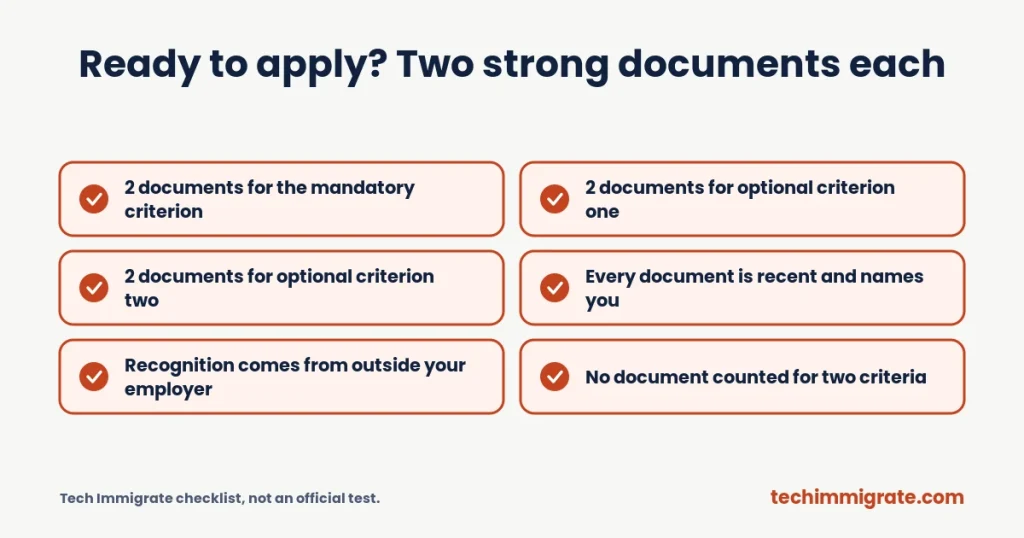
Here is how the rule works in practice, using an illustrative, invented example. Imagine a backend engineer with 7 years of experience at a product company. For the mandatory criterion, they gave a main-stage talk to 400 people at a sector conference. They also have a trade magazine profile, so that is two strong items.
For significant contribution, they hold an architecture document showing their design, plus a letter from a second manager with figures on latency savings. Both are personal and quantified. For recognition outside work, however, they only have 3 months of open source commits. That criterion fails the rule. So the sensible plan is to keep contributing for a year, or switch to a criterion they can prove today.
The rule is strict on purpose. Because each refusal means paying the endorsement fee again, waiting a few months to strengthen one criterion is usually cheaper than applying early.
What a Successful Case Looks Like, and Its Limits
Real outcomes show that the Global Talent Visa criteria are achievable without a famous name. The Tech Immigrate homepage shares genuine client messages. One shows a person endorsed for Exceptional Talent, and another shows a visa granted by the Home Office.
Those messages have limits, though. They confirm the outcome but not the evidence behind it, and names are hidden for privacy. So treat them as proof that the route works, not as a template to copy. Tech Nation also publishes success stories. It reports an alumni community of more than 2,600 members on its Global Talent Visa page.
The common thread in successful applications is fit. Strong applicants prove each criterion with evidence made for it. They do not stretch one big achievement across three criteria.
Frequently Asked Questions About the Global Talent Visa Criteria
You need to meet the mandatory criterion and 2 of the 4 optional criteria. Tech Nation’s guide asks for at least 2 documents for the mandatory criterion and 2 for each optional criterion, within a limit of 10 documents.
No. The Global Talent Visa does not require a job offer or sponsor. However, Tech Nation considers how you will contribute to UK digital technology, so your personal statement should explain your plans.
No. Gov.uk says you cannot use the same piece of evidence for more than one criterion, so each document should prove one criterion clearly.
No degree is required. Academic research is only one of the four optional criteria, and most applicants meet the criteria through work, open source, talks or business results instead.
It is harder. Tech Nation’s guide says consultancy, outsourcing and service-delivery roles are generally not suitable, so you would need strong evidence from product work or contributions outside your job.
Evidence for the mandatory criterion should come from the last 5 years, according to gov.uk and Tech Nation. Older achievements can give context, but they should not carry your case.
Your Next Step
Start with one exercise. List your evidence under the mandatory criterion and your two strongest optional criteria. Then apply the two-document rule to each column. You will know within an hour whether you are ready, and which column needs work.
For a structured way to do this, the Tech Immigrate endorsement guides are written for software developers, digital marketers and tech investors. Each one includes an evidence checklist and planner built around these criteria. You can also compare the benefits and costs of the Global Talent Visa, or go back to the Tech Immigrate homepage to see real client results.
How We Checked This Article
We checked every rule and figure in this article against two sources before publication. These were the gov.uk Global Talent pages for digital technology and Tech Nation’s published application guide. Tech Immigrate is independent of Tech Nation and the Home Office. This article is general information, not legal advice, and no one can guarantee an endorsement.
Always confirm the latest Global Talent Visa criteria on gov.uk before you apply, and visit techimmigrate.com for more guides.
Every figure in this guide was checked against its original source before publication. Figures marked as illustrative are invented examples, not real results.
We write practical guides for tech professionals applying for the UK Global Talent visa. Tech Immigrate is independent of Tech Nation and the Home Office, and our articles are general information, not legal advice. Rules and fees change, so always check gov.uk before you apply.