What Can You Do on a Global Talent Visa? Work, Freelance, Start a Business
Global Talent visa work restrictions explained: employment, freelancing, running a company, remote work, study, travel, public funds and records to keep.


In this article
- The Conditions of a Global Talent Visa
- Working as an Employee
- Freelancing and Self-Employment
- Starting and Running a Business
- Working Remotely for an Overseas Company
- Study
- Volunteering, Mentoring and Community Work
- Travel
- Real Career Moves on Global Talent
- Side Projects, Open Source and Creator Income
- Tax Basics for Global Talent Holders
- Regulated Professions
- Working Abroad for a While
- Questions Employers May Ask
- What You Cannot Do
- How Your Choices Affect Extension and Settlement
- What the Visa Does Not Give You
- Your Family's Rights
- A Simple Record-Keeping Habit
- Frequently Asked Questions
- Freedom Starts With an Endorsement
- How We Checked This Article
The main reason tech professionals want a Global Talent visa is freedom. Unlike sponsored routes, it does not tie you to an employer, a salary or a job title. But "you can do almost anything" is not quite the same as "you can do anything", and the limits that do exist matter, especially for founders, freelancers and anyone planning to settle.
This guide sets out exactly what you can and cannot do on a Global Talent visa: employment, self-employment, starting a business, working for overseas companies, study, volunteering, travel and access to public services. It also explains how each choice affects your extension and settlement, because the one thing Global Talent does ask of you later is evidence that you have earned money in your field.
Key takeaways
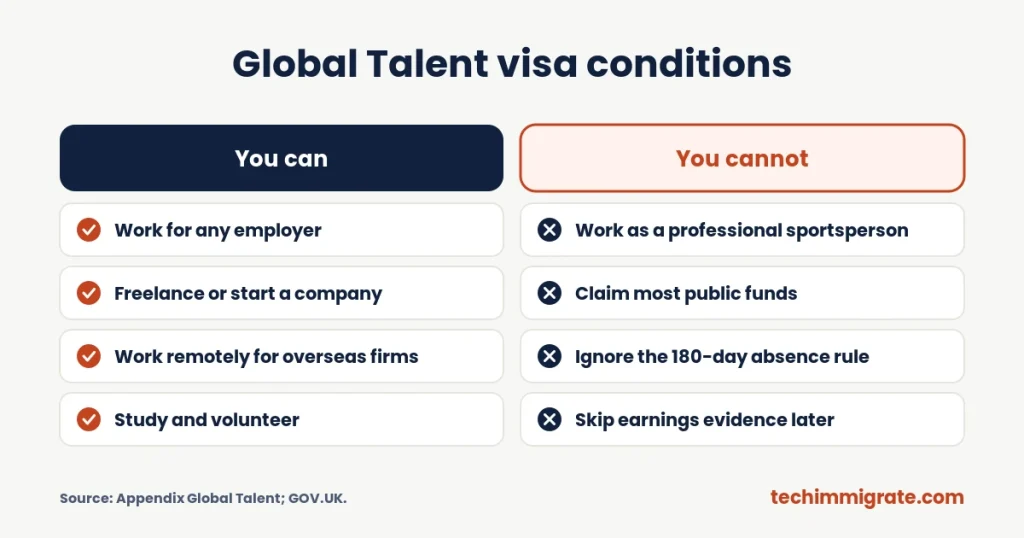
- You can work for any employer, at any salary, full-time or part-time, and change jobs without telling the Home Office.
- You can be self-employed, freelance, consult or start and run your own company.
- You can work remotely for an overseas employer while living in the UK, subject to UK tax and employment rules.
- You can study, although some postgraduate subjects in sensitive fields may need an Academic Technology Approval Scheme certificate.
- You cannot work as a professional sportsperson or sports coach, and you cannot claim most public funds.
- To extend or settle, you must show you have earned money in your field in the UK, so keep records whatever you do.
- Time abroad counts against the 180-day absence limit for settlement.
The Conditions of a Global Talent Visa
Every UK visa comes with conditions. For Global Talent, they are light. In summary:
| Activity | Allowed? | Notes |
|---|---|---|
| Work as an employee for any UK employer | Yes | No sponsor, no salary threshold |
| Change jobs | Yes | No need to tell the Home Office |
| Hold more than one job | Yes | |
| Self-employment and freelancing | Yes | Register with HMRC and pay tax |
| Start and run a company | Yes | |
| Work remotely for an overseas employer | Yes | Check tax, payroll and social security |
| Study | Yes | Some subjects may need an ATAS certificate |
| Volunteer | Yes | |
| Travel abroad and return | Yes | Absences affect settlement |
| Work as a professional sportsperson or sports coach | No | |
| Claim most public funds | No | Most benefits and housing assistance are excluded |
The Home Office does not monitor your employment on Global Talent. There is no sponsor reporting and no requirement to stay in a particular role.
Working as an Employee
You can work for any UK employer, in any role, at any salary. You do not need a job offer to arrive, and you can change jobs as often as you like.
In practice, this means:
- No going rates. Unlike Skilled Worker, your salary is not checked against an occupation code.
- No skill level rule. You can take a role at any level, though staying in your field helps at extension and settlement.
- Part-time is fine. You can work part-time, take a sabbatical or combine several part-time roles.
- Startups without sponsor licences can hire you. That opens up early-stage companies that cannot sponsor visas.
Employers check your right to work using a share code from your UKVI account. Because they do not need to sponsor you, hiring you is faster and cheaper for them.
Freelancing and Self-Employment
Global Talent allows self-employment. Many holders freelance, consult, or combine part-time employment with their own work.
If you are self-employed:
- Register with HMRC for Self Assessment, and file a tax return every year.
- Keep invoices, contracts and bank statements showing payments for work in digital technology.
- Consider your structure. Some freelancers work as sole traders; others set up a limited company. Each has different tax and evidence implications. Take accounting advice.
Self-employment can make extension and settlement evidence more complicated than for employees, because there are no payslips. The current caseworker guidance sets no minimum earnings and no fixed list of documents, but your evidence must be independent and verifiable. Tax records such as SA302 calculations are particularly useful.
Starting and Running a Business
You can found a company, raise investment, hire staff and run the business while on Global Talent. You do not need approval from an endorsing body, and there are no business check-ins like those on the Innovator Founder route.
Points founders should plan for:
- Pay yourself in a way you can evidence. At extension and settlement, you need to show you earned money in your field. A salary through payroll, dividends with clear records, or a mix, documented by your accountant, makes this easier.
- Keep company filings up to date. Late accounts or confirmation statements can weaken your evidence.
- Do not let personal earnings drop to nothing for long periods without being able to explain why. The current rules set no minimum, but you still need to have earned money in your field.
- Watch the reforms. The earned settlement response proposes earnings-based settlement paths and new mandatory requirements, including sustained earnings and no debts to HMRC. The Migration Advisory Committee has also recommended considering an income threshold at settlement for talent routes.
Our article on Global Talent for startup founders explains how founders get endorsed in the first place.
Working Remotely for an Overseas Company
The visa allows you to work for an overseas employer while living in the UK. Many Global Talent holders keep a job with a company abroad, at least at first. Practical points:
- Tax. Once you are UK tax resident, you usually pay UK income tax on your earnings, wherever your employer is based.
- Payroll. An overseas employer with an employee living in the UK may need to run UK payroll, use an employer of record, or treat you as a contractor.
- Social security. Depending on the countries involved, you may pay UK National Insurance or remain in your home system under a social security agreement.
- Settlement evidence. The rules ask for money earned in your field in the UK. Applicants on the Tech Nation Visa Forum report that income from overseas clients or employers while living and working in the UK can count if it is properly evidenced and taxed, but take advice if your situation is unusual.
Study
You can study on a Global Talent visa, whether that is a short course, a part-time master's or a full degree. You do not need a Student visa.
Some postgraduate study and research in subjects with possible military or security applications can require an Academic Technology Approval Scheme (ATAS) certificate for many visa holders. If you plan to study in areas such as advanced engineering, certain computing or physical sciences, check with your university whether ATAS applies to you before you start.
Tuition fees are another consideration. Universities usually charge international fees unless you meet residence and immigration status rules for home fees. Ask the university's fees team before you enrol.
Study can be valuable evidence for your career, but remember that extension and settlement depend on earning money in your field. Full-time study with no work for a long period could make that harder.
Volunteering, Mentoring and Community Work
You can volunteer and contribute to the tech community freely: mentoring, running meetups, maintaining open source, judging hackathons or teaching. These activities are often what got people endorsed in the first place, and they remain valuable for career growth. They do not count as earnings for extension or settlement, so combine them with paid work in your field.
Travel
You can travel in and out of the UK freely using your eVisa and the passport linked to your UKVI account. There is no limit on trips, but absences matter for settlement:
- To settle, you must not have spent more than 180 days outside the UK in any 12-month period during your qualifying period.
- Do not travel while an extension or settlement application made inside the UK is pending, or it will be withdrawn.
If your work involves a lot of travel, keep a log of every trip from day one. Our Global Talent ILR guide explains how to count absences.
Real Career Moves on Global Talent
These examples show how the flexibility works in practice. They are illustrative, not case studies.
Leaving a big company for a seed-stage startup. A senior engineer at a large company wants to join a 6-person startup that has never held a sponsor licence. On Skilled Worker, that would not be possible without the startup getting a licence first. On Global Talent, the engineer simply resigns and starts. The startup checks right to work with a share code.
Going part-time to build a product. A product manager reduces to three days a week to build a side product. Global Talent allows both the part-time employment and the side business. The product manager keeps payslips from the job and records from the business.
Contracting between permanent roles. A data engineer is made redundant and decides to contract for six months before choosing a new permanent role. No visa change is needed. The engineer registers as self-employed or works through a limited company, files tax returns and keeps invoices.
Founding a company and taking a low salary. A founder raises a pre-seed round and pays themselves a modest salary while the company grows. That is allowed. The founder keeps payroll records, board minutes and accountant letters to show earnings in the field.
Taking a master's degree while working. A cybersecurity specialist studies part-time for a master's degree while continuing to work. No Student visa is needed. The specialist checks with the university whether an ATAS certificate applies to the course.
In each case, the visa allows the move. The common thread is record-keeping, so that extension and settlement are straightforward.
Side Projects, Open Source and Creator Income
Many tech professionals earn small amounts from side projects: app sales, open-source sponsorships, technical writing, courses, newsletters or speaking fees. All of this is allowed on Global Talent. Declare the income to HMRC, keep records, and treat it as part of your earnings evidence where it is in digital technology. Small, irregular side income is unlikely to carry an extension on its own, but it can support a wider picture of work in your field.
Tax Basics for Global Talent Holders
Your visa does not change how UK tax works, but your freedom means you are more likely to deal with it directly.
- Employees pay income tax and National Insurance through PAYE.
- Self-employed people register for Self Assessment, file a tax return each year and pay Class 4 National Insurance on profits.
- Company directors usually file a personal tax return as well as company accounts.
- People with overseas income or assets may need to report them, depending on their tax residence and the rules that apply. The UK replaced the old remittance basis with a new regime for new arrivals from April 2025, so take advice if you have significant overseas income.
Good tax records do double duty: they keep you compliant and they are some of the strongest evidence of earnings at extension and settlement.
Regulated Professions
The visa lets you work in any field, but some jobs need professional registration regardless of immigration status: for example, medicine, law, accountancy and some engineering roles. Global Talent does not replace those requirements. For most tech roles, there is no registration requirement.
Working Abroad for a While
Some Global Talent holders take assignments abroad, spend a few months working from another country, or travel extensively for clients. The visa does not stop you, but two rules make long periods abroad risky:
- The 180-day absence limit for settlement. Spending more than 180 days outside the UK in any 12-month window during your qualifying period breaks continuous residence for settlement under the current rules.
- Earnings in the UK. Extension and settlement ask for money earned in your field in the UK. Work done while physically abroad for long periods may be harder to count.
If you expect a long assignment abroad, plan it around your settlement date or take advice first. A few weeks at a time is rarely a problem; several months in one year can be.
Questions Employers May Ask
Because Global Talent is less familiar than Skilled Worker, employers sometimes ask questions. Useful answers:
- "Do we need to sponsor you?" No. Global Talent is an unsponsored visa. There is no certificate of sponsorship and no Immigration Skills Charge.
- "Are there restrictions on the role or salary?" No, apart from limited exceptions such as professional sport.
- "How do we check your right to work?" With a share code from my UKVI account, through the government's online right-to-work service.
- "What if your visa expires?" I can extend it, and I may become eligible for settlement. I will provide a new share code when my status changes.
Having these answers ready can make you a more attractive hire, especially for small companies that have never sponsored anyone.
What You Cannot Do
Professional sport
You cannot work as a professional sportsperson, including as a sports coach. This rarely affects tech professionals.
Most public funds
You cannot claim most public funds. That includes most social security benefits, such as Universal Credit and Child Benefit, and help with housing from local councils. Using the NHS and sending your children to state school are not public funds; you are entitled to both.
If you claim public funds by mistake, it can affect future applications. The earned settlement response also proposes that recent receipt of public funds could push people onto a much longer settlement path. If you are unsure whether something is a public fund, check GOV.UK before applying for it.
Losing your endorsement through dishonesty
The caseworker guidance allows permission to be cancelled if your endorsement is withdrawn. This is rare and usually linked to false information in the original application. It is not about what you do day to day.
How Your Choices Affect Extension and Settlement
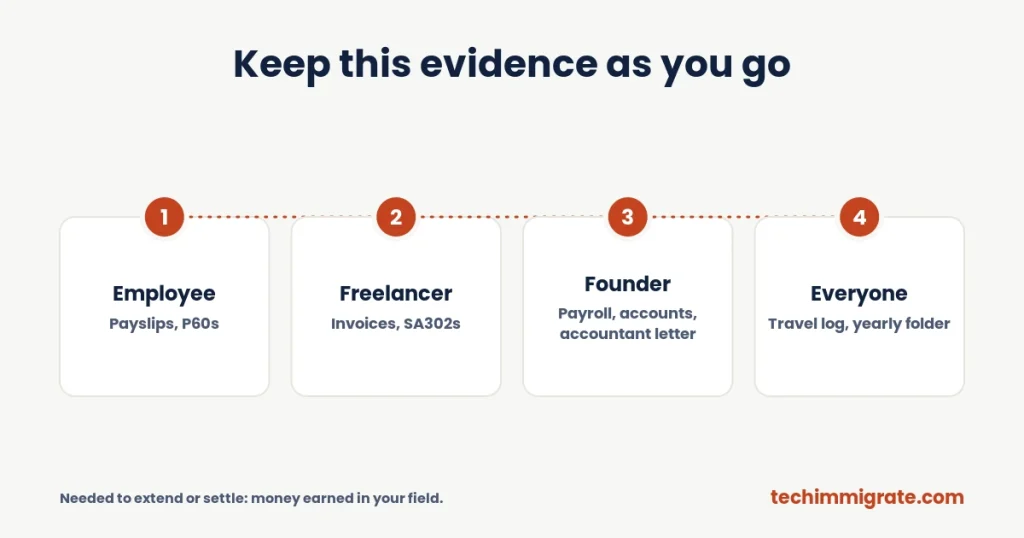
The freedom of Global Talent comes with one ongoing responsibility: you must be able to show you earned money in your field when you extend or settle.
| What you do | Evidence to keep |
|---|---|
| Employee in the UK | Payslips, P60s, employer letters |
| Remote employee of an overseas company | Contract, payslips, bank statements, UK tax records |
| Freelancer or contractor | Invoices, contracts, bank statements, SA302s |
| Company founder | Payroll and dividend records, accounts, accountant's letter |
| Mix of the above | All of the relevant items, with a short summary |
Work outside digital technology is allowed, but it may not count as earnings in your field. If you take an unrelated job for a while, make sure you can still show earnings in digital technology across your permission, or explain how your work connects to the field.
What the Visa Does Not Give You
It is also worth knowing what Global Talent does not do:
- It does not make you a British citizen or give you settled status. That comes later, after indefinite leave to remain.
- It does not let you vote in UK general elections, unless you are a Commonwealth citizen with the right to do so.
- It does not give you access to most public funds.
- It does not let your parents or other relatives join you as dependants. Only partners and children qualify.
Your Family's Rights
Your partner and children on Global Talent dependant visas can also work, study and travel. Partners can work for any employer or be self-employed, except as a professional sportsperson or sports coach. Our article on Global Talent dependants explains the family rules.
A Simple Record-Keeping Habit
The single best habit for any Global Talent holder is a yearly evidence folder. At the end of each tax year, save your P60 or tax calculation, a few representative payslips or invoices, any company accounts, and a one-page note of what you worked on and for whom. Add your travel log. When it is time to extend or settle, you will have everything in one place, instead of chasing old employers, banks and accountants for documents from years ago. It takes an hour a year and can save weeks of stress later.
Frequently Asked Questions
Yes. You can work for any employer, at any salary, and change jobs without telling the Home Office.
Yes. You can freelance, consult or run your own business. Register with HMRC and keep good records for extension and settlement.
Yes. Check UK tax, payroll and social security arrangements before you start.
Yes. Some postgraduate subjects in sensitive fields may need an Academic Technology Approval Scheme certificate, so check with your university.
No, you cannot claim most public funds. You can use the NHS and your children can attend state school.
There is no salary threshold, but you must show you earned money in your field to extend or settle.
Yes, the visa allows it. Plan ahead so you can still show earnings in your field across your permission at extension or settlement.
Freedom Starts With an Endorsement
The Global Talent visa is one of the few UK visas that lets your career lead and your immigration status follow. You can follow the best opportunity rather than the one with a sponsor licence, build something of your own, or step back for a while, as long as you keep sensible records along the way. Everything in this article depends on getting endorsed first. Our role-specific Global Talent guides explain what Tech Nation looks for in your field, so you can earn the freedom to build your career the way you want.
How We Checked This Article
We checked the conditions against Appendix Global Talent, GOV.UK's Global Talent visa pages and the Home Office Global Talent caseworker guidance (version 19.0, 3 August 2026), and GOV.UK guidance on public funds, in November 2026. The settlement reform points draw on the government's earned settlement response (2 November 2026). Experiences with overseas income come from the Tech Nation Visa Forum and are applicant-reported, not official guidance.
Tech Immigrate is independent of Tech Nation and the Home Office. This article is general information, not legal or tax advice.
We write practical guides for tech professionals applying for the UK Global Talent visa. Tech Immigrate is independent of Tech Nation and the Home Office, and our articles are general information, not legal advice. Rules and fees change, so always check gov.uk before you apply.