Recommendation Letter Global Talent Visa Guide: 7 Rules for Writing One That Works
Recommendation letter Global Talent Visa guide: what Tech Nation requires, a letter structure and mistakes to avoid. See the 7 rules before you ask.

In this article
- Recommendation letter Global Talent Visa rules: what Tech Nation requires
- What does a recommendation letter need to prove?
- Rule 1: Write from first-hand knowledge
- Rule 2: Follow a clear structure
- Rule 3: Be specific, not flattering
- Rule 4: Keep the three letters independent and different
- Rule 5: Use the referee's own voice
- Rule 6: Match each letter to your evidence
- Rule 7: Get the format and credentials right
- How should a letter cover the UK points?
- Talent or promise: how should the letter frame you?
- What if a referee is short of time or says no?
- Referee checklist: ten questions before signing
- Do referees need to know the rules of the visa?
- How applicants can support a referee: a timeline
- Common recommendation letter Global Talent Visa mistakes
- Recommendation letter Global Talent Visa FAQ
- Your Next Step
- How We Checked This Article
A recommendation letter Global Talent Visa panels can trust comes from an established expert who has known your work for at least 12 months. It is typed, dated, signed and specific, and it names real projects and results in the referee's own voice.
This guide is for referees and for applicants who support them, so you get seven rules, a skeleton outline, a vague versus specific example and a list of mistakes. Because choosing your referees is a separate step, we cover it in our recommendation letters guide.
Key takeaways
- You need three letters, each from an established digital technology expert who has known your work for at least 12 months.
- Each letter must say how the author knows you, what you achieved, and your UK plans, within 3 sides of A4.
- Specific projects, numbers and outcomes beat praise. Vague letters undermine an application.
- The three letters should give different examples, and each should come from a separate perspective.
- Tech Nation's guidance rules out templated and AI-written documents, so the words must be the referee's own.
- Letters support your evidence. They cannot replace it.
Recommendation letter Global Talent Visa rules: what Tech Nation requires
Each recommendation letter Global Talent Visa applicants send must be typed, dated, signed and up to 3 single sides of A4, and you must send three of them. The author must be an established expert in digital technology with 12 months or more of knowledge of your work.
These points come from the gov.uk document list. Note that the 3-side limit excludes the author's credentials and contact details.
Each letter must also come with the author's CV or other proof of their credentials. The signature can come from the author, or from someone who signs for the recommending organisation.
Two more rules matter for writers. First, the three letters must give different examples of your achievements. Second, you cannot use a letter that was written for another reason, such as an old job reference.
What does a recommendation letter need to prove?
A recommendation letter needs to show that an expert has seen your work and believes you are a leader or potential leader in digital technology. It supports your evidence, so it gives the panel a view from outside your own file.
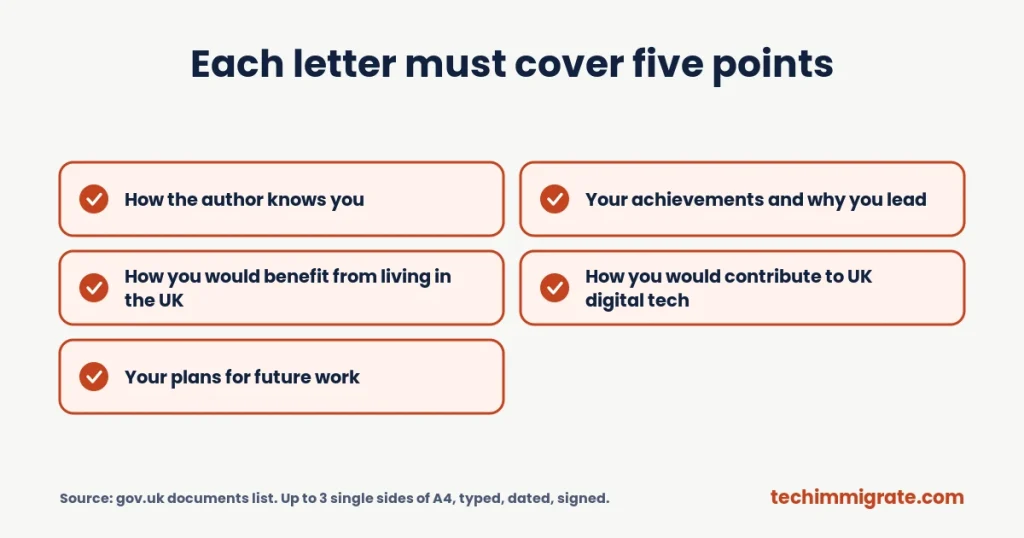
Under the gov.uk guidance, each letter must cover five points:
- How the author knows you.
- Your achievements in digital technology and why you lead or could lead.
- How you would benefit from living in the UK.
- How you would contribute to digital technology in the UK.
- What plans you have for future work.
Letters work with your evidence, not instead of it. Our criteria guide shows how the mandatory and optional criteria fit together, and a good letter points at them.
Rule 1: Write from first-hand knowledge
The referee should write only about work they have seen, used or judged themselves. First-hand detail is what makes a letter believable, because the panel can compare it with your evidence.
Panels cannot check a referee's heart, but they can check whether the story fits the evidence. A referee who writes "I reviewed the architecture in March and approved the launch" sounds real. However, a referee who writes "I hear she is brilliant" does not.
Good sources of first-hand knowledge include:
- Working with you on a project, even across companies.
- Using your product, library or research.
- Judging your work at a competition or review panel.
- Hearing you speak and then working with you after.
The referee should say how long they have known your work, and it should be at least 12 months. If the period is close to the limit, give exact dates, such as "since September".
Rule 2: Follow a clear structure
A clear structure helps the panel find what it needs, so follow the five points above in order. Short paragraphs read well when each one holds a single idea.
First, open with who the author is and why their view counts. Next, explain the link to you. Then give the achievements, then the UK points, then close with a short summary.
A letter does not need to be long, since three sides is a maximum and not a target. Many strong letters fill one and a half to two sides.
Illustrative example (fictional): skeleton outline
Illustrative example (fictional): a referee called Dr Ayo Bello, a research director at an invented AI company, uses this outline. Notes in brackets show what each paragraph does.
- Paragraph 1: who I am. Role, organisation, field and two lines of proof that I am an established expert.
- Paragraph 2: how I know the applicant. The project, the dates and my part in it.
- Paragraph 3: what they did. One or two named projects, with results and numbers.
- Paragraph 4: why they lead. What the work changed for others in the field.
- Paragraph 5: the UK. How the applicant would benefit from living in the UK and what they would contribute.
- Paragraph 6: plans. What I understand of their next steps.
- Close. Name, title, signature, contact details and a note that my CV is attached.
This is an outline and not a copy-paste letter, so each referee must fill it with their own facts and wording.
Rule 3: Be specific, not flattering
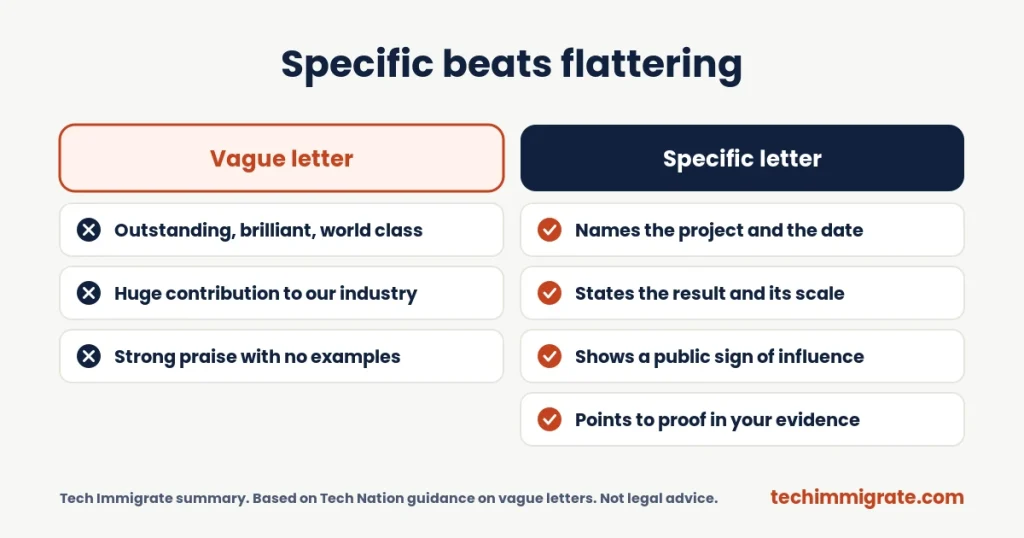
Name the project, the date, the result and the referee's part in it. Specific facts do the work that praise cannot do.
Tech Nation's applicant guidance warns against letters that are vague, generic or lack details of the applicant's achievements and impact. That is the failure to avoid.
Words like "brilliant", "outstanding" and "world class" prove nothing alone, so replace each one with a fact the panel can test.
Illustrative example (fictional): vague versus specific
Illustrative example (fictional): both versions describe the same engineer, Lena. The details are invented, so they only show the difference.
Vague: "Lena is an outstanding engineer who has made a huge contribution to our industry. I strongly recommend her."
Specific: "Last spring I reviewed Lena's redesign of an open source payment library. It cut integration time for partner banks from six weeks to nine days, and teams in more than 15 countries now use it. I have cited it in two industry talks."
The second version gives a date, a result, a scale and a public sign of influence. As a result, the panel can match each point to evidence in the file.
Rule 4: Keep the three letters independent and different
Each letter should come from a separate source, speak from its own angle and give different examples. If three letters tell the same story, they look like one voice, repeated.
The gov.uk rules ask for different examples in the three letters, so plan for it early. Give each referee a lane that matches how they know you.
| Referee type | Lane to cover |
|---|---|
| A senior colleague or client | Impact on a real product or customer |
| An industry peer or judge | Standing in the field and outside recognition |
| An academic or standards contact | Technical depth and research influence |
Independence matters too, because a referee outside your employer carries more weight than your own manager, though letters from a manager can still help. If two referees work at the same company, check that each writes about a separate part of your work.
Applicants often ask about the mix of letters. Our other guide on choosing authors covers who to approach.
Rule 5: Use the referee's own voice
The referee must write, check and own every sentence. Tech Nation's guidance rules out templated and AI-written documents, and a letter that sounds like a form helps nobody.
What does that mean for you as the applicant? You can give facts, but you should not hand over a finished letter and ask for a signature.
Safe support includes:
- Your CV and a list of the projects the referee saw.
- Dates, numbers and links to public proof.
- The five points the letter must cover.
- A reminder of the length and format rules.
Applicants report that some senior referees ask for a first draft because they are short of time. That is a practice reported by applicants and not official guidance. If a referee asks, give notes and facts, then let them write, rewrite and sign the letter in their own words.
Rule 6: Match each letter to your evidence
Every claim in a letter should match something in your CV, your evidence or your personal statement. Panels read the documents together, so a loose claim stands out.
Check these three links before the letters go in:
- Names, titles and dates match your CV.
- Projects in the letter appear in your evidence folder.
- UK plans match your personal statement.
A referee may know about a result that you cannot prove. In that case, either find proof or ask the referee to leave it out, because a claim with no support reads like a courtesy note and not like an endorsement.
Also keep one clear story, since letters that mix "you are already a leader" with "you could become one" can confuse the panel. Pick the route that fits your record, then ask each referee to speak to it.
Rule 7: Get the format and credentials right
Follow the format rules exactly, because a small slip can delay an application. Check each letter against this list before you upload it.
- Typed and dated.
- Up to 3 single sides of A4, excluding credentials and contact details.
- Signed by the author, or by someone signing for the organisation.
- A telephone number and email address.
- The organisation's logo and registered address, where they apply.
- The author's CV or other proof of credentials attached.
- A different set of examples from the other two letters.
Letters on company letterhead look professional, and many referees already have one. Then save each file as a PDF, and check that it opens and reads clearly.
How should a letter cover the UK points?
A letter should cover the UK in two or three plain sentences, because the referee is rarely a UK immigration expert. The aim is to show that the author understands your plans, not to argue your case.
Referees often skip this part because they feel unsure. However, gov.uk lists it as required content, so every letter needs it. A short, honest paragraph works well in any recommendation letter Global Talent Visa panels read.
Illustrative example (fictional): a referee writes, "I understand that Lena plans to join a London fintech and keep maintaining the library as open source. UK banks already use it, so I expect her work to help more UK teams adopt safer payment code."
Notice what this paragraph does. First, it names a plan, links it to the referee's own knowledge and avoids big promises. If the referee does not know your plans, share them first. Then let the referee decide what they can honestly say.
Keep these points consistent with your personal statement. For example, if the statement says you will start a company, the letters should not describe a job search.
Talent or promise: how should the letter frame you?
The letter should match the route you chose, so ask referees to speak to either established leadership or emerging potential. A mixed message makes the case harder to read, so pick one.
For Exceptional Talent, the referee describes a record: years of work, recognised results and standing in the field. For Exceptional Promise, the referee describes direction: rapid growth, early recognition and signs of what comes next.
Both routes still need facts. A referee writing about promise should still name projects and results, because "great potential" proves nothing alone. Our guide to Exceptional Talent and Exceptional Promise helps you choose before you brief anyone.
Share your chosen route with each referee, so they can use the same wording as your application.
What if a referee is short of time or says no?
If a referee is short of time, make the task smaller and give a clear date. If they say no, thank them and move on to another option early.
Senior people often want to help but fear a long task. However, you can ease the load in a few ways:
- Send a one-page brief with your facts in one email.
- Offer a 15-minute call to answer questions.
- Confirm that three single sides is a limit and that one page is fine.
- Give a deadline that leaves time for edits.
A polite no is useful, because it leaves time to ask someone else. A late yes with a rushed letter is worse. For that reason, approach four or five possible referees when you start, and then settle on the best three.
Referee checklist: ten questions before signing
Use this checklist before the referee signs, since it works for the author and for the applicant who checks the final file.
- Is the letter typed, dated and within 3 single sides of A4?
- Does it say how the author knows you and for how long?
- Does it name at least two real projects with results?
- Why does the author say you lead or could lead in digital technology?
- Can the reader see your benefit from living in the UK?
- Is your contribution to UK digital technology covered?
- Are your future plans mentioned?
- Do the examples differ from the other two letters?
- Are the signature, contact details and credentials all attached?
- Does every claim match your CV and evidence?
If any answer is no, fix it before you upload, because a short edit now costs little.
Do referees need to know the rules of the visa?
Referees do not need immigration knowledge, but they do need to know the five points the letter must cover. A short brief from you removes the guesswork.
Most referees are engineers, founders, researchers or executives. They know your work well, yet they may never have read a visa guide. If you send the list of required points, they can focus on facts.
Keep the brief practical and short, ideally one page. Share the length limit, the format rules, the five content points and the deadline. Then add your own notes on the projects they saw, with dates and public links.
Avoid telling them what to conclude. The panel wants an honest view, and a referee who feels pushed may write a stiff, careful letter. Instead, ask them what they saw, what changed and why it mattered, then let them choose the words.
How applicants can support a referee: a timeline
Applicants can support a referee by asking early, sharing facts and making the task easy. A rushed request usually leads to a weak letter.
| When | What to do |
|---|---|
| 6 to 8 weeks before | Ask the referee in person or by call, then send a short written follow-up |
| 5 weeks before | Send your CV, project notes, links and the five required points |
| 3 weeks before | Offer a short call to answer questions |
| 2 weeks before | Gently check progress and confirm the format rules |
| 1 week before | Collect the signed PDF and the author's credentials |
| Before upload | Check dates, names and numbers against your own documents |
These timings are practical suggestions and not official deadlines. Because senior experts are busy, give them room. Then thank them whether or not the letter is used.
Common recommendation letter Global Talent Visa mistakes
The most common mistakes are vague praise, copied wording and letters that do not match the evidence. Each is avoidable if you plan early.
- Vague praise. Fix it by asking for named projects and numbers.
- Templated or AI-written text. Fix it by letting each referee write from scratch.
- Three identical letters. Fix it by giving each referee a different lane and examples.
- Old references reused. Fix it by writing new letters for this application, as gov.uk requires.
- Missing credentials. Fix it by attaching the author's CV with each letter.
- Unsupported claims. Fix it by checking each claim against your evidence.
For wider patterns, see our guide to Tech Nation endorsement mistakes. Applicants report that weak letters come up often in refusal stories. However, that is applicant-reported, not official data, so use it as a warning and not a statistic.
Recommendation letter Global Talent Visa FAQ
You must provide three letters. Each author must be an established expert in digital technology who has known your work for at least 12 months. The letters should give different examples of your achievements, so each one adds something new for the panel to weigh.
Each letter can run to up to 3 single sides of A4, not counting the author's credentials and contact details. Many strong letters are shorter. Length does not matter as much as detail, so spend the space on named projects, results and the UK points.
It should say how the author knows you, what you achieved and why you lead or could lead, how you would benefit from living in the UK, how you would contribute to UK digital technology, and your future plans. It must be typed, dated and signed.
This is risky. Tech Nation's guidance rules out templated and AI-written documents, and the words must reflect the referee's own views. Give them facts, dates, links and the required points, then let them write and sign the letter in their own words.
Yes. Each letter must come with the author's CV or other proof of their credentials that the endorsing body will accept. The letter should also carry a telephone number, an email address and, where it applies, the organisation's logo and registered address.
Your Next Step
A strong recommendation letter Global Talent Visa applicants can rely on sits on top of strong evidence. Our role-specific endorsement guides give you an evidence checklist and planner, so you know what each referee can back up. Start at the guides hub and pick your role.
Engineers can open the software developers guide, and cybersecurity applicants have the cybersecurity specialists guide. Product and data applicants can use the product managers guide or the data and AI specialists guide. Want the guide for your role? See the guides.
How We Checked This Article
We checked the letter rules against the gov.uk page on documents you need to apply for endorsement: the number of letters, the 12-month rule, the required content, the format and the attached credentials. We checked the quality warning against Tech Nation's own guidance on supporting documents. Several law firm and adviser guides helped us find common gaps.
Statements about what applicants report come from applicant communities, so they are not official. The people, projects and letter extracts here are fictional, and the skeleton outline is not a template to copy.
Tech Immigrate is independent of Tech Nation and the Home Office. This article is general information, not legal advice, and nobody can guarantee an endorsement. Always confirm current rules on gov.uk before you apply.
We write practical guides for tech professionals applying for the UK Global Talent visa. Tech Immigrate is independent of Tech Nation and the Home Office, and our articles are general information, not legal advice. Rules and fees change, so always check gov.uk before you apply.