Global Talent Visa Evidence Strategy: How to Match Evidence to Your Career Stage (3 Profiles)
Build a Global Talent Visa evidence strategy that fits your career stage. Compare 3 profiles, match criteria to proof, and plan what to build first.

In this article
- What is a Global Talent Visa evidence strategy?
- The rules that shape every evidence plan
- Start with an inventory, not with the criteria
- Global Talent Visa evidence strategy by career stage
- Profile 1: the early-career applicant
- Profile 2: the mid-career specialist
- Profile 3: the senior or established leader
- How to choose between Promise and Talent when you sit in the middle
- How to sequence your evidence over 24 months
- How to test each document before you include it
- Evidence strategy mistakes that applicants report
- What if your evidence is thin in one area?
- Which referees suit which stage?
- Worked example: one profile mapped to ten documents
- How the personal statement ties it together
- From weak plan to strong plan: an illustrative example (fictional)
- What does it cost, and how long does it take?
- Global Talent Visa evidence strategy FAQ
- Your Next Step
- How We Checked This Article
A Global Talent Visa evidence strategy means choosing your route, your criteria and your documents together, based on your career stage. Early-career, mid-career and senior applicants need different proof. A plan that fits your stage saves months.
Most applicants start by collecting documents. That backfires, because you cannot fit everything into 10 documents. This guide gives three fictional profiles, a decision table, and a build order.
Key takeaways
- Pick your evidence from what you have already done, then choose the criteria it supports.
- Career stage shapes the route: Exceptional Promise for emerging talent, Exceptional Talent for established leaders.
- Each document must stand alone, come from a credible outside source, and fit one criterion only.
- Early-career applicants lean on outside recognition and contribution. Senior applicants lean on scale, influence and leadership.
- Build the slowest evidence first, such as talks, press and awards, and write the documents last.
What is a Global Talent Visa evidence strategy?
A Global Talent Visa evidence strategy is a plan that links your career story to the criteria and to specific documents. It answers three questions: which route, which criteria, and which proof.
Tech Nation's independent panel decides overall whether to endorse you. Meeting the criteria is necessary but not sufficient, so the way you present your proof matters as much as the proof itself.
A good plan also saves effort. You have room for up to 10 documents, and you need to cover three criteria. That leaves little space for weak or duplicate items.
The rules that shape every evidence plan
Five rules limit your options, and a strategy has to work inside them. Tech Nation reads your file against these limits, so plan around them from day one.
| Rule | What it means for your plan |
|---|---|
| Up to 10 evidence documents | You must choose, not collect everything |
| Up to 3 A4 sides each | One clear argument per document |
| At least 2 documents per criterion | Plan 2 for the mandatory and 2 for each optional criterion |
| No reuse across criteria | One item cannot prove two things |
| Evidence from the last 5 years | Older work needs a fresh angle or goes unused |
You also need three recommendation letters and a CV of up to 3 sides. These sit outside the 10-document count. However, letters support your evidence and cannot replace it. See our guide to recommendation letters for how to brief your referees.
Tech Nation's guidance, as we reflect it here, rejects AI-written or templated documents. It also does not count internal awards, or LinkedIn and Medium posts on their own, as recognition.
Start with an inventory, not with the criteria
The safest first step is a full inventory of your work, because you should choose criteria after you know what you have. If you pick criteria first, you may chase proof you cannot produce.
Some adviser sites make the same point. One tells applicants to list every project and achievement before choosing criteria. We agree, because good evidence often hides in places you overlook.
Your inventory should cover the last five years. For each item, note the date, your exact role, the outcome, and who outside your team can confirm it. Then score each item by how independent it is. Our full criteria guide explains what each criterion asks for.
You will find that some items fit two criteria. For example, a conference talk may show recognition and also contribution. You still need separate documents for each use, so decide where each item is strongest.
Global Talent Visa evidence strategy by career stage
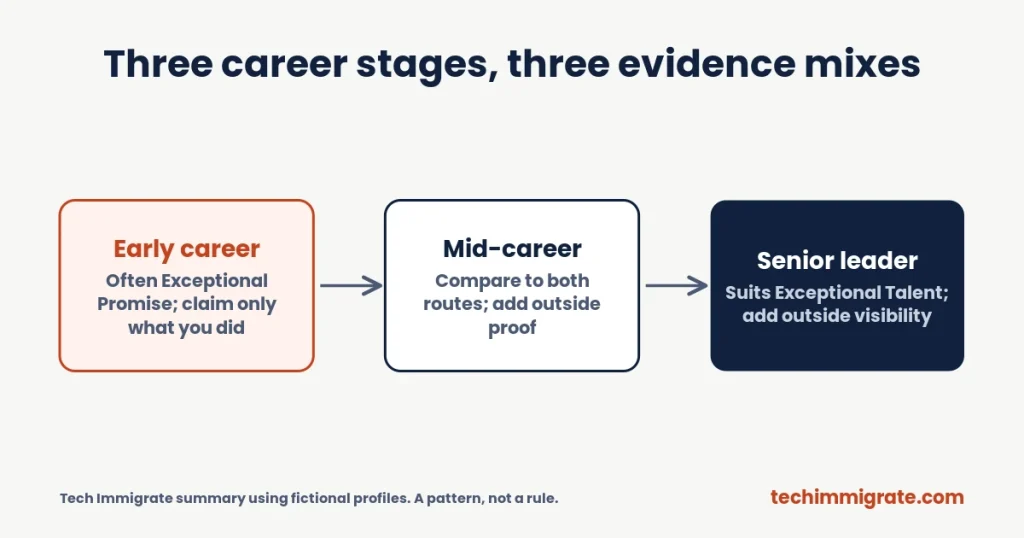
The right mix of evidence depends on how long you have worked and how far your influence reaches. The table below compares the three profiles we use in this guide.
| Emerging (Ana) | Mid-career specialist (Marcus) | Senior leader (Helen) | |
|---|---|---|---|
| Typical experience | Under 5 years | About 5 to 10 years | 10 years or more |
| Likely route | Exceptional Promise | Either, depending on proof | Exceptional Talent |
| Mandatory criterion proof | Early awards, selective programmes, press, invited talks | Awards, strong press, keynote or panel roles | International awards, major press, keynotes |
| Strongest optional criteria | Outside contribution, product contribution | Product contribution, outside contribution or innovation | Innovation, product contribution |
| Main risk | Claiming too much | Looking like a strong employee only | Proof stuck inside one company |
| Build first | Public output and mentors | Independent recognition | External visibility of leadership |
This table is a pattern, not a rule. Tech Nation decides each case on its merits, and applicants in similar situations still get different outcomes.
Profile 1: the early-career applicant
Illustrative example (fictional): "Ana" has three years as a junior data engineer at a product-led fintech. She wants a plan she can finish within a year.
Route and criteria
Applicants like Ana often look at Exceptional Promise. The gov.uk page says Promise applicants are likely to have less than 5 years of experience in technology. Ana needs recognition as a potential talent, plus two optional criteria.
Her likely pair is outside contribution and a significant contribution to her company's product. Innovation for Promise is framed around founders or new-field employees, so it can be harder to show early on.
Evidence that fits
For recognition, Ana can use an accepted place on a selective programme, a hackathon prize judged by outsiders, and an invited talk. For contribution, she can use a verified pipeline project with business results.
Outside work, she can show an open-source project with real use, or a volunteer mentoring programme. Our GitHub evidence guide shows how to present code evidence.
Her main risk
Ana's biggest danger is overreach. Promise-level evidence presented as Talent-level invites doubt. She should claim what she did, with dates, and let the proof speak.
Profile 2: the mid-career specialist
Illustrative example (fictional): "Marcus" has eight years as a machine learning engineer. He has strong internal ratings but little public recognition.
The common trap
Marcus's trap is that most of his proof sits inside his employer. Internal awards and manager praise do not show outside recognition. Applicants in this situation often discover the gap only when they map documents to criteria.
Route and criteria
Marcus could sit between the routes. His years of experience point to Talent, but his public record is thinner than a leader's. He should compare his evidence to both standards before choosing.
His strongest criteria might be significant contribution, with a shipped model and measurable impact, and outside contribution through conference talks and technical writing in independent outlets.
Evidence that fits
For recognition, Marcus needs independent proof. Examples include an accepted talk at a respected industry event, a press feature, or a judging invitation. For contribution, he can use model performance data confirmed by a senior leader.
Our guide to Exceptional Talent vs Exceptional Promise helps decide when a profile like his leans one way or the other.
Profile 3: the senior or established leader
Illustrative example (fictional): "Helen" has fifteen years in product leadership and now heads product at a scale-up.
Route and criteria
Helen's profile suits Exceptional Talent, where recognition as a leading talent in the last 5 years is the starting point. Her optional criteria could be significant contribution and innovation.
Innovation for Talent asks for a record as a founder or senior executive of a product-led company, or as an employee in a new digital technology field. Helen's record of launching a new product line may fit.
Evidence that fits
Helen needs outside signals for recognition, such as keynotes, international awards, and independent press. Her contribution case can use revenue and growth data confirmed by audited or formal company records.
Innovation can rest on product launch evidence with market adoption. If she held a founder or senior executive role, she should also check whether proof of business connection is required.
Her main risk
Helen's risk is that her proof stays inside one company. Her title says leader, but the panel wants outside recognition. She should add external visibility, not more internal praise.
How to choose between Promise and Talent when you sit in the middle
If your profile sits between the two routes, compare your evidence to each standard, not your years of service. Experience is a guide, but the strength of independent proof usually decides which fits.
Ask three questions. Is your recognition international, or mostly local? Are your achievements established and repeated, or still emerging? Can senior outside experts speak to your impact?
If the honest answer is "emerging", Promise may fit better. One adviser site notes that applicants can move from Promise to Talent later if their evidence grows. That is adviser commentary, not an official rule.
Remember the settlement difference. Settlement is possible after 3 years on Talent and 5 years on Promise. However, a weaker Talent application that fails costs time and a fee. The panel still weighs the whole file.
How to sequence your evidence over 24 months
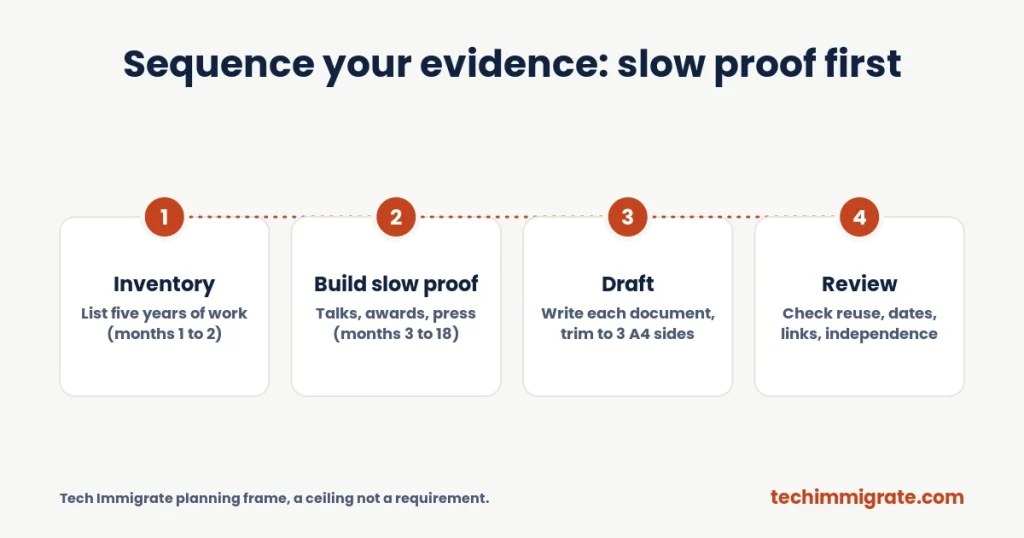
Build the slowest evidence first and write the documents last. Talks, awards, press and mentoring take months to arrange, while documents take days to write.
| Phase | Months | What to do |
|---|---|---|
| Inventory | 1 to 2 | List five years of work, outcomes, dates and verifiers |
| Gap check | 2 to 3 | Compare your list to the criteria and mark thin areas |
| Build slow proof | 3 to 18 | Pitch talks, enter awards, mentor, publish in independent outlets |
| Gather verification | 12 to 20 | Collect programme pages, data confirmations and referee agreement |
| Draft | 20 to 22 | Write each document, then trim to 3 A4 sides |
| Review | 22 to 24 | Check for reuse, dates, links and independence |
Not everyone needs 24 months. Many applicants already hold most of the proof and only need to organise it. Use the table as a ceiling, not a requirement.
How to test each document before you include it
Every document should pass four tests: it is independent, attributable, verifiable and relevant. If a document fails one, replace it or fix it.
- Independent: someone outside your team produced it or confirms it.
- Attributable: it names you and your exact role, not just the team.
- Verifiable: a reader can check it through a link, a page or a named person.
- Relevant: it proves the one criterion it sits under.
One refusal-focused article from a law firm lists weak evidence, overlapping documents, generic letters and mismatched criteria among common problems. That is a firm's view, but it matches the four tests above.
Evidence strategy mistakes that applicants report
Most strategy mistakes come from mismatch, not from a lack of talent. Our endorsement mistakes guide covers more. Applicants and advisers report these patterns:
- Choosing the wrong route. Talent claims with Promise-level proof.
- Picking criteria before taking stock. You end up chasing proof you lack.
- Leaning on internal material. Employer praise is not outside recognition.
- Repeating the same achievement. Overlapping documents add little.
- Using generic letters. Praise without dates and detail does not help.
- Mixing unrelated items in one file. Keep each document on one point.
- Using templated or AI text. Tech Nation says it does not accept it.
These come from applicant communities and adviser sites. They are not official findings, so treat them as warnings.
What if your evidence is thin in one area?
You do not need to be strong everywhere, so lean on your strongest two optional criteria and fix the weakest area first. A thin spot is a planning problem, not a verdict.
First, check whether you hold unused proof. Next, find the quickest credible way to fill the gap, such as a judging invitation or a verified project result. Finally, consider whether another criterion fits better.
If the gap is in the mandatory criterion, give it priority. That criterion needs recognition from others, and recognition takes time to earn. Start now, and keep dated records of each step.
If you are refused, you can request a free review within 28 days. You cannot add new evidence to it. A fresh application carries a new fee, so most applicants fix the evidence map first.
Which referees suit which stage?
Your referees should match your stage, because each letter must come from an established expert who has known your work for at least 12 months. A good letter adds context that your documents cannot.
Ana might ask a senior engineer at her company, a programme lead who ran her bootcamp, and a maintainer of an open-source project she works on. Each can speak to a different slice of her work. In the same way, Marcus could ask a director, a conference chair and a research partner.
Helen has more choice. Her letters could come from a board member, a long-term industry peer and a leader at a partner firm. However, all three should describe different parts of her impact. Repeating the same praise three times wastes a letter.
Brief every referee in writing. Share your draft evidence map so they can point to facts, dates and results. Never write the letter for them, and never copy a template. Tech Nation says it does not accept templated documents.
Worked example: one profile mapped to ten documents
A document map shows each slot and its job, so you can spot gaps early. Here is a map for Marcus, our fictional mid-career specialist.
| Slot | Criterion | Document idea |
|---|---|---|
| 1 | Mandatory | Programme page for an invited talk at an industry event |
| 2 | Mandatory | Independent press feature that names his model work |
| 3 | Outside contribution | Mentoring scheme confirmation with hours and mentee numbers |
| 4 | Outside contribution | Technical articles in an independent trade outlet |
| 5 | Contribution | Summary of a shipped model and its measured results |
| 6 | Contribution | Product data confirmed by a senior leader |
| 7 to 10 | Spare | Extra proof for the weakest criterion, if needed |
Notice the spare slots. You do not have to fill all ten. It is better to send eight strong documents than ten thin ones. However, keep at least two per criterion.
Then check the map for reuse. If the same talk appears in slots 1 and 4, you have a conflict. Swap one of them out before you write a word.
How the personal statement ties it together
The personal statement is the thread that makes your evidence read as one story. It does not replace proof, but it tells the panel why your documents belong together.
Write it after your evidence map is stable. Then explain your career path, the criteria you chose, and how you plan to contribute to UK digital technology. Keep it specific. Avoid grand claims that your documents do not support.
Also keep it consistent with your CV and letters. Dates, titles and project names should match across every file. Small mismatches make a file harder to trust, and they are easy to avoid.
From weak plan to strong plan: an illustrative example (fictional)
A weak plan collects everything, while a strong plan chooses. Here is how one fictional applicant, "Tomas", changed his Global Talent Visa evidence strategy.
Tomas first planned ten documents, all from his employer. He had a promotion letter, two internal awards, a team newsletter, and project reports. Since none came from outside, he had no real answer for the mandatory criterion.
After an inventory, he found unused proof. He had spoken at a regional meetup, and a trade site had quoted his work. He had also judged a student hackathon. Then he mapped each item to one criterion.
His new plan swapped four internal items for the talk page, the press quote, the judging invitation, and a mentoring record. As a result, every criterion had two independent documents. He kept his project reports for the contribution criterion, where a senior leader could confirm them.
The lesson is simple. Tomas did not need more achievements. He needed a better match between his proof and the criteria. This example is only an illustration and does not predict any decision.
What does it cost, and how long does it take?
At the time of writing, the endorsement fee is £561 and the visa fee is £205. That makes £766 for the main applicant before the Immigration Health Surcharge of £1,035 per year. Dependants pay their own visa fee and surcharge.
Tech Nation usually decides within 5 to 8 weeks. The visa decision usually takes 3 weeks from outside the UK and 8 weeks from inside it. You must apply for the visa within 3 months of the endorsement. There is no points system. Always check gov.uk for current figures.
Global Talent Visa evidence strategy FAQ
You can send up to 10 documents, each up to 3 A4 sides. You need at least 2 for the mandatory criterion and at least 2 for each optional criterion you claim. Your CV and three recommendation letters sit outside that count. One document cannot be reused for two criteria.
Choose the route that fits your honest evidence level, not your job title. Promise suits emerging talent, and the gov.uk page says Promise applicants are likely to have under 5 years of experience in technology. Talent suits established leaders. Tech Nation decides each case overall.
One project can inspire several documents, but one document cannot prove two criteria. For example, a product launch might support contribution in one document and innovation in another. Each needs its own independent proof, so plan separate items from the start.
Gather first. List your last five years of work, then see which criteria it supports. Choosing criteria first can push you to chase proof you cannot produce. Applicants in this situation often find strong evidence in places they had ignored.
Internal evidence is weaker for recognition, because the criteria look for recognition from others. Applicants often add independent proof, such as talks, press, awards or judging roles. Internal material can still support a contribution document when a credible person confirms the facts.
Your Next Step
Start your inventory this week. List five years of work, then mark each item as independent, attributable, verifiable and relevant. Want the guide for your role? See the guides.
For a role-specific plan, browse the guides hub. Each guide is a role-specific endorsement guide with an evidence checklist and planner. Popular starting points include the software developer guide, the data and AI specialist guide and the product manager guide. Founders can use the startup founder guide.
How We Checked This Article
We checked the route, criteria, experience wording, document limits and review rules on the official gov.uk pages for See the guides, documents you need and refused applications. We also checked the main digital technology page for fees and timings.
Next, we read adviser and law firm articles on evidence and refusals. Because they are commentary, we label them that way. Our three profiles are fictional and do not describe real people or predict any decision.
Tech Immigrate is independent of Tech Nation and the Home Office. This article is general information, not legal advice, and nobody can guarantee an endorsement. Always confirm current rules on gov.uk before you apply.
We write practical guides for tech professionals applying for the UK Global Talent visa. Tech Immigrate is independent of Tech Nation and the Home Office, and our articles are general information, not legal advice. Rules and fees change, so always check gov.uk before you apply.