Global Talent Visa Lawyer or Adviser: What They Cost and Whether You Need One
Global Talent visa lawyers and advisers: what they do, published fees, how to check they are regulated, red flags, and when doing it yourself works.


In this article
- What a Global Talent Lawyer Actually Does
- What Lawyers and Advisers Charge
- Who Is Allowed to Give Immigration Advice?
- Red Flags
- When You Probably Do Not Need a Lawyer
- When Legal Advice Is Worth Paying For
- Solicitor, Barrister or Adviser: Who Does What?
- What Applicants Report About Paid Help
- Weighing the Cost Against the Risk
- Comparing Your Options
- Getting the Most From a Paid Consultation
- Questions to Ask Before You Hire Anyone
- What a Good Adviser Will Tell You
- Doing It Yourself: A Realistic Plan
- A Note on Our Own Guides
- Frequently Asked Questions
- Spend Where It Makes a Difference
- How We Checked This Article
Search for help with a Global Talent visa and you will find solicitors, barristers, regulated immigration advisers, unregulated consultants, coaching services, guide sellers, and people on social media offering to "get you endorsed". Prices range from nothing to well over £15,000. It is hard to know what you are paying for, whether you need it, and whether the person helping you is even allowed to give immigration advice.
This guide explains the options honestly: what lawyers and advisers actually do on a Global Talent application, what they typically charge, how to check they are regulated, the red flags to avoid, and when doing it yourself makes more sense. We sell Global Talent guides ourselves, so we have tried to be fair about where a guide is enough and where you genuinely need regulated legal advice. Whatever you decide, the aim is the same: spend your money where it changes the outcome, and avoid anyone who puts your future applications at risk.
Key takeaways
- You do not need a lawyer to apply for the Global Talent visa. Many successful applicants apply on their own.
- Published law firm prices for Global Talent work range from around £2,500 to £5,000 for the endorsement stage alone, and from around £6,000 to £18,000 plus VAT for full support from some London firms. Government fees are extra.
- Only regulated people can legally give UK immigration advice: solicitors, barristers, chartered legal executives with the right authorisation, and advisers registered with the Immigration Advice Authority. Giving unregulated immigration advice is a criminal offence.
- Nobody can guarantee an endorsement. Tech Nation decides, and it refused about 82% of decided cases in 2025, according to Freedom of Information figures reported by Edgewater Legal.
- Legal advice is most valuable when your immigration history is complicated, you have had a refusal for deception or suitability reasons, or you need to challenge a decision.
- For most applicants with a clean history, the hard part is evidence and writing, which no lawyer can do for you.
What a Global Talent Lawyer Actually Does
It helps to separate the two stages, because they need different kinds of help.
Stage 1: endorsement
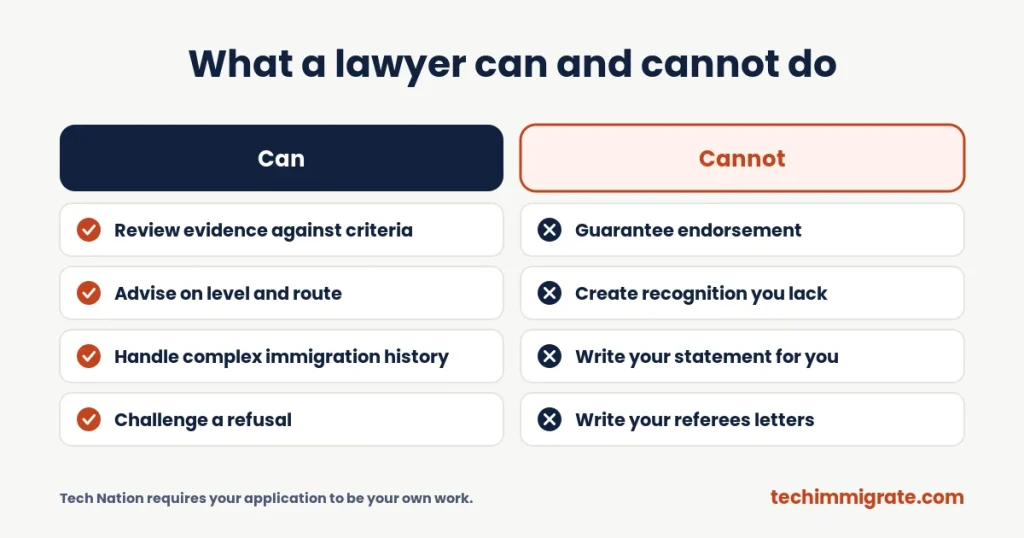
At Stage 1, Tech Nation assesses whether you are a leader or potential leader in digital technology. That is a judgement about your career, not a legal question. A lawyer or adviser can:
- review your evidence against Tech Nation's criteria;
- suggest which of your achievements to use and how to present them;
- comment on your personal statement and CV;
- check that your letters of recommendation meet the format requirements;
- manage the submission and correspondence with the Home Office.
What they cannot do is create recognition you do not have, write your personal statement for you, or write your referees' letters. Tech Nation's guidance requires your application to be your own work and your letters to be written by your referees. A lawyer who offers to draft everything is putting you at risk.
Stage 2: the visa
At Stage 2, the Home Office checks timing, identity, suitability and immigration history. For most people with a clean record, this is straightforward. Legal help becomes valuable when there is something to manage: a previous refusal, an overstay, a criminal conviction, an unusual switching situation, or family members with complicated status.
After a refusal
If you are refused, a lawyer can help decide between an endorsement review, a fresh application and, in rare cases, judicial review. Our guide on how to challenge a Global Talent visa refusal explains these routes.
What Lawyers and Advisers Charge
Law firms in England and Wales must publish price information for some immigration services. Here are examples from published price pages in 2026. They exclude VAT unless stated, and exclude government fees.
| Provider type | Published example | What it covers |
|---|---|---|
| National law firm (London office) | £2,500 to £5,000 | Stage 1 endorsement |
| National law firm (London office) | £2,000 to £3,500 | Stage 2 visa application |
| Large commercial law firm | £6,000 to £8,000 plus VAT | Both stages |
| Large commercial law firm | £3,500 plus VAT | Stage 2 only |
| Specialist immigration firm | £7,500 to £18,000 plus VAT | Global Talent applications, depending on complexity |
| Smaller specialist firm | Tiered packages from about £2,700 to £6,800 plus VAT | Varying levels of involvement |
Other guides commonly quote £3,000 to £8,000 for Global Talent legal fees. Remember that VAT at 20% applies to most UK legal fees, so a £5,000 fee is £6,000 with VAT.
These fees come on top of government fees: £561 for endorsement, £205 for the visa, and the Immigration Health Surcharge of £1,035 a year. For a single applicant on a 5-year visa, government fees alone are £5,941. Our Global Talent cost breakdown covers every fee.
What drives the price
- How much drafting support you get. Packages where the firm reviews your work are cheaper than those where it is heavily involved.
- Whether both stages are included.
- Complexity. Previous refusals, unusual immigration histories and dependants add cost.
- Seniority. Partners charge more than junior lawyers. Published hourly rates at large firms range from a few hundred pounds to over £600 an hour.
- Location. Central London firms are usually more expensive.
Who Is Allowed to Give Immigration Advice?
This is the most important part of this article. In the UK, it is a criminal offence to provide immigration advice or services unless you are qualified to do so.
People allowed to give immigration advice include:
- solicitors and firms regulated by the Solicitors Regulation Authority;
- barristers regulated by the Bar Standards Board;
- chartered legal executives authorised by CILEx Regulation;
- advisers registered with the Immigration Advice Authority (IAA), at the level they are authorised for.
The Immigration Advice Authority is the regulator formerly called the Office of the Immigration Services Commissioner (OISC). It changed its name on 16 January 2025. Advisers registered with it are authorised at levels 1 to 3, which limit the type of work they can do.
How to check an adviser
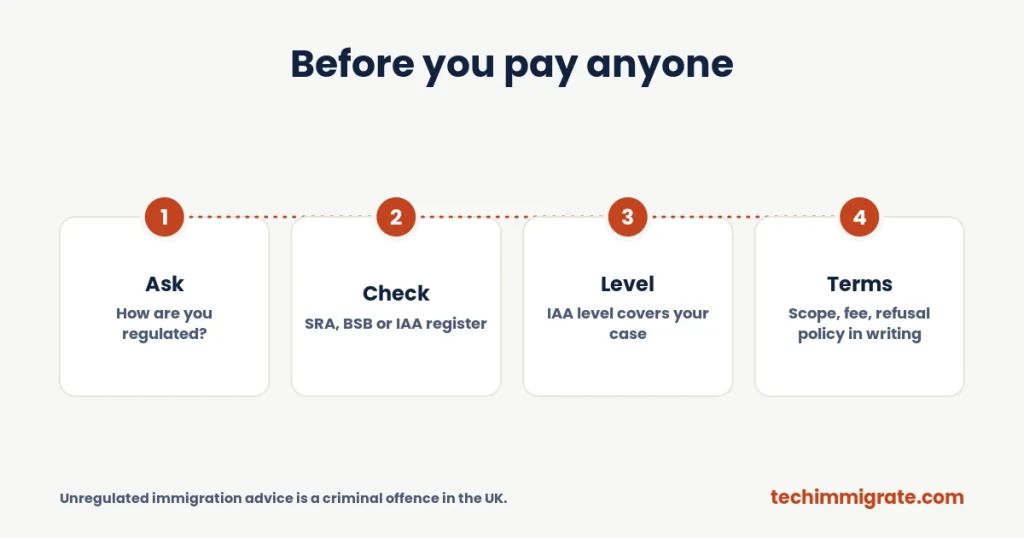
Before you pay anyone:
- Ask how they are regulated. A regulated adviser will tell you immediately and give you a registration number.
- Check the register. Use the Solicitors Regulation Authority register for solicitors, the Bar Standards Board's Barristers' Register for barristers, or the Immigration Advice Authority's adviser register.
- Check the level. Immigration Advice Authority advisers must be authorised at a level that covers your type of application.
- Get terms in writing. What is included, what is not, the fee, and what happens if you are refused.
What about "Global Talent coaches" and consultants?
Many services offer help with Global Talent applications without being regulated. Helping someone understand Tech Nation's published criteria, or selling general guides, is not the same as giving immigration advice about a person's specific case. But advising you on your individual application, telling you which visa route to use, or preparing and submitting your application for you is regulated activity.
If someone is advising you on your personal immigration situation, ask how they are regulated. If they cannot answer clearly, walk away.
Red Flags
Be cautious if a provider:
- guarantees endorsement or a visa. Nobody can. Tech Nation decides, and refusal rates are high.
- offers to write your personal statement or draft your referees' letters for them to sign. Tech Nation requires the application to be your own work and may contact referees.
- uses AI to generate your documents. Tech Nation's guidance says AI use within the application is not acceptable. See our article on using AI in a Global Talent application.
- offers to arrange press coverage, awards or speaking slots purely to manufacture evidence.
- cannot tell you how they are regulated, or gives a registration number you cannot find.
- asks for full payment up front with no written terms.
- claims special access to Tech Nation or the Home Office.
- charges for "fast-track" endorsement. Tech Nation has had no fast track since August 2025.
When You Probably Do Not Need a Lawyer
Most applicants do not need legal representation if:
- your immigration history is clean, with no refusals, overstays or convictions;
- you are applying from outside the UK, or switching from a standard route such as Skilled Worker or Graduate;
- your dependants have straightforward status;
- you are comfortable reading GOV.UK guidance and Tech Nation's criteria;
- you have time to prepare.
In that situation, the outcome depends almost entirely on your evidence, your statement and your letters. A lawyer can comment on them, but the substance has to come from you. Many applicants use the Tech Nation Visa Forum, published guidance and structured guides instead.
When Legal Advice Is Worth Paying For
Regulated advice is worth the money if:
- you have a previous UK refusal, especially for deception or suitability;
- you have overstayed or breached visa conditions;
- you have a criminal record, in the UK or abroad;
- your current visa is about to expire and your endorsement is not yet decided;
- your family situation is complicated, such as a child with one parent abroad or a partner on a different route;
- you want to challenge a refusal through judicial review or a complaint;
- you are switching from an unusual route, or are unsure whether you can switch at all.
In these situations, a mistake can have consequences far more serious than a refused endorsement, including future refusals on other routes.
Solicitor, Barrister or Adviser: Who Does What?
People often search for a Global Talent visa adviser, lawyer, solicitor or consultant as if they were the same thing. They are not.
Solicitors work in law firms regulated by the Solicitors Regulation Authority. Most Global Talent legal work is done by solicitors and their teams, from initial assessment to submission. They are the usual first choice for full representation.
Barristers are specialist advocates regulated by the Bar Standards Board. Some immigration barristers accept instructions directly from the public. They are particularly useful for complex legal questions, written opinions and challenges such as judicial review.
Immigration Advice Authority advisers are registered with the regulator formerly called the OISC. They range from sole practitioners to larger firms. Level 1 advisers can handle straightforward applications; levels 2 and 3 can take on more complex work. They can be a cost-effective option for a straightforward case, as long as their level covers what you need.
Consultants and coaches who are not regulated may offer general help with evidence and writing. They cannot lawfully advise you on your personal immigration case or prepare and submit your application. If you use one, treat it as you would a writing coach, not as legal advice.
Whichever you choose, experience with Tech Nation digital technology applications matters more than general immigration experience. Global Talent work is unusual because the hardest stage is about evidence of professional standing, not law.
What Applicants Report About Paid Help
On the Tech Nation Visa Forum, applicants regularly discuss whether paid help was worth it. These views are applicant-reported, not official, but some themes come up often:
- Some applicants were refused despite paying for help, and later succeeded on their own after building stronger evidence. The common lesson is that help with presentation cannot replace missing recognition.
- Others found an expert review valuable for spotting weak evidence, choosing the right level, or fixing letters that did not meet the format Tech Nation expected.
- Several warn about providers that promise outcomes or offer to write documents, especially letters.
- Experienced forum members often recommend reading the guidance carefully, asking specific questions publicly, and paying for advice only where there is a clear legal issue.
Weighing the Cost Against the Risk
A refused endorsement costs £561 in fees, plus the weeks you spent preparing and any delay to your plans. Full legal representation can cost ten times that or more. For a straightforward case, paying for a lawyer to reduce the risk of a £561 refusal is often poor value, because the main risk is weak evidence, which a lawyer cannot fix.
The calculation changes when the stakes are higher. If your current visa is expiring, if a refusal for deception could affect future applications, or if your family's status depends on getting it right, the cost of a mistake is much greater than the legal fee.
Comparing Your Options
| Option | Typical cost | Best for | Limits |
|---|---|---|---|
| Do it yourself with free resources | Government fees only | Confident applicants with clean history and strong evidence | Time-consuming; easy to miss what Tech Nation expects |
| Structured guide for your role | Usually much less than legal fees | Applicants who want a clear method and examples for their role | Not legal advice about your personal case |
| Regulated adviser or solicitor review | From a few hundred pounds for a consultation to several thousand for review | Applicants who want expert feedback on a draft | Quality varies; check experience with Tech Nation |
| Full legal representation | Roughly £6,000 to £18,000 plus VAT | Complex histories, high stakes, little time | Expensive; still cannot create evidence |
Our article on Global Talent guidance: DIY vs professional help compares these options from a different angle.
Getting the Most From a Paid Consultation
If you decide to pay for a one-off consultation rather than full representation, prepare so that you get real value from the time:
- Send your draft documents in advance: CV, a list of your 10 evidence items with the criterion each one supports, and an outline of your statement.
- List your specific questions, such as which level to apply for or whether a particular piece of evidence is strong enough.
- Explain your immigration history honestly, including any refusals, overstays or gaps.
- Ask for written notes of the advice, so you can refer back to them.
A focused consultation of an hour or two can be far better value than a full package if your case is straightforward.
Questions to Ask Before You Hire Anyone
- How are you regulated, and what is your registration number?
- How many Global Talent digital technology applications have you worked on in the last year?
- Who will actually work on my case, and what is their experience?
- What exactly is included in the fee? Both stages? Dependants? A review if I am refused?
- Will you write my documents, or review documents I write? (The right answer is review.)
- What happens to the fee if I am refused?
- How do you handle letters of recommendation?
- How do you communicate, and how quickly will you respond?
What a Good Adviser Will Tell You
A good adviser is often most valuable when they tell you something you did not want to hear:
- that your evidence is not ready yet, and you should wait 6 to 12 months;
- that you should apply for Exceptional Promise rather than Exceptional Talent;
- that a different route, such as Skilled Worker, is a better fit for now;
- that a referee is not senior enough or does not know your work well enough;
- that an item you are proud of is weak evidence.
If an adviser tells you everything looks great and takes your money without any challenge, be wary. Honest advice sometimes means being told to wait, to change your plan, or that you do not need to pay for help at all. The best advisers are comfortable saying all three.
Doing It Yourself: A Realistic Plan
If you decide to apply without a lawyer, a realistic plan looks like this:
- Read the rules. GOV.UK's Global Talent pages and Tech Nation's applicant guidance.
- Do an honest self-assessment. Our eligibility self-check helps.
- Map your evidence to the mandatory criterion and at least two optional criteria.
- Brief your referees early, with facts, not drafts.
- Write your statement yourself and get feedback from people who know your field.
- Prepare documents properly: PDFs, no links, clear file names, under 25MB per email.
- Apply, keeping copies of everything.
Our step-by-step guides on how to apply for the Global Talent visa and how to apply for endorsement walk through each stage.
A Note on Our Own Guides
Tech Immigrate sells role-specific Global Talent guides. They explain what Tech Nation looks for in each role, with examples, checklists and a method for building your application. They are not legal advice about your personal immigration situation, and we do not submit applications or advise on your individual case. If your situation involves any of the complications listed above, speak to a regulated adviser as well.
Frequently Asked Questions
No. Many applicants apply successfully on their own. Legal advice is most useful if your immigration history is complicated or you need to challenge a refusal.
Published examples range from about £2,500 to £5,000 for the endorsement stage, and from about £6,000 to £18,000 plus VAT for full support at some firms, on top of government fees.
No. Tech Nation makes the decision. Be wary of anyone who offers a guarantee.
Solicitors, barristers, authorised chartered legal executives, and advisers registered with the Immigration Advice Authority, formerly the OISC. Giving unregulated immigration advice is a criminal offence.
They should not. Tech Nation requires the application to be your own work and letters to be written by your referees.
Ask for their registration and check it on the Solicitors Regulation Authority, Bar Standards Board or Immigration Advice Authority register.
No. A guide explains criteria and methods. It does not advise on your personal immigration case.
Spend Where It Makes a Difference
For most tech professionals, the money that makes the biggest difference is not spent on paperwork. It is the time you invest in building and presenting real evidence of your impact. Our role-specific Global Talent guides show what that evidence looks like in your field. If your situation is complex, pair them with advice from a regulated professional.
How We Checked This Article
We reviewed published price information from UK law firms in 2026, including JMW Solicitors, Fieldfisher, Laura Devine Immigration and Sterling Law, and checked regulation against the Home Office guidance Working with immigration advisers and the Immigration Advice Authority, in November 2026. Prices change and may not reflect the firms' current terms. The refusal figure comes from a Freedom of Information response published by Edgewater Legal.
Tech Immigrate is independent of Tech Nation and the Home Office. This article is general information, not legal advice, and does not recommend any particular firm.
We write practical guides for tech professionals applying for the UK Global Talent visa. Tech Immigrate is independent of Tech Nation and the Home Office, and our articles are general information, not legal advice. Rules and fees change, so always check gov.uk before you apply.