Global Talent Visa Personal Statement: How to Write One Tech Nation Can Assess
A Global Talent Visa personal statement answers four questions Tech Nation publishes. Here is what each question tests, how to answer it in your own words, and a rule that ties every UK plan to proof already in your application.

In this article
- What Most Global Talent Visa Personal Statement Advice Gets Wrong
- How Tech Nation Uses Your Global Talent Visa Personal Statement: A Plan Checked Against Proof
- The Four Questions Test Different Things
- How to Answer Each Question in Your Own Words
- Exceptional Talent vs Exceptional Promise: Same Questions, Different Proof
- The Small-Print Rules for a Global Talent Visa Personal Statement
- How to Measure Your Global Talent Visa Personal Statement Before You Submit
- The Decision Rule: Every Future Claim Points to a Past Proof
- What a Successful Application Looks Like, and Its Limits
- Frequently Asked Questions About the Global Talent Visa Personal Statement
- Your Next Step
- How We Checked This Article
The Tech Nation personal statement for the UK Global Talent Visa is a section of the Home Office application form where you set out your future plans in the UK and your value to the UK digital technology sector. The statement is limited to 1,000 words when you submit your application for endorsement. A strong statement answers the four questions Tech Nation publishes: why the UK, your planned occupation, where you will live and how UK digital technology will benefit. You write it yourself inside the form. Every plan it describes should point back to proof already in your application.
Key takeaways
- Tech Nation’s application guide lists 4 questions your personal statement should answer, and it sits in a section of the Home Office form rather than in your 10 evidence documents.
- Tech Nation says the use of templates and AI tools such as ChatGPT for a personal statement is “not acceptable”, and it may check applications for AI use.
- The personal statement is limited to 1,000 words when you submit your application for endorsement, so write to that limit.
- The panel weighs how you will contribute to UK digital technology by being based in the UK, which is exactly what the statement explains.
- A refused endorsement costs the £561 fee listed on gov.uk, and the decision usually takes 5 to 8 weeks, so a vague statement is an expensive gamble.
What Most Global Talent Visa Personal Statement Advice Gets Wrong
Most advice on the Global Talent Visa personal statement starts with a word count and a sample to copy. The 1,000-word limit is real, but a sample is shaky: Tech Nation’s guide says templates of any kind are not acceptable. That includes the personal statement, which it names in the same sentence.
What that advice misses is the job the statement does. Your CV, letters and evidence prove your past. The personal statement is the only document where you explain your future in the UK. Tech Nation then checks whether that future is believable, given the proof in the rest of your file.
This guide explains how the statement is read and what each of the four questions tests. It also shows how to answer each one in your own words, and how to check your draft before you pay the fee.
Some ground rules first. The rules quoted here come from Tech Nation’s application guide and the gov.uk Global Talent pages. When we describe how assessors are likely to read a statement, that is our interpretation. Treat it as an informed inference, not a settled fact, because Tech Nation does not publish a marking scheme. Rules change, so check gov.uk before you apply.
How Tech Nation Uses Your Global Talent Visa Personal Statement: A Plan Checked Against Proof
Tech Nation’s guide says the Home Office form includes a section for a personal statement. Its purpose is to explain the contribution you will make to the UK digital technology sector. The guide adds that the statement should be “relevant and consistent” with the rest of your application.
That word “consistent” is the key to the whole Global Talent Visa personal statement. Endorsement, the approval from Tech Nation that you need before you can apply for the visa itself, rests on your evidence. The statement cannot replace that evidence. Instead, it gives assessors a reason to believe the evidence will turn into something useful for the UK.
The Four Questions Tech Nation Publishes
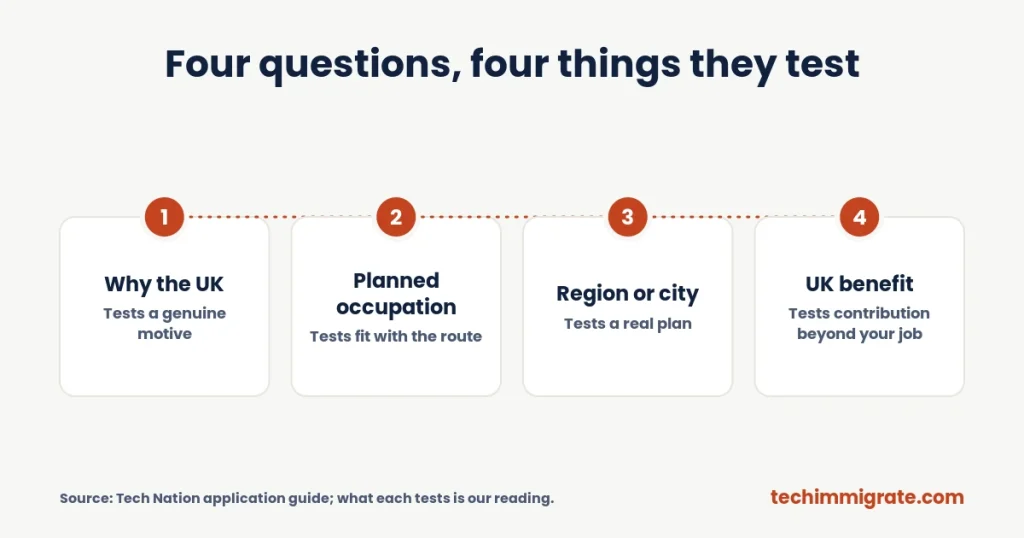
Tech Nation’s guide lists four questions a Global Talent Visa personal statement should answer:
- Why do you want to come to the UK?
- What is your planned occupation in the UK?
- Which region or city of the UK are you planning to live in?
- How will the UK digital technology sector benefit from your work?
The guide also says you can add any other information you consider relevant. In practice, though, the four questions give you a structure without needing anyone else’s wording.
Why Consistency With Your Letters Matters
The statement also connects to a factor the panel weighs. According to the gov.uk eligibility page for digital technology, Tech Nation considers how you will contribute to UK digital technology by being based in the UK. Your statement is the clearest place to answer that.
Your three letters repeat the same theme. Tech Nation says each letter should cover the contribution you would make to the UK digital economy and your future plans. So your statement and your letters describe the same future from two angles. If they disagree, an assessor will notice.
The Four Questions Test Different Things
The four questions look simple, so many applicants answer them in a single paragraph each. Our reading is that each question in a Global Talent Visa personal statement tests something different. Knowing what it tests tells you what a strong answer has to contain.
Why the UK: Built to Test a Genuine Motive
The first question tests whether the UK is a deliberate choice or just a destination. A reason that could apply to any country tells an assessor little. A reason tied to your field, such as a UK market, research community or company cluster, shows you have thought about where your work fits.
This matters because the visa is not tied to an employer. With no sponsor vouching for your move, the statement is the only place where you explain, in your own words, why the UK is the right base for the work your evidence describes.
Planned Occupation: Built to Test Fit With the Route
The second question tests whether your future role still fits the route. Tech Nation’s guide says consultancy, outsourcing and service-delivery roles are generally not suitable. It also says business skills should apply to in-house work at product-led companies. That means companies whose main revenue comes from their own digital product. A planned occupation outside that line raises doubts.
Region or City: Built to Test a Real Plan
The third question tests whether your plan is concrete. A named city with a reason shows you have looked at where your industry works. An answer like “wherever I find a job” suggests the plan has not started yet.
UK Benefit: Built to Test Contribution Beyond Your Job
The fourth question carries the most weight, in our reading. Tech Nation’s guide gives examples of what benefit might look like. These are the technological advances you will bring, the creation of new markets, the planned growth of a digital technology company, and activities outside your direct occupation. Each example describes an outcome for the UK sector, not for you.
How to Answer Each Question in Your Own Words
Knowing what a question tests is half the work. The other half is writing an answer that passes that test, using facts only you can supply. The same four questions, mirrored, look like this.
Why the UK: Lead With a Specific Pull
Start with the one reason the UK matters for your field. Name the thing that draws you, such as a sector, a type of customer or a community you already contribute to. Then give one fact from your career that makes the reason credible. For example, you might mention UK users of a product you built, or a UK conference where you have spoken.
Keep personal reasons short. They are allowed, and they can make a statement feel human. However, they rarely help an assessor decide whether you will contribute to UK digital technology.
Planned Occupation: Lead With a Product-Led Role
Describe the role you plan to do in plain terms, with the kind of company you plan to do it in. If you plan to join a product company, say what product area. If you plan to found a company, say what it will build and who will pay for it.
The visa itself is flexible. Tech Nation’s guide says it lets you work, change employers or be self-employed without further authorisation. So you do not need a job offer. You do need a plan that sits inside digital technology.
There is a practical reason for this, too. The Immigration Rules in Appendix Global Talent say an extension needs you to have earned money in the UK in your endorsed field. Settlement has a similar earnings test. So a plan that keeps you in digital technology is not just good for the statement. It also matches what later applications ask of you.
Region or City: Lead With a Named Place and a Reason
Name a city or region, then give one reason linked to your work. That might be where your target employers are, where your customers sit or where a community you belong to meets. If you are genuinely open to two places, name both and explain why.
Avoid a list of every tech hub you can think of. A short, reasoned answer reads as a plan, while a long list reads as a guess.
UK Benefit: Lead With What Your Evidence Already Proves
This is where a Global Talent Visa personal statement most often fails, by promising impact it cannot show. A stronger method is to start from your strongest evidence and project it forward. If your documents prove you grew a product’s users, your UK benefit is doing that again for a UK product. If they prove you mentor through a structured programme, your benefit includes doing the same in the UK.
Tech Nation’s guide says any statements about your previous or future impact on UK digital technology should be supported by relevant evidence where possible. So each benefit claim should point to a document, a letter or a line on your CV. A benefit with no link back is a wish, not a plan.
Exceptional Talent vs Exceptional Promise: Same Questions, Different Proof
Both routes ask the same four questions of your Global Talent Visa personal statement. What changes is the level of the claims your evidence can support. Exceptional Talent is for recognised leaders. Exceptional Promise is for emerging leaders who, according to gov.uk, are likely to have less than 5 years of experience in technology.
| Part of the statement | Exceptional Talent | Exceptional Promise |
|---|---|---|
| Tone of the plan | Continue leading work you already lead | Grow into a leading role your evidence points towards |
| UK benefit | Impact at the scale your evidence already shows | A credible next step up from your early results |
| Recognition it builds on | Sustained national or international recognition | Emerging national or international recognition |
| Settlement after | 3 years | 5 years |
The “sustained” and “emerging” wording comes from Tech Nation’s guide, and the settlement periods come from the gov.uk settlement page. The main risk for Promise applicants is overclaiming. A statement that promises to lead a national programme, backed by two years of early results, invites doubt. Our comparison of Exceptional Talent vs Exceptional Promise explains how to tell which route your evidence supports.
The Small-Print Rules for a Global Talent Visa Personal Statement
Some rules around the personal statement are easy to miss because they sit elsewhere in Tech Nation’s guide. Check your draft against each one.
- Write it yourself. Tech Nation says using AI or language processing tools such as ChatGPT to create a Global Talent Visa personal statement is not acceptable. It adds that the application must be created by the applicant.
- No templates or samples. The guide says templates within your application are not acceptable and names the personal statement as an example. Reading someone else’s statement and reshaping it carries the same risk.
- Stay consistent. Dates, job titles and figures should match your CV, letters and evidence. Tech Nation says it cross-checks applications and conducts due diligence.
- Do not overstate. The guide says misrepresenting experience, job titles or contributions is treated as false information, and false claims are reported to the Home Office.
- Follow the 1,000-word limit. The statement is limited to 1,000 words when you submit your application for endorsement. Stay under it, and check the form when you open it in case the limit changes.
These checks matter because Tech Nation says it stores application data for up to 6 years. A statement that contradicts a later application is on file.
How to Measure Your Global Talent Visa Personal Statement Before You Submit
You cannot see how Tech Nation scores a Global Talent Visa personal statement. You can, however, measure your own draft. These five checks turn the guidance into numbers you can track while you edit.
- Question coverage: the number of Tech Nation’s four questions your draft answers directly. Anything under 4 out of 4 is a gap an assessor will see.
- Evidence link rate: the share of future claims that point to a document, letter or CV line. Aim for every benefit claim to have one.
- Specificity count: the number of named places, products, figures and communities in the draft. A low count usually means generic wording that could belong to anyone.
- Consistency errors: the number of dates, titles or figures that differ from your CV or letters. The target is zero, because each one invites doubt.
- Future share: the rough share of the statement about what you will do, not what you did. If most of it retells your CV, move that detail back to the CV.
Test Your Draft on a Second Reader
A second reader helps, as long as they only point out problems. Ask someone who knows your field but has not seen your application to read the draft once. Then ask them which of the four questions they could answer about you afterwards. Any question they cannot answer shows where your draft is vague. Make the fixes yourself, because the words must stay yours.
Read these checks alongside your letters. Each letter should describe your future plans, so compare them line by line with your statement. Our guide to Global Talent Visa recommendation letters explains how to brief referees so their letters and your statement tell the same story.
The Decision Rule: Every Future Claim Points to a Past Proof
The most useful rule in this guide: for every sentence in your Global Talent Visa personal statement that promises something for the UK, name the document, letter or CV line that proves you have done something similar before. If you cannot name one, cut the sentence or add the proof to your application.
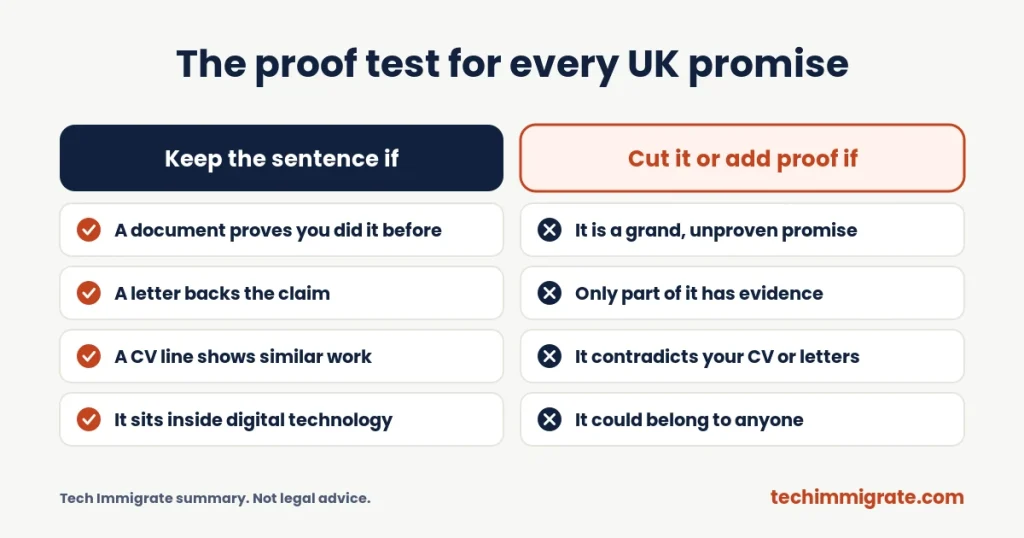
Here is the rule in action, using an illustrative, invented example. Imagine a data engineer with 6 years of experience at a product company. Their first draft says they will “transform the UK data ecosystem”. It also says they will “mentor hundreds of engineers” and will build a data platform for a UK health-tech company.
The first claim has no proof, so it goes. Next, the mentoring claim is only partly backed, because their evidence shows 2 years in a structured programme with 30 mentees. So the sentence becomes a plan to continue that programme’s model in the UK. The platform claim is well backed by an architecture document in their evidence, so it stays and moves to the top.
The engineer also checks the other three questions. Their city choice matches where their target employers sit, and their planned occupation stays in product work. So those answers need no change, which leaves the benefit section as the only real rewrite.
The final draft is shorter and less grand. It is also far easier to believe, because every promise now has a document behind it.
What a Successful Application Looks Like, and Its Limits
The Tech Immigrate homepage shares genuine client messages. One shows a person endorsed for Exceptional Talent, and another shows a visa granted by the Home Office.
Those messages have clear limits. They confirm outcomes, but they do not show the personal statements behind them, and names are hidden for privacy. So they prove the route works for real people, not that any one way of writing a statement works.
Tech Nation also reports a community of more than 2,600 visa alumni on its Global Talent Visa page. The same page recommends giving yourself up to 12 weeks to prepare your application. Our view is that the Global Talent Visa personal statement belongs near the end, once your evidence and letters are settled. That way you write the plan after you know exactly what proof supports it.
If your application is refused, a Global Talent Visa personal statement cannot be fixed on review. Tech Nation’s guide says new evidence cannot be submitted under review, which is only for processing mistakes. See the gov.uk page on refused endorsements, and our list of Tech Nation endorsement mistakes for common causes.
Frequently Asked Questions About the Global Talent Visa Personal Statement
The personal statement is limited to 1,000 words when you submit your application for endorsement. Answer the four questions concisely rather than filling space.
No. Tech Nation’s guide says the personal statement is written in a section of the Home Office form, while the 10 evidence documents are separate uploads that prove the criteria.
No. Tech Nation says the use of AI tools and templates for a personal statement is not acceptable, and it may check applications for AI use. Write it yourself, in your own words.
No. The Global Talent Visa does not need a job offer, and Tech Nation’s guide says it lets you change employers or be self-employed. You should still describe a realistic role in digital technology.
No. Your CV already covers your career history. Use the statement for your UK plans, and refer to past work only where it proves a plan is realistic.
The visa lets you change employers or work for yourself. However, the Immigration Rules say extensions and settlement need earnings in your endorsed field, so plans should stay within digital technology.
Your Next Step
Start with one exercise before you write a single sentence. Write the four questions at the top of a page. Under each one, list the documents, letters and CV lines that already support an answer. Any question with an empty list tells you where your plan, or your evidence, needs work.
For a structured way to build that evidence, the Tech Immigrate endorsement guides are written for specific roles, including software developers, digital marketers and tech investors. Each one includes evidence checklists and a 12-week planner. You can also review the Global Talent Visa criteria your statement should sit alongside.
How We Checked This Article
We checked every rule and figure in this article against its original source before publication. These were Tech Nation’s published application guide, the gov.uk Global Talent pages, the gov.uk fee page, and Appendix Global Talent of the Immigration Rules. Where a figure circulates online but does not appear in those sources, we say so rather than repeat it.
Tech Immigrate is independent of Tech Nation and the Home Office. This article is general information, not legal advice, and no one can guarantee an endorsement. For more guides, visit techimmigrate.com.
Every figure in this guide was checked against its original source before publication. Figures marked as illustrative are invented examples, not real results.
We write practical guides for tech professionals applying for the UK Global Talent visa. Tech Immigrate is independent of Tech Nation and the Home Office, and our articles are general information, not legal advice. Rules and fees change, so always check gov.uk before you apply.