Letter of Recommendation Authors: 6 Types of Referee to Approach (and 3 to Avoid)
Letter of Recommendation authors for a Global Talent Visa: 6 referee types to approach, 3 to avoid, how to ask and when. Pick your three with confidence.

In this article
- Who makes the best letter of recommendation authors?
- What makes someone an established expert?
- How independent should your referees be?
- 6 types of letter of recommendation authors to approach
- 3 types of referee to avoid
- Build your shortlist in five steps
- How to ask: an outreach outline
- What to give your referee
- A timeline for asking your authors
- What if you have few contacts?
- Illustrative example (fictional): a balanced trio for a founder
- Common mistakes when choosing letter of recommendation authors
- Letter of Recommendation authors FAQ
- Your Next Step
- How We Checked This Article
The best letter of recommendation authors for a Global Talent Visa are established digital technology experts who have known your work for at least 12 months. Tech Nation needs three of them. Each should see your work from a different angle.
This guide shows you six types of referee to approach and three to avoid. It also gives you a shortlist method, an outreach outline and a timeline. For help with the writing itself, see our guide to recommendation letters.
Key takeaways
- You need three letters from established experts in digital technology who have known your work for at least 12 months.
- The best authors have first-hand knowledge of your work and standing of their own in the field.
- Pick three authors who see different sides of your work, so the letters give different examples.
- Avoid friends, family, people who have not seen your work and anyone who wants to write from a template.
- Ask early, keep the request small and give your referee facts, not a finished letter.
- Shortlist five or six people, because some will say no or run out of time.
Who makes the best letter of recommendation authors?
The best letter of recommendation authors are established experts in digital technology with first-hand knowledge of your work. The gov.uk guidance sets two hard tests.
First, each author must be an established expert in digital technology, as judged by the endorsing body. Second, each must have known your work for at least 12 months. You must provide three letters, and each must come with the author's CV or other proof of their credentials.
Those two tests leave a lot of room. A senior engineer, a founder, a researcher or a conference chair can all pass, if they have the standing and the knowledge.
So the real question when you pick letter of recommendation authors is not "who is most famous?" It is "who has seen my work, and can the panel see why their view counts?"
What makes someone an established expert?
An established expert has a visible record of their own in digital technology, such as a senior role, published work, products, patents or community leadership. Tech Nation decides who counts, so your job is to make the evidence easy to see.
The guidance does not give a job title list. Therefore, treat seniority as one signal and not the only one. A principal engineer with a public body of work can carry more weight than a vice president with no public trace.
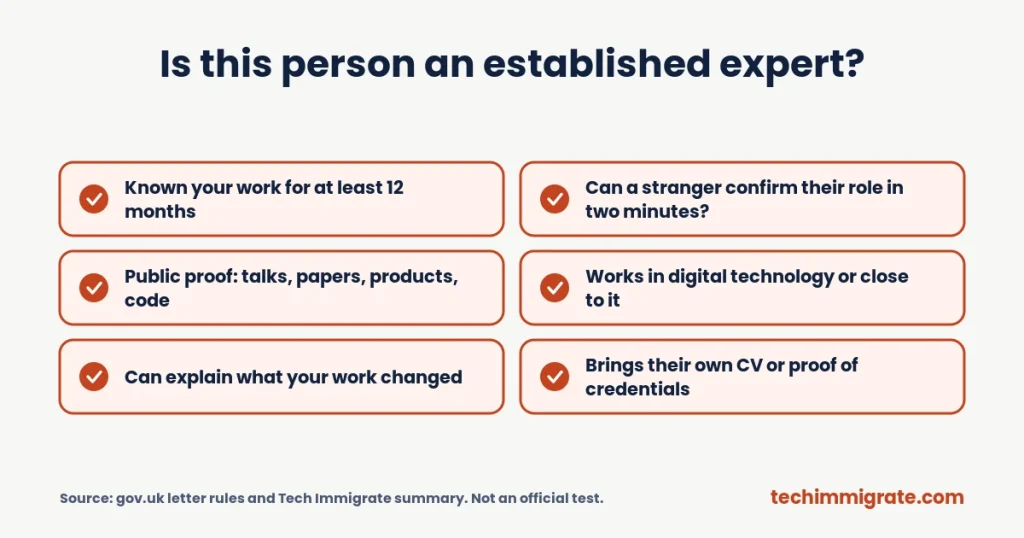
Ask these questions about each possible referee, whatever their title:
- Can a stranger confirm their role and field in two minutes?
- Do they have public proof of expertise, such as talks, papers, products or open source work?
- Do they work in digital technology, or in a field close to it?
- Can they explain what your work changed, from their own view?
If most answers are yes, the person is a strong candidate. If most are no, keep looking.
How independent should your referees be?
Referees outside your employer usually add more weight than people inside it, because they show recognition beyond your own company. Letters from a manager or founder can still help, so use them for the part of your story only they can tell.
Tech Nation's rules on recognition ask for evidence from outside your employer, so independence matters across the whole application. The letters are different from evidence, but the same logic helps. A mix of inside and outside voices reads as more balanced, which is why many applicants choose their letter of recommendation authors from both groups.
Applicants often aim for a blend like this:
- One person who saw your work up close, such as a senior colleague or manager.
- Another from outside your company, such as a client, partner or peer.
- A third who can judge your standing in the field, such as an organiser, academic or community leader.
That mix is a practice and not an official rule. The only formal requirements are the number of letters, the expertise and the 12 months.
6 types of letter of recommendation authors to approach
Six types of referee work well for most digital technology applicants, and each brings a different lane. Pick the three that match your story best.
Use the lane idea carefully when you weigh up letter of recommendation authors. The gov.uk rules ask for different examples across the three letters, so overlap is a risk. Each author should speak about a different project, period or kind of impact.
1. A senior leader from a company where you worked
A senior leader can speak about your role, your results and your standing inside a product team. This is often the strongest source of detail, because they saw the work daily.
Choose someone who directly led, reviewed or relied on your work, such as a CTO, head of engineering or product director. They should be able to name projects, dates and outcomes without notes.
The risk is overlap with your CV. If your referee only repeats your job description, the letter adds little. So ask them to focus on what changed because of you.
2. A client, customer or partner
A client or partner can show that your work mattered outside your own company. Their view is also independent of your employer, which adds weight.
Good examples include a customer's technical lead, a partner company's product head or a bank's engineering director who used your product. Ask them to describe the problem, what you built and what the result was for their business.
Check that they are an expert in digital technology and not only a buyer. A senior technical voice carries more weight than a procurement contact.
3. An industry peer, judge or conference organiser
A peer or organiser can speak to your standing in the field and your recognition outside your day job. This type suits applicants who speak, judge, mentor or write publicly.
For example, a hackathon judge, a conference programme chair or a leader of a respected tech community can say why they invited you and what you gave. They can also say how others reacted.
Ask for specifics: the event, the date, the audience and what changed afterwards. Without those, the letter reads as a courtesy.
4. An academic or research collaborator
A researcher can vouch for your technical depth, your papers or your standards work. This type suits applicants who publish, review papers or build on research.
The best choice is someone who worked with you or reviewed your work, such as a co-author, a lab lead or a journal editor. They can explain why your contribution was new and how others used it.
Avoid asking a famous academic who has never read your work. A less famous collaborator with first-hand knowledge writes a stronger letter.
5. An open source maintainer or community leader
An open source maintainer can confirm real use, real influence and real code. This type works well for developers whose public work sits at the core of their case.
Look for a maintainer of a major project, a core team member or a leader of a large community, who reviewed your pull requests or relied on your library. They can say who uses your work and why it mattered.
Pair their letter with public proof, such as usage numbers or release notes. Our guide to GitHub evidence covers how to document that proof.
6. An investor, board member or accelerator mentor
An investor or mentor can explain your commercial or entrepreneurial impact. This type suits founders and senior product leaders.
A venture investor, advisory board member or accelerator lead can describe how your product grew, what the market response was and why your decisions mattered. Their outside view on traction is valuable.
Make sure they know your work in detail. A passive investor who sees one update a quarter may struggle to give examples, so choose the person who spent time with you.
3 types of referee to avoid
Avoid three types of referee: people who do not know your work, people without standing of their own, and anyone who will not write in their own voice. Each one puts the whole application at risk.
Tech Nation's guidance on supporting documents warns that vague or generic letters undermine an application. These three types are the usual source of that problem.
1. Friends, family and people who have not seen your work
Friends and family cannot give first-hand, expert judgement of your work, even if they know you well. The same goes for a famous name who has never worked with you.
Gov.uk requires the author to have known your work for at least 12 months. A letter that only says "I know she is talented" fails that test. A well-known name with no detail is also weaker than a lesser-known person with real examples.
2. People without expert standing, or too many from one company
A junior colleague, a peer with no public record or a team of referees from one employer rarely shows breadth. The panel wants three views that stand up alone.
If two or three of your referees share a manager or a team, their letters tend to repeat each other. That risks breaking the rule that the letters should show different examples. Also, a letter from someone who reports to you says little about your standing in the field.
Seniority alone is not enough, but a visible record of expertise is.
3. Anyone who wants a template or a ghost-written letter
Avoid anyone who offers to sell you a letter, or who insists you write it and they just sign. Tech Nation's guidance rules out templated and AI-written documents.
Some referees are short of time and ask for a draft. Applicants report this often, but that report is not official guidance. A safe path is to give notes and facts, then let the referee write in their own words.
Also avoid reusing an old reference. Gov.uk says you cannot use a letter that was written for another reason.
Build your shortlist in five steps
Build a shortlist of five or six people, then narrow it to three after you talk to them. This gives you a back-up if someone declines.
- List everyone who has seen your best work in the last five years.
- Mark each person's standing. Note their role, public record and field.
- Match each person to a lane such as product impact, field standing or technical depth.
- Check the 12-month rule. Confirm how long they have known your work.
- Rank them. Keep the three with the strongest first-hand detail and the least overlap.
Illustrative example (fictional): Maya, a backend engineer, lists seven people. She drops two because they have not seen her recent work. She drops one because he works in HR. Then she keeps a former CTO, a partner company's head of platform and a maintainer of a payments library she contributes to.
Maya's trio gives three lanes: product impact, outside client view and open source influence. Her fourth and fifth names stay on the list as back-ups.
How to ask: an outreach outline
Ask by email or message with a short, specific request, and offer a call. Make it easy for the person to say yes or no quickly.
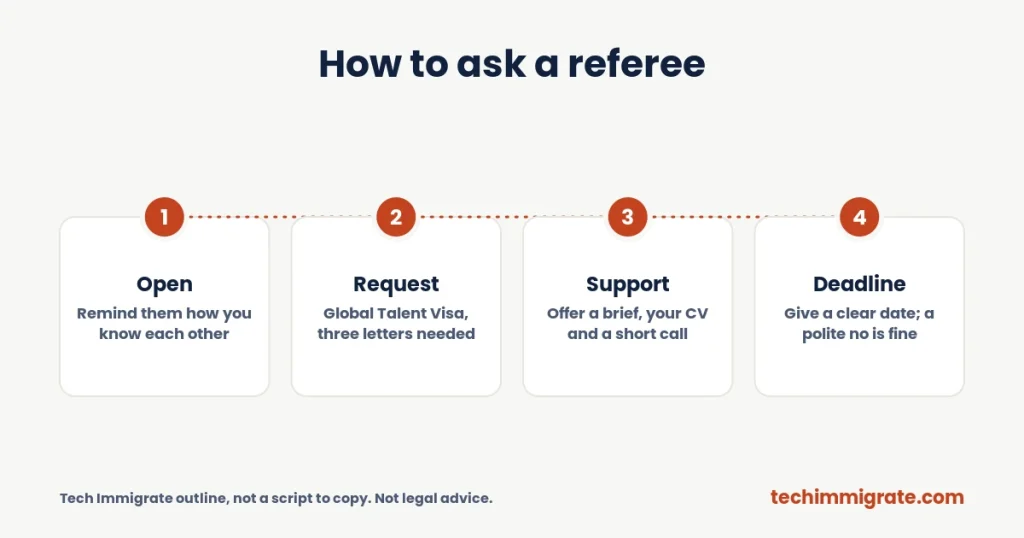
Here is a simple outline. It is not a script to copy.
- Opening: remind them how you know each other and the project you shared.
- Request: say you are applying for the Global Talent Visa and need three letters.
- Why them: name what they saw that others did not.
- Size of task: say the letter can run up to three sides, and that shorter is fine.
- Support: offer a one-page brief, your CV and a short call.
- Deadline: give a clear date and say a polite no is fine.
Illustrative example (fictional): "Hi Dr Okafor, I am applying for a UK Global Talent Visa and I would value your view on the routing project we worked on together for two years. Would you be open to writing a letter? I can send a one-page brief and a call if useful. A date of 15 March would give us both time, and I understand if you are too busy."
Keep it warm, brief and specific. Never pressure a referee, and never imply that you will write the letter for them.
What to give your referee
Give your referee facts and requirements, not a finished letter. A good pack helps them write something specific in less time.
Send these items in one tidy email:
- The five points a letter must cover, from the gov.uk guidance.
- The format rules: typed, dated, signed, up to three single sides of A4.
- Your CV and a list of the projects they saw, with dates.
- Links to public proof, such as talks, papers, press or code.
- Your chosen route, Exceptional Talent or Exceptional Promise.
- A reminder to attach their own CV or proof of credentials.
Our guide to Exceptional Talent and Exceptional Promise helps you pick the route before you brief anyone.
Then step back. The panel wants the referee's honest view, so let them choose the words, the examples and the order.
A timeline for asking your authors
Start asking about eight weeks before you plan to apply, because senior people need time. These timings are suggestions and not official deadlines.
| When | Action |
|---|---|
| 8 weeks before | Build the shortlist and check the 12-month rule |
| 7 weeks before | Send the first requests to five or six people |
| 6 weeks before | Confirm your three and thank the rest |
| 5 weeks before | Send the brief, CV and format rules |
| 3 weeks before | Offer a short call and answer questions |
| 2 weeks before | Gently check progress |
| 1 week before | Collect signed PDFs and credentials, then check dates and names |
Remember that the endorsement stage usually takes five to eight weeks once you apply. Therefore, finish your letters before you start the clock.
What if you have few contacts?
If you have few contacts, start with the people who saw your best work, even if they work at small companies or in other countries. Expertise matters more than company size, and you can build contacts in the weeks before you apply.
New arrivals and early-career applicants often worry here. For Exceptional Promise, referees speak to your potential, so a senior mentor, a lead from a recent project or a community organiser can work well.
Career switchers can use the new field as the anchor. Pick people who saw your work in the last few years, not old managers from a different field.
Applicants under NDAs can ask referees to describe impact in general terms, such as scale, type of system and result. The referee should not break any confidentiality rules.
If you still cannot find three, spend a few months building real working links. Join a project, speak at a meet-up or contribute to open source, then ask once people have seen your work for 12 months.
Illustrative example (fictional): a balanced trio for a founder
Illustrative example (fictional): Tomas founded a data tool company and plans to apply as Exceptional Talent. He picks three authors and gives each a lane.
| Author | Why they count | Lane |
|---|---|---|
| A lead investor in his company | Saw growth and decisions up close | Commercial impact |
| A technical director at a customer bank | Used the product in production | Outside client view |
| A programme chair at a data conference | Invited and judged his talks | Standing in the field |
Each author knows his work for more than 12 months and has public credentials. Their letters should give different examples, so none repeats the others.
Tomas then checks each claim against his evidence folder. If a letter mentions a result he cannot prove, he finds proof or asks the author to drop it.
Common mistakes when choosing letter of recommendation authors
The most common mistakes are picking by title alone, asking too late and sending three letters that overlap. All of them are fixable if you plan early.
Applicants report that weak or generic letters come up often when applications fail. That comes from applicant communities, not official data. Even so, it matches Tech Nation's own warning about vague letters.
Read our guide to Tech Nation endorsement mistakes for the wider list. For letters, the fix is the same each time: choose authors for what they saw, not what they are called.
Letter of Recommendation authors FAQ
Each author must be an established expert in digital technology who has known your work for at least 12 months. Seniors, founders, clients, researchers, peers and community leaders can all qualify, as long as they have standing in the field and can describe your work first-hand.
Yes, a manager can write one letter if they are an established expert and know your work well. Many applicants balance that with authors from outside their employer, such as clients or peers, because outside voices show recognition beyond your own company.
This is not a good choice. Friends and family rarely have expert standing or first-hand knowledge of your technical work. The gov.uk rules ask for established experts who have known your work for at least 12 months, so choose people who can judge it.
You must submit three letters, but ask five or six people first. Some will decline or run out of time. A longer shortlist gives you room to pick the three with the strongest detail and the least overlap.
This is risky. Tech Nation's guidance rules out templated and AI-written documents, and the letter must reflect the author's own view. Give them facts, dates and links, then let them write, check and sign it in their own words.
Your Next Step
Strong letter of recommendation authors help most when your evidence is already clear. Our role-specific endorsement guides give you an evidence checklist and planner, so your referees know what to confirm. Start at the guides hub and open your role.
Founders can use the startup founders guide, and researchers have the tech researchers guide. Investors can open the tech investors guide, while engineers have the software developers guide. Want the guide for your role? See the guides.
How We Checked This Article
We checked the letter rules against the gov.uk page on documents you need to apply for endorsement: three letters, established experts, 12 months, different examples and no reused letters. We checked the eligibility criteria on the gov.uk See the guides and the warning about vague letters against Tech Nation's own guidance. Adviser guides helped us find common gaps.
The six types and three to avoid are our own practice-based grouping, not an official list. Statements about what applicants report come from applicant communities. The people and cases here are fictional.
Tech Immigrate is independent of Tech Nation and the Home Office. This article is general information, not legal advice, and nobody can guarantee an endorsement. Always confirm current rules on gov.uk before you apply.
We write practical guides for tech professionals applying for the UK Global Talent visa. Tech Immigrate is independent of Tech Nation and the Home Office, and our articles are general information, not legal advice. Rules and fees change, so always check gov.uk before you apply.