Global Talent for PhD Students and Researchers: Which Route Fits
Global Talent visa for PhD students and researchers in tech: Tech Nation or a research body, switching from a Student visa, the Graduate route and settlement.

In this article
- Your Options at a Glance
- Can You Apply While Doing a PhD?
- Tech Nation or a Research Body?
- Presenting Academic Work to Tech Nation
- Presenting Work to a Research Body
- Three Example Profiles
- Letters of Recommendation for Researchers
- Building Evidence During Your PhD
- The Graduate Visa for PhD Graduates
- Switching From a Postdoc on Skilled Worker
- Settlement for Researchers
- Funding and Support for Researchers
- A Decision Path for PhD Students and Postdocs
- Moving to the UK for a Postdoc or Research Role
- What Happens to Your PhD After You Switch
- Common Mistakes Researchers Make
- Frequently Asked Questions
- Choose the Route That Fits Your Research
- How We Checked This Article
PhD students and early-career researchers in computing, AI, data science, cybersecurity and related fields have more Global Talent options than most applicants, and more ways to choose wrongly. Depending on your work, you might apply to Tech Nation for digital technology, to one of the research endorsing bodies through peer review, or through a research fast-track based on a job, fellowship or grant. You might also stay on a Student visa, move to the Graduate route, or take a Skilled Worker job first.
This guide is for PhD students, recent doctoral graduates and postdoctoral researchers whose work sits in or near digital technology. It explains which Global Talent route fits which profile, when you can switch from a Student visa, how to present academic work to Tech Nation, how the Graduate visa compares, and how each choice affects settlement.
Key takeaways
- PhD students on a Student visa can switch to Global Talent inside the UK once they have studied a full-time PhD for at least 24 months, or completed their course.
- Tech Nation assesses digital technology applicants. Academic contributions are one of its four optional criteria, but it still looks for impact in the digital technology sector.
- Research endorsing bodies (the Royal Society, the Royal Academy of Engineering, the British Academy and UK Research and Innovation) assess academic and research applicants. Fast-track routes based on an eligible job, fellowship or endorsed grant are usually decided in about 2 weeks; peer review in about 5 weeks.
- Research body endorsements lead to settlement after 3 years under the current rules. Tech Nation Exceptional Promise leads to settlement after 5.
- The Graduate visa for PhD graduates stays at 3 years, even after the cut to 18 months for other graduates from 1 January 2027, but Graduate time does not count towards settlement.
- Choose the body that matches where your strongest recognition comes from: industry or academia.
Your Options at a Glance
| Route | Best for | Settlement under current rules | Counts towards settlement? |
|---|---|---|---|
| Global Talent via Tech Nation | Researchers whose work has impact in industry and tech products | 3 years (Talent) or 5 years (Promise) | Yes |
| Global Talent via a research body, fast-track | Researchers with an eligible job offer, fellowship or endorsed grant | 3 years | Yes |
| Global Talent via a research body, peer review | Researchers with strong academic recognition but no qualifying position | 3 years | Yes |
| Graduate visa (PhD) | Recent PhD graduates who need time | Not a settlement route | No |
| Skilled Worker | Researchers with a sponsored job offer | 5 years now; changing under reforms | Yes |
Can You Apply While Doing a PhD?
Yes, but timing matters if you want to switch inside the UK.
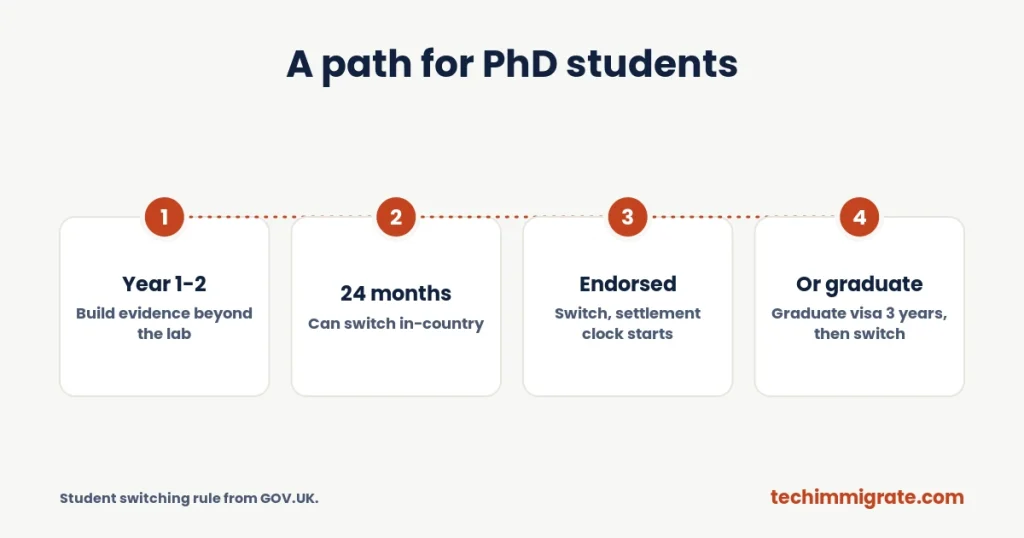
GOV.UK says Student visa holders can switch to Global Talent only if they have either completed their sponsored course, or have been studying a full-time PhD for at least 24 months. Before that point, you could still apply for endorsement, but you would need to leave the UK and apply for the visa from outside if you wanted to switch earlier.
In practice, many PhD students apply for endorsement in their third year, once they have papers, talks or industry collaborations to show, and switch once endorsed. Switching gives you open work rights and a settlement clock, both of which a Student visa does not.
Points to check before switching mid-PhD:
- Your funding. Some studentships have conditions about immigration status or nationality. Ask your funder.
- Your university. Tell your university's visa team. If you leave the Student route, your university stops sponsoring you, but you can continue your PhD on Global Talent.
- Tuition fees. Changing visa does not usually change your fee status mid-course, but check.
Tech Nation or a Research Body?
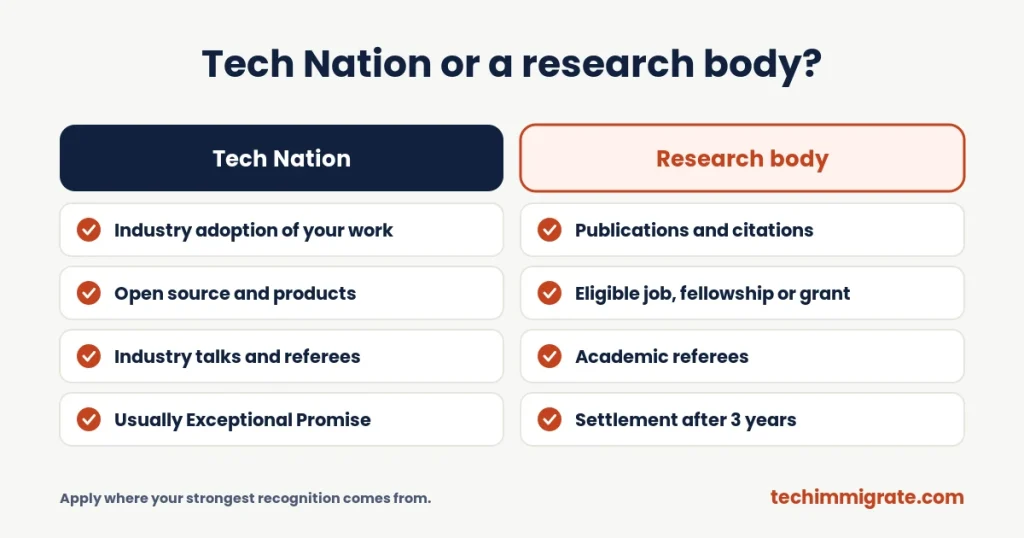
This is the most important decision for PhD-level applicants. The rule of thumb: apply where your strongest recognition comes from.
When Tech Nation fits
Tech Nation assesses leaders and emerging leaders in digital technology. Your work fits well if:
- your research is used in products, platforms or open-source tools adopted by industry;
- you have worked with tech companies, through internships, collaborations or spin-outs;
- your recognition includes industry conferences, technical talks, hackathons or startup programmes;
- your referees include senior people in tech companies as well as academics.
Tech Nation's fourth optional criterion is academic contributions through research endorsed by experts. Papers, citations and conference publications can support it. But you still need to meet the mandatory criterion, recognition as a leading or emerging talent in digital technology, and at least one other optional criterion. A strong publication record alone is not usually enough for Tech Nation. Our article on the academic contribution Tech Nation looks for explains how to present it.
Most PhD students who apply to Tech Nation apply as Exceptional Promise, which leads to settlement after 5 years.
When a research body fits
The research endorsing bodies assess people in academia and research. Your profile fits better if:
- your recognition comes mainly from peer-reviewed publications, citations and academic awards;
- you hold, or have been offered, an eligible academic or research position at a UK institution;
- you hold an eligible individual fellowship;
- you are named on research funded by an endorsed funder, through the UK Research and Innovation-approved route;
- your referees are mainly senior academics.
GOV.UK says the fast-track routes, based on an eligible job, fellowship or endorsed grant, are usually decided in about 2 weeks. Peer review, for people without a qualifying position, usually takes about 5 weeks.
Research body endorsements lead to settlement after 3 years under the current rules, and absences for overseas research can be disregarded in some cases. That exemption does not apply to Tech Nation endorsements.
A comparison for PhD-level applicants
| Tech Nation | Research body | |
|---|---|---|
| Field | Digital technology | Academia and research |
| Best evidence | Industry impact, products, open source, technical recognition | Publications, citations, fellowships, academic positions |
| Typical level for PhD students | Exceptional Promise | Promise or Talent, depending on route |
| Fast-track | None since August 2025 | Job offer, fellowship or endorsed grant |
| Decision time | Applicants report 5 to 8 weeks | About 2 weeks (fast-track) or 5 weeks (peer review) |
| Settlement | 3 years (Talent) or 5 years (Promise) | 3 years |
| Research absence exemption | No | Yes, in some cases |
If you are genuinely between the two, look at your three strongest referees and your five strongest pieces of evidence. They usually point clearly to one body. Our tech researchers guide explains the choice in depth.
Presenting Academic Work to Tech Nation
If you choose Tech Nation, the biggest risk is presenting your PhD as an academic CV. Tech Nation's assessors want to see impact in digital technology. Useful approaches applicants report:
- Translate citations into impact. Explain who uses your work: companies, open-source projects, standards bodies or products.
- Show adoption. If your code is on GitHub, show stars, forks, downloads and dependent projects. If your model or dataset is widely used, show the evidence.
- Highlight industry collaboration. Internships, joint projects, patents and spin-outs connect research to the sector.
- Include talks beyond academia. Industry conferences, meetups and invited talks at companies show recognition outside your lab.
- Choose referees across both worlds. A senior academic plus industry leaders who know your work often makes a stronger set than three academics.
Our article on why tech researchers get refused Global Talent endorsement covers the common mistakes.
Presenting Work to a Research Body
If you choose a research body through peer review, your application is assessed by academic peers. Strong applications typically show:
- publications in recognised venues, with your contribution clear;
- citations and other measures of influence, explained in context for your field;
- awards, fellowships or competitive funding;
- invitations to review, speak or collaborate;
- letters from senior academics who know your work.
If you have an eligible job offer, fellowship or endorsed grant, the fast-track routes rely on that instead of a full peer review.
Three Example Profiles
These illustrative profiles show how the choice plays out.
A final-year machine learning PhD student with a widely used open-source library. The library has thousands of users in industry, the student has spoken at two industry conferences and interned at an AI company. Referees could include the library's industry users and the student's supervisor. Tech Nation as Exceptional Promise is the natural fit, because the strongest recognition is in industry adoption.
A postdoc in cryptography with strong publications and a fellowship offer. The researcher has papers in top venues, has reviewed for major conferences, and has been offered an eligible individual fellowship at a UK university. The research fast-track is likely faster and leads to settlement after 3 years.
A second-year PhD student in human-computer interaction with early papers and a startup idea. The student has a few workshop papers and some hackathon wins, but limited recognition so far. Switching inside the UK is not yet possible until 24 months into the PhD. The better plan may be to keep building evidence, apply in the third year or after completion, and use the Graduate visa as a bridge if needed.
Letters of Recommendation for Researchers
Researchers often have easy access to senior academics, which is an advantage. But the right letters depend on the body you apply to.
For Tech Nation, letters should come from established people in digital technology who know your work and can describe its impact on the sector. A supervisor's letter can be useful, but three academic letters that focus on publication quality rarely speak to Tech Nation's criteria. Aim for a mix: an academic who can explain the significance of your research, and industry leaders who have used or built on it.
For research bodies, letters from senior academics in your field who can assess your research standing are usually most relevant.
In both cases, each referee must write their own letter with different examples. Tech Nation's guidance says AI-written content is not acceptable and that it may contact referees. Our guides on recommendation letters and choosing referees go deeper.
Building Evidence During Your PhD
If you want Global Talent as an option when you finish, start building the right kind of evidence early:
- Release your code and data where you can, and track adoption.
- Present beyond academic venues, at industry meetups and conferences.
- Collaborate with industry through internships, joint projects or consulting allowed by your visa.
- Write for practitioners, for example technical blog posts explaining your research.
- Keep a log of every talk, release, citation milestone, award and media mention, with dates.
Be careful about work limits on a Student visa. Students usually have restricted working hours during term time, so check what your visa allows before taking on paid work.
The Graduate Visa for PhD Graduates
If you complete a PhD in the UK, you can usually apply for the Graduate visa, which gives you 3 years to work or look for work without sponsorship. From 1 January 2027, the Graduate visa is being cut from 2 years to 18 months for bachelor's and master's graduates, but doctoral graduates keep 3 years.
The Graduate visa is simple and flexible, but it has two important limits:
- It cannot be extended. When it ends, you need another visa.
- It does not count towards settlement. The earned settlement response confirms that time on the Graduate route will not count under the new framework either.
Many PhD graduates use the Graduate visa as a bridge: they take a job or postdoc, build evidence, and then switch to Global Talent. The earlier you switch, the earlier your settlement clock starts.
Switching From a Postdoc on Skilled Worker
Many postdoctoral researchers are sponsored on Skilled Worker visas by their universities. Switching to Global Talent can give you:
- freedom to move between institutions, or into industry, without a new sponsor;
- the ability to consult, found a spin-out or take on side projects;
- a faster route to settlement if you are endorsed by a research body or as Tech Nation Exceptional Talent.
The caseworker guidance confirms that time on Skilled Worker can be combined with Global Talent towards settlement. Our guide to switching to Global Talent inside the UK explains the process.
Settlement for Researchers
Under the current rules:
| Route | Qualifying period for indefinite leave to remain |
|---|---|
| Research body endorsement | 3 years |
| Tech Nation Exceptional Talent | 3 years |
| Tech Nation Exceptional Promise | 5 years |
| Prize holder | 3 years |
The 180-day absence limit applies, but research bodies' endorsees can have some research absences disregarded. You must also show you earned money in your field, meet the English requirement (B1, rising to B2 for applications from 26 March 2027) and pass the Life in the UK test.
The government's earned settlement response of 2 November 2026 keeps a 3-year path for a "Highest Talent Group" expected to include Global Talent holders, subject to Migration Advisory Committee advice. Our Global Talent ILR guide explains the details.
Funding and Support for Researchers
In June 2025, the government launched a Global Talent Taskforce and a £54 million Global Talent Fund, run through UK Research and Innovation, to cover relocation and research costs for world-class researchers and their teams over five years. It is aimed at senior researchers recruited by UK institutions rather than individual PhD students, but it shows the government's interest in attracting research talent. Some UK institutions also cover visa costs for their staff; ask your employer.
A Decision Path for PhD Students and Postdocs
- Are you the named winner of an eligible prize? Use the prize route.
- Do you have an eligible academic job offer, fellowship or endorsed grant? Consider the research fast-track.
- Is your strongest recognition academic? Consider research peer review.
- Is your strongest recognition in industry and tech? Apply to Tech Nation, usually as Exceptional Promise at PhD level.
- Not ready yet? Use the Graduate visa or a sponsored role while you build evidence, then switch.
Moving to the UK for a Postdoc or Research Role
If you are currently abroad and have been offered a research role at a UK university or institute, you have a choice: come on a Skilled Worker visa sponsored by the institution, or on Global Talent through a research fast-track. Many universities support Global Talent applications for eligible posts because it removes sponsorship costs and gives researchers more flexibility.
Ask your future employer's HR or immigration team whether your post is eligible for the fast-track job offer route, and whether they cover visa and health surcharge costs. If your role is in industry rather than academia, the research fast-track usually does not apply, and Tech Nation or a sponsored route is more likely.
What Happens to Your PhD After You Switch
Switching from a Student visa to Global Talent does not end your PhD. You can continue studying on Global Talent, because study is allowed on the route. The practical differences are that your university no longer sponsors your visa, you no longer have Student visa work-hour limits, and your status no longer depends on your attendance and progress being reported to the Home Office.
You may also be able to take paid work alongside your PhD more freely, but check your studentship terms first. Some funders limit outside work regardless of immigration status.
Common Mistakes Researchers Make
- Sending an academic CV to Tech Nation without showing industry impact. Assessors need to see why your research matters to the digital technology sector, not only to other researchers.
- Applying to Tech Nation as Exceptional Talent too early in a research career.
- Relying only on publications for Tech Nation.
- Choosing three academic referees for a Tech Nation application with an industry focus.
- Switching from a Student visa before 24 months of a PhD, which is not allowed in-country.
- Staying on the Graduate visa too long, losing time that could count towards settlement.
- Ignoring the research body routes when they would be faster and lead to 3-year settlement.
Frequently Asked Questions
You can apply for endorsement at any time. To switch to Global Talent inside the UK from a Student visa, you must have completed your course or studied a full-time PhD for at least 24 months.
Apply where your strongest recognition comes from. Industry impact points to Tech Nation; academic recognition, positions and fellowships point to a research body.
Yes, under the academic contributions optional criterion. But you still need to meet the mandatory criterion and at least one other optional criterion.
GOV.UK says fast-track routes are usually decided in about 2 weeks and peer review in about 5 weeks.
No. It stays at 3 years for doctoral graduates. Bachelor's and master's graduates applying from 1 January 2027 get 18 months.
No. Switching to Global Talent earlier starts your settlement clock sooner.
Yes. Study is allowed on Global Talent, so you can finish your PhD. Your university no longer sponsors your visa, and Student visa work-hour limits no longer apply, but check your funding terms.
The caseworker guidance says time on certain routes, including Skilled Worker, can be combined with Global Talent towards settlement.
After 3 years for research body endorsements and Tech Nation Exceptional Talent, or 5 years for Tech Nation Exceptional Promise, under the current rules.
Choose the Route That Fits Your Research
Researchers often underestimate how much their work already counts, or apply to the wrong body because it feels more familiar. Take an hour to map your evidence honestly against both sets of criteria before you decide. The right choice can save you months of waiting and, under the current rules, two years on the road to settlement. The right route depends on where your work makes its mark. If your research shapes products and industry practice, our tech researchers guide and other role-specific Global Talent guides show how to present it to Tech Nation.
How We Checked This Article
We checked the rules against GOV.UK's pages on switching to a Global Talent visa and Global Talent for researchers and academics, Appendix Global Talent and the Home Office Global Talent caseworker guidance (version 19.0), in November 2026. Graduate visa changes come from the statement of changes confirming the cut to 18 months from 1 January 2027, with doctoral graduates keeping 3 years. The settlement section draws on the government's earned settlement response (2 November 2026), and the funding section on the government's Global Talent Taskforce announcement. Endorsement timings for Tech Nation are applicant-reported.
Tech Immigrate is independent of Tech Nation, the research endorsing bodies and the Home Office. This article is general information, not legal advice.
We write practical guides for tech professionals applying for the UK Global Talent visa. Tech Immigrate is independent of Tech Nation and the Home Office, and our articles are general information, not legal advice. Rules and fees change, so always check gov.uk before you apply.