Am I Eligible for the Global Talent Visa? A 10-Question Self-Check
Global Talent visa eligibility for tech professionals: the formal rules, Tech Nation criteria and a 10-question self-check to see if you are ready to apply.


In this article
- The Formal Eligibility Rules
- How Tech Nation Decides
- The 10-Question Self-Check
- Reading Your Score
- Exceptional Talent or Exceptional Promise?
- Two Example Self-Checks
- Myths About Eligibility
- Eligibility by Role
- Eligibility at the Visa Stage
- If You Have Been Refused Before
- What to Do If You Are Not Ready Yet
- Alternatives If Global Talent Is Not Right Now
- Frequently Asked Questions
- Turn Your Self-Check Into a Plan
- How We Checked This Article
Before you spend £561 on a Global Talent endorsement application and weeks gathering evidence, it makes sense to ask a simple question: am I actually eligible? The honest answer is harder to find than it should be. The formal rules are short, but what Tech Nation expects in practice is set out in its guidance, its refusal letters and years of applicant experience.
This article gives you a 10-question self-check for tech professionals. It covers the formal eligibility rules, the criteria Tech Nation assesses, the practical hurdles that trip applicants up, and how to read your result. It will not tell you for certain whether you will be endorsed, because no checklist can. But it will show you where you stand, where your gaps are, and whether you should apply now, apply later or look at another route.
Key takeaways
- The formal rules are simple: you must be 18 or over and be a leader or potential leader in an eligible field, shown through endorsement or an eligible prize.
- For tech, eligibility in practice means meeting Tech Nation's mandatory criterion and at least two of its four optional criteria, with separate evidence for each.
- There is no minimum salary, no English test at entry, no degree requirement and no job offer needed.
- The questions that decide most applications are about external recognition, personal impact and the quality of your letters.
- Exceptional Talent is for established leaders; Exceptional Promise is for people earlier in their careers. Choose the level your evidence supports.
- Tech Nation refused about 82% of decided cases in 2025, according to Freedom of Information figures reported by Edgewater Legal, so an honest self-assessment is worth the time.
The Formal Eligibility Rules
Appendix Global Talent sets out the legal requirements. For a tech applicant applying through endorsement, the core rules are:
- You must be 18 or over.
- You must hold a valid endorsement from an approved endorsing body, which for digital technology is Tech Nation, or have won an eligible prestigious prize.
- You must apply for the visa within 3 months of your endorsement.
- Your endorsement must not have been withdrawn.
- You must meet the general suitability rules, which cover things like criminality and immigration history.
That is it. There is no minimum salary, no English language test at entry, no maintenance funds requirement for the main applicant, no degree requirement and no requirement for a job offer. Our article on what the Global Talent visa is explains the route in more detail.
The real test is the endorsement. That is what the self-check below focuses on.
How Tech Nation Decides
Tech Nation assesses whether you are a leader (Exceptional Talent) or potential leader (Exceptional Promise) in digital technology. To be endorsed, you must meet:
- the mandatory criterion: recognition as a leading talent, or potential leading talent, in digital technology; and
- at least two of four optional criteria.
The four optional criteria are:
- OC1: innovation, typically in a product-led company or a new product;
- OC2: recognition for work beyond your occupation that advances the field;
- OC3: significant technical, commercial or entrepreneurial contributions;
- OC4: academic contributions through research endorsed by experts.
You submit up to 10 pieces of evidence, a CV, a personal statement and three letters of recommendation. Each optional criterion needs its own evidence. Our article on Global Talent visa criteria explains each one.

The 10-Question Self-Check
Answer each question honestly. Give yourself 2 points for a clear yes, 1 point for a partial yes, and 0 for no. The scoring is not official, because Tech Nation does not use points, but it helps you see your position.
1. Is your work clearly in digital technology?
Tech Nation assesses people working in digital technology: software, data, AI, cybersecurity, product, design for digital products, technical founding, tech investment and commercial leadership in tech companies.
Applicants report that people whose work is mainly IT support, generic consultancy, or non-technical roles in non-tech companies find it harder to show they are part of the digital technology sector. If your role uses technology but is not about building or scaling technology, think carefully about how your work fits.
Score 2 if your work is clearly building, leading or scaling digital technology. Score 1 if it is partly in tech. Score 0 if technology is incidental to your role.
2. Has anyone outside your employer recognised your work?
This is the heart of the mandatory criterion. Recognition means things like:
- invited talks at recognised conferences or events;
- press coverage about your work, not just your employer;
- industry awards or shortlists;
- open-source projects used by others;
- judging, reviewing or advisory roles;
- papers or patents with you as a named contributor.
Score 2 for several clear examples in the last five years. Score 1 for one or two. Score 0 if all your recognition is internal, such as promotions, ratings and internal awards.
3. Can you show impact you personally created?
Tech Nation looks at what you did, not what your company did. Can you point to a product, system, feature, company or piece of research and show your specific role and its measurable effect?
Score 2 if you can show specific, measurable results with your role clear. Score 1 if your role was significant but hard to separate from the team. Score 0 if you mostly have job titles and responsibilities.
4. Is your strongest evidence from the last five years?
Tech Nation's guidance focuses on recent achievements. Old successes help explain your career but rarely carry an application on their own.
Score 2 if your strongest evidence is recent. Score 1 if it is mixed. Score 0 if most of it is older.
5. Can you meet at least two optional criteria with separate evidence?
List your evidence against OC1 to OC4. You need at least two criteria covered, each with its own documents.
Score 2 if two criteria are clearly covered with strong, separate evidence. Score 1 if one is strong and one is weak. Score 0 if you can only cover one.
6. Do you have three strong referees?
You need three letters from established experts in digital technology who know your work and can describe it in detail. They should be recognised in their own right, and each should give different examples.
Score 2 if you have three senior, credible referees who know your work well. Score 1 if you have two strong ones and one weaker. Score 0 if your referees are mainly your line managers or colleagues at your level.
7. Have you done anything for the tech community beyond your job?
This supports OC2 and often strengthens the mandatory criterion. Examples include mentoring, running meetups, maintaining open-source projects, teaching, writing widely-read technical content, or contributing to standards.
Score 2 for sustained, visible contributions. Score 1 for occasional activity. Score 0 for none.
8. Can you prove everything with documents?
Web links are not accepted. Every claim needs a document: PDFs of articles, screenshots of metrics with dates, conference programmes, letters from organisations. Confidential numbers need company approval or a different form of evidence.
Score 2 if you can document everything. Score 1 if some key claims are hard to prove. Score 0 if much of your impact is confidential or undocumented.
9. Is your immigration history clean?
The visa stage checks suitability. Previous overstays, refusals for deception, or criminal convictions can cause problems even after endorsement.
Score 2 if your history is clean. Score 1 if there is something minor you can explain. Score 0 if there are serious issues, in which case take regulated advice before applying.
10. Can you explain what you will do in the UK?
Your personal statement should explain your plans and how you will contribute to UK digital technology. You do not need a job offer, but you do need a credible plan.
Score 2 if you have a clear plan. Score 1 if it is general. Score 0 if you have not thought about it.
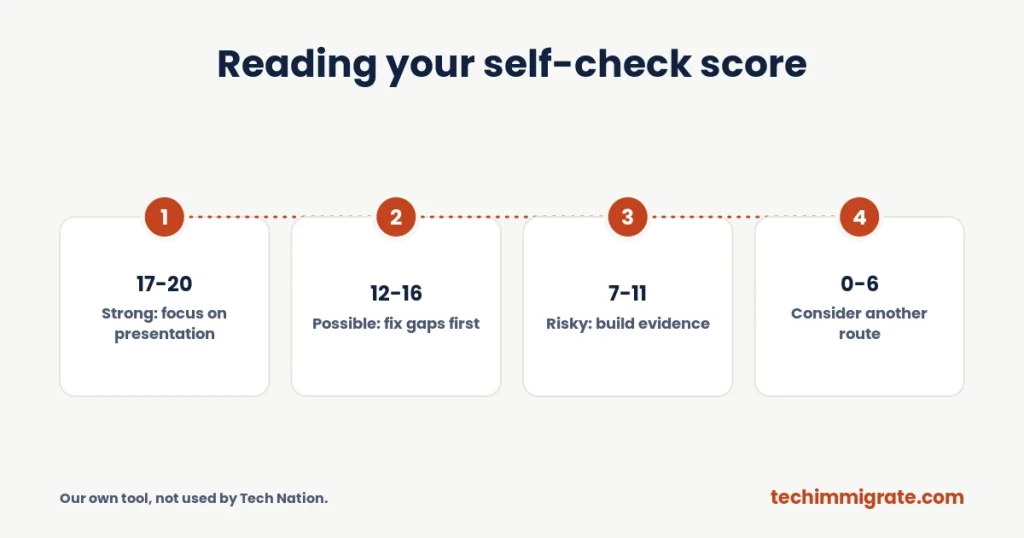
Reading Your Score
| Score | What it suggests |
|---|---|
| 17 to 20 | Strong position. Focus on presenting your evidence well and choosing the right level. |
| 12 to 16 | Possible, with work. Your gaps are probably in recognition or letters. Fix them before applying. |
| 7 to 11 | Risky now. Consider spending 6 to 12 months building external recognition first. |
| 0 to 6 | Unlikely to succeed at the moment. Consider another route, such as Skilled Worker, while you build your profile. |
Questions 2, 3, 5 and 6 matter most. A low score on any of those is a serious warning even if your total looks reasonable. A perfect score on questions 1, 9 and 10 does not compensate for weak recognition.
Exceptional Talent or Exceptional Promise?
Your self-check also helps you choose your level.
| Signal | Leans to Exceptional Talent | Leans to Exceptional Promise |
|---|---|---|
| Career stage | Established, often senior | Earlier career |
| Recognition | Sustained, national or international | Emerging, growing |
| Leadership | Leading teams, companies or communities | Showing clear potential to lead |
| Settlement | 3 years | 5 years |
Applying for Exceptional Talent when your evidence shows promise is a common reason for refusal. Applying for Exceptional Promise when you are clearly established can also be a mistake, because you settle 2 years later than you could. Our comparison of Exceptional Talent and Exceptional Promise and our article on qualifying as an emerging leader go deeper.
Two Example Self-Checks
To show how the scoring works in practice, here are two fictional profiles based on patterns that come up often.
Profile A: senior backend engineer at a large company. Eight years of experience, led the redesign of a payments system used by millions of customers, and has a strong internal reputation. No public talks, no open-source work, no press. Referees would be two managers and a colleague.
- Question 1 (digital technology): 2
- Question 2 (external recognition): 0
- Question 3 (personal impact): 1, because the role is significant but internal
- Question 4 (recent): 2
- Question 5 (two optional criteria): 1
- Question 6 (referees): 0
- Question 7 (community): 0
- Question 8 (documents): 1
- Question 9 (immigration history): 2
- Question 10 (UK plans): 2
Total: 11. On paper this is a strong engineer, but the application is risky because almost nothing is recognised outside the employer and the referees are all internal. The fix is not more years of experience. It is external recognition: a talk about the payments redesign, a write-up on the engineering blog, a referee from outside the company who knows the work.
Profile B: early-career ML engineer at a startup. Three years of experience, maintains an open-source library with several thousand users, has spoken at two meetups, and co-authored a workshop paper. Referees include a well-known open-source maintainer and the startup's CTO.
- Questions 1, 2, 4, 7, 9 and 10: 2 each
- Question 3 (personal impact): 2
- Question 5 (two optional criteria): 2
- Question 6 (referees): 1
- Question 8 (documents): 2
Total: 19. This profile fits Exceptional Promise well. The main risk is choosing Exceptional Talent too early.
The lesson from both: seniority and years of experience do not decide eligibility. Recognition, documented impact and strong referees do.
Myths About Eligibility
"I need a PhD." No. There is no degree requirement. Many endorsed applicants have no postgraduate degree.
"I need to earn a high salary." No. There is no salary threshold at entry. Salary can be part of evidence of impact, but it is not a requirement.
"I need a UK job offer." No. The visa is not tied to an employer.
"Working at a famous tech company is enough." No. Tech Nation looks for your individual contribution and external recognition, not your employer's brand.
"Senior job titles are enough." No. Titles describe responsibility, not impact or recognition.
"I need to have founded a company." No. Employees, engineers, researchers and product leaders are endorsed too.
"There is a points system." No. Tech Nation assesses evidence against criteria, not points. Our article on Global Talent visa scoring explains how assessment works.
"I can use AI to write my statement." Tech Nation's guidance says AI-generated content is not acceptable within the application. See our article on using AI in a Global Talent application.
Eligibility by Role
Eligibility looks different depending on what you do. Some patterns from our role articles:
- Software engineers often succeed with open-source adoption, technical talks and products with clear reach. See Global Talent for software engineers.
- Product managers need to show product outcomes and their own role in them. See Global Talent for product managers.
- Data scientists and ML engineers can draw on models in production, papers and community work. See Global Talent for data scientists.
- Cybersecurity specialists often use research disclosures, talks and community recognition. See Global Talent for cybersecurity.
- Digital marketers must show work in product-led tech businesses. See Global Talent for digital marketers.
- Founders need to show company traction and their personal leadership. See Global Talent for startup founders.
- Business analysts, CTOs, DevOps engineers, sales leaders and investors each have their own patterns, covered in our role articles.
Eligibility at the Visa Stage
Endorsement is the hard part, but you still need to pass the visa stage. Stage 2 caseworkers do not reassess your talent. They check that:
- you apply within 3 months of your endorsement letter;
- your endorsement has not been withdrawn;
- you are 18 or over;
- you meet the suitability rules, including on criminality, previous breaches of immigration law and any outstanding debts to the NHS;
- if you apply from inside the UK, you hold a type of permission you are allowed to switch from.
You cannot switch into Global Talent from inside the UK as a visitor, and some other routes are restricted. If you are in the UK as a student, check whether you can switch before finishing your course. If you are on a Skilled Worker or Graduate visa, switching is usually possible.
If anything in your history could be a problem, such as a previous refusal, an overstay or a conviction, get regulated advice before you pay for Stage 1. It is far better to know about a suitability problem before you spend money on endorsement.
If You Have Been Refused Before
A previous refusal does not make you ineligible. Many endorsed applicants were refused the first time. What matters is that your new application fixes the reasons given.
Read your refusal letter alongside this self-check. Usually, the criteria Tech Nation said you did not meet map directly onto the questions where you scored lowest. Build new evidence for those gaps rather than resubmitting the same documents with a rewritten statement. If you believe Tech Nation made an error on the evidence you sent, an endorsement review may be an option instead. Our guides on what to do after a Global Talent visa rejection and the endorsement review explain both paths.
What to Do If You Are Not Ready Yet
A low score is not a dead end. It tells you what to build. The most effective steps applicants report:
- Speak publicly. Submit talks to meetups and conferences in your field.
- Write. Publish technical articles, case studies or research that others cite or share.
- Contribute to open source, ideally maintaining something people use.
- Mentor and lead communities. Run a meetup, mentor through a recognised programme, or judge hackathons.
- Get your impact documented. Ask your employer for permission to share key metrics, or for a letter confirming your role in a launch.
- Build relationships with potential referees by working with senior people outside your immediate team.
Six to twelve months of focused effort can change your position significantly. Our guide on evidence strategy by career stage suggests what to focus on.
Alternatives If Global Talent Is Not Right Now
If your self-check says you are not ready, you can still move to the UK by another route and switch to Global Talent later:
- Skilled Worker visa, if you have a job offer from a licensed sponsor at the required salary.
- Graduate visa, if you have recently completed an eligible UK degree.
- High Potential Individual visa, if you graduated from an eligible top-ranked university in recent years.
- Innovator Founder, if you are building an innovative business with an endorsement from an approved body.
Many Global Talent holders started on one of these. Time on Skilled Worker can count towards Global Talent settlement, but time on the Graduate and High Potential Individual routes does not.
Frequently Asked Questions
Anyone 18 or over who is endorsed as a leader or potential leader by an approved endorsing body, or who has won an eligible prize, and who meets the suitability rules. In tech, endorsement comes from Tech Nation.
No. There is no minimum salary, degree requirement, English test at entry or job offer requirement.
Exceptional Talent is for established leaders with sustained recognition. Exceptional Promise is for people earlier in their careers showing clear potential. Choose the level your evidence supports.
Possibly, if your work is clearly in digital technology, such as building products or platforms. Applicants report it is harder if technology is incidental to the role.
No. It assesses your evidence against its mandatory and optional criteria.
The mandatory criterion and at least two of the four optional criteria, each with separate evidence.
Endorsing bodies do not review applications in advance. Use their published guidance and an honest self-assessment.
Turn Your Self-Check Into a Plan
Redo this self-check every few months while you build your profile. Watching your score move from 11 to 16 is a better signal that you are ready than any deadline you set yourself. This self-check tells you where you stand. The next step is turning gaps into evidence. Our role-specific Global Talent guides show exactly what Tech Nation looks for in your role, with examples of strong evidence for each criterion, so you can apply when your case is ready.
How We Checked This Article
We checked the formal rules against Appendix Global Talent, GOV.UK's Global Talent visa pages and the Home Office Global Talent caseworker guidance (version 19.0, 3 August 2026), and the criteria against Tech Nation's Global Talent visa pages, in November 2026. The refusal figure comes from a Freedom of Information response published by Edgewater Legal. Patterns about role fit come from the Tech Nation Visa Forum and our own role research, and are applicant-reported, not official guidance. The scoring in this article is our own tool for self-assessment and is not used by Tech Nation.
Tech Immigrate is independent of Tech Nation and the Home Office. This article is general information, not legal advice.
We write practical guides for tech professionals applying for the UK Global Talent visa. Tech Immigrate is independent of Tech Nation and the Home Office, and our articles are general information, not legal advice. Rules and fees change, so always check gov.uk before you apply.