Global Talent Visa Endorsement Review: 6 Things to Know Before You Request One
Global Talent Visa endorsement review explained: who can ask, the 28-day limit, what it can fix and how to build a request. Read this before you file.


In this article
- What a Global Talent Visa Endorsement Review Actually Is
- Thing 1: Who Can Request a Global Talent Visa Endorsement Review
- Thing 2: The 28 Days and the Zero Fee
- Thing 3: The Review Uses the Same Evidence
- Thing 4: What a Review Can and Cannot Fix
- How to Read Your Refusal Before You Request a Review
- Thing 5: How to Structure a Review Request
- Illustrative Example (Fictional)
- Thing 6: Timeline and Possible Outcomes
- When to Reapply Instead of Requesting a Review
- Review Versus New Application: Side by Side
- What to Do While You Wait
- Mistakes to Avoid With a Global Talent Visa Endorsement Review
- Global Talent Visa Endorsement Review FAQ
- Your Next Step
- How We Checked This Article
A Global Talent Visa endorsement review is a free request, made within 28 days of a refusal, asking the endorsing body to check whether it judged your original application correctly. You cannot add new evidence, so the review only helps when the problem was how your file was read.
This guide is for applicants who hold a Tech Nation refusal and are weighing a review. It covers six things to know, a request structure and a fictional example.
Key takeaways
- A review is free, and you must ask within 28 calendar days of the refusal email.
- You cannot add new evidence. The review looks at the application you already sent.
- Reviews fit decision errors, such as missed evidence or a processing mistake. They rarely fix thin evidence.
- A good request quotes each refusal reason and points to the exact document that answers it.
- Outcomes are: upheld, upheld with new reasons, or overturned with an endorsement issued.
- Requesting a review does not extend any UK permission that is about to expire.
What a Global Talent Visa Endorsement Review Actually Is
A Global Talent Visa endorsement review is a second check of your refused endorsement application, not a second application.
The route has two stages: an endorsement from Tech Nation, then a visa from the Home Office. The review only applies to the first stage. You can see the full route on the gov.uk Global Talent digital technology page.
A review is not a re-mark
Nobody scores your evidence again from scratch. Instead, the reviewer checks the original file to see whether the right steps were followed. For example, did the panel receive every document, and did the refusal reasons match what the panel decided?
Where it sits in the bigger picture
If you have just been refused, start with the wider picture. Our guide on what to do after a Global Talent Visa rejection explains the options side by side. It covers review, reapplying and visa refusals. This article goes deeper on the review itself.
Thing 1: Who Can Request a Global Talent Visa Endorsement Review
Only an applicant who has been refused an endorsement, and who believes the decision was wrong, can request a review.
The Home Office guidance says you may apply if you were refused an endorsement under the Global Talent category and believe an incorrect decision was made on your case. So the review belongs to the applicant. A friend, employer or referee cannot start it for you.
What if you got a visa refusal instead?
A review of an endorsement is different from a visa refusal. If the Home Office refused your visa after you already held an endorsement, a different route applies. Read your decision letter before you pick a form.
Can a representative help?
You may ask a representative to help prepare the request. However, you remain the applicant, and the facts must come from your own file. Be careful with anyone who guarantees a reversal, because nobody can promise one.
Thing 2: The 28 Days and the Zero Fee
You must request the review within 28 calendar days of receiving the refusal email, and there is no fee.
The official guidance says you have 28 calendar days from the date you receive the refusal email. The gov.uk page confirms there is no fee. Because the clock starts at receipt, note the date on day one.
Calendar days, not working days
Weekends and holidays count. So a request sent on day 27 over a holiday weekend is risky. Aim to send yours well before the last day.
What the review does not do
The gov.uk page is clear that a review will not extend your stay. If your UK permission is about to expire, you need a separate plan. Do not treat the review as a way to stay longer.
A cost-free option still costs time
The review has no fee, but it uses your time and your energy. Even so, many applicants see it as a low-cost first step when the refusal looks like a misreading. Others skip it and rebuild their evidence instead.
Thing 3: The Review Uses the Same Evidence
A Global Talent Visa endorsement review uses the same evidence you sent the first time, and you cannot add anything new.
The gov.uk page says you cannot give new evidence as part of the review. The Home Office guidance goes further and says any new evidence you submit will be returned to you with the outcome. So extra documents do not help, and they may distract.
Why the rule exists
A review checks the decision, not the person. If new documents could join the file, it would become a new application. That is why the free route is closed to new material.
What you can still do
You can explain the evidence you already have. For instance, you can point to page two of document four and say it shows a shipped product. You can also correct how the panel read a document. That is argument, not new evidence.
What this means for weak files
If your file was thin, the same evidence will probably meet the same answer. In that case, applicants often choose to build a stronger file and apply again. The criteria guide shows what each criterion expects.
Thing 4: What a Review Can and Cannot Fix
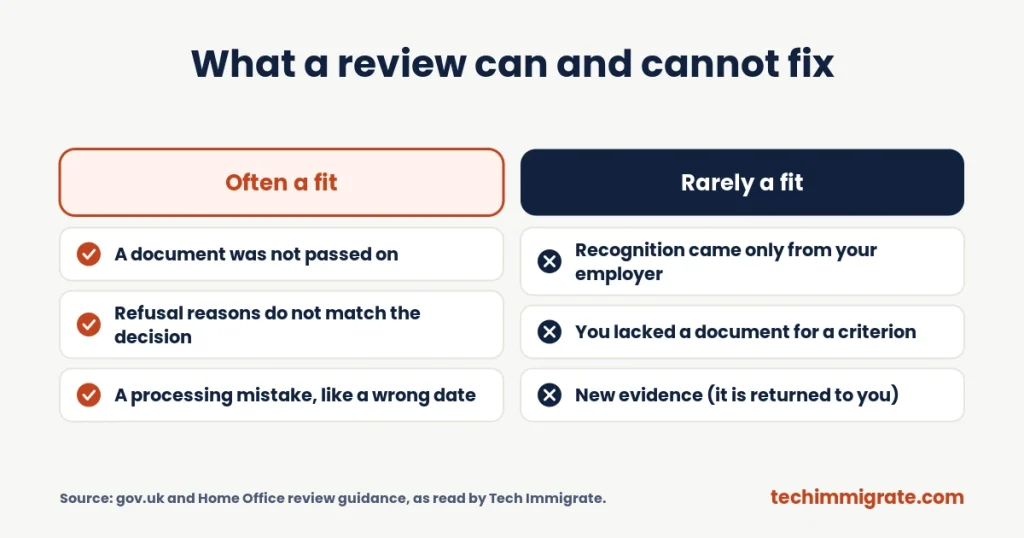
A review can fix errors in how your application was handled, but it cannot fix evidence that was not strong enough.
The guidance says reviewers may recommend reconsideration if they find that evidence was not passed on, that there was a mistake in processing, or that the refusal reasons were not passed on correctly. That list is narrow, so read it closely.
| What went wrong | Does a review fit? | Why |
|---|---|---|
| A document you sent was not seen or not passed on | Often yes | The guidance names failing to pass on evidence |
| The refusal reasons do not match the panel's decision | Often yes | The guidance names passing on reasons incorrectly |
| A processing mistake, such as a wrong date or wrong criterion | Often yes | The guidance names processing mistakes |
| The panel read your document differently than you hoped | Sometimes | You can argue it, but the panel's judgement is hard to challenge |
| Your recognition came only from your employer | Rarely | This is an evidence gap, and you cannot add documents |
| You lacked a document for a criterion | Rarely | New evidence is not allowed |
Treat the table as a guide. Each decision has its own detail.
Errors versus weak evidence
Think of two buckets. In bucket one, something went wrong in the process. In bucket two, the evidence did not persuade. A review suits bucket one. Bucket two usually needs a new application.
A note on panel judgement
Tech Nation's independent panel decides overall whether to endorse you. Meeting the criteria is necessary but not sufficient. Because of that, a review that only says "I disagree with the panel's view" is unlikely to move much.
How to Read Your Refusal Before You Request a Review
Read the refusal one reason at a time, and sort each reason into "process error" or "evidence did not persuade".
Open a blank table with four columns: the reason, the criterion, the document you think answers it, and your verdict. Then work down the list. The exercise takes under an hour, and it saves you from a weak request.
Questions to ask of each reason
First, does the reason describe something that is in your file? If the panel says there was no product evidence but you sent a product page, that is a possible miss. Second, does the reason cite the right criterion? A reason filed under the wrong criterion is a possible processing slip.
Third, does the reason rely on a rule you can check? For example, the evidence must come from the last 5 years. If the panel dismissed recent work as too recent, the policy may help you. Check the official criteria wording before you argue it.
Be honest about the verdict column
It is tempting to mark every reason as a panel error. Resist that. A request that argues five weak points hides the one strong point. Pick the reasons where your file clearly answers, and let the rest go.
Thing 5: How to Structure a Review Request
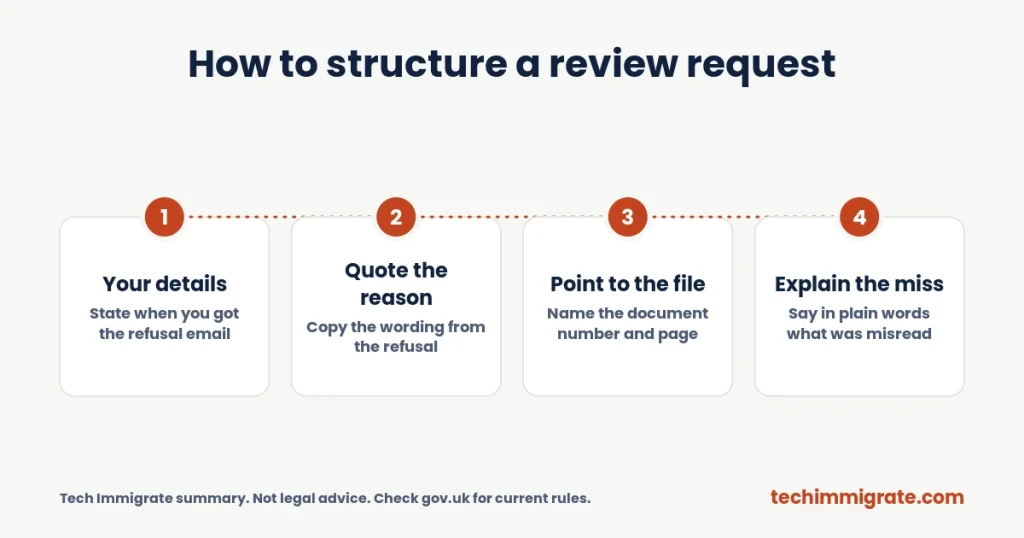
A strong request is short, follows the refusal reasons in order, and points to documents you already submitted.
You send the Global Talent endorsement review form by email, and the Home Office passes it to the endorsing body that made the original decision. Use the form that gov.uk links to, and keep your points on the form clear.
A simple structure
- Your details and decision date. State when you received the refusal email.
- Reason 1, quoted exactly. Copy the wording from the refusal.
- Where the file answers it. Name the document number and page.
- Why the reason is wrong. Explain in plain words how the panel misread or missed it.
- Repeat for each reason. Keep each one separate.
- A closing request. Ask the reviewer to reconsider the decision on those points.
Tone and length
Keep the tone calm and factual. Short sentences work better than long arguments. Skip emotion, and skip claims about your career that are not in the original file.
What to leave out
Leave out new documents, new links and new achievements. They will not be used. Leave out criticism of the panel members as people. Focus on the decision and the file.
Using your own evidence map
Before you write, list each criterion you relied on and the documents under it. Then match each refusal reason to a document. If you cannot find a match, that reason likely belongs in bucket two. The Tech Nation endorsement mistakes page lists common gaps to check for.
Illustrative Example (Fictional)
This is a made-up case. It is not a real person, and it does not predict any outcome.
Imagine "Alex", a data engineer. Alex applies and is refused on optional criterion 2, recognition outside the day job. The refusal says the community work "appears to be part of Alex's occupation".
What the file already showed
In the original application, document four was a letter from a non-profit board. It showed that Alex founded a volunteer community, holds no pay from it, and runs events for hundreds of engineers. Alex's day job was at an unrelated employer.
The review request
Alex quotes the reason. Then Alex writes, "Document 4, page 2, states that the community is a separate non-profit and that I receive no payment." Alex asks the reviewer to check whether that evidence was weighed. Alex adds no new links or documents.
Possible results
If the reviewer agrees the document was missed or misread, the decision could be overturned. If not, the decision stays. In a second version of the story, the file never had the board letter. Then the review has nothing to point to, and Alex would likely rebuild the evidence and apply again.
Thing 6: Timeline and Possible Outcomes
A review should finish within about 28 days, and it ends in one of three outcomes.
The official guidance says the review is completed within 28 calendar days of receipt of your request. The gov.uk page says you are told by email within 28 days whether it succeeded. So plan for about a month of waiting.
Outcome 1: Overturned
The endorsing body reverses its decision and issues your endorsement. You then move to the visa stage. Remember that you must apply for the visa within 3 months of the endorsement, so do not wait.
Outcome 2: Upheld for the same reasons
The refusal stands for the same reasons. You cannot ask for another review. If you want to try again, you make a new application and pay the fee again, which is £561 at the time of writing.
Outcome 3: Upheld for new reasons
The refusal stands, but the reasons have changed. The guidance says you may be able to ask for a further review limited to those new reasons. Check your outcome letter, because it sets out what you can do next.
When to Reapply Instead of Requesting a Review
You should think about reapplying instead when your refusal shows a real evidence gap, not a handling error.
Reasons that often point this way include recognition that came only from your own employer, a company that did not look product-led, or recommendation letters that repeated each other. A review cannot fix any of these.
Doing both in sequence
Some applicants request a review and, at the same time, start building a stronger file. If the review fails, they are ready to apply again. This is a common approach, not a rule, and it depends on your situation.
Use a three-question check
Ask yourself three things. Did the panel miss something I sent? Did the refusal misstate something? Or did my file simply lack something? A "yes" to either of the first two questions points to a review. A "yes" to the third points to a new application. Our recommendation letters guide helps if letters were the weak spot.
Review Versus New Application: Side by Side
A review is cheap and quick but narrow, while a new application is open but costs a fee and more time.
| Endorsement review | New application | |
|---|---|---|
| Fee | None | Endorsement fee again |
| Deadline | 28 calendar days from the refusal email | No official deadline in the pages we checked |
| New evidence | Not allowed | Allowed |
| Who decides | The endorsing body that refused you | The endorsing body, as a fresh case |
| Best for | Handling errors and missed evidence | Evidence gaps and weak criteria |
| Usual wait | About 28 days | Usually 5 to 8 weeks, at the time of writing |
What the table means in practice
If your evidence was sound but the decision looks wrong, the left column fits. If the evidence needs work, the right column fits. However, many files sit in between. In that case, the three-question check above helps you decide.
Keep the visa clock in mind
Once you hold an endorsement, you must apply for the visa within 3 months. So a successful review starts a new clock. Gather your visa documents while you wait, so you are ready if the answer is yes.
What to Do While You Wait
Use the review period to prepare for both outcomes, because the answer will arrive by email without much warning.
Prepare for a yes
Check your passport, your funds and your travel plans. Read the visa application steps on gov.uk. Remember the visa fee and the Immigration Health Surcharge are separate from the endorsement fee. Your dependants pay their own visa fee and surcharge.
Prepare for a no
Start your evidence map now. List every criterion, the documents under it and the gaps. Then pick the two weakest documents and ask what stronger replacements could exist. Ask referees early, since good letters take weeks.
Stay in status
Keep your current UK permission in mind, if you hold any. The review will not extend it. If your leave runs out soon, get legal advice on your options, because that is a separate question from the endorsement.
Mistakes to Avoid With a Global Talent Visa Endorsement Review
The most costly mistakes are missing the deadline, adding new evidence, and arguing opinion instead of the file.
- Missing day 28. The free route closes. Send the request early.
- Attaching new documents. They are returned and do not count.
- Arguing "I deserve it". Point to documents, not worth.
- Ignoring the reasons. Answer each one, in order.
- Assuming it extends your stay. It does not.
- Believing guarantees. Nobody can promise a result, and the guidance gives no success rate.
Applicant stories are not official data
Law-firm case studies describe reviews that succeeded when an overlooked document was pointed out. They are marketing, not statistics. Treat them as examples of the kind of argument that fits, not as a forecast.
Global Talent Visa Endorsement Review FAQ
Any applicant refused an endorsement under the Global Talent category who believes the decision was wrong. You request it yourself within 28 calendar days of the refusal email. It is a review of an endorsement, not of a visa refusal, which follows a different route.
Yes. The gov.uk guidance says there is no fee for an endorsement review. A new endorsement application does cost a fee again, which was £561 at the time of writing. So the review is a low-cost step when your refusal looks like a handling error.
No. The gov.uk page says you cannot give new evidence as part of the review, and the Home Office guidance says any new evidence is returned with the outcome. You can explain and point to evidence you already submitted. New material belongs in a new application.
The guidance says the review is completed within 28 calendar days of the Home Office receiving your request. The gov.uk page says you will be told by email within 28 days whether it succeeded. A review does not extend any UK permission that is about to expire.
Not for the same reasons. If the refusal is upheld for the same reasons, you pay the fee again for a new application. If it is upheld for new reasons, you may be able to request a further review limited to those new reasons.
Your Next Step
Decide whether your refusal is a handling error or an evidence gap, then act inside the 28 days. If the gap is in the evidence, a structured plan makes the next attempt stronger. Our role-specific endorsement guides include an evidence checklist and planner for each specialisation.
Good places to start include the software developers guide, the data and AI specialists guide and the product managers guide. Want the guide for your role? See the guides.
How We Checked This Article
We read the official gov.uk Global Talent digital technology page, its page on what happens if your endorsement application is refused, and the Home Office endorsement review guidance. These sources gave us the 28-day limit, the no-fee rule, the ban on new evidence, the possible outcomes, and the review timing.
We also read law-firm articles to find gaps, and treated them only as examples. Fees and timings are correct at the time of writing, so check the pages before you act.
The three official pages are the endorsement review guidance, the refusal and review page and the Global Talent overview.
Tech Immigrate is independent of Tech Nation and the Home Office. This article is general information, not legal advice, and nobody can guarantee an endorsement. Always confirm current rules on gov.uk before you apply.
We write practical guides for tech professionals applying for the UK Global Talent visa. Tech Immigrate is independent of Tech Nation and the Home Office, and our articles are general information, not legal advice. Rules and fees change, so always check gov.uk before you apply.