
Global Talent Visa for Cyber Security Specialists: Who Qualifies and What Evidence Counts
Can cyber security specialists get the Global Talent visa? Which security roles qualify, what evidence Tech Nation accepts, costs and Talent vs Promise.


In this article
- Can Cyber Security Specialists Get the Global Talent Visa?
- Which Security Roles Fit Tech Nation's Criteria?
- What Does "Product-Led" Mean for Security Work?
- Exceptional Talent or Exceptional Promise?
- What Is the Mandatory Criterion for a Security Specialist?
- Which Optional Criteria Suit Security Work?
- What Counts as Recognition in Security?
- How Do You Prove Impact When Your Work Is Confidential?
- What Real Security Applications Show
- Who Should Write Your Recommendation Letters?
- How Much Does It Cost and How Long Does It Take?
- How Does It Compare With a Skilled Worker Visa for Security Roles?
- How to Get Started as a Security Specialist
- Get the Guide for Cybersecurity Specialists
- Frequently Asked Questions
- How We Checked This Article
Yes, cyber security specialists can get the UK Global Talent visa. GOV.UK names cyber security as one of the digital technology areas the route covers, and the Tech Nation skills list, updated on 1 July 2026, includes cybersecurity experts as a technical role. You need an endorsement from Tech Nation first, which means showing recognition as a leader (Exceptional Talent) or a potential leader (Exceptional Promise) in security, not just a strong security career.
This article is for security engineers, application security specialists, vulnerability researchers, detection and threat intelligence engineers, security architects and heads of security who want to know whether the route fits them. It covers which security roles Tech Nation tends to accept, how the criteria apply to security work, what counts as recognition in this field, the costs and timings in 2026, and how to decide between Talent and Promise.
Key takeaways
- Cyber security is named on GOV.UK as a digital technology field, and "cybersecurity experts" are on the Tech Nation skills list updated 1 July 2026.
- Where you work matters: in-house security at a product-led tech company or work at a security product vendor fits best. Consultancy, outsourcing, service delivery and systems administration are listed as unsuitable.
- The Mandatory Criterion is about recognition from outside your employer. Certifications, salary and bug bounty hall-of-fame pages rarely carry it alone.
- Security specialists often choose two of: innovation (OC1), contribution beyond your job such as open-source tools (OC2), technical impact at a product-led company (OC3) or published research (OC4).
- The endorsement costs £561 and the visa £205, plus the Immigration Health Surcharge of £1,035 a year. Endorsement usually takes 5 to 8 weeks.
- Exceptional Talent can lead to settlement after 3 years and Exceptional Promise after 5, according to GOV.UK in November 2026.
Can Cyber Security Specialists Get the Global Talent Visa?
Yes. The Global Talent visa has a digital technology route, and cyber security sits inside it. GOV.UK lists cyber security alongside fintech, gaming and artificial intelligence as examples of the field, and the government's list of technical and business skills covered by Tech Nation includes cybersecurity experts as a suitable technical role. That list was last updated on 1 July 2026.
There is no separate "cyber" category on the application. When you apply, your field is Digital Technology and your endorsing body is Tech Nation. Applicants on the Tech Nation Visa Forum who typed "cyber security" as their field have been told the right answer is digital technology, with security as their specialism.
Two points shape everything else in this article:
- The bar is recognition, not competence. Tech Nation endorses people who are recognised as leaders, or emerging leaders, in digital technology. Being a capable security engineer with good reviews is not enough on its own.
- The sector test applies to security too. Tech Nation assesses work done in the digital technology sector. Security work done for a product-led tech business or a security product company usually fits. Security services delivered to clients usually does not.
The visa itself is attractive for security people. You do not need a job offer or a sponsor, there is no minimum salary, and you can work for any employer, freelance, or start a company. Our article on the benefits of the Global Talent visa covers the full list and the trade-offs.
Which Security Roles Fit Tech Nation's Criteria?
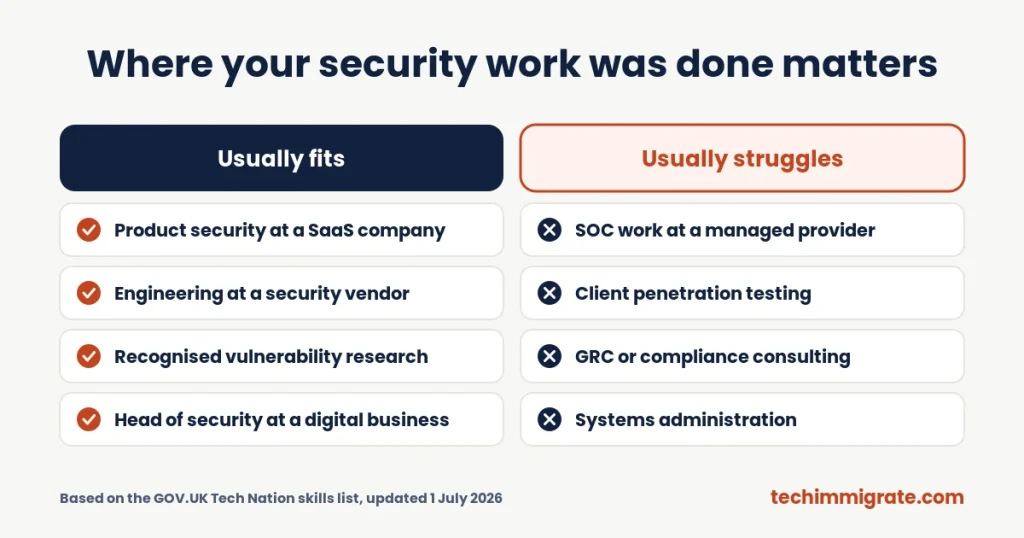
The role title matters less than where you did the work and what you can prove about it. The GOV.UK skills list names cybersecurity experts as suitable, but it also lists roles that are unsuitable: corporate roles, service delivery, process delivery, outsourcing, technical or management consultancy, and systems administration. Many security careers sit close to those lines, so it helps to be honest about where yours sits.
| Security role | Usual fit | What to watch |
|---|---|---|
| Application or product security engineer at a SaaS or software company | Strong | Show your own design decisions, not the team's |
| Security engineer at a security product vendor (EDR, SIEM, identity, cloud security) | Strong | Tie your work to the product's adoption or capability |
| Vulnerability or security researcher | Strong if recognised | Findings need context, credit and impact, not just counts |
| Detection engineer or threat intelligence lead at a product company | Good | Show detections or research others adopted |
| Head of security or CISO at a growing digital business | Good | Show the business and product outcome, not just policy |
| Security architect at a bank or large corporate | Mixed | Corporate roles are listed as unsuitable; product impact must be clear |
| SOC analyst at a managed security provider | Weak | Service delivery to clients rarely meets the sector test |
| Penetration tester at a consultancy | Weak to mixed | Client work is consultancy; outside research or tools may carry you |
| GRC or compliance consultant | Weak | Usually seen as consultancy or process delivery |
| Systems administrator with security duties | Weak | Systems administration is named as unsuitable |
Weak does not mean impossible. A penetration tester at a consultancy who has published widely used open-source tooling, spoken by invitation at selective conferences and been credited for important vulnerabilities may have a strong case built on that outside work. What does not work is relying on client engagements as the main evidence.
What Does "Product-Led" Mean for Security Work?
A product-led digital technology company makes most of its money from its own software, platform, hardware or data product. Tech Nation uses this idea to decide whether your experience counts as digital technology sector experience.
For security specialists, this creates three common situations:
- You work at a security product company. A company selling an endpoint detection platform, an identity product or a cloud security tool is a product-led tech business. Your engineering or research work there sits squarely in the sector.
- You work in-house at a tech company. A security engineer at a fintech app, a SaaS platform or a marketplace protects a digital product. The company is product-led, so your work counts, provided you can show what you changed.
- You deliver security as a service. Managed detection, penetration testing for clients, audits and compliance consulting are services. The skills list treats consultancy and service delivery as unsuitable, and refusal feedback reflects this.
One security applicant shared panel feedback on the forum in December 2025 after an Exceptional Talent refusal. Part of their technical contribution evidence came from a project delivered through a consultancy, and the panel described that firm as a solutions company rather than a product-led digital technology business. Volunteer work for a charity in the same application was described as laudable but not advancing the sector. Both points are applicant-reported, but they match what the published skills list says.
If most of your career is in services, look for the parts of your work that sit outside it: tools you built and released, research you published, product work you did in-house, or roles at product companies earlier in your career.
Exceptional Talent or Exceptional Promise?
Tech Nation endorses at two levels. Exceptional Talent is for recognised leaders. Exceptional Promise is for people at an earlier stage who show the potential to become leaders. Both use the same criteria, but the level of recognition expected is different.
| Exceptional Talent | Exceptional Promise | |
|---|---|---|
| Who it suits | Established security leaders with clear external recognition | Earlier-career specialists with strong signs of emerging recognition |
| Typical experience | Usually 5 years or more | Usually under 5 years, or newer to the field |
| What recognition looks like | Recognised across the security community or industry | Recognised within a growing part of it |
| Settlement (ILR) | After 3 years | After 5 years |
| Risk | Endorsed at Promise or refused if recognition is thin | Assessed as Talent if experience is long |
Tech Nation can endorse you at a different level from the one you chose. A security specialist who switched from a Student visa reported on the forum that they applied for Exceptional Talent in August 2024 and were endorsed for Exceptional Promise seven working days later. An earlier applicant who moved from UX design into cyber security at a bank applied for Promise and was endorsed for Talent.
The experience point cuts both ways. Forum reviewers repeatedly warn that someone with more than five years in security may be assessed against the Talent standard even if they apply for Promise. Our article on Exceptional Talent vs Exceptional Promise explains how to choose.
What Is the Mandatory Criterion for a Security Specialist?
The Mandatory Criterion asks you to show that you are recognised as a leading talent (Talent) or an emerging leader (Promise) in digital technology. The key word is recognised. It is about what others outside your employer have said or done because of your work.
For security specialists, recognition usually comes from:
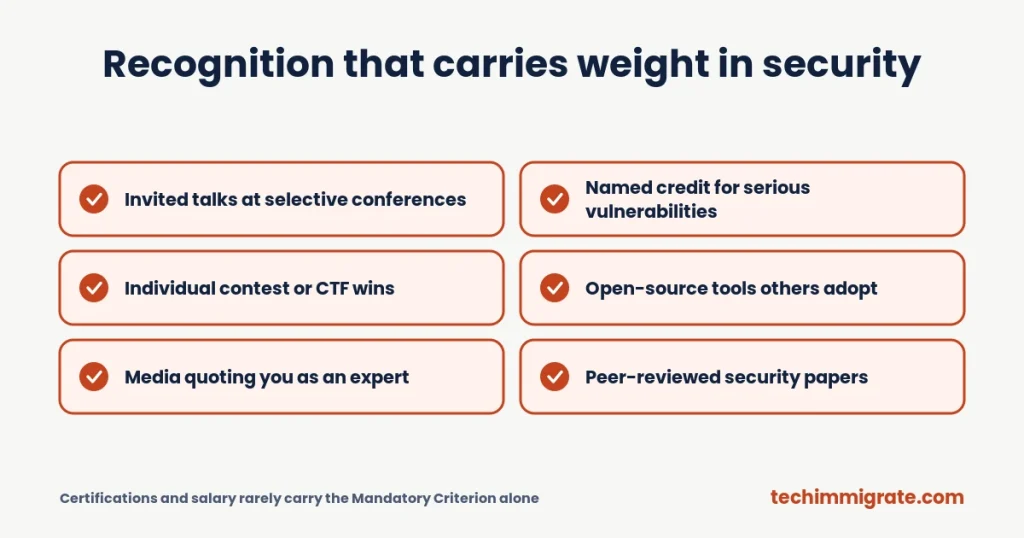
- Selective speaking invitations. Being invited, or accepted through a competitive call for papers, to speak at respected security conferences. The invitation or acceptance record matters as much as the talk.
- Named credit for significant research. Vendor advisories or CVE records that credit you by name for serious vulnerabilities, ideally with coverage showing why the finding mattered.
- Competitive wins. Winning a security contest or capture-the-flag event as an individual, with the result published by the organiser.
- Expert roles. Being asked to judge, review papers for a security conference, sit on an industry working group or advise a standards body.
- Media that names you as an expert. Coverage in recognised technology or security media that quotes you because of your expertise, not because you paid for it or wrote it yourself.
- Awards. Industry awards with a credible, independent judging process.
What rarely carries the Mandatory Criterion alone: certifications such as OSCP or CISSP, high salary, internal promotions, internal awards and hall-of-fame listings on bug bounty programmes. Forum reviewers consistently describe salary as the weakest Mandatory Criterion evidence. Certifications show you passed an exam; they do not show that the field recognises you.
Tech Nation's applicant guide and GOV.UK both describe the criteria, and our article on what Tech Nation actually checks covers them in detail.
Which Optional Criteria Suit Security Work?
As well as the Mandatory Criterion, you need to meet two of four optional criteria. Security careers produce evidence for all four, but most applicants have a natural pair.
| Optional criterion | What it asks | Security examples |
|---|---|---|
| OC1: Innovation | A track record of innovation as a founder or senior executive of a product-led company, or as an employee working on a new digital field or concept | A detection or security product you created that customers adopted; a new approach to a security problem that shipped |
| OC2: Beyond your job | Recognition for work outside your occupation that contributes to the field | Open-source security tools used by others; leading an OWASP-style community project; structured, voluntary mentoring with clear results |
| OC3: Technical or commercial impact | Significant technical, commercial or entrepreneurial contribution as an employee of a product-led company | Redesigning a product's authentication or encryption; a security platform you led that cut incidents for millions of users |
| OC4: Academic | Contributions through research, such as published papers | Papers at peer-reviewed security venues; research cited or built on by others |
A few patterns from security applications:
- Researchers often pair OC2 (public tools and disclosures) with OC4 (papers), or OC3 if they did research inside a product company.
- Product security engineers often pair OC3 (what they built into the product) with OC2 (open-source or community work).
- Founders and early employees of security start-ups often pair OC1 with OC3.
Whichever pair you choose, every piece of evidence needs to show your individual part. Security work is usually team work, and the refusal patterns Tech Nation applicants report most often include individual contribution being lost in team achievements. Our article on why cybersecurity specialists get refused goes through those patterns one by one.
What Counts as Recognition in Security?
Security has its own signals of standing, and some carry more weight with assessors than others. This is a general guide based on the criteria and on what applicants report, not an official scoring system. There is no points system in the Global Talent route.
| Evidence | Weight on its own | What makes it stronger |
|---|---|---|
| Professional certifications | Low | Nothing: they show training, not recognition |
| Bug bounty hall-of-fame listings | Low | Rankings, payouts and severity with third-party context |
| Count of CVEs or findings | Low to medium | Severity, the products affected, and coverage of why it mattered |
| Individual contest or CTF win | Medium to strong | Published results naming you, size and standing of the event |
| Talk at a community security event | Medium | Competitive selection, invitation letter, audience and follow-up use |
| Invited talk at a selective conference | Strong | Invitation explaining why you were chosen, recording, programme listing |
| Open-source security tool | Medium to strong | Independent adoption: users, downloads, mentions by other organisations |
| Media quoting you as an expert | Strong if independent | Recognised publication, journalist approached you |
| Peer-reviewed security paper | Strong for OC4 | Citations, use by others, venue reputation |
Forum reviewers made this point clearly on an August 2026 thread where a smart contract security researcher asked about eligibility. The applicant had an individual contest win, a competitive grant and a record of valid findings across audit contests. Reviewers disagreed on several points, but all treated the contest win as the strongest external recognition and the raw list of findings as weak unless it was shown to be recognised and important.
How Do You Prove Impact When Your Work Is Confidential?
Confidentiality is the security-specific problem most applicants face. Incident reports, penetration test findings and internal architecture are rarely shareable, and documents you send to the Home Office are read by assessors.
The answer is to prove outcomes and recognition, not secrets. Practitioners recommend focusing on what changed, who relied on it and who recognised it, while leaving out sensitive technical detail. Sterling Law described in July 2025 how it secured an endorsement for a cyber security specialist whose main work was on classified government projects: the case focused on outcomes, strategic roles and the wider significance of the work, supported by letters from senior security figures, rather than technical specifics.
In practice, this means relying on:
- Letters from senior people who saw your work and can describe its scale and effect in general terms.
- Public outputs connected to the private work: a conference talk, a published advisory, an open-source release, a product feature announcement.
- Approved figures your employer is willing to confirm, such as reductions in incidents or time to detect.
The guide has a full section on presenting confidential security work. Here, the key message is that "I can't share it" is not a reason to send thin evidence. It is a reason to choose different evidence.
What Real Security Applications Show
These cases come from the Tech Nation Visa Forum and practitioner write-ups. Forum material is applicant-reported and not verified by Tech Nation.
- August 2024, endorsed at a lower level. A security specialist switching from a Student visa applied for Exceptional Talent with speaking, panel roles, a peer-reviewed paper and letters from two PhD advisers. They were endorsed for Exceptional Promise in seven working days. Repliers suggested the evidence read as early-career rather than established.
- October 2022, refused then rebuilt. A cybersecurity engineer with about four and a half years in monitoring and investigations was refused Exceptional Talent, and the review also failed. In an interview published by Immigram in April 2026, he said the refusal centred on business impact and that achievements must be clearly mapped to the criteria. He reapplied under Exceptional Promise and now works in the UK.
- December 2025, refused at Talent. An applicant with about eight years in IT, covering SOC work, secure fintech architecture and cyber education, shared the panel's feedback. The Mandatory Criterion was not met because the evidence did not show a track record of recognition. Community talks were described as lacking detail on impact on the field. The applicant then asked the forum about trying the Promise route.
- July 2025, endorsed despite classified work. Sterling Law reported an endorsement for a security specialist whose main experience was on classified government projects, built on outcomes and senior letters rather than technical detail.
- August 2026, eligibility review. A blockchain security researcher with about four years and eight months of experience asked whether to apply under Promise. Reviewers rated the profile very differently, from about 3 to 7 out of 10, which is a reminder that forum scores are opinions, not predictions.
These cases show a pattern that matches Tech Nation's published bar: security skill and experience are assumed; the decision turns on whether recognition outside your employer is visible and documented. Tech Nation has become stricter in recent years. Our article on the Global Talent visa success rate covers the published figures.
Who Should Write Your Recommendation Letters?
You need three letters from established leaders in digital technology who know your work. For security specialists, strong letter writers usually include:
- A CISO, head of security or CTO who managed or worked directly with you at a product-led company.
- A recognised figure in the security community who knows your research, tools or talks: a conference organiser, a respected researcher or a maintainer of a project you contributed to.
- A senior person from a different organisation, such as a security vendor whose product you improved, or a partner who relied on your work.
Each letter should describe your specific contributions, explain why they matter to the field, and say how the writer knows you. Letters that repeat your CV or praise you in general terms add little. The Home Office does not accept web links as evidence, so each letter must be sent as a signed document, not a link to a profile or page. Our guide to Global Talent recommendation letters explains who to ask and what each letter must cover.
How Much Does It Cost and How Long Does It Take?
These figures were checked on GOV.UK in November 2026.
| Item | Cost or time |
|---|---|
| Stage 1 endorsement fee | £561 |
| Stage 2 visa fee | £205 |
| Immigration Health Surcharge | £1,035 per year, per adult |
| Partner or child | £766 each, plus their surcharge |
| Endorsement decision | Usually 5 to 8 weeks |
| Visa decision | About 3 weeks outside the UK, 8 weeks inside |
| Free endorsement review | Must be requested within 28 days of a refusal |
| Settlement | After 3 years (Talent) or 5 years (Promise) |
The visa can be granted for between one and five years at a time, and you choose the length. Our full Global Talent visa cost breakdown works through examples for single applicants and families.
On settlement, the government published its response on earned settlement on 2 November 2026. It sets a 10-year baseline for most routes but keeps 3 years for a "highest talent" group that includes Global Talent. The new rules are expected from December 2026 into 2027, and it is not yet clear how Exceptional Promise will be treated. Check GOV.UK before you rely on any settlement timeline.
How Does It Compare With a Skilled Worker Visa for Security Roles?
Many security specialists come to the UK on a Skilled Worker visa, which needs a licensed employer to sponsor you. The Global Talent visa is harder to get but gives far more freedom once you have it.
| Global Talent | Skilled Worker | |
|---|---|---|
| Employer sponsor | Not needed | Required |
| Minimum salary | None | Yes, set by GOV.UK for each occupation |
| Changing jobs | Free to change at any time | New sponsorship needed |
| Freelancing or a start-up | Allowed | Very limited |
| Settlement | 3 or 5 years (current GOV.UK) | Under review; check GOV.UK |
| Main hurdle | Endorsement by Tech Nation | Finding a sponsoring employer |
If you are already in the UK on another visa, you can usually switch to Global Talent from inside the country once endorsed. Security specialists who change employers often, take contract work, or plan to start a security company benefit most from not needing a sponsor.
How to Get Started as a Security Specialist
Before you pay the £561 endorsement fee, work through these steps:
- Check the sector test honestly. List where your security work was done. Separate product-led company work from consultancy and service work.
- List your external recognition. Talks, credited research, contest results, tools others use, media, expert roles. If this list is short, build it before applying.
- Pick your level. Compare your experience and recognition with the Talent and Promise standards.
- Choose your two optional criteria. Pick the pair where you have the strongest independent evidence, not the one that sounds best.
- Approach letter writers early. Senior security people are busy and letters take weeks.
- Read Tech Nation's applicant guide and the GOV.UK pages. The process changed in 2025 and 2026, and older advice is out of date.
Our article on how much evidence is enough helps you judge whether you are ready.
Get the Guide for Cybersecurity Specialists
The Global Talent Visa Endorsement Guide for Cybersecurity Specialists takes you from "do I qualify?" to a finished application. It is 126 pages, aligned with Tech Nation's applicant guide, and covers which security roles and evidence fit, how to present confidential work, 24 evidence checklists, a 12-week planner, 30 refusal fixes and 4 applicant-reported refusal cases with the wording decoded.
I was refused the first time I applied for Global Talent, then reapplied and was endorsed. The guide is built on what changed between those two applications.
Frequently Asked Questions
Yes. GOV.UK lists cyber security as part of the digital technology field, and the Tech Nation skills list, updated 1 July 2026, names cybersecurity experts as a suitable technical role.
Tech Nation. You apply on the GOV.UK Stage 1 form under Digital Technology, and the Home Office passes your application to Tech Nation for assessment.
It is harder, because the skills list treats consultancy and service delivery as unsuitable. A strong case usually relies on recognised work outside client engagements, such as published research, widely used tools or invited talks.
Not much on their own. Certifications show training and competence. Tech Nation looks for recognition by others in the field, such as invitations, credited research, awards or independent media coverage.
No. The Global Talent visa needs no job offer, no sponsor and no minimum salary. Once you have it, you can work for any employer, freelance or start a business.
GOV.UK says endorsement decisions usually take 5 to 8 weeks. The visa decision then takes about 3 weeks outside the UK or 8 weeks inside, according to GOV.UK in November 2026.
Talent suits established security leaders with clear external recognition, usually with five years or more of experience. Promise suits earlier-career specialists with emerging recognition. Tech Nation can endorse you at a different level from the one you chose.
How We Checked This Article
We checked eligibility, fees, timings and settlement periods on the GOV.UK digital technology Global Talent pages and the government's list of technical and business skills covered by Tech Nation, updated 1 July 2026, in November 2026. The process details draw on the Home Office Global Talent caseworker guidance published 3 August 2026.
Applicant cases come from the Tech Nation Visa Forum: an August 2024 cyber security endorsement at Promise level, a December 2025 thread with Talent-route panel feedback, an August 2026 security researcher eligibility review, a May 2025 cyber security Promise application and an earlier endorsement of a designer turned security professional. Forum material is applicant-reported or member opinion, not official guidance. We also used Sterling Law's July 2025 case study and Immigram's April 2026 interview with a cybersecurity engineer.
Tech Immigrate is independent of Tech Nation and the Home Office. This article is general information, not legal advice.
We write practical guides for tech professionals applying for the UK Global Talent visa. Tech Immigrate is independent of Tech Nation and the Home Office, and our articles are general information, not legal advice. Rules and fees change, so always check gov.uk before you apply.


