Global Talent Visa for Data Scientists and ML Engineers: Who Qualifies and What Counts
Can data scientists and ML engineers get the Global Talent visa? Which roles fit, when research counts, how to prove model impact, and 2026 costs.

In this article
- Can Data Scientists Get the UK Global Talent Visa?
- Which Data and AI Roles Fit Tech Nation's Criteria?
- How Do the Criteria Apply to Data and AI Work?
- When Does Research Count for the Global Talent Visa?
- What Recognition Looks Like in Data and AI
- How Do You Prove a Model's Impact?
- Which Data Evidence Is Strong, and Which Is Weak?
- What Recent Data and AI Applications Show
- Exceptional Talent or Exceptional Promise for Data Scientists?
- Who Should Write a Data Scientist's Letters?
- What Does the Visa Cost for a Data Scientist?
- Why Do Data Scientists Choose Global Talent Over Other Visas?
- How Should a Data Scientist Start?
- What If Your Models and Data Are Confidential?
- Get the Guide for Data and AI Specialists
- Frequently Asked Questions
- How We Checked This Article
Data scientists and machine learning engineers can get the UK Global Talent visa. The government's list of skills covered by Tech Nation, updated on 1 July 2026, names AI, natural language processing and machine learning specialists, and experienced data scientists and data engineers, as suitable technical applicants. To be endorsed, you need recognition outside your employer as a leader (Exceptional Talent) or emerging leader (Exceptional Promise), and evidence that your models, data systems or research changed something others can verify.
This article is for data scientists, machine learning and AI engineers, NLP specialists, data engineers and applied researchers, whether you are abroad or already in the UK. It explains which data and AI profiles fit, how each criterion applies to data work, when research counts and when it does not, what recent endorsements and refusals on the Tech Nation Visa Forum show, and what the visa costs in 2026.
Key takeaways
- AI, NLP and ML specialists and experienced data scientists and data engineers are named on the GOV.UK Tech Nation skills list, updated 1 July 2026.
- Data analysts and BI developers are not named. They can apply, but often face a harder test on sector and impact.
- Research done as part of a degree, a thesis or a very recent paper with no citations is usually weak. A June 2026 refusal described recent papers as being in venues of limited standing.
- Model and data results need verification. Internal dashboards and self-reported metrics are often discounted.
- Endorsement costs £561 and the visa £205, plus the £1,035 yearly health surcharge. Decisions usually take 5 to 8 weeks.
- Talent leads to settlement after 3 years and Promise after 5, according to GOV.UK in November 2026.
Can Data Scientists Get the UK Global Talent Visa?
Yes. Data and AI are at the centre of the digital technology route. GOV.UK names artificial intelligence as one of the fields covered, and the government's list of technical and business skills covered by Tech Nation includes, in paraphrase:
- AI, natural language processing and machine learning specialists
- Experienced data scientists and data engineers
The list was updated on 1 July 2026. As with other roles, the word "experienced" matters. Tech Nation is not endorsing everyone who builds models. It is endorsing data and AI specialists whose work is recognised beyond their own team, or who are clearly becoming recognised.
The Global Talent visa suits data people well. Many work across start-ups, research labs and contract roles, and the visa needs no sponsor, no job offer and no minimum salary. You can move between employers, take freelance work or start a company. Our article on the benefits of the Global Talent visa covers the advantages and trade-offs.
Which Data and AI Roles Fit Tech Nation's Criteria?
Your job title matters less than where the work happened and whether you can show your part in it.
| Role | Typical fit | What usually decides it |
|---|---|---|
| ML or AI engineer at a product-led tech company | Strong | Models in production and their measured effect on the product |
| Data scientist at a SaaS, fintech or marketplace company | Strong | Decisions or features your work drove, confirmed by the company |
| NLP or computer vision specialist with published work | Strong | Peer-reviewed research others cite or use |
| Data engineer who built a platform a product depends on | Good | Scale, reliability and what the platform made possible |
| Applied scientist at a research lab | Good | Research output and its uptake |
| Data scientist at a bank or large corporate | Mixed | Corporate roles are flagged; product impact must be clear |
| Data analyst or BI developer | Mixed to weak | Not named on the skills list; reporting work rarely shows field impact |
| Data scientist at a consultancy or analytics agency | Weak | Consultancy and service work are listed as unsuitable |
The distinction between analysis and building is important. Producing reports and dashboards for a business is valuable work, but it is often read as competent delivery rather than leadership in digital technology. Building a model, system or platform that a product relies on is closer to what the criteria describe. If your work is mainly analytics, our article on the why business analysts get refused covers the issues analysts face.

How Do the Criteria Apply to Data and AI Work?
Every applicant needs the Mandatory Criterion plus two of four optional criteria.
| Criterion | What it asks | Data and AI evidence that fits |
|---|---|---|
| Mandatory | Recognition as a leading talent or emerging leader | Invited talks, competition wins, expert roles, media naming you, widely used open models or libraries |
| OC1: Innovation | A track record of innovation as a founder, senior executive or employee working on a new digital field or concept | A new model, product or technique you created that reached the market |
| OC2: Beyond your job | Recognition for work outside your occupation that advances the field | Open-source ML libraries, public datasets or models others use, selective technical writing |
| OC3: Significant contribution | Technical, commercial or entrepreneurial contribution at a product-led company | A model or data system that changed product performance, revenue or cost, confirmed by the company |
| OC4: Academic | Contributions through research | Peer-reviewed papers in respected venues, citations, research others built on |
Data and AI specialists are one of the few groups for whom OC4 is a realistic choice. Common pairings are OC3 with OC4 for applied scientists in industry, OC2 with OC4 for researchers with a strong open-source profile, and OC1 with OC3 for founders and early ML engineers at start-ups.
Forum reviewers stress two rules. Each piece of evidence should support one criterion only, so a paper used for OC4 should not reappear under the Mandatory Criterion. And recommendation letters support evidence; they do not meet a criterion on their own. Our article on what Tech Nation actually checks goes through each criterion.
When Does Research Count for the Global Talent Visa?
OC4 asks for exceptional ability shown through research, published or endorsed by an expert. In practice, it is narrower than many data scientists expect.
What tends to count:
- First-author or significant co-author papers in respected, peer-reviewed venues in AI, ML or data science.
- Research that others cite, build on, or use in products.
- Research done in industry or after your studies, not only as part of a degree.
What tends not to count:
- Degree work. Forum reviewers repeatedly point out that research done as part of an MSc, including the thesis and a supervisor's letter about it, is not considered. A 2023 refusal shared on the forum said degrees and courses are not eligible for OC4.
- Very recent papers with no uptake. A June 2026 refusal of an AI and robotics applicant described their research as very recent, in venues of limited standing, with no demonstrable citation or independent recognition. Papers under review at the time of applying added little.
- A single paper. One publication is usually treated as a single event rather than a track record.
If research is your strongest evidence, the timing of your application matters. Waiting until papers are published and have begun to be cited can change the outcome. Our article on academic contribution for Tech Nation explains how to present research, including outside academia.
What Recognition Looks Like in Data and AI
The Mandatory Criterion asks for recognition of you, by people outside your employer. In data and AI, recognition usually comes from:
- Invited talks at respected AI, ML or data conferences, where you were chosen for your expertise.
- Competition results in serious ML competitions, especially individual wins with published results.
- Open models, datasets or libraries that other people and organisations use, with download or dependency figures and named users.
- Expert roles, such as area chair or senior programme committee member at a respected venue. Forum reviewers in 2026 said an ordinary reviewer invitation sits below the Mandatory Criterion bar, while senior programme roles carry more weight.
- Media that seeks your expert view, in publications with editorial selection.
What rarely works alone: internal awards, high salary, academic prizes such as student of the year, and press about your employer. The June 2026 refusal described the applicant's recognition as principally academic and institutional. In a September 2026 review of a data scientist reapplying under Promise, reviewers said newspaper coverage without evidence of being approached as a domain expert may be read as promotional.
How Do You Prove a Model's Impact?
Data scientists often have the best numbers of any applicant and the hardest time proving them. Accuracy, recall, latency, revenue uplift and cost savings are all internal figures until someone else confirms them.
Three things make model impact persuasive:
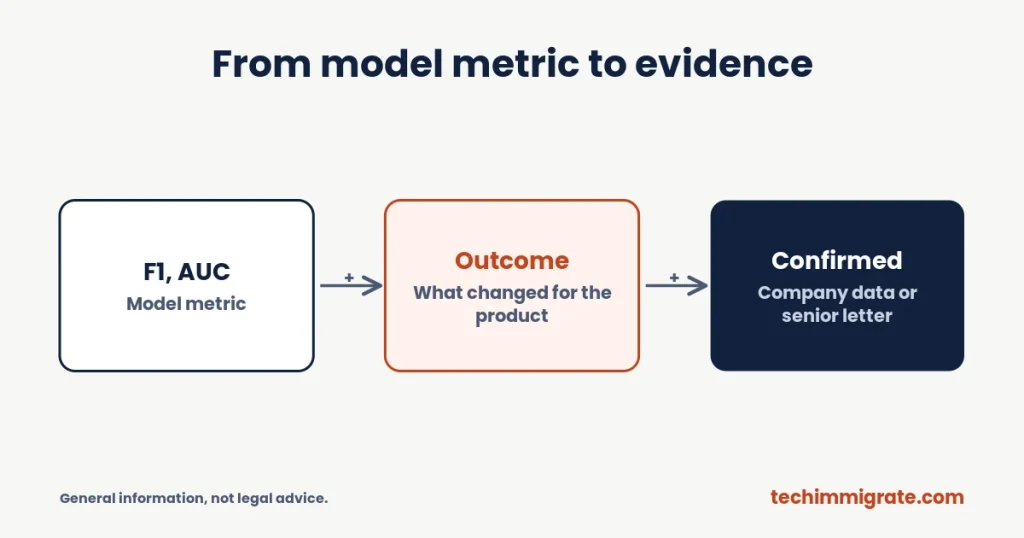
- Business outcome, not model metric. An F1 score is not impact. What changed for the product: fraud losses fell, conversions rose, support tickets dropped, a product launched that could not exist without the model.
- A baseline. The figure before your model, the figure after, the period and how it was measured.
- Confirmation. A company-approved report, a letter from a senior leader who saw the result, a customer case study, an investor update or public material that refers to it.
Screenshots of internal dashboards are one of the most common reasons data evidence is discounted. The 2026 pattern across many refusals is that self-reported metrics, however impressive, carry little weight without someone else standing behind them. Our article on why data scientists get refused covers this and the other refusal patterns one by one.
Which Data Evidence Is Strong, and Which Is Weak?
This is general guidance based on the criteria and forum reports, not an official scoring system.
| Evidence | Usually strong when | Usually weak when |
|---|---|---|
| Production model | Company confirms the business result and your role | Only model metrics, or a team result |
| Open-source library or model | Others adopt it, with downloads, dependents or named users | A few minor commits to several projects |
| Peer-reviewed paper | Respected venue, citations, used by others | Degree work, very recent, or under review |
| Kaggle or ML competition | Individual win or top finish in a major event | Participation or team result with no clear role |
| Technical articles | Selective outlets, real readership, cited by others | Self-published posts with low reach |
| Conference talk | Invited, credible event, audience and recording | Student or internal audiences |
| Mentoring | Structured, voluntary, selective, with outcomes | Informal or paid mentoring |
What Recent Data and AI Applications Show
These cases come from the Tech Nation Visa Forum. They are applicant-reported, and replies are member opinion, not official guidance.
- 2023, endorsed under Promise. A research scientist in the UK on a Skilled Worker visa was endorsed in four days using OC2 and OC4, with letters from a manager, their PhD supervisor and a professor at another university.
- 2025, refused then endorsed on review. An applicant whose work covered AI-powered education tools, analytics and NLP research met OC2 and OC4 but was refused on the Mandatory Criterion. The panel's reading of their job title seemed to shape its view. A review clarifying their leadership succeeded, and the decision was reversed.
- 2025, refused under Promise. A data scientist working in computer vision with about five years of experience was told their roles did not show significant advancement in accountability, and that an MSc thesis was not valid innovation evidence.
- June 2026, refused under Promise. An applied AI engineer and founder was refused on the Mandatory Criterion, OC2 and OC4. The panel called their recognition academic and institutional, their audiences largely students, and their papers too recent and uncited.
- September 2026, preparing to reapply. A data scientist at a funded fintech start-up had judging roles, media, talks, open-source contributions and papers. Reviewers advised cutting to ten documents, not double-counting a paper, deepening one open-source project rather than listing several small ones, and waiting for papers to be published.
The pattern: endorsed applicants had evidence recognised by people in their own field. Refused applicants relied on academic, institutional or self-reported evidence. Tech Nation has become stricter across all roles; our article on the Global Talent visa success rate covers the figures.
Exceptional Talent or Exceptional Promise for Data Scientists?
| Exceptional Talent | Exceptional Promise | |
|---|---|---|
| Typical profile | Senior or lead data scientist or ML engineer with external standing | Earlier-career specialist with emerging recognition |
| Experience | Usually more than 5 years | 5 years or less |
| Research | Established record, cited | Early record, ideally published |
| Settlement | After 3 years | After 5 years |
Refusal wording shared on the forum in 2026 described Promise as intended for applicants with 5 or less years experience. Data scientists who moved into the field from another career should count their digital technology experience carefully, because Tech Nation may count from when your tech track record began. Our article on Exceptional Talent vs Exceptional Promise explains the choice.
Who Should Write a Data Scientist's Letters?
You need three letters from established leaders in digital technology. For data and AI specialists, strong combinations usually include:
- A head of data, chief data officer, CTO or VP of engineering who saw your models or systems change the product.
- A recognised researcher or practitioner outside your employer who knows your research, open-source work or talks.
- A senior person from a partner, customer or investor who relied on your work.
Reviewers in September 2026 suggested that a letter from your immediate manager may be given less weight, and that letter writers should have known your work for at least a year. Letters from your MSc supervisor about your degree work are usually weak, for the same reason degree research is. Letters must be sent as signed documents; the Home Office does not accept web links. Our guide to recommendation letters covers who to ask.
What Does the Visa Cost for a Data Scientist?
Figures checked on GOV.UK in November 2026:
| Item | Cost or time |
|---|---|
| Endorsement (Stage 1) | £561 |
| Visa (Stage 2) | £205 |
| Immigration Health Surcharge | £1,035 per adult per year |
| Each partner or child | £766 each, plus their surcharge |
| Endorsement decision | Usually 5 to 8 weeks |
| Visa decision | About 3 weeks outside the UK, 8 weeks inside |
| Settlement | After 3 years (Talent) or 5 years (Promise) |
The June 2026 applicant reported 59 days from submission to decision, so allow for the upper end of the range. The government's response on earned settlement, published 2 November 2026, keeps 3 years for a highest talent group that includes Global Talent while setting a 10-year baseline for most routes. New rules are expected from December 2026. Our cost breakdown has worked examples.
Why Do Data Scientists Choose Global Talent Over Other Visas?
Many data scientists in the UK hold Skilled Worker or Graduate visas. Global Talent differs in three ways that matter for data careers:
- Research and industry can mix. You can move between a lab, a start-up and a large company without changing visa.
- Contracting and founding are allowed. Many ML specialists consult or start companies, which a sponsored visa does not allow.
- No salary threshold. Earlier-career researchers and start-up employees are not held back by salary rules.
If you are in the UK on another visa, you can usually switch to Global Talent from inside the country once endorsed.
How Should a Data Scientist Start?
Before paying £561:
- Separate building from reporting. List the models, systems and research you created, and set aside routine analytics.
- Check where the work happened. Product-led companies and public research fit best; consultancy work does not.
- Translate model metrics into outcomes and find a baseline and a confirmation for each.
- Audit your research. Leave out degree work and papers still under review. Note citations and uptake.
- List outside recognition only. Talks, competitions, expert roles, adoption by others.
- Pick your level and criteria, then choose letter writers who saw the work.
Our article on how much evidence is enough helps you decide if you are ready.
What If Your Models and Data Are Confidential?
Most data scientists work on proprietary data and models. Training data may include customer records, models may be trade secrets, and results may be commercially sensitive. That is normal, and Tech Nation does not expect you to breach confidentiality. It does expect you to prove your contribution and its effect.
The answer is to separate the secret from the evidence. The architecture, features and data can stay private. What you need to show is that a model you built went into production, what it changed for the business, and that someone senior confirms both. A short letter from a head of data or CTO that states the outcome in approved figures, without technical detail, is often enough to anchor a piece of evidence. Public material helps too: a product launch announcement, a customer case study, an engineering blog post the company published, or a conference talk where you described the approach in general terms.
Ask your employer early what they are willing to confirm in writing. Many companies have a process for reference letters and approved figures, and it can take weeks. If an employer will not confirm anything, choose different evidence rather than sending documents that rely only on your own word. Self-reported figures are one of the most common reasons data evidence is discounted.
Remember too that documents go to the Home Office by email and are read by Tech Nation assessors. Do not include personal data, customer names you are not allowed to share, or internal documents marked confidential. Redacted screenshots of internal tools rarely help: they show that something exists, not what it achieved. Our guide to choosing your evidence documents explains how to pick the ten that make your case.
Get the Guide for Data and AI Specialists
The Global Talent Visa Endorsement Guide for Data Scientists and AI/ML Specialists is 129 pages, aligned with Tech Nation's applicant guide. It covers how to turn models, data platforms and research into evidence Tech Nation accepts, with 25 evidence checklists, a 12-week planner, 30 refusal fixes and 4 applicant-reported refusal cases with the wording decoded.
I was refused the first time I applied for Global Talent, then reapplied and was endorsed. The guide is built on what changed between those two applications.
Frequently Asked Questions
Yes. Experienced data scientists and data engineers, and AI, NLP and ML specialists, are named on the GOV.UK Tech Nation skills list, updated 1 July 2026. You need an endorsement showing recognition as a leader or emerging leader.
Yes, but data analysts and BI developers are not named on the skills list. Reporting work is often read as competent delivery, so analysts usually need evidence of building systems or driving product decisions.
Usually not. Forum reviewers and refusal wording shared by applicants say research done as part of a degree is not considered for OC4.
Citations are not a formal requirement, but a June 2026 refusal cited no demonstrable citation or independent recognition for very recent papers. Uptake by others makes research evidence much stronger.
An individual win or top finish in a major competition, with published results, can support recognition. Participation or team results with no clear individual role carry little weight.
No. The Global Talent visa needs no job offer, sponsor or minimum salary. You can work for any employer, freelance or start a company.
Talent suits data scientists with more than five years and clear external recognition. Promise suits those with five years or less and emerging recognition, according to refusal wording shared in 2026.
How We Checked This Article
We checked eligibility, fees, timings and settlement periods on the GOV.UK digital technology Global Talent pages and the list of technical and business skills covered by Tech Nation, updated 1 July 2026, in November 2026. Process details draw on the Home Office Global Talent caseworker guidance published 3 August 2026.
Applicant cases come from the Tech Nation Visa Forum: a June 2026 AI and robotics Promise refusal, a September 2026 data scientist reapplication review, a 2025 refusal reversed on review, a 2025 computer vision refusal, a 2023 research scientist endorsement, a 2023 refusal on OC4 evidence and a 2026 Promise refusal proforma on experience. Forum material is applicant-reported or member opinion, not official guidance.
Tech Immigrate is independent of Tech Nation and the Home Office. This article is general information, not legal advice.
We write practical guides for tech professionals applying for the UK Global Talent visa. Tech Immigrate is independent of Tech Nation and the Home Office, and our articles are general information, not legal advice. Rules and fees change, so always check gov.uk before you apply.