Using AI in Your Global Talent Application: What Tech Nation Says and What Gets Refused
Can you use ChatGPT or other AI for your Global Talent visa application? What Tech Nation's guidance says, the checks it runs, and the safe line.


In this article
- What Tech Nation's Guidance Says About AI
- Why This Matters More in 2026
- Why AI-Written Applications Fail Even When Nobody Spots the AI
- What Applicants Report
- The Safe Line: What You Can and Cannot Do
- Letters of Recommendation: The Highest-Risk Area
- Your Personal Statement: Write It Like Evidence
- Evidence Documents: Real Proof, Not Generated Summaries
- What About AI Specialists?
- What Happens If Tech Nation Suspects AI Use?
- A Simple Checklist Before You Submit
- How Our Guides Fit In
- Frequently Asked Questions
- Grey Areas Applicants Ask About
- The Bottom Line
- How We Checked This Article
Almost every Global Talent applicant now asks the same question: can I use ChatGPT, Claude, Gemini or another AI tool to help with my application? It is a reasonable question. AI tools are part of daily work in tech, and the application involves a lot of writing: a personal statement, a CV, descriptions of 10 pieces of evidence, and three letters of recommendation written by other people.
The short answer is that Tech Nation treats AI-written application content as unacceptable, checks for it, and can treat it in the same way as false evidence. This article explains exactly what Tech Nation's guidance says, why the issue has become more serious in 2026, what applicants report when AI use goes wrong, and where the safe line sits between getting help and handing your application to a machine.
Key takeaways
- Tech Nation's applicant guidance says the use of AI and language processing tools such as ChatGPT within your application is not acceptable, including for letters, the personal statement and evidence documents.
- Tech Nation says it may check applications, including by contacting referees and checking for unacceptable use of AI.
- If Tech Nation finds false or fraudulent evidence, the application is treated as ineligible and the Home Office is told. That can affect future visa applications on any route.
- The Migration Advisory Committee's review, published on 17 November 2026, raised concerns about the integrity of talent route applications and recommended that referees send letters directly to endorsing bodies.
- The safest approach: write every word of your statement and evidence descriptions yourself, make sure referees write their own letters, and use software only for things like spell-checking.
- AI-written applications also tend to fail on quality, not just rules. They sound polished but generic, and Tech Nation is looking for specific, verifiable impact.
What Tech Nation's Guidance Says About AI
Tech Nation's applicant guide for the Digital Technology route includes a section on artificial intelligence. Its message is direct. The guide says that using AI or language processing tools "within your application is not acceptable", and gives examples: the creation of letters of reference, the personal statement and evidence documents.
The guide explains why. The standard for endorsement requires that the application is created by the applicant. Tech Nation also warns that using AI or similar tools may weaken your application, or raise concerns about whether the application is valid at all.
Three further points in the guidance matter:
- Checks. Tech Nation says it may check the information applicants provide, including contacting referees and checking for unacceptable AI use.
- Evidence must be verifiable. Work you describe should be backed by things such as screenshots, press coverage and company-approved performance data.
- False or fraudulent evidence. If Tech Nation finds false or fraudulent evidence, the application is treated as ineligible for consideration and the Home Office is informed. Submitting fraudulent information may lead to refusal of future applications on Global Talent or any other route.
Tech Nation's guide is hosted as an online document that it updates from time to time. Always read the current version before you apply, because wording can change between application rounds.

Why This Matters More in 2026
The concern about AI is not just a line in a guide. It sits inside a wider push on the integrity of the Global Talent route.
Refusal rates are high. Freedom of Information figures reported by Edgewater Legal suggest Tech Nation refused about 82% of the cases it decided in 2025 and about 91% of decided cases in 2026 up to July. Our article on the Global Talent visa success rate explains these numbers in more detail. When most applications fail, anything that makes yours look less genuine is a serious risk.
The Migration Advisory Committee has looked closely at the route. Its Review of Talent Routes, published on 17 November 2026, found that endorsement rates on the standard talent routes fell from 74% in 2021 to 44% in 2025. It recommended changes designed to make applications harder to game, including that referees send their letters directly to endorsing bodies, and conflict-of-interest rules for referees. These are recommendations, not rules yet, but they show the direction of travel.
The application process has changed. Since February 2026, the personal statement is typed directly into the Home Office form rather than uploaded as a document. The text is submitted as plain text, which makes it easier to read closely and compare across applications.
Put together, applicants in 2026 are being assessed by people who read a very large number of applications, are alert to templated and generated writing, and work within a system that is actively trying to tighten integrity.
Why AI-Written Applications Fail Even When Nobody Spots the AI
Even if you ignore the rules, AI-written content is usually weaker. That is partly why Tech Nation says AI use may weaken an application.
Tech Nation's assessors want to see three things in your writing:
- Specific contribution. What you personally did, not what your team or company did.
- Evidence of impact beyond your job. Recognition, adoption, influence on the wider sector.
- A clear link from claim to proof. Each statement in your personal statement should point to a document that backs it up.
Generic AI output tends to fail all three. It produces confident, smooth language that says very little: phrases about passion for innovation, driving transformation and making a lasting impact. Assessors see this pattern all the time. A statement full of polished but empty claims is easy to recognise and easy to refuse, whether or not anyone decides it was machine-written.
AI tools also make up details. If a tool adds a metric, a date, an award or a job duty that is not quite right, you have just put a false statement into an immigration application. That can move the problem from a weak application to a credibility issue.
What Applicants Report
On the Tech Nation Visa Forum, applicants have discussed AI use with growing concern since late 2025. These reports are applicant-reported and not official guidance, but some patterns are consistent:
- Refusals that comment on generic writing. Several applicants have shared refusal feedback that criticised statements or letters as generic, repetitive or lacking specific examples. Some suspected AI detection was involved, though refusal letters do not always say so directly.
- Letters that sound the same. Applicants report concern when their three letters share phrasing or structure. This was a problem even before AI tools, because some applicants wrote drafts for referees to sign. Similar letters can be read as templated and lose weight, or raise questions about who wrote them.
- Referees contacted. Some applicants report that referees were contacted to confirm their letters. If a referee cannot describe the content of a letter they signed, that is a serious problem.
- Confusion about what is allowed. Many forum questions are about grey areas: is spell-checking allowed, can I translate a document, can I ask a tool to shorten my statement? Experienced forum members consistently advise caution.
For more on why applications fail, see our articles on Tech Nation rejection reasons and Tech Nation application mistakes.
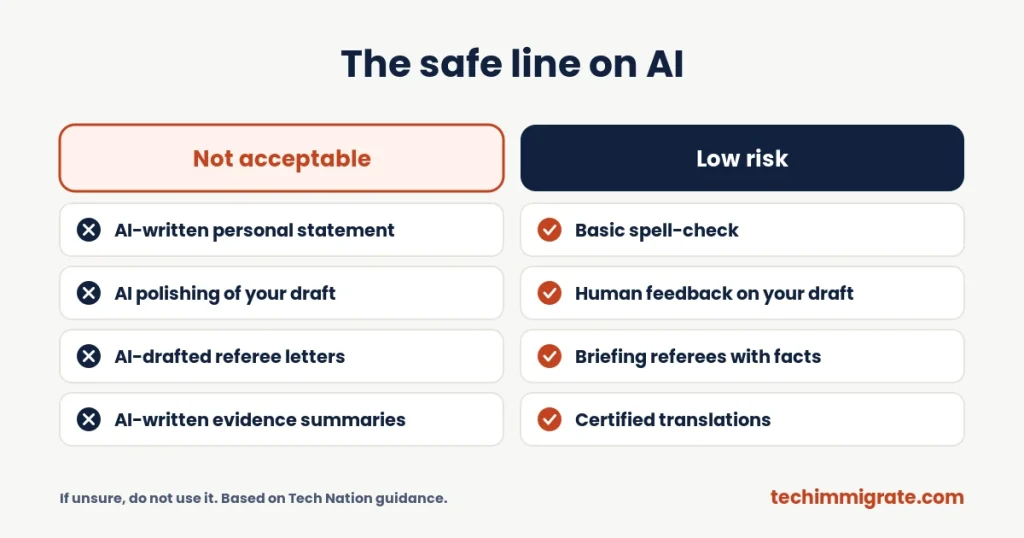
The Safe Line: What You Can and Cannot Do
Tech Nation does not publish a list of acceptable tools, so the safest reading of the guidance is strict: the words in your application should be yours. Here is how that works in practice.
| Activity | Risk level | Why |
|---|---|---|
| Writing your personal statement with an AI tool | Not acceptable | The guide names the personal statement directly |
| Asking AI to rewrite or polish your own draft | Not acceptable | The final text is still AI-created, and the risk of invented detail remains |
| Using AI to draft letters for referees | Not acceptable | The guide names letters of reference, and letters must be the referee's own |
| Using AI to write evidence descriptions or summaries | Not acceptable | The guide names evidence documents |
| Spell-check and basic grammar check in your word processor | Low | Correcting typos does not create content, but keep changes minimal |
| Using AI to brainstorm which achievements might be relevant, then writing everything yourself | Grey area | Nothing AI-generated goes into the application, but be careful not to copy wording |
| Asking a friend, mentor or adviser to review your draft | Normal | Human feedback is fine, as long as the final words are yours |
| Translating an official document that is not in English | Use a proper translation | Use a certified or professional translation, not a raw machine translation |
If you are unsure whether something is acceptable, do not do it. The cost of a refusal, or worse a finding of false evidence, is far higher than the time saved.
Letters of Recommendation: The Highest-Risk Area
Your three letters of recommendation are where AI use is most dangerous, because three people are involved and only one of them is you.
The rule is simple: each referee must write their own letter, in their own words, describing work they know first-hand. Each letter should give different examples. Three letters that say the same thing are weak even when they are genuine.
What you can do:
- Brief your referees. Tell them what the letters are for, what Tech Nation looks for, and which parts of your work each of them knows best. A short bullet list of facts and dates is reasonable.
- Give them the guidance. Point them to Tech Nation's guide so they understand the standard.
- Warn them about AI. Tell every referee directly that Tech Nation does not accept AI-written letters and may contact them. Busy senior people are increasingly tempted to draft with AI. They need to know the risk.
- Let them write. Do not send a finished draft for signature. Do not edit their wording.
Our guides on writing a recommendation letter that works and choosing the right referees go into more detail.
Your Personal Statement: Write It Like Evidence
The best defence against both AI concerns and generic writing is to write your statement as a structured argument, backed by your documents.
- Lead with facts. Names, dates, numbers, links to your evidence. Facts are hard to fake and easy to verify.
- Say what you did. Use "I" for your own actions, and be clear where you led a team.
- Connect each claim to a document. Assessors should be able to move from a sentence to the proof.
- Cut adjectives. Words like passionate, visionary and world-class add nothing. Let the evidence carry the weight.
- Sound like yourself. Your statement does not need perfect English. Tech Nation assesses your achievements, not your prose. Plain, slightly imperfect writing that is clearly yours is far better than a polished text that sounds like everyone else's.
Our guide to the Global Talent personal statement explains structure and length.
Evidence Documents: Real Proof, Not Generated Summaries
Your 10 pieces of evidence should mainly be existing documents: press coverage, conference programmes, GitHub repositories with usage data, product launch announcements, analytics screenshots, patents, papers, and letters from organisations. Where you add a short description or a cover page, write it yourself and keep it factual.
Two specific risks:
- AI-generated charts or summaries of your impact. If a figure in a chart cannot be traced back to a real source, it weakens the evidence and can raise concerns.
- Edited screenshots. Never alter screenshots, metrics or documents. Redact confidential information openly, for example by blacking out a client name, and say that you have done so.
Our evidence documents guide and portfolio checklist cover how to choose and present evidence.
What About AI Specialists?
If you work in AI or machine learning, the rules are exactly the same. Your work in AI can be excellent evidence: models you built, papers you published, open-source libraries you maintain, products you shipped. But the application itself must still be written by you, and your letters by your referees.
Tech Nation's guidance names AI and machine learning as part of digital technology, and many successful applicants work in the field. Our article on the Global Talent visa for data scientists and ML engineers explains what tends to get endorsed, and our article on why data and AI specialists get refused covers the common mistakes.
What Happens If Tech Nation Suspects AI Use?
Tech Nation does not publish a step-by-step process, but its guidance and applicant reports suggest a range of outcomes:
- Weaker assessment. Generic or templated content simply carries less weight, which can lead to a standard refusal for not meeting the criteria.
- Checks. Tech Nation may contact your referees or look more closely at your documents.
- Ineligibility for false evidence. If Tech Nation concludes that evidence is false or fraudulent, it treats the application as ineligible and tells the Home Office.
- Consequences for future applications. The Home Office can refuse future applications where false information or deception has been used. Depending on the circumstances, this can affect applications on any route, not just Global Talent.
If you are refused, read the refusal letter closely. If it criticises the authenticity of your documents rather than just their strength, take advice before you reapply or request a review. Our guide on how to challenge a Global Talent visa refusal explains your options.
A Simple Checklist Before You Submit
Run through these questions before you press submit:
- Did I write every sentence of my personal statement myself?
- Could I explain and defend every claim, number and date in it at an interview?
- Did each referee write their own letter, without a draft from me or an AI tool?
- Do my three letters give different examples, in clearly different voices?
- Is every figure in my evidence traceable to a real source?
- Have I avoided editing any screenshot or document beyond open redaction?
- Have I read the current version of Tech Nation's guide, including its section on AI?
If the answer to any of these is no, fix it before you apply.
How Our Guides Fit In
Our role-specific Global Talent guides are written to help you plan and structure your own application: which evidence to choose, how to frame it, what each criterion needs and what assessors look for. They are not templates to copy, and they do not write your application for you. That is deliberate. The guides show you what good looks like, with examples, so you can write your own statement and brief your referees with confidence. Browse the Global Talent guides for your role.
Frequently Asked Questions
No. Tech Nation's guidance says AI and language processing tools such as ChatGPT are not acceptable within your application, and names the personal statement as an example.
It is not safe. Rewriting by an AI tool still creates AI-generated text, and it can introduce errors. A basic spell-check is low risk, but the words should be yours. Tech Nation assesses your achievements, not the elegance of your writing.
No. Tech Nation names letters of reference as an example of unacceptable AI use and may contact referees. Tell your referees this directly before they write.
Tech Nation says it may check for unacceptable use of AI, but it does not publish how. Assume your documents may be checked, and that experienced assessors recognise generic, templated writing.
It may simply be weaker and refused for not meeting the criteria. If Tech Nation concludes evidence is false or fraudulent, the application is treated as ineligible and the Home Office is told, which can affect future applications.
Yes. Your AI work can be strong evidence, but the application must be written by you and the letters by your referees.
Use a proper professional or certified translation for official documents that are not in English, not a raw machine translation.
Grey Areas Applicants Ask About
Some situations come up again and again on the forum. Here is how to think about them, based on a strict reading of the guidance.
I used AI at work to help write a blog post or documentation that I now want to use as evidence. Your evidence is judged on what it shows about your work and its impact. A published article that you wrote with help from tools is part of your professional record, but be careful: if the evidence is meant to show your thought leadership, an article that is largely machine-written is weak evidence of it. Choose pieces that clearly reflect your own expertise, and do not rewrite old evidence with AI before submitting it.
English is not my first language. This is the most common reason applicants are tempted to use AI. Tech Nation does not require polished English. Write clearly and simply, use short sentences, and ask a human reviewer to point out anything that is unclear. Then fix it yourself.
I want to cut my statement down to fit the space. Edit it yourself. Cutting is a good discipline anyway, because it forces you to keep only the claims you can prove.
My referee is very senior and asked me to send a draft. Explain the rules politely and offer a list of facts instead. A letter that is clearly in the referee's own voice is worth far more than a polished one that reads like yours.
A paid service offered to write my application with AI. Walk away. Whoever writes it, you are the one who signs the declaration and bears the consequences.
The Bottom Line
Tech Nation's position on AI is clear: your application must be your own work, and your letters must be your referees' own work. With refusal rates high and the government focused on the integrity of talent routes, AI-written content is a risk with no upside. The applicants who succeed are the ones who present specific, verifiable, personal evidence of impact in their own words.
How We Checked This Article
We reviewed Tech Nation's applicant guidance on the use of artificial intelligence as quoted in practitioner analysis of the guide, including this summary by a UK immigration barristers' chambers, and checked it against Tech Nation's Global Talent visa pages in November 2026. Figures on refusals come from a Freedom of Information response published by Edgewater Legal, and the referee and integrity proposals from the Migration Advisory Committee's Review of Talent Routes (17 November 2026). Applicant experiences come from the Tech Nation Visa Forum and are applicant-reported, not official guidance.
Tech Immigrate is independent of Tech Nation and the Home Office. This article is general information, not legal advice. Tech Nation updates its guide from time to time, so read the current version before you apply.
We write practical guides for tech professionals applying for the UK Global Talent visa. Tech Immigrate is independent of Tech Nation and the Home Office, and our articles are general information, not legal advice. Rules and fees change, so always check gov.uk before you apply.