UK Global Talent Visa for Software Engineers: What Gets Endorsed
Can software engineers get the UK Global Talent visa? Which engineering profiles Tech Nation endorses, what evidence counts, open source, costs and timings.


In this article
- Which Software Engineers Qualify for the Global Talent Visa?
- How Do the Criteria Apply to Engineering Work?
- What Does the Mandatory Criterion Look Like for an Engineer?
- Does Open Source Count for the Global Talent Visa?
- Does Big Tech or Start-Up Experience Matter More?
- How Do Back-End, Front-End and Mobile Evidence Differ?
- What Recent Engineering Endorsements and Refusals Show
- Exceptional Talent or Exceptional Promise for Engineers?
- Who Should Write a Software Engineer's Letters?
- What Does the Global Talent Visa Cost for a Software Engineer?
- Why Do Engineers Choose Global Talent Over a Skilled Worker Visa?
- How Should a Software Engineer Start?
- Get the Guide for Software Developers
- Frequently Asked Questions
- How We Checked This Article
Software engineers can get the UK Global Talent visa, but the bar is recognition, not seniority. The government's list of skills covered by Tech Nation, updated on 1 July 2026, names principal-level software engineers, senior back-end developers driving major new technologies or open-source projects, and experienced front-end and mobile developers. To be endorsed, you need to show that people outside your employer recognise you as a leader (Exceptional Talent) or an emerging leader (Exceptional Promise), and that your best work was done in a product-led tech company or in public, not in IT services.
This article is for back-end, front-end, full-stack, mobile and platform engineers thinking about the route, whether you are abroad or already in the UK on a Skilled Worker or Graduate visa. It explains which engineering profiles Tech Nation tends to endorse, how each criterion applies to engineering work, what recent endorsements and refusals reported on the Tech Nation Visa Forum have in common, and what the visa costs in 2026.
Key takeaways
- The Tech Nation skills list, updated 1 July 2026, names principal-level engineers, senior back-end developers leading new technologies or open-source projects, and experienced front-end and mobile developers.
- Engineering experience at outsourcing, IT services, consultancy or ERP firms is listed as unsuitable. Product-led companies and public open-source work fit best.
- Internal performance ratings, salary benchmarks and big-tech job titles do not meet the Mandatory Criterion on their own, according to forum reviewers in 2026.
- Evidence created just before applying, or events not yet held, is usually discounted. Sustained, independent adoption carries more weight.
- The endorsement costs £561 and the visa £205, plus the £1,035 yearly health surcharge. Endorsement usually takes 5 to 8 weeks.
- Talent leads to settlement after 3 years and Promise after 5, according to GOV.UK in November 2026.
Which Software Engineers Qualify for the Global Talent Visa?
Tech Nation, the endorsing body for digital technology, assesses software engineers under its technical skills. The GOV.UK list of skills covered by Tech Nation, last updated on 1 July 2026, gives an indication of the engineering profiles it expects. Paraphrased, it includes:
- Principal-level software engineers or developers
- Senior back-end developers driving major new technologies or open-source projects
- Experienced front-end developers
- Experienced mobile app developers
- Operating systems, hardware, video game, VR and AR engineers
- DevOps and SysOps engineers, and CTOs or VPs of engineering at growing digital businesses
The same list says some work is unsuitable: corporate roles, service delivery, outsourcing, technical or management consultancy, ERP consultancy and systems administration.
The words "experienced", "senior" and "principal" matter. They signal that Tech Nation is not looking for every competent engineer. It is looking for engineers whose work is visible and valued beyond their own team. A mid-level engineer can still be endorsed under Exceptional Promise, but they need early signs of that outside recognition.
| Engineering profile | Typical fit | What usually decides it |
|---|---|---|
| Senior or principal engineer at a SaaS or app company | Strong | Your own design decisions and their measured effect |
| Maintainer or core contributor of a widely used open-source project | Strong | Independent adoption and your role in the project's substance |
| Founding or early engineer at a start-up | Strong | What you built, and evidence the product grew because of it |
| Mobile developer behind a widely used app | Good | Users, ratings and third-party coverage of the app |
| Front-end engineer who created a design system or library others use | Good | Adoption outside your employer |
| Engineer at a bank, insurer or retailer's internal IT | Mixed | Corporate roles are flagged; product impact must be clear |
| Engineer at an outsourcing or IT services firm | Weak | Listed as unsuitable; outside work must carry the case |
| ERP or CRM implementation consultant | Weak | ERP consultancy is listed as unsuitable |
If you are near the weak end, the route is not closed, but the evidence needs to come from somewhere other than client delivery: open-source work, a side product with real users, published research, or earlier roles at product companies.
How Do the Criteria Apply to Engineering Work?
Every applicant must meet the Mandatory Criterion and two of four optional criteria. For engineers, they translate like this.
| Criterion | What it asks | Engineering evidence that fits |
|---|---|---|
| Mandatory | Recognition as a leading talent or emerging leader | Invited talks, awards with independent judging, media naming you, maintainer status in a respected project, expert roles |
| OC1: Innovation | A track record of innovation as a founder, senior executive or employee working on a new digital field or concept | A new product, system or technique you created that reached the market |
| OC2: Beyond your job | Recognition for work outside your occupation that advances the field | Open-source projects others depend on, technical writing in selective outlets, structured voluntary mentoring |
| OC3: Significant contribution | Technical, commercial or entrepreneurial contribution as an employee of a product-led company | A system you designed that changed a product's performance, reliability, revenue or reach |
| OC4: Academic | Contributions through research | Peer-reviewed papers, cited work, research others built on |
Most engineers choose two from OC1, OC2 and OC3. Engineers with open-source standing often pick OC2 and OC3. Founding engineers often pick OC1 and OC3. Engineers with research backgrounds may use OC4.
Two rules from forum reviewers save a lot of wasted effort. First, each piece of evidence should support one criterion only. You can describe one large project from different angles, but the same achievement repeated across criteria tends to be counted once. Second, recommendation letters do not meet any criterion by themselves. They support the evidence. Our article on what Tech Nation actually checks goes through each criterion in detail.

What Does the Mandatory Criterion Look Like for an Engineer?
The Mandatory Criterion is where most engineering applications are weakest, because engineering work is usually recognised inside a company, not outside it.
Recognition that tends to work for engineers:
- Invitations to speak at respected developer conferences, where the organiser chose you for your expertise. Talks you were accepted for through a competitive call for papers can also count.
- Maintainer or core contributor status in an open-source project that many organisations depend on, especially where other maintainers or companies acknowledge your role.
- Awards and competitions with independent judging and a limited number of winners.
- Media coverage that names you as the engineer behind something notable, in publications with editorial selection.
- Expert roles, such as judging selective hackathons, reviewing for a conference programme committee, or advising on a technical standard.
What forum reviewers repeatedly say does not meet the Mandatory Criterion alone:
- Internal performance ratings. In an August 2026 thread, an engineer described being rated a top performer at a large US tech company in consecutive years. Reviewers pointed out that this is an internal company signal and that Tech Nation's guide says internal awards do not meet the Mandatory Criterion.
- Salary benchmarks. High pay, even backed by public benchmarking sites, was described in the same thread as insufficient without impact beyond the day-to-day role.
- Big-tech job titles. Working at a well-known company can help the story, but reviewers said it does not satisfy the criterion on its own.
Our article on the emerging leader standard covers the Mandatory Criterion for Promise applicants in more depth.
Does Open Source Count for the Global Talent Visa?
Yes, open source is one of the strongest kinds of evidence a software engineer can have, but only when it shows substance and adoption.
Tech Nation looks for contributions that matter to a project and to its users. A single bug fix or a set of documentation changes in a famous repository is not the same as designing a core feature or maintaining a library that thousands of projects depend on. One applicant who shared refusal feedback in August 2026 reported that their contribution to a major open-source project was described as improved documentation within an established project rather than the substance of the project.
What makes open-source evidence strong:
- Your role is clear. You authored, maintain or led a significant part of the project, and the commit history and release notes show it.
- Adoption is independent. Downloads, dependent repositories, usage by named companies, or mentions in other people's articles and talks.
- It is sustained. Activity over months or years, not a burst before applying.
One engineer endorsed as Exceptional Talent in May 2025 described presenting several years of contributions across projects, plus Stack Overflow answers with tens of thousands of views, as sustained activity rather than a one-off. Another, endorsed under Exceptional Promise in 2025 after applying for Talent, reported being among the top ten contributors to a project with over 30,000 GitHub stars.
Stars and commit counts alone rarely persuade assessors. Our article on turning GitHub into Global Talent evidence explains the proof types that do.
Does Big Tech or Start-Up Experience Matter More?
Neither is better in itself. What matters is whether your evidence shows you, individually, changing a product or the field.
At large tech companies, engineers often work on systems with huge scale, but the company's success can make it hard to show personal impact. Assessors may see your work as what the role would normally require. One applicant who shared feedback in 2026 reported that their technical contribution was described as sitting within what the role would ordinarily require, and that the platform was already operating at significant scale before the period their evidence covered. The lesson is to show what changed because of you, with a before-and-after baseline.
At start-ups, engineers often have clearer ownership: you built the first version, you designed the architecture, you shipped the feature that won the first big customer. The risk is the opposite: the company may be small, and growth figures may be self-reported. Evidence that a third party confirms, such as investor updates, press coverage, R&D tax relief claims or customer letters, carries more weight than internal dashboards.
The engineer endorsed as Exceptional Talent in May 2025 worked at a UK start-up for four years after two years on a Skilled Worker visa. For innovation, they used a system they took from proof of concept to production, linked to a patent held by the company's chief executive, and R&D work that received HMRC research and development tax relief.
How Do Back-End, Front-End and Mobile Evidence Differ?
The criteria are the same for every engineer, but the evidence that proves impact looks different by specialism.
| Specialism | Impact that assessors can check | Recognition that often exists |
|---|---|---|
| Back-end and distributed systems | Latency, throughput, cost, uptime, scale handled, before and after | Talks on architecture, open-source infrastructure tools, engineering blog posts others cite |
| Front-end | Performance scores, conversion changes, accessibility improvements, design system adoption | Component libraries, framework contributions, conference talks |
| Mobile | Downloads, ratings, crash rates, store features | App store featuring, media coverage of the app, awards |
| Platform and developer tools | Adoption by internal and external teams, time saved | Open-source tools, community talks |
| Machine learning engineering | Model performance in production, cost or revenue effect | Papers, open models, competition results |
Whatever your specialism, numbers need a base. "Improved performance by 60%" means little until the reader knows the starting point, the scale and how it was measured.
What Recent Engineering Endorsements and Refusals Show
These cases are from the Tech Nation Visa Forum. They are applicant-reported, and the advice in replies is member opinion, not official guidance.
- October 2023, endorsed under Promise in three weeks. A mid-level back-end engineer applied on 10 October and was endorsed on 31 October, and shared their full evidence list to help others.
- 2025, applied for Talent, endorsed under Promise. An engineer with a growing company of their own, growth at a previous platform and a top-ten contributor position in a 30,000-star open-source project reported endorsement at Promise level.
- May 2025, endorsed under Talent. An engineer with about seven years' experience, switching from a Skilled Worker visa, was endorsed using innovation and significant contribution, with letters from a partner company's chief executive, another company's VP of engineering and their own CTO.
- June 2026, not ready yet. An engineer refused in 2024 was rebuilding with new articles and small open-source packages. Reviewers warned that planned evidence does not count and that evidence created mainly to fit the application timing is weak.
- August 2026, refused under Promise. A back-end engineer reported a refusal in which awards were described as non-selective, press coverage as paid or self-written, judging and mentoring as career support rather than field advancement, and an open-source contribution as documentation work.
The pattern across these cases is consistent: endorsed engineers had evidence that other people, outside their employer, had chosen to recognise or adopt their work. Refused or not-yet-ready engineers had evidence they had produced or arranged themselves. Tech Nation has also become stricter. Our article on the Global Talent visa success rate covers the published figures.
Exceptional Talent or Exceptional Promise for Engineers?
Exceptional Talent is for engineers who are already recognised leaders. Exceptional Promise is for engineers at an earlier stage who show the potential to become leaders. Tech Nation can endorse you at a different level from the one you apply for.
| Exceptional Talent | Exceptional Promise | |
|---|---|---|
| Typical engineer | Senior, staff or principal with external standing | Early or mid-career with emerging external standing |
| Typical experience | Usually 5 years or more | Usually under 5 years |
| Recognition expected | Recognised across a technical community | Signs of recognition that is growing |
| Settlement | After 3 years | After 5 years |
Forum reviewers often warn that engineers with long careers may be assessed against the Talent standard even when they apply for Promise. If you have many years of experience but little outside recognition, the honest answer may be to build recognition first. Our article on Exceptional Talent vs Exceptional Promise explains the choice.
Who Should Write a Software Engineer's Letters?
You need three letters from established leaders in digital technology who know your work. Strong letters for engineers usually come from:
- A CTO, VP of engineering or engineering director who saw your work directly and can describe its effect on the product.
- A senior person outside your employer, such as a maintainer of a project you contributed to, a partner company's technical leader, or a conference organiser who invited you.
- A recognised figure in your specialism who knows your public work.
The applicant endorsed in May 2025 advised helping referees by reminding them of specific contributions and outcomes, while letting them write in their own words. Letters that sound like the applicant wrote them are a common refusal reason. The Home Office does not accept web links as evidence, so letters must be sent as signed documents. Our guide to recommendation letters covers who to ask.
What Does the Global Talent Visa Cost for a Software Engineer?
These figures were checked on GOV.UK in November 2026.
| Item | Cost or time |
|---|---|
| Endorsement (Stage 1) | £561 |
| Visa (Stage 2) | £205 |
| Immigration Health Surcharge | £1,035 per adult per year |
| Each partner or child | £766, plus their surcharge |
| Endorsement decision | Usually 5 to 8 weeks |
| Visa decision | About 3 weeks outside the UK, 8 weeks inside |
| Settlement (ILR) | After 3 years (Talent) or 5 years (Promise) |
You choose a visa length of one to five years. For a single engineer choosing five years, the surcharge is £5,175, so the total government cost is £5,941. Our Global Talent visa cost breakdown has worked examples for families.
Settlement rules are changing. The government's response on earned settlement, published on 2 November 2026, sets a 10-year baseline for most routes but keeps 3 years for a highest talent group that includes Global Talent. New rules are expected from December 2026. Check GOV.UK before relying on a settlement date.
Why Do Engineers Choose Global Talent Over a Skilled Worker Visa?
Many software engineers already in the UK hold a Skilled Worker visa. The main differences:
- No sponsor. Global Talent is not tied to an employer. You can change jobs, go contracting or start a company without new sponsorship.
- No salary threshold. There is no minimum salary for Global Talent.
- Faster settlement for Talent. Exceptional Talent leads to settlement after 3 years under the current GOV.UK rules.
- Harder to get. The Skilled Worker visa depends on a job offer; Global Talent depends on an endorsement that many applicants do not get.
You can usually switch to Global Talent from inside the UK once endorsed. The engineer endorsed in May 2025 advised explaining the switch clearly in the personal statement.
How Should a Software Engineer Start?
Before paying £561, work through these steps:
- Map where your work was done. Separate product-company and open-source work from services, consultancy or internal IT.
- List outside recognition only. Talks, maintainer roles, awards, coverage, adoption by others. Leave out internal ratings and salary.
- Pick your strongest two optional criteria based on independent evidence, not on what sounds impressive.
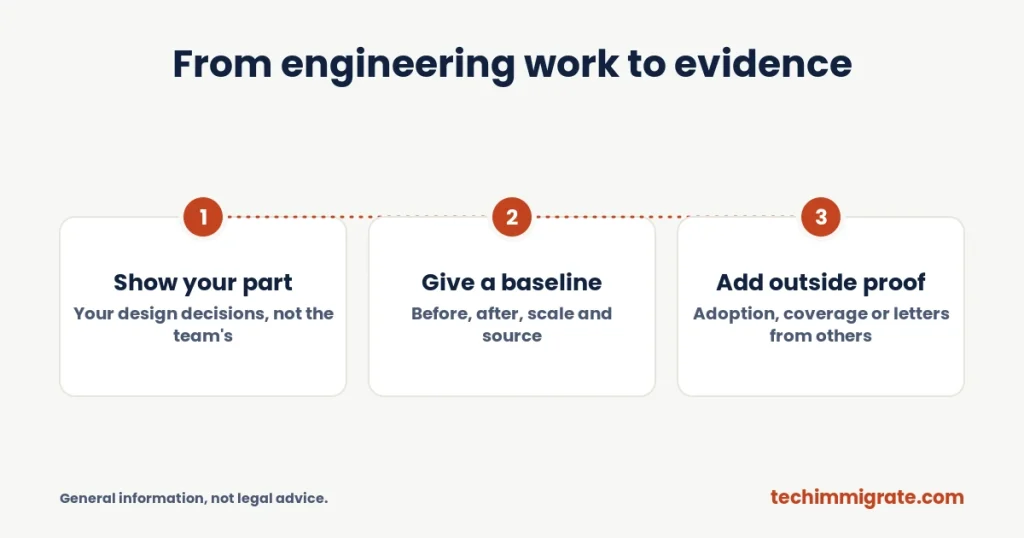
- Find baselines for your numbers. Every performance or business figure needs a starting point and a source.
- Choose letter writers who can describe specific work, at least one of them from outside your employer.
- Read the current Tech Nation guide and GOV.UK pages. Since 2025 you apply on GOV.UK, type your personal statement into the form and email documents to the Home Office.
Our article on the documents to include explains how to choose your 10 pieces of evidence.
Get the Guide for Software Developers
The Global Talent Visa Endorsement Guide for Software Developers is 114 pages, aligned with Tech Nation's applicant guide. It shows how to turn engineering work into evidence Tech Nation accepts, with 20 evidence checklists, a 12-week planner, 30 refusal fixes and 4 anonymised refusal cases with the wording decoded.
I was refused the first time I applied for Global Talent, then reapplied and was endorsed. The guide is built on what changed between those two applications.
Frequently Asked Questions
Yes. The Tech Nation skills list, updated 1 July 2026, names principal-level engineers, senior back-end developers, and experienced front-end and mobile developers. You need an endorsement showing recognition as a leader or emerging leader.
No. The Global Talent visa needs no job offer, no sponsor and no minimum salary. You can work for any employer, contract or start a business.
It can strengthen your story, but forum reviewers in 2026 said it does not meet the Mandatory Criterion on its own. Internal ratings and high pay are treated as internal signals, not outside recognition.
Yes, when your contribution is substantial and others adopt it. Documentation changes or a few commits to a famous project are usually treated as weak evidence.
They can apply, but the skills list treats outsourcing and consultancy work as unsuitable. A strong case usually relies on open-source work, side products or earlier product-company roles.
GOV.UK says endorsement decisions usually take 5 to 8 weeks. Forum applicants report decisions from about three weeks to over five weeks.
Talent suits engineers with five years or more and clear external recognition. Promise suits earlier-career engineers with emerging recognition. Tech Nation can endorse you at a different level.
How We Checked This Article
We checked eligibility, fees, timings and settlement periods on the GOV.UK digital technology Global Talent pages and the list of technical and business skills covered by Tech Nation, updated 1 July 2026, in November 2026. Process details draw on the Home Office Global Talent caseworker guidance published 3 August 2026.
Applicant cases come from the Tech Nation Visa Forum: a May 2025 Exceptional Talent endorsement, an October 2023 Promise endorsement for a back-end engineer, a 2025 endorsement at Promise level, a June 2026 readiness review, an August 2026 review of internal ratings and salary evidence and an August 2026 Promise refusal and review. Forum material is applicant-reported or member opinion, not official guidance.
Tech Immigrate is independent of Tech Nation and the Home Office. This article is general information, not legal advice.
We write practical guides for tech professionals applying for the UK Global Talent visa. Tech Immigrate is independent of Tech Nation and the Home Office, and our articles are general information, not legal advice. Rules and fees change, so always check gov.uk before you apply.