
Global Talent Visa for Digital Marketers: The Product-Led Test
Can digital marketers get the Global Talent visa? The product-led test, which marketing roles pass, what recognition counts, and which results convince.


In this article
- Can Digital Marketers Get the Global Talent Visa?
- What Is the Product-Led Test for Marketers?
- Which Marketing Roles Usually Pass?
- Why Marketing Recognition Is Not Enough
- Which Criteria Suit Marketing Work?
- Which Marketing Results Make Convincing Evidence?
- What Recent Marketing Applications Show
- Exceptional Talent or Exceptional Promise for Marketers?
- Who Should Write a Marketer's Letters?
- What Does the Visa Cost for a Marketer?
- Why Marketers Value Global Talent Over Sponsored Visas
- How Should a Digital Marketer Start?
- How Should Marketers Show Their Own Contribution?
- Which Marketing Evidence Tends to Backfire?
- Get the Guide for Digital Marketers
- Frequently Asked Questions
- How We Checked This Article
Digital marketers can get the UK Global Talent visa, but only on one condition that rules out many marketing careers: the work must be done in-house for a product-led digital technology business. The government's list of skills covered by Tech Nation, updated on 1 July 2026, names in-house performance marketing experts for digital businesses as a suitable business skill, while agencies and marketing firms are excluded. On top of that, you need recognition as a leader (Exceptional Talent) or emerging leader (Exceptional Promise) in digital technology, not only in marketing.
This article is for performance, growth, lifecycle, SEO and product marketers, heads of growth and CMOs who want to know whether the route can work for them. It explains the product-led test, which marketing roles pass it, the difference between marketing recognition and digital technology recognition, which results make convincing evidence, and what recent applications reported on the Tech Nation Visa Forum show.
Key takeaways
- "In-house performance marketing experts for digital businesses" are named on the GOV.UK Tech Nation skills list, updated 1 July 2026. C-suite roles such as CMO at digital businesses are also listed.
- Business skills only count for in-house work at product-led digital technology companies. Agencies, marketing firms and outsourcers are excluded.
- Refusal feedback shared in July 2026 described evidence as marketing-profession recognition rather than digital technology-sector recognition.
- Growth you bought with ad spend, or growth shared with product and sales, is hard to claim as yours. Efficiency and attribution matter.
- Team awards, education and scholarships rarely carry the Mandatory Criterion, according to forum reviewers in 2026.
- Endorsement costs £561 and the visa £205, plus the £1,035 yearly health surcharge.
Can Digital Marketers Get the Global Talent Visa?
Yes, but the route is narrower for marketers than for engineers. Tech Nation assesses marketers as business applicants. The GOV.UK list of technical and business skills covered by Tech Nation, last updated on 1 July 2026, includes, in paraphrase:
- In-house performance marketing experts for digital businesses
- Commercial or business leads in digital businesses who own growth or distribution strategy
- C-suite leaders such as chief marketing officers at SMEs or larger digital businesses
The same list says business skills apply to in-house work within product-led digital technology companies, not tech-enabled or service companies such as agencies, outsourcers and marketing firms.
So the question for a marketer is not only "am I good enough?" but "was my best work done in the right place?" A brilliant agency strategist and an average in-house growth marketer are on different sides of the eligibility line, regardless of talent.
If you do pass that test, the visa is valuable. It needs no sponsor and no minimum salary, and you can move between start-ups, consult or found a company. Our article on the benefits of the Global Talent visa covers the full list.
What Is the Product-Led Test for Marketers?
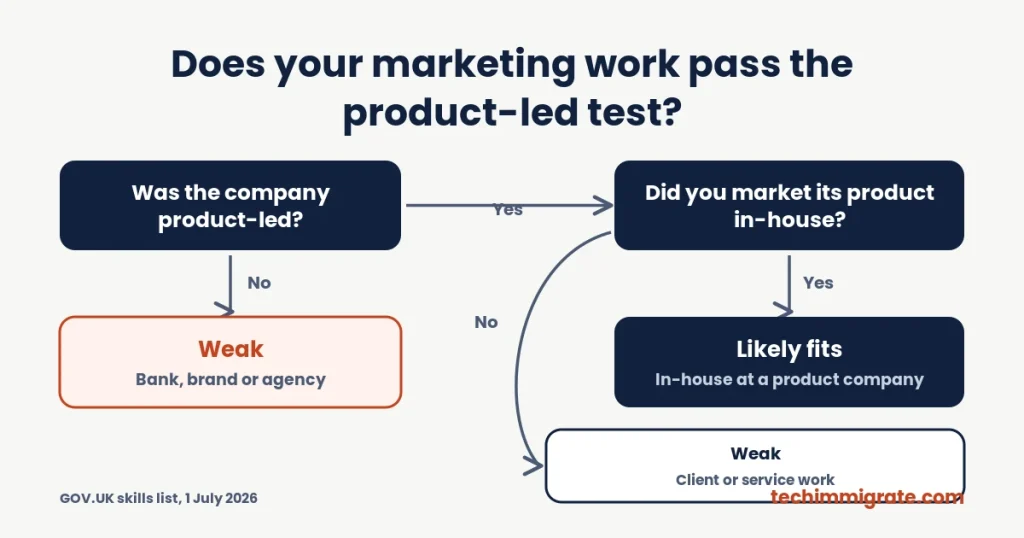
The product-led test has two parts, and marketers need to pass both.
First, the company. A product-led digital technology company earns most of its revenue from its own software, app, platform or data product. A SaaS company, a consumer app, a marketplace or a fintech whose app is the business all qualify. A bank, a retailer, a consumer goods brand or an agency does not, even if it has a big digital marketing team.
Second, your work. You need to have marketed that digital product in-house, as an employee or senior leader, with outcomes tied to the product's growth. Marketing for clients, even tech clients, is agency work.
Forum reviewers in 2026 have also stressed a third point: you need to show how you led the product's growth, not just that the product exists and grew. Stating that an app is live, or that the company raised money, does not show your contribution.
Which Marketing Roles Usually Pass?
| Role | Typical fit | What usually decides it |
|---|---|---|
| Growth or performance marketer in-house at a SaaS or app company | Strong | Efficient growth you drove, confirmed by the company |
| Head of growth or CMO at a digital business | Strong | Strategy you set and the growth it produced |
| Product marketing manager at a SaaS company | Good | Launches and positioning tied to adoption and revenue |
| Lifecycle or retention marketer at a subscription app | Good | Retention or lifetime value changes with a baseline |
| In-house SEO lead at a digital product company | Good | Organic acquisition growth you can attribute |
| Social media manager at a tech company | Mixed | Must show business outcomes, not reach alone |
| Marketer at a bank, retailer or brand | Weak | The company is not product-led |
| Agency strategist or account lead | Weak | Agencies are listed as unsuitable |
| Freelance marketer for clients | Weak | Client work is service work |
If most of your career sits in the weak rows, the honest path is usually to build two or more years of in-house experience at a product-led company before applying.
Why Marketing Recognition Is Not Enough
The Mandatory Criterion asks for recognition as a leader or emerging leader in digital technology. Marketers often have plenty of recognition, but it is recognition within the marketing profession: marketing awards, marketing conference talks, marketing certifications.
In July 2026, an applicant who had been refused shared the panel's main concern: their evidence was seen as marketing-profession recognition rather than digital technology-sector recognition. Their in-house marketing results were described as marketing outcomes within the expected scope of a marketing specialist role.
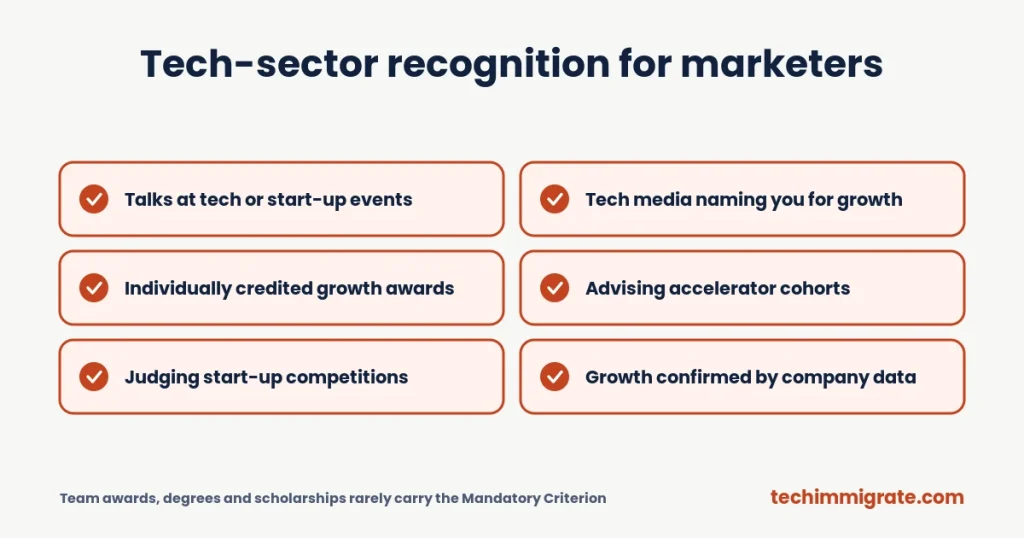
Recognition that tends to carry more weight for marketers:
- Invitations to speak at technology or start-up events about how you grew a digital product, not general marketing talks.
- Media in technology publications that names you as the person behind a product's growth.
- Awards judged on the growth of a digital product, with clear selection criteria and individual credit.
- Expert roles in the tech ecosystem, such as advising accelerator cohorts on growth or judging start-up competitions.
What forum reviewers in 2026 said tends not to work: team awards without proof of your individual part, scholarships and degrees, teaching appointments in marketing, and press that covers the company or a role announcement. In an August 2026 review of a social media manager's profile, reviewers said a well-known scholarship and a master's degree were education, not sector recognition, and that team awards are generally not accepted unless ownership is clear.
Which Criteria Suit Marketing Work?
| Optional criterion | What it asks | Marketer evidence |
|---|---|---|
| OC1: Innovation | A track record of innovation as a founder, senior executive or employee working on a new digital field or concept | A new growth channel, model or go-to-market approach you created that the product adopted at scale |
| OC2: Beyond your job | Recognition for work outside your occupation that advances the field | Growth frameworks or tools others in tech use, structured voluntary mentoring of founders, selective writing |
| OC3: Significant contribution | Commercial contribution at a product-led company | Growth you drove, measured and confirmed: users, revenue, retention, efficiency |
| OC4: Academic | Research contributions | Rarely relevant for marketers |
OC3 is where most marketers' strongest evidence sits. OC2 is often weak, because marketers' outside work can look like personal brand building or a side business. Template packs, courses and paid communities have generally not been accepted as field advancement in 2025 and 2026 refusals.
Which Marketing Results Make Convincing Evidence?
Marketing has more numbers than almost any other function, and more ways for those numbers to be discounted.
| Result | Persuasive when | Discounted when |
|---|---|---|
| User or customer growth | You can show which part came from your channels | The whole company's growth is claimed as yours |
| Revenue influenced | Finance or leadership confirms attribution | Last-click data from your own dashboard only |
| Customer acquisition cost | Lower cost at higher volume, with a baseline | Cost fell because spend fell |
| Payback or lifetime value | Measured over a meaningful period | Short window, cherry-picked cohort |
| Organic or SEO growth | Third-party tools and company data agree | Traffic with no business outcome |
| Retention or activation | Before and after a change you led | No baseline or no link to your work |
Two warnings apply to most marketers. First, bought growth is not exceptional on its own: if users rose because the budget tripled, the assessor will see the budget, not you. Efficiency is what shows skill. Second, growth has many owners. Product, engineering, sales and the founders will all claim part of it, so show the decision that was yours and what changed because of it.
Reviewers in 2026 suggested sources that are harder to dispute than your own dashboards: payment provider data, app store data, audited accounts and company-approved reports. Our article on why digital marketers get refused covers these refusal patterns in depth.
What Recent Marketing Applications Show
These cases are from the Tech Nation Visa Forum. They are applicant-reported, and replies are member opinion, not official guidance.
- 2022, SEO marketer refused under Promise. A digital marketer specialising in search applied in mid-July and was refused in mid-August, with letters from leaders at an advertising company and an e-commerce business.
- 2023, product marketing manager endorsed on the second attempt. Their first application failed on the Mandatory Criterion and OC1 but met OC3. They rebuilt the other criteria, kept OC3 untouched, and were endorsed under Promise. Their letters came from a former chief product officer and their chief executive, who referred to specific pieces of evidence.
- 2023, digital marketer endorsed under Promise. A marketer and strategist shared that reading earlier refusals helped them avoid mistakes before they were endorsed.
- July 2026, refused and rebuilding. A marketer moving into founder and ecosystem work shared feedback that their recognition was marketing-profession recognition and their results were within the expected scope of a marketing role. Reviewers advised showing that press named them, proving the start-up was product-led with payment or app store data, and avoiding role-based awards.
- August 2026, profile review. A social media manager at a listed cloud company, with about 18 months in tech, planned to use a scholarship, a teaching role and team marketing awards. Reviewers said 18 months was not automatically disqualifying for Promise, but that the evidence was education-based or team-based and too vague.
The pattern: endorsed marketers showed individual, verifiable growth at product-led companies, recognised by the tech sector. Refused marketers relied on marketing awards, education, team results or company news. Our article on the Global Talent visa success rate covers how much stricter Tech Nation has become.
Exceptional Talent or Exceptional Promise for Marketers?
| Exceptional Talent | Exceptional Promise | |
|---|---|---|
| Typical marketer | Head of growth or CMO with tech-sector standing | Growth or performance marketer with emerging recognition |
| Experience | Usually more than 5 years | 5 years or less |
| Recognition | Recognised across the tech sector for growing products | Signs of tech-sector recognition |
| Settlement | After 3 years | After 5 years |
Refusal wording shared in 2026 described Promise as intended for applicants with 5 or less years experience. For marketers who moved into tech from brand, agency or traditional marketing, count your years in digital technology carefully, and expect the assessor to look at when your tech track record began. Our article on Exceptional Talent vs Exceptional Promise explains the choice.
Who Should Write a Marketer's Letters?
You need three letters from established leaders in digital technology. For marketers, strong letter writers usually include:
- A founder, CEO or CPO who saw your growth work change the product's trajectory.
- A senior tech leader outside your company: an investor, an accelerator director, or a partner who relied on your work.
- A recognised figure in the tech ecosystem who knows your public work.
Letters from marketing agency heads or marketing educators carry the same risk as marketing awards: they may read as marketing-profession recognition. Letters should name the specific growth you drove and why it mattered to the product. They must be sent as signed documents, since the Home Office does not accept web links. Our guide to recommendation letters covers who to ask.
What Does the Visa Cost for a Marketer?
Figures checked on GOV.UK in November 2026:
| Item | Cost or time |
|---|---|
| Endorsement (Stage 1) | £561 |
| Visa (Stage 2) | £205 |
| Immigration Health Surcharge | £1,035 per adult per year |
| Each partner or child | £766 each, plus their surcharge |
| Endorsement decision | Usually 5 to 8 weeks |
| Visa decision | About 3 weeks outside the UK, 8 weeks inside |
| Free endorsement review | Within 28 days of a refusal; no new evidence |
| Settlement | After 3 years (Talent) or 5 years (Promise) |
The government's earned settlement response of 2 November 2026 keeps 3 years for a highest talent group that includes Global Talent, while setting a 10-year baseline for most routes. New rules are expected from December 2026. Our cost breakdown has worked examples.
Why Marketers Value Global Talent Over Sponsored Visas
Marketing careers in tech often involve moving between start-ups, consulting for several companies, or joining a founding team. A sponsored visa ties you to one employer and requires a salary threshold. Global Talent removes both. You can join an early-stage start-up that has no sponsor licence, take a fractional CMO role, or found a company.
That freedom is also a reason to be careful about timing. If you are in the UK on a Skilled Worker visa at an in-house product company, you may be building exactly the evidence Global Talent needs. Applying too early, with agency-heavy evidence, risks a refusal that the next application has to overcome.
How Should a Digital Marketer Start?
Before paying £561:
- Run the product-led test on every role. Mark which employers were product-led and which work was in-house.
- Separate tech recognition from marketing recognition. Keep the first; treat the second as background.
- Choose two or three growth results where you can show your decision, a baseline and an outside confirmation.
- Check efficiency, not just volume. Be ready to explain growth that came from spend.
- Pick referees from the tech side, including at least one outside your employer.
- Read the current Tech Nation guide and GOV.UK pages. Since August 2025 you apply on GOV.UK and email documents to the Home Office.
Our article on the Global Talent business route explains how business applicants can prove innovation.
How Should Marketers Show Their Own Contribution?
Marketing results are almost always shared. A growth number belongs to the product team, the sales team, the brand and the budget as much as to the marketer. Assessors know this, so a chart that shows revenue going up proves very little on its own. What persuades them is a clear line from a decision you made to a result that followed, with dates, and with someone outside your own team confirming it.
In practice, that means three things. First, name the decision: the channel you chose, the experiment you designed, the pricing or onboarding change you pushed for. Second, show the before and after over a fixed period, and say what else changed in that time so the assessor does not have to guess. Third, back it with a source the assessor can trust, such as a dated report from your company's data team, a product release note that names your change, or a letter from a senior leader who saw the work first-hand.
Keep the numbers modest and exact. A precise figure with a clear period, like a lower cost per acquisition over two quarters, reads as more credible than a large percentage with no baseline. Where results are confidential, explain what you can share and why, rather than leaving gaps the assessor has to fill in.
A simple test helps before you submit. For each piece of evidence, ask whether someone who has never met you could see what you decided, what changed as a result, and who outside your team confirms it. If any of those three answers is missing, the evidence will probably be read as your team's work rather than your own, and it is worth strengthening before you pay the fee.
Which Marketing Evidence Tends to Backfire?
Some evidence that looks impressive to marketers can count against an application, because it signals the wrong thing to a digital technology panel. Applicants on the Tech Nation Visa Forum report refusals that cite these patterns.
- Paid or sponsored press presented as independent recognition.
- Dashboards and screenshots you produced yourself, with no outside confirmation.
- Client results from agency work, which sits outside the product-led businesses Tech Nation looks for.
- Vanity metrics such as followers, impressions or awards for campaigns, without a link to product or business outcomes.
- Marketing-industry awards and talks presented as recognition in the wider digital technology sector.
None of these is fatal if it is supporting evidence and framed honestly. The problem comes when they carry the weight of a criterion. The guide for digital marketers covers how to rebuild a pack around stronger evidence.
Get the Guide for Digital Marketers
The Global Talent Visa Endorsement Guide for Digital Marketing Professionals is 95 pages, aligned with Tech Nation's applicant guide. It covers the product-led test, how to turn growth work into evidence Tech Nation accepts, 17 evidence checklists, a 12-week planner, 40 refusal fixes and 10 anonymised refusal cases from the forum with the wording decoded.
I was refused the first time I applied for Global Talent, then reapplied and was endorsed. The guide is built on what changed between those two applications.
Frequently Asked Questions
Yes, if their main work was in-house at a product-led digital technology company. The GOV.UK Tech Nation skills list, updated 1 July 2026, names in-house performance marketing experts for digital businesses.
They can apply, but agencies and marketing firms are listed as unsuitable for business skills. Agency experience rarely carries an application without in-house product company work.
Often not on their own. Refusal feedback in July 2026 described marketing awards as marketing-profession recognition rather than digital technology-sector recognition. Team awards need proof of your individual part.
Growth you can attribute to your decisions, with a baseline and outside confirmation: acquisition efficiency, retention, activation or revenue confirmed by the company, payment data or audited accounts.
It can, but spend alone is not exceptional. Show efficiency, such as lower acquisition cost at higher volume, and what you did differently.
Business applicants. Business skills only count for in-house work at product-led digital technology companies.
GOV.UK says endorsement decisions usually take 5 to 8 weeks.
How We Checked This Article
We checked eligibility, fees, timings and settlement periods on the GOV.UK digital technology Global Talent pages and the list of technical and business skills covered by Tech Nation, updated 1 July 2026, in November 2026. Process details draw on the Home Office Global Talent caseworker guidance published 3 August 2026.
Applicant cases come from the Tech Nation Visa Forum: a July 2026 refusal and rebuild for a marketer, an August 2026 social media manager profile review, a 2023 product marketing manager endorsement, a 2023 digital marketer endorsement, a 2022 SEO marketer refusal and a 2026 Promise refusal proforma on experience. Forum material is applicant-reported or member opinion, not official guidance.
Tech Immigrate is independent of Tech Nation and the Home Office. This article is general information, not legal advice.
We write practical guides for tech professionals applying for the UK Global Talent visa. Tech Immigrate is independent of Tech Nation and the Home Office, and our articles are general information, not legal advice. Rules and fees change, so always check gov.uk before you apply.


