Global Talent Visa for Startup Founders: Prove Innovation, Impact and Leadership (7 Proofs)
Global Talent Visa for Startup Founders explained: map your product, traction, hiring, funding and press to the criteria with seven proofs. Plan yours now.

In this article
- How Does the Global Talent Visa for Startup Founders Work?
- The Criteria a Founder Must Meet
- How to Map Founder Evidence to the Criteria
- The 7 Proofs of Global Talent Visa for Startup Founders
- Strong and Weak Founder Evidence Side by Side
- Illustrative Example (Fictional): A Founder's Evidence Map
- Global Talent Visa for Startup Founders: Choosing Optional Criteria
- Illustrative Example (Fictional): A Pre-Revenue Founder's Map
- Global Talent Visa for Startup Founders: A Document Allocation Example
- Global Talent Visa for Startup Founders Who Are Pre-Revenue
- How to Keep Your Evidence Honest
- Recommendation Letters for Founders
- Exceptional Talent or Exceptional Promise?
- Writing the Personal Statement as a Founder
- From Evidence to Visa: A Simple Timeline
- Global Talent Visa for Startup Founders: Mapping Mistakes
- A Founder's Planning Checklist
- Global Talent Visa for Startup Founders FAQ
- Your Next Step
- How We Checked This Article
The Global Talent Visa for Startup Founders works by mapping your real evidence to Tech Nation's criteria. Your product, traction, hiring, funding, press, speaking and advisory roles each prove something specific. Match each one to a criterion, and you have a plan.
This is the how-to guide. It shows which proof fits which criterion, how to split your ten documents, and what to do if you have no revenue yet. It is general information, so use it to plan, not to decide.
Key takeaways
- Founders apply through the digital technology endorsement: one mandatory criterion plus two of four optional criteria.
- Seven kinds of founder evidence do most of the work: product, traction, hiring, funding, press, speaking and advisory roles.
- Each document counts for one criterion only, so allocate all ten before you write any.
- Pre-revenue founders can still build a case with users, pilots, grants and outside validation.
- Meeting the criteria is necessary but not enough, because the panel decides overall.
How Does the Global Talent Visa for Startup Founders Work?
The Global Talent Visa for Startup Founders is not a separate visa. Founders use the digital technology route, which has two stages: an endorsement from Tech Nation, then a visa application to the Home Office. There is no points system, and you do not need a job offer.
At the time of writing, the endorsement fee is £561 and the visa fee is £205, which makes £766 before the Immigration Health Surcharge. The surcharge is £1,035 per year for adults. Dependants pay their own visa fee and surcharge. Check the gov.uk digital technology page and the main gov.uk Global Talent page for current figures.
Tech Nation usually decides within 5 to 8 weeks. The visa decision takes about 3 weeks from outside the UK and 8 weeks from inside it. You must apply for the visa within 3 months of the endorsement. For costs in more detail, see our benefits and costs guide.
The Criteria a Founder Must Meet
Every founder needs one mandatory criterion plus two of four optional criteria. The mandatory criterion (MC) is recognition as a leading or emerging talent in digital technology within the last five years. The four optional criteria are:
- Innovation (OC1): a product-led company, or a new product or technology.
- Recognition (OC2): credit for work outside your day job.
- Contribution (OC3): a significant technical, commercial or entrepreneurial input to a product-led digital technology business.
- Academic work (OC4): research, peer review or publications.
Founders usually lean on OC1 and OC3, then add OC2 or the MC evidence from outside sources. OC4 suits fewer founders. For the full text, read our Global Talent Visa criteria guide and the Tech Nation visa page.
How to Map Founder Evidence to the Criteria
Mapping means choosing, for each piece of evidence, the one criterion it proves best. For example, a launch record proves innovation, while a hiring plan proves contribution. Likewise, a press article proves recognition. Because one document cannot count twice, you must choose.
Start with a simple grid. List every piece of evidence you hold in rows, and put the criteria across the top. Then mark the strongest fit for each row and delete weak ones. The table below shows a typical founder pattern.
| Founder evidence | Usually fits | Why |
|---|---|---|
| Product launch record | OC1 | Shows what was new and when |
| Usage and revenue exports | OC1 or OC3 | Shows the market responded |
| Hiring and team plans | OC3 | Shows leadership and commercial impact |
| Funding and term sheets | MC or OC3 | Shows outside validation |
| Trade press coverage | MC | Shows independent recognition |
| Conference talks, judging, mentoring | OC2 | Shows work beyond the day job |
| Advisory and board roles | MC or OC2 | Shows peers trust your judgement |
This is a planning pattern, not a rule. The right fit depends on your evidence and Tech Nation's current wording.
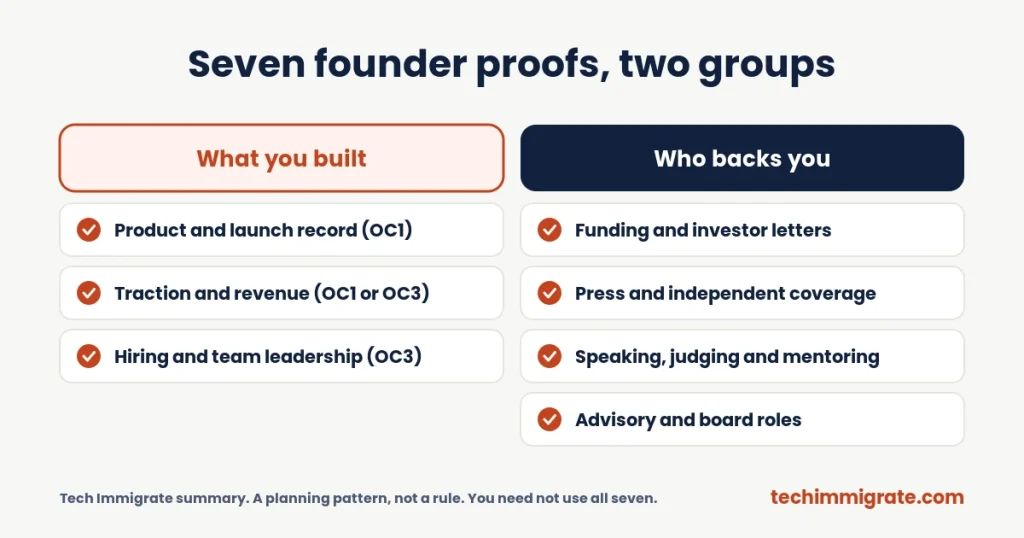
The 7 Proofs of Global Talent Visa for Startup Founders
Seven proofs cover most founder cases, and each one answers a different reviewer question. You do not need all seven. In practice, most applicants use four or five strong ones.
Proof 1: Product and launch record (OC1)
This proof shows you created something new. Use dated release notes, a product page, an archive link and a short note on what existed before. Name the feature or model you shaped. A launch date inside the last five years keeps it current.
Weak versions are an undated screenshot or a pitch-deck slide. Strong versions are archived pages, public changelogs and customer-facing announcements that anyone can check. Also add one line on what your product replaced or did differently.
Proof 2: Traction and revenue (OC1 or OC3)
This proof shows the market responded. Use analytics exports, invoices, accountant-prepared accounts or payment reports. Always show the source and date range. Tie numbers to your own product decisions, not to the whole company.
For instance, if you changed pricing and conversion rose, show the dates of the change and the before-and-after export. If you only show a rising line, the reviewer cannot tell why it rose. Therefore, annotate every chart with the decision behind it.
Proof 3: Hiring and team leadership (OC3)
This proof shows commercial and entrepreneurial contribution. Use a hiring plan you wrote, an org chart with dates, or a letter from a senior hire who explains your leadership. Say how many people you hired and for which roles.
A vague claim such as "built a great team" proves little. A dated plan, a list of roles and a letter from a senior hire prove a lot more. Besides, a hire who joined because of your vision can explain in a letter what you changed.
Proof 4: Funding and investor validation (MC or OC3)
This proof shows outsiders backed your work. Use a term sheet, a funding announcement that names you, or a letter from an investor. However, amounts alone say little, so show your role in winning and using the money.
When an investor writes a letter, ask them to say what they checked before they invested and what you did afterwards. That detail turns a funding round into proof of your judgement. Meanwhile, a grant or accelerator place works in the same way for smaller companies.
Proof 5: Press and independent coverage (MC)
This proof shows independent recognition. Use articles by journalists, trade press features or sector reports that name you or your product. Tech Nation's guidance says evidence for recognition must come from outside your employer, so your own blog does not count.
If you have only a few mentions, rank them by independence and keep the best. A journalist's article that you did not write or pay for beats a sponsored feature. Also keep archive links, because pages can disappear before you apply.
Proof 6: Speaking, judging and mentoring (OC2)
This proof shows work beyond your day job. Use programmes, agendas and invitations from recognised events, or records of structured mentoring. Unpaid, independent activity tends to read stronger than a sponsored slot.
Pick activity with a clear audience and a named organiser. A talk at a recognised sector event, a judging panel or a structured mentoring programme is easy to check. In contrast, a chat with friends or an online profile is hard to verify.
Proof 7: Advisory and board roles (MC or OC2)
This proof shows peers trust your judgement. Use letters of appointment, advisory agreements or announcements. Keep them current and specific, and say what you advised on.
Since these roles show trust rather than output, pair them with a letter or announcement that explains the scope. Applicants often put advisory roles under the mandatory criterion, but they can serve OC2 when they sit outside your day job. Choose one home for each document.
Strong and Weak Founder Evidence Side by Side
Strong founder evidence is dated, sourced, personal and independent. Weak evidence fails at least one of those four tests. Use this table as a quick filter when you sort your pile.
| Proof | Stronger version | Weaker version |
|---|---|---|
| Product | Archived launch page with date | Undated screenshot |
| Traction | Analytics export with date range | Number on a slide |
| Hiring | Dated hiring plan plus senior hire letter | "Built a great team" |
| Funding | Investor letter naming your role | Funding headline alone |
| Press | Journalist article about your product | Your own press release |
| Speaking | Programme from a recognised event | Internal talk |
| Advisory | Signed appointment with scope | A job title on LinkedIn |
Notice that each stronger version gives a reviewer something to check. That is the real test. If a stranger can confirm the fact in two minutes, you have a good page.
Illustrative Example (Fictional): A Founder's Evidence Map
Illustrative example (fictional): Lena founded a compliance software company four years ago. It has 60 customers, £1.2 million in annual revenue and a £3 million seed round. She has no patents.
She lists all her evidence, then maps it. Her launch record and usage exports go to OC1. Her hiring plan and a letter from her head of sales go to OC3. Finally, her trade press features and an investor letter go to the MC.
Lena skips speaking and advisory roles, because she has only one small talk. That is fine. She does not claim a criterion where the evidence is thin, so her portfolio stays focused.
Global Talent Visa for Startup Founders: Choosing Optional Criteria
Choose the two optional criteria where you hold the strongest and most independent evidence. Do not choose by habit or by what other founders did. Instead, score each criterion from your grid.
First, count how many strong documents you can attach to each one. Strong means dated, sourced, linked to you and checkable by someone outside your company. Second, check that you can reach two documents per chosen criterion without reusing any. Third, ask which two criteria tell your story best.
If two criteria tie, pick the one with more outside proof. For example, a founder with strong press but only internal letters should lean on the mandatory criterion and OC1. A founder with deep hiring evidence and a solid investor letter may lean on OC3. When in doubt, check the current wording on the Tech Nation visa page before you lock the plan.
Illustrative Example (Fictional): A Pre-Revenue Founder's Map
Illustrative example (fictional): Tomas built a developer-tools startup 20 months ago. It has 3,500 active users, no revenue and a small grant. He has two conference talks and one trade press mention.
He maps his evidence with care. The launch record and usage export go to OC1. The two talks go to OC2. Then the trade press mention and a letter from a design partner go to the mandatory criterion.
Because Tomas lacks hiring and revenue proof, he skips OC3. That choice keeps his case honest. Applicants in this position often consider Exceptional Promise, and they plan to add outside evidence before they apply.
Global Talent Visa for Startup Founders: A Document Allocation Example
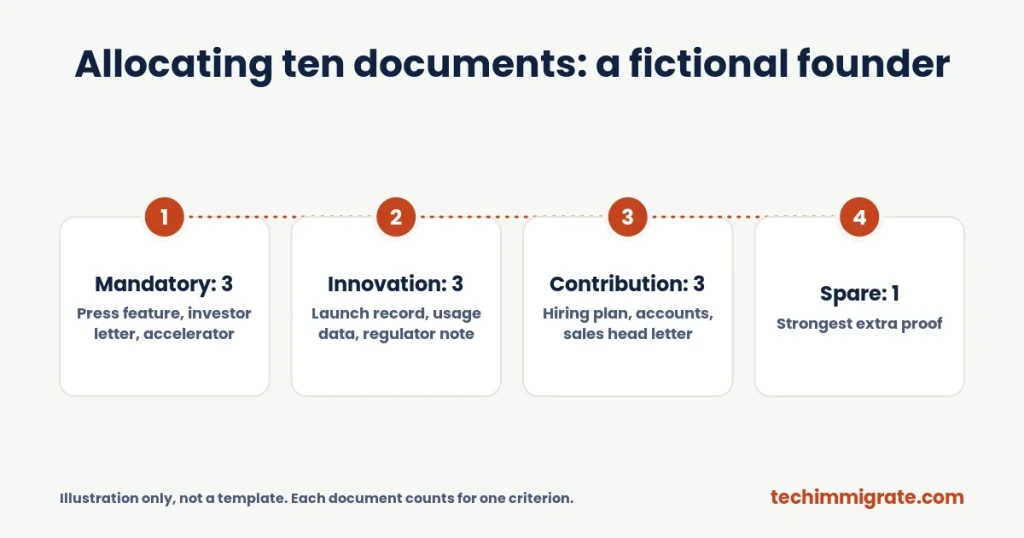
A ten-document plan gives each criterion two or three documents, with one spare. Lena's allocation looks like this. It is an illustration, not a template, because every case differs.
| Doc | Content | Criterion |
|---|---|---|
| 1 | Trade press feature naming Lena | MC |
| 2 | Investor letter and term sheet | MC |
| 3 | Accelerator acceptance and mentor note | MC |
| 4 | Dated launch record of her core product | OC1 |
| 5 | Analytics export and a customer partner letter | OC1 |
| 6 | Compliance regulator's acknowledgement of the product | OC1 |
| 7 | Hiring plan she wrote, with dates | OC3 |
| 8 | Accountant-prepared accounts tied to her pricing work | OC3 |
| 9 | Letter from head of sales on her leadership | OC3 |
| 10 | Spare: strongest extra proof | Any one |
Each document stays inside three A4 sides, and no document appears twice. Three recommendation letters sit alongside the ten, and they support the evidence. They do not replace it.
Global Talent Visa for Startup Founders Who Are Pre-Revenue
Pre-revenue founders can still apply, because revenue is only one proof among seven. The criteria look at recognition and contribution, so you need outside voices more than income.
Strong pre-revenue proof includes user numbers, a signed pilot, a grant award, an accelerator place and a working product that reviewers can see. Likewise, a letter from an early customer can confirm real use. In practice, a thin track record often points towards Exceptional Promise.
Applicants in this situation often wait to build outside evidence first. For example, they may join a structured mentoring programme or speak at a recognised event. That takes time, but it fills the gap that revenue would normally cover. A separate article in this series explains why company success alone is not enough.
How to Keep Your Evidence Honest
Honest evidence is the safest evidence, because reviewers compare every page against the others. If your CV says one date and your launch record says another, doubt spreads. So build one master timeline first, and then check each document against it.
Also avoid stretching a role. If you shared a decision with a co-founder, say so, and then explain your part. Tech Nation does not accept AI-written or templated documents, so write each page yourself. When you are unsure whether a claim holds up, remove it. A smaller, firmer case usually reads better than a large, shaky one.
Recommendation Letters for Founders
Recommendation letters are three letters from established experts who have known your work for at least 12 months. They support your evidence but cannot replace it. Founders often choose an investor, a customer and a respected peer.
Ask each person to name what you built, when, and what changed. Specific facts help more than praise. Send a short fact sheet and let them write in their own words, since templated letters weaken the case. Our recommendation letters guide covers who to ask.
Exceptional Talent or Exceptional Promise?
Established founders usually look at Exceptional Talent, and emerging founders at Exceptional Promise. Settlement is possible after 3 years on Talent and 5 years on Promise. Your years of results and recognition shape which fits.
Tech Nation also notes that Promise requires three senior stakeholders in product-led digital technology who vouch for you. Plan those names early. Our comparison of Exceptional Talent vs Exceptional Promise explains the trade-offs.
Writing the Personal Statement as a Founder
The personal statement ties your seven proofs into one clear story. It should say who you are, what you built and why it matters to digital technology. Keep it factual and write it yourself.
Founders often over-sell here. Instead, point to the documents and let them carry the weight. Our personal statement guide shows how to structure it.
From Evidence to Visa: A Simple Timeline
Most founders need a few months from first audit to visa, so plan backwards. Tech Nation says preparation can take up to 12 weeks. Then the endorsement decision usually takes 5 to 8 weeks.
After endorsement, you must apply for the visa within 3 months. The visa decision takes about 3 weeks from outside the UK and 8 weeks from inside it. So a realistic plan runs from the evidence audit through drafting, letters, review, endorsement and visa.
If the endorsement is refused, you can ask for a free review within 28 days, although you cannot add new evidence. Otherwise, you can make a fresh application and pay a new fee. Check the current rules on gov.uk before you rely on any date.
Global Talent Visa for Startup Founders: Mapping Mistakes
Most mapping mistakes come from reusing evidence or claiming a criterion without proof. These patterns come from applicant forums and adviser blogs, so treat them as prompts, not official rules.
- Placing one document under two criteria.
- Using the pitch deck as a catch-all.
- Counting a self-published post as recognition.
- Claiming team results as personal results.
- Using evidence older than five years.
- Choosing OC2 with no real activity beyond the day job.
If you want a wider list, search for common Tech Nation endorsement mistakes. Also remember that a separate article in this series covers the five gaps between a successful business and an endorsement.
A Founder's Planning Checklist
Use this checklist before you start drafting. It takes less than an hour.
- List all evidence you hold from the last five years.
- Map each piece to one criterion, and drop the weak ones.
- Choose your two optional criteria, then check each has two or more strong documents.
- Name three recommenders who have known your work for 12 months or more.
- Check that each document names you, a date, a source and a number.
- Allow up to 12 weeks for preparation, according to Tech Nation.
Global Talent Visa for Startup Founders FAQ
Yes, if Tech Nation endorses them first. Founders use the digital technology route and need one mandatory criterion plus two optional criteria. The panel decides overall, so strong evidence of personal innovation and leadership matters more than company size or funding.
No threshold is set for either. Funding and revenue can serve as proof, but pre-revenue founders can use users, pilots, grants and outside validation. What matters is evidence that you led or built something significant, confirmed by people outside your business.
Founders often use innovation (OC1) and contribution (OC3), plus independent recognition for the mandatory criterion. Some add outside-work activity for OC2. The right mix depends on your evidence, so map first and then choose your two optional criteria.
A common pattern gives two or three documents to each criterion you claim, plus one spare. Each document can run up to three A4 sides and can count for only one criterion. Plan the full allocation before you write.
Both cases can work if the evidence is real. A failed startup can still show innovation and impact. Applicants with a side startup report that reviewers want traction, so show users, revenue or outside support rather than intent.
Your Next Step
Want the guide for your role? See the guides.
Then open the startup founders guide, a role-specific endorsement guide with an evidence checklist and planner. You can also browse the guides hub, or read the tech investors guide and the product managers guide if your work blends those roles.
How We Checked This Article
We checked the route structure, fees, timings and the 3-month visa window on the gov.uk Global Talent digital technology page and the main gov.uk Global Talent page. We checked the application process and the Exceptional Promise referee wording on the Tech Nation visa page. Beyond that, we read adviser articles and applicant discussions about founders, and we label those points as applicant-reported, not official.
Tech Immigrate is independent of Tech Nation and the Home Office. This article is general information, not legal advice, and nobody can guarantee an endorsement. Always confirm current rules on gov.uk before you apply.
We write practical guides for tech professionals applying for the UK Global Talent visa. Tech Immigrate is independent of Tech Nation and the Home Office, and our articles are general information, not legal advice. Rules and fees change, so always check gov.uk before you apply.