Global Talent Visa From Pakistan: A Guide for Freelancers, Engineers and Founders
Applying for the UK Global Talent visa from Pakistan: freelance and remote careers, services roles, the TB test, paying fees and evidence Tech Nation accepts.


In this article
- Why the Global Talent Visa Appeals to Tech Professionals in Pakistan
- How the Process Works From Pakistan
- Practical Steps for Applicants in Pakistan
- Freelancers: What Counts and What Does Not
- Software Export and Services Companies
- Startups and Founders in Pakistan
- Communities and Training
- Examples of Strong Evidence by Role
- Letters of Recommendation
- Exceptional Talent or Exceptional Promise?
- Costs
- Helping Assessors Understand Your Clients and Companies
- A Six-Month Plan if You Are Not Ready Yet
- Choosing Your Strongest 10 Documents
- Writing Your Personal Statement
- Bringing Your Family
- A Realistic Timeline
- Talking to UK Employers and Clients
- Applying From Outside Pakistan
- Common Mistakes Applicants Report
- After You Arrive: Freelancing From the UK
- Frequently Asked Questions
- Turn Client Work Into Recognition
- How We Checked This Article
Pakistan has one of the world's largest communities of tech freelancers and remote workers, a fast-growing software export sector, and active startup scenes in Lahore, Karachi and Islamabad. Many Pakistan-based engineers, designers, product people and founders have built careers serving clients and users around the world without leaving the country. The UK Global Talent visa can turn that track record into the right to live and work in the UK without a job offer or employer sponsor.
This guide is for tech professionals applying for the Global Talent visa from Pakistan, whatever passport they hold. It focuses on the questions that come up most for applicants from Pakistan: how freelance and remote careers are assessed, what counts as recognition when much of your work is for overseas clients, how to present work in software export and services companies, and the practical steps of applying, including the tuberculosis test and paying fees.
Key takeaways
- Both Global Talent stages can be completed from Pakistan: endorsement by Tech Nation through GOV.UK, then the visa within 3 months.
- Tech Nation assesses your contribution to digital technology, not where you are based. Work for international clients and employers from Pakistan counts.
- Freelance platform ratings and earnings badges are not, on their own, recognition as a leader. Tech Nation looks for impact and recognition beyond your immediate work.
- Services and outsourcing roles are harder to present than product roles, according to applicant reports. Focus on innovation, ownership and external recognition.
- People who have lived in Pakistan for 6 months or more and apply for a UK visa of more than 6 months need a tuberculosis test certificate from an approved clinic.
- Government fees are £561 for endorsement, £205 for the visa and £1,035 a year for the health surcharge. Check that your payment method can handle international payments of this size.
Why the Global Talent Visa Appeals to Tech Professionals in Pakistan
For many Pakistan-based professionals, the alternative is the Skilled Worker visa, which needs a UK employer with a sponsor licence offering a role at or above the going rate for your occupation, and B2 English for new applicants. Many remote workers and freelancers already earn from international clients and do not want to give up that independence for one employer.
Global Talent fits that kind of career:
- No job offer or sponsor. You qualify on your own track record.
- Freedom to work for anyone. Including continuing to work with your existing international clients, subject to UK tax and contract rules.
- Self-employment allowed. You can freelance, consult or run your own company.
- No salary threshold.
- Faster settlement under current rules. 3 years for Exceptional Talent, 5 years for Exceptional Promise.
The challenge is the endorsement. Tech Nation refused about 82% of decided cases in 2025, according to Freedom of Information figures reported by Edgewater Legal. Our eligibility self-check helps you see where you stand.
How the Process Works From Pakistan
Stage 1: endorsement. Apply on GOV.UK, type your personal statement into the form, pay £561 and email your documents to the Home Office for referral to Tech Nation. Applicants report most decisions within 5 to 8 weeks of paying.
Stage 2: the visa. Within 3 months of your endorsement letter, apply for the visa, pay £205 and the health surcharge, prove your identity and provide documents including your tuberculosis certificate. Decisions from outside the UK usually take about 3 weeks.
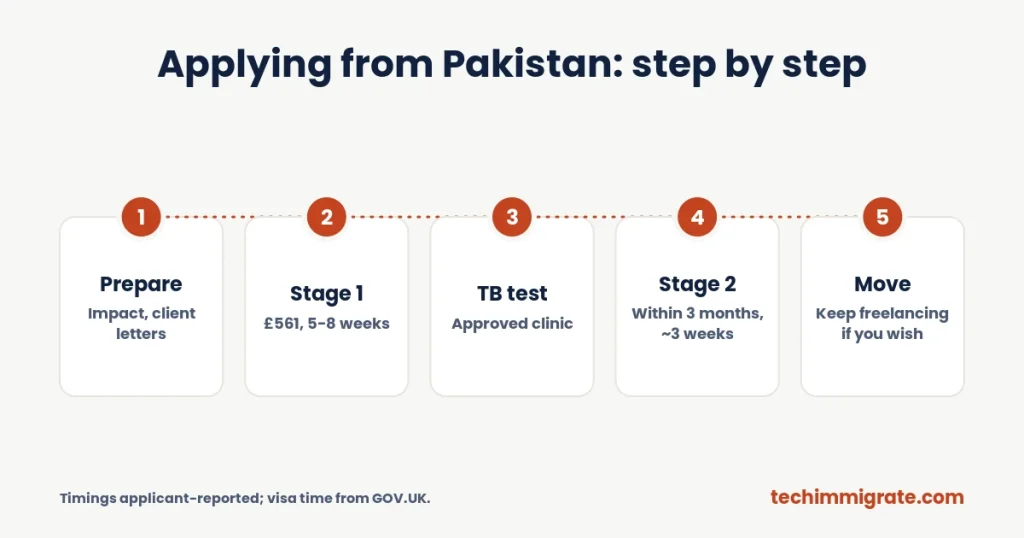
Our articles on how to apply for the Global Talent visa and how to apply for endorsement cover every step.
Practical Steps for Applicants in Pakistan
Tuberculosis test
Pakistan is on the Home Office list of countries where a tuberculosis test is required for visas of more than 6 months. If you have lived in Pakistan for 6 months or more, you need a certificate from a Home Office-approved clinic. Approved clinics have operated in major cities. Check the current list on GOV.UK, book in good time, and make sure the certificate is still valid when you apply. Family members applying with you usually need their own.
Visa application centres and identity
Depending on your passport, you will either use the UK Immigration: ID Check app or attend a visa application centre for fingerprints and a photo. Visa application centres have operated in several Pakistani cities. Check current locations and booking rules before you apply.
Paying fees
UK government fees are charged in pounds and can be large: the health surcharge for a 5-year visa alone is £5,175. Applicants sometimes report difficulties with international card payments because of bank or card limits. Check your payment method well before you apply, and do not leave Stage 2 payments until the last days of your 3-month window.
Documents
Prepare all Stage 1 evidence as clear PDFs, with no web links, keeping each email under 25MB. Any document not in English needs a proper translation.
Freelancers: What Counts and What Does Not
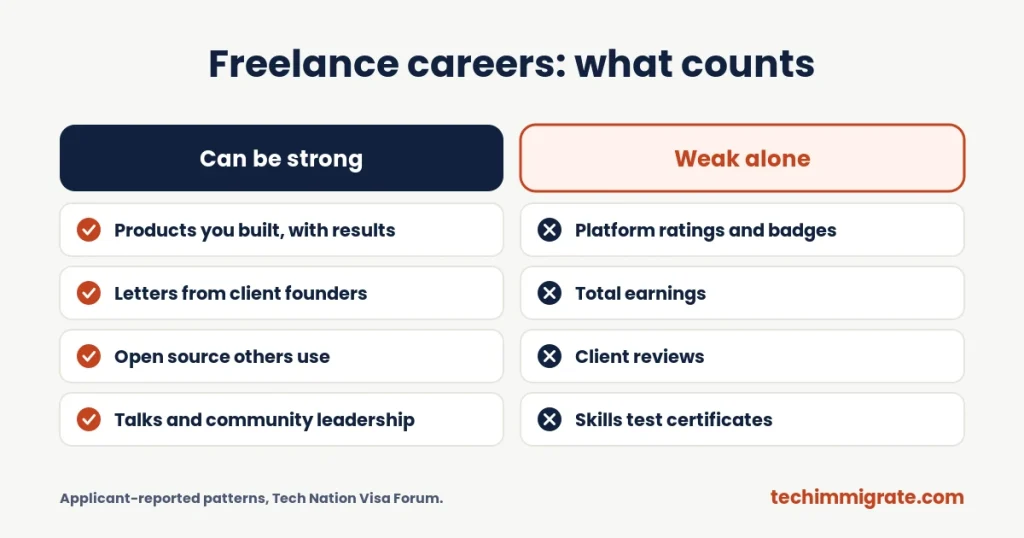
This is the most important section for many applicants from Pakistan. Freelance platforms show ratings, badges, earnings and job counts. Those numbers show you are a successful, trusted freelancer. On their own, they do not show that you are a leader or emerging leader in digital technology, which is what Tech Nation assesses.
| Usually weak on its own | Can be strong |
|---|---|
| Platform ratings and top-rated badges | Products you built that became significant for a client, with data and a letter from the client |
| Total earnings or number of jobs | Long-term technical leadership for a known company, documented |
| Client reviews praising reliability | Open-source tools you created that others use |
| Skills tests and certificates | Talks, writing or training that made you recognised in your niche |
| Portfolio screenshots without context | Case studies showing measurable impact, verified by the client |
To turn a freelance career into strong evidence:
- Pick your most significant engagements. Focus on work that shaped a product or company, not the largest number of small jobs.
- Get client letters. A letter from a founder or CTO explaining what you built, why it mattered and the results is far stronger than platform reviews. If they are an established figure in digital technology, they may even be one of your three referees.
- Show results. User numbers, revenue, performance improvements or funding the product went on to raise, with sources.
- Build recognition beyond clients. Talks, writing, open source and community leadership show you are known in the field, not only to the people who paid you.
Software Export and Services Companies
Pakistan's software export sector employs many engineers in companies building software for overseas clients. As with services work elsewhere, applicants report that Tech Nation finds it harder to see personal innovation and recognition in client projects. To strengthen your case:
- Highlight what was new. Platforms, frameworks, tools or approaches you created that were reused or adopted.
- Show leadership. Leading teams, architecture decisions, or client relationships that shaped products.
- Get permission to share client names and metrics, or use letters to confirm your role where details are confidential.
- Add external recognition through talks, publications, open source and community work.
Our article on why software developers get refused Global Talent endorsement covers related pitfalls.
Startups and Founders in Pakistan
Pakistan's startup ecosystem has produced companies in fintech, e-commerce, logistics, health and education, some backed by international investors. Founders and early employees can use funding announcements, user growth, revenue, press coverage and investor letters as evidence. Founders should show their personal leadership, not just the company's progress. Early employees should show what they specifically built or led. Coverage in recognised national and international business and technology media can help show recognition, as long as it is about your work and not only about the company. Our startup founders guide explains how.
Communities and Training
Many Pakistan-based tech professionals contribute to the ecosystem through developer communities, university chapters, training programmes and online teaching. Substantial, documented community leadership, such as running a well-attended community, creating training that reached many developers, or mentoring through recognised programmes, can support the mandatory criterion and the optional criterion about recognition beyond your occupation. Keep programmes, attendance numbers, outcomes and letters from partner organisations.
Online courses and tutorials you created can count if they have significant reach and recognition, for example large audiences, use by companies or universities, or coverage by respected outlets. Courses you completed, by contrast, rarely help.
Examples of Strong Evidence by Role
- Full-stack engineer working remotely for a funded startup. Evidence: the product you built from scratch, user growth after launch, the funding the company raised with your product, and a letter from the founder.
- Mobile developer. Evidence: apps you built with large download numbers and strong ratings, documented with store screenshots, plus talks and open-source libraries.
- AI and data specialist. Evidence: models in production for clients with measurable results, research papers, competition results and a widely used open-source project. See our data and AI guide.
- Designer. Evidence: products whose design you led, with adoption data, design awards and community leadership. See our UX and product designers guide.
- Security researcher. Evidence: responsible disclosures with acknowledgements, talks at security conferences and tools adopted by the community. See our cybersecurity guide.
- Founder. Evidence: funding from recognised investors, growth data, press and investor letters.
Letters of Recommendation
You need three letters from established experts in digital technology who know your work well. For freelancers and remote workers, senior people at client companies are often the strongest referees, because they saw your impact first-hand. Referees can be anywhere in the world.
Each letter must be written by the referee in their own words, with different, specific examples. Tech Nation's guidance says AI-written content within the application is not acceptable and that it may contact referees. Our guides on recommendation letters and choosing referees explain more.
Exceptional Talent or Exceptional Promise?
Most applicants with recent, growing recognition fit Exceptional Promise, which leads to settlement after 5 years under the current rules. Applicants with sustained leadership recognised well beyond their clients or employer may fit Exceptional Talent, which leads to settlement after 3 years. Choosing the wrong level is a common reason for refusal. See our comparison of Exceptional Talent and Exceptional Promise.
Costs
| Cost | Single applicant, 5-year visa | Family of four, 5-year visas |
|---|---|---|
| Endorsement | £561 | £561 |
| Main applicant's visa | £205 | £205 |
| Dependants' visas (£766 each) | £0 | £2,298 |
| Health surcharge | £5,175 | £20,700 |
| Total government fees | £5,941 | £23,764 |
Tuberculosis test fees are extra. See our Global Talent cost breakdown.
Helping Assessors Understand Your Clients and Companies
Many of your clients or employers may be small or unfamiliar to a UK assessor. Give each one a line of context: what it does, its scale, its funding or market position, and a source. For clients under confidentiality agreements, describe the industry and size without naming them, and rely on letters confirming your role. If a product you built later raised funding, was acquired or reached significant users, say so with evidence, because that shows the impact of your work beyond the original engagement.
A Six-Month Plan if You Are Not Ready Yet
- Audit your career and pick the three or four engagements with the biggest impact.
- Ask those clients for permission to share results, and for detailed letters.
- Turn one engagement into a public case study, with the client's approval.
- Speak and write at recognised events and in respected publications in your niche.
- Release an open-source tool from your work, where your contracts allow, and grow its adoption.
- Mentor or lead a community, and keep records of outcomes.
- Reassess before paying for Stage 1.
Our guide on evidence strategy by career stage suggests where to focus.
Choosing Your Strongest 10 Documents
You can submit up to 10 pieces of evidence. Each should support one criterion, show impact or recognition beyond your job, and be verifiable from the document alone. Make sure the mandatory criterion and at least two optional criteria each have their own documents. Leave out weak items such as course certificates, skills tests and platform badges. Our guide on choosing your 10 evidence documents explains how.
Writing Your Personal Statement
Your statement is typed into the GOV.UK form, in your own words. For freelancers and remote workers, the most common weakness is a statement that lists clients and technologies. Instead:
- Open with your area of digital technology and the core of your claim.
- Describe your two or three most significant achievements, each linked to numbered evidence.
- Show how others have recognised your work beyond the clients who paid you.
- Explain how you meet the mandatory criterion and each optional criterion you claim.
- Finish with your plans in the UK.
Tech Nation's guidance says AI-generated content within the application is not acceptable. Our personal statement guide has more detail.
Bringing Your Family
Your partner and children under 18 can apply as dependants. Each pays £766 plus the health surcharge, and each usually needs a tuberculosis certificate if they have lived in Pakistan for 6 months or more. GOV.UK lists no financial requirement for Global Talent dependants. Partners can work for any employer, and children can attend state schools free of charge. Under the current rules, dependants usually need 5 years to settle. Our article on Global Talent dependants explains the details.
A Realistic Timeline
| Phase | Typical time |
|---|---|
| Preparing evidence, statement and CV | 4 to 12 weeks |
| Client and referee letters | 4 to 6 weeks, in parallel |
| Stage 1 decision after paying | Applicants report 5 to 8 weeks |
| Tuberculosis test | Book while waiting for Stage 1 |
| Stage 2 visa decision | About 3 weeks after identity and documents |
| Total | Usually 3 to 6 months |
Freelancers often need longer at the start, because gathering client letters and permissions takes time. Begin those conversations early.
Talking to UK Employers and Clients
Once endorsed, you can tell UK employers and clients that you do not need sponsorship and can work on any basis: employee, contractor or through your own company. That flexibility is valuable to startups and small companies that cannot sponsor visas. Some applicants line up UK contracts while waiting for the visa decision; others keep their international clients and build UK work gradually.
Applying From Outside Pakistan
If you are living temporarily in another country, such as in the Gulf for work, you can usually apply from there using the local visa application centre. Whether you need a tuberculosis test depends on where you have lived in the last 6 months. Check that the centre accepts applications from residents of that country, and allow for any differences in booking and processing.
Common Mistakes Applicants Report
These patterns come from the Tech Nation Visa Forum and our research. They are applicant-reported, not official guidance.
- Relying on freelance ratings, badges and earnings as the main evidence.
- Long lists of client projects without showing impact or innovation.
- Certificates from courses and skills tests used as evidence of leadership.
- Client reviews instead of detailed letters from senior people.
- Numbers without sources or context.
- Applying for Exceptional Talent too early.
- Payment problems and late tuberculosis tests delaying Stage 2.
- Using unregulated agents who promise endorsement or write documents. See our article on Global Talent lawyers and advisers.
After You Arrive: Freelancing From the UK
One of the biggest advantages of Global Talent for freelancers is that you can keep freelancing in the UK. You can work for international clients, take UK contracts, or set up a company. Once you are UK tax resident, you usually pay UK tax on your worldwide income, so register for Self Assessment, keep invoices and bank records, and take accounting advice. These records are also your evidence of earnings in your field when you extend or settle. Keep a travel log too, because more than 180 days outside the UK in any 12-month period can affect settlement. Our article on what you can do on a Global Talent visa explains your rights.
Frequently Asked Questions
Yes. You can apply for endorsement and the visa from Pakistan. After endorsement, you have 3 months to apply for the visa.
It can, if you show impact and recognition beyond your clients. Platform ratings and earnings alone are rarely enough.
If you have lived in Pakistan for 6 months or more and are applying for a visa of more than 6 months, yes, from a Home Office-approved clinic.
Only as supporting context. A profile page rarely shows leadership on its own. Detailed client letters and documented results are much stronger.
Yes. Global Talent allows self-employment and working for international clients, subject to UK tax rules.
Yes, if they are established experts in digital technology who know your work well.
No. Global Talent needs no job offer, sponsor or salary threshold.
Not on their own. They show reliability to clients. Tech Nation looks for recognition and impact in the wider field, such as talks, adoption, press and senior letters.
Applicants report endorsement within 5 to 8 weeks of paying; the visa usually takes about 3 weeks from outside the UK.
Turn Client Work Into Recognition
If you have spent years building software for clients around the world, you may already have more evidence than you think. The work is in finding it, documenting it, and getting the right people to confirm what you did. That takes weeks, not days, so start with the engagements you are proudest of and the clients who would be happy to write about them. The strongest applications from Pakistan show not just that the applicant did great work for clients, but that their work changed products and companies, and that people beyond those clients recognised it. Our role-specific Global Talent guides show what Tech Nation looks for in your field.
How We Checked This Article
We checked the process against GOV.UK's Global Talent visa pages, applying from outside the UK, the tuberculosis test guidance and the Home Office Global Talent caseworker guidance (version 19.0), in November 2026. Fees come from the Home Office fee schedule in force from 8 April 2026. Clinic and visa application centre locations can change, so check the current lists. Evidence patterns and common mistakes come from the Tech Nation Visa Forum and are applicant-reported, not official guidance. The refusal figure comes from a Freedom of Information response published by Edgewater Legal.
Tech Immigrate is independent of Tech Nation and the Home Office. This article is general information, not legal or tax advice.
We write practical guides for tech professionals applying for the UK Global Talent visa. Tech Immigrate is independent of Tech Nation and the Home Office, and our articles are general information, not legal advice. Rules and fees change, so always check gov.uk before you apply.