
Global Talent Visa From Ghana: A Guide for Ghana-Based Tech Professionals
Applying for the UK Global Talent visa from Ghana: the process, TB test, fees, and how to present work in a smaller market so Tech Nation sees its impact.


In this article
- Why Global Talent Rather Than a Sponsored Visa?
- The Process From Ghana
- Practical Steps for Applicants in Ghana
- Presenting Work From a Smaller Market
- Evidence That Works Well From Ghana
- Remote Work for International Companies
- Letters of Recommendation
- Exceptional Talent or Exceptional Promise?
- Costs
- Examples of Strong Evidence by Role
- AI, Data and Research for African Contexts
- Choosing Your Strongest 10 Documents
- Bringing Your Family
- A Realistic Timeline
- Talking to UK Employers
- Writing Your Personal Statement
- Common Mistakes Applicants Report
- A Six-Month Plan if You Are Not Ready Yet
- After You Arrive
- Applying From Outside Ghana
- Frequently Asked Questions
- Show the Significance of Your Work
- How We Checked This Article
Ghana's tech scene has grown into one of West Africa's most respected, with Accra home to fintech companies, software studios, developer communities, research labs and a growing number of founders building for markets across the continent. For tech professionals based in Ghana who want to work in the UK, the Global Talent visa offers something the sponsored routes do not: you qualify on your own track record, without a UK job offer, an employer sponsor or a minimum salary.
This guide is for tech professionals applying for the UK Global Talent visa from Ghana, whatever passport they hold. It explains how the process works when you apply from Ghana, how to present work done in a smaller but fast-moving market so that Tech Nation can see its significance, how regional and remote work fits in, and the practical steps, including the tuberculosis test, that applicants in Ghana need to plan for.
Key takeaways
- Both Global Talent stages can be completed from Ghana: endorsement by Tech Nation through GOV.UK, then the visa within 3 months of endorsement.
- Tech Nation assesses your contribution to digital technology wherever it happened. Work in Ghana and across Africa counts.
- In a smaller market, context matters: explain what your work achieved relative to the market, the region and the problem it solved.
- Regional and pan-African impact, remote work for international companies and community leadership can all be strong evidence.
- People who have lived in Ghana for 6 months or more and are applying for a UK visa of more than 6 months need a tuberculosis test certificate from an approved clinic.
- The main fees are £561 for endorsement, £205 for the visa and £1,035 a year for the health surcharge.
Why Global Talent Rather Than a Sponsored Visa?
For tech professionals outside the UK, the usual alternative is the Skilled Worker visa, which depends on a UK employer with a sponsor licence offering you a role at or above the going rate for your occupation. For software developers, that going rate is £54,700 under occupation code 2134. Finding such an offer from outside the UK can take a long time, and the visa ties you to that employer.
Global Talent works differently:
- No job offer. You can arrive and then look for the right role, or bring your own work with you.
- No sponsor. You can work for any employer, start a company or freelance.
- No salary threshold. Your pay is not tested against an occupation code.
- Long visas. You choose 1 to 5 years per grant.
- Faster settlement under current rules. 3 years for Exceptional Talent, 5 years for Exceptional Promise.
The trade-off is that the bar is high. Freedom of Information figures reported by Edgewater Legal suggest Tech Nation refused about 82% of decided cases in 2025. Strong preparation is essential. Our eligibility self-check helps you assess where you stand.
The Process From Ghana
Stage 1: endorsement. You apply online on GOV.UK, type your personal statement into the form, pay £561, and email your CV, three letters of recommendation and up to 10 pieces of evidence to the Home Office. The Home Office refers your application to Tech Nation. Applicants report most decisions within 5 to 8 weeks of paying.
Stage 2: the visa. Within 3 months of your endorsement letter, apply for the visa online, pay £205 and the health surcharge, prove your identity and provide documents. Decisions from outside the UK usually take about 3 weeks.
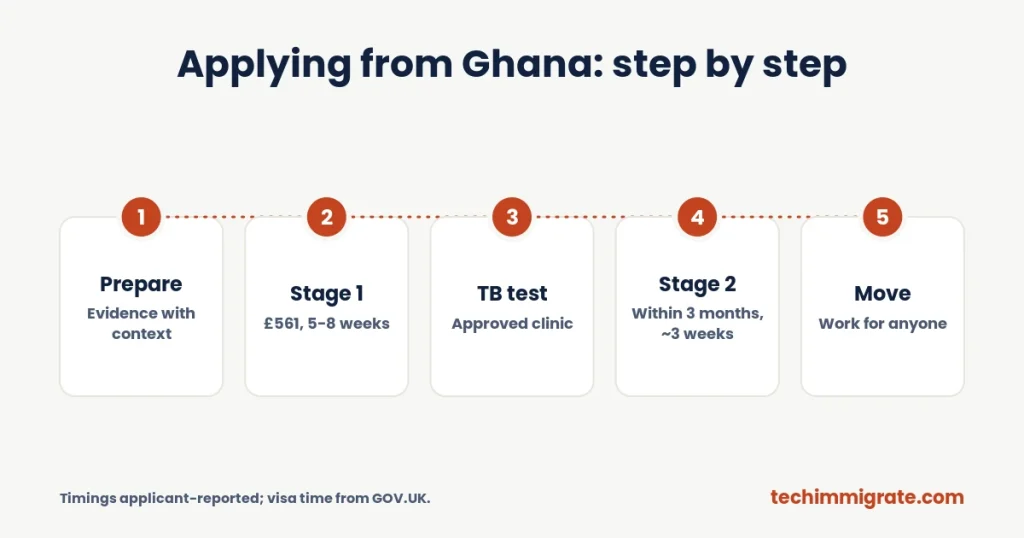
Our articles on how to apply for the Global Talent visa and Global Talent Stage 2 explain each step in detail.
Practical Steps for Applicants in Ghana
Tuberculosis test
Ghana is on the Home Office list of countries where a tuberculosis test is required. If you have lived in Ghana for 6 months or more and are applying for a visa of more than 6 months, you need a certificate from a clinic approved by the Home Office. Approved testing has been available in Accra; Ghana also serves as the testing location for residents of some neighbouring countries. Check GOV.UK for the current clinic list, book early, and time the test so the certificate is still valid when you apply for the visa.
Proving your identity
Depending on your passport, you will either use the UK Immigration: ID Check app or attend a visa application centre to give fingerprints and a photo. A visa application centre has operated in Accra. Check the current location and booking rules before applying.
Payments
Fees are charged in pounds. Make sure your card or payment method can handle international payments of several thousand pounds, because the health surcharge for a 5-year visa alone is £5,175. Some applicants report failed payments when cards have international limits, so check in advance.
Documents
Your documents are likely to be in English already. Prepare all Stage 1 evidence as clear PDFs, with no web links, and keep each email under 25MB.
Presenting Work From a Smaller Market
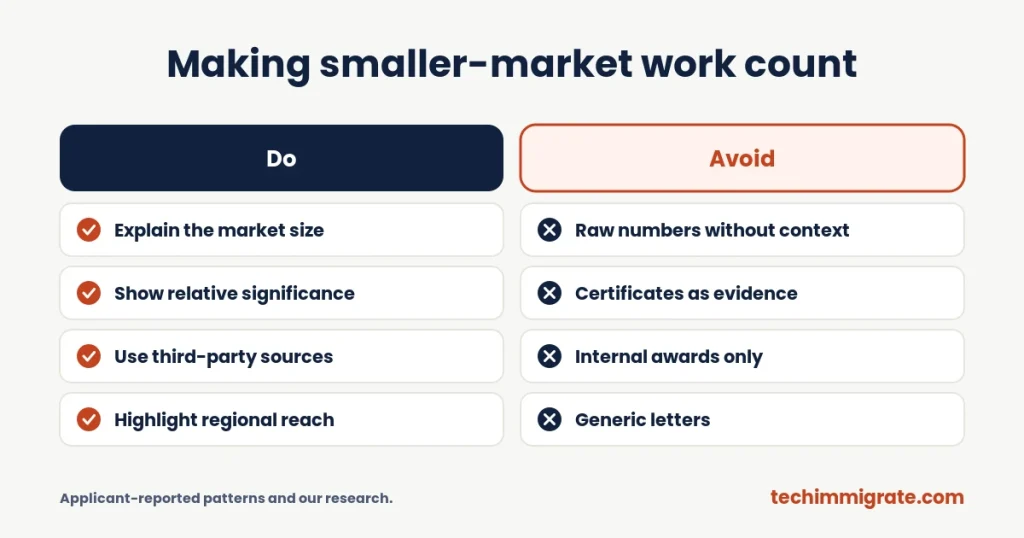
One challenge for applicants from Ghana, and from many smaller tech markets, is that absolute numbers can look modest compared with products in the largest economies. A product with 200,000 users might be one of the most significant in its market. Tech Nation assessors need help to see that.
Give context, with sources
- Explain the market. In one or two sentences, describe the market your product serves and its size.
- Show relative significance. Market share, ranking, growth rate, or being first to solve a problem in the region can matter as much as raw numbers.
- Use third-party sources. Industry reports, investor announcements, regulator publications and recognised media make your claims credible.
Show regional and pan-African impact
Many Ghana-based professionals build products or lead teams serving several African markets. Expansion into new countries, partnerships with regional institutions, and recognition at pan-African events and awards are strong evidence of influence beyond a single company or country.
Highlight problem-solving
Tech in Ghana often solves hard problems: payments across fragmented systems, connectivity limits, logistics, identity and access to services. Explaining the problem and how your work solved it helps assessors see innovation, which supports the optional criterion about innovation. A short before-and-after description, backed by data, is often more persuasive than a long technical explanation.
Evidence That Works Well From Ghana
| Evidence type | What makes it strong |
|---|---|
| Products you built or led | Clear role, documented users, transactions or revenue, and context for the market |
| Funding and investors | Rounds from recognised investors, with your role in raising or using the funds |
| Media coverage | Articles in recognised African or international tech and business media about your work |
| Talks and events | Speaking at recognised regional and international conferences, not only company events |
| Community leadership | Organising developer communities, running training programmes, mentoring through established initiatives |
| Open source | Projects with real adoption beyond your employer |
| Awards and selection | Competitive awards, fellowships and accelerator programmes with clear selection processes |
| Research | Papers, datasets or tools used by others, especially in AI and data for African contexts |
Community work deserves special attention. Ghana's tech ecosystem has grown partly through people who built communities, trained developers and organised events. If you have done this at scale, it can support both the mandatory criterion and the optional criterion about recognition beyond your occupation. Keep programmes, participant numbers, outcomes and letters from partner organisations.
Remote Work for International Companies
Many Ghana-based engineers, designers and product people work remotely for companies in Europe, North America or elsewhere in Africa. That experience can be valuable evidence, but it is often invisible outside the company. To make it count:
- Document your ownership. Use release notes, product announcements and letters from senior leaders that name your contribution.
- Explain the company if it is not widely known.
- Add public recognition. Talks, writing and open source help assessors see your standing in the field.
- Choose referees who saw your work closely, even if they are in other countries.
Letters of Recommendation
You need three letters from established experts in digital technology who know your work well. Referees can be based in Ghana, elsewhere in Africa, the UK or anywhere else. Strong referees include founders and senior leaders of respected tech companies, investors, leaders of established tech organisations and communities, and senior academics for research-focused applicants.
Each referee must write their own letter, with different, specific examples. Tech Nation's guidance says AI-written content within the application is not acceptable, and that it may contact referees. Our guides on recommendation letters and choosing referees explain what makes a letter strong.
Exceptional Talent or Exceptional Promise?
Many applicants from Ghana apply as Exceptional Promise, because their recognition is recent and growing. That route leads to settlement after 5 years under the current rules. Applicants with sustained leadership recognised beyond their company, such as founders of significant companies, leaders of regional platforms, or people with international recognition, may fit Exceptional Talent, which leads to settlement after 3 years.
Choosing the wrong level is a common reason for refusal. Our comparison of Exceptional Talent and Exceptional Promise helps you decide.
Costs
| Cost | Single applicant, 5-year visa | Family of four, 5-year visas |
|---|---|---|
| Endorsement | £561 | £561 |
| Main applicant's visa | £205 | £205 |
| Dependants' visas (£766 each) | £0 | £2,298 |
| Health surcharge | £5,175 | £20,700 |
| Total government fees | £5,941 | £23,764 |
Tuberculosis test fees are extra for each person who needs one. Our Global Talent cost breakdown covers every fee.
Examples of Strong Evidence by Role
These illustrative examples show how common career paths can become strong evidence.
- Fintech engineer. You designed the integration that let a payments product work across several mobile money and banking systems. Evidence: architecture documentation you are allowed to share, transaction growth after launch, a talk at a regional fintech event, and a letter from the CTO describing your role.
- Product manager at a regional platform. You led expansion into new countries. Evidence: launch announcements, user growth in each market, press coverage of the expansion, and letters from the CEO and a partner organisation.
- Data scientist. You built credit-scoring or fraud models used in production. Evidence: measurable impact on approvals or losses, a paper or technical write-up, competition results, and a letter from a senior data leader.
- Designer. You led the design of a widely used app adapted for low-bandwidth or feature-phone users. Evidence: user research outcomes, adoption data, design awards or talks, and a letter from the product lead.
- Founder. You built a company with funding from recognised investors, customers in several markets and a growing team. Evidence: funding announcements, revenue and customer data, press coverage, and letters from investors and partners. See our startup founders guide.
- Community builder. You founded a developer community that has trained hundreds of developers and runs regular events. Evidence: programme records, outcomes such as jobs or projects, sponsorship from recognised companies, and letters from partner organisations.
AI, Data and Research for African Contexts
Research and engineering that bring AI, data and digital tools to African languages, health, agriculture and finance attract growing international attention. If your work in this area has been published, adopted by others or recognised by international organisations, it can be strong evidence. Tech Nation looks for impact in digital technology, so show adoption and recognition, not only publications. If your recognition is mainly academic, compare Tech Nation with the research endorsing bodies; our article on Global Talent for PhD students and researchers explains the choice.
Choosing Your Strongest 10 Documents
You can submit up to 10 pieces of evidence. More is not better. Each document should clearly support one criterion, show impact or recognition beyond your job, and be verifiable from the document itself. Make sure the mandatory criterion and at least two optional criteria each have their own evidence, and drop anything weak. Our guide on choosing your 10 evidence documents explains how.
Bringing Your Family
Your partner and children under 18 can apply as dependants. Each pays £766 plus the health surcharge, and each usually needs a tuberculosis certificate if they have lived in Ghana for 6 months or more. GOV.UK lists no financial requirement for Global Talent dependants. Partners can work for any employer, and children can attend state schools free of charge. Under the current rules, dependants usually need 5 years to settle. Our article on Global Talent dependants explains the details.
A Realistic Timeline
| Phase | Typical time |
|---|---|
| Preparing evidence, statement and CV | 4 to 12 weeks |
| Referees writing letters | 4 to 6 weeks, in parallel |
| Stage 1 decision after paying | Applicants report 5 to 8 weeks |
| Tuberculosis test | Book while you wait for Stage 1 |
| Stage 2 visa decision | About 3 weeks after identity and documents |
| Total | Usually 3 to 6 months |
Talking to UK Employers
Once endorsed, you can tell UK employers that you do not need sponsorship. That makes hiring you simpler and cheaper, and opens up startups and smaller companies that do not hold sponsor licences. Some applicants interview while waiting for the visa decision; others move first and take their time. Either works on Global Talent.
Writing Your Personal Statement
Your personal statement is typed into the GOV.UK form and should be your own words. For applicants from Ghana, a structure that works well is:
- Who you are and your field, in two or three sentences.
- The context, briefly: the market or problem your work addresses.
- Your strongest achievements, each linked to a numbered piece of evidence.
- How you meet the mandatory criterion and each optional criterion you claim.
- Your plans in the UK, and how they connect to your work.
Avoid generic language. Specific facts, names, dates and numbers, with evidence behind them, carry far more weight. Tech Nation's guidance says AI-generated content is not acceptable. Our personal statement guide has more detail.
Common Mistakes Applicants Report
These patterns come from the Tech Nation Visa Forum and our own research. They are applicant-reported, not official guidance.
- Numbers without context, leaving assessors unable to judge significance.
- Evidence of activity rather than impact, such as lists of projects and responsibilities.
- Certificates and course completions used as evidence of leadership.
- Internal-only recognition, such as promotions and internal awards.
- Letters that are generic or appear to share an author.
- Claims without documents, especially for user numbers and revenue.
- Applying for Exceptional Talent too early.
- Leaving the tuberculosis test and payments to the last minute.
- Using unregulated agents who promise endorsement. Check that any adviser is regulated; see our article on Global Talent lawyers and advisers.
A Six-Month Plan if You Are Not Ready Yet
- Audit your evidence against the mandatory criterion and the four optional criteria.
- Document your impact with permission from employers, and gather third-party sources for your numbers.
- Build visibility through talks at recognised events, technical writing and open source.
- Grow your community work and keep records of its outcomes.
- Develop relationships with senior referees outside your immediate team.
- Reassess before paying for Stage 1.
After You Arrive
On Global Talent, you can work for any UK employer, freelance, run a company, or keep working remotely for a Ghanaian or international employer, subject to UK tax rules. To extend or settle, you need to show you have earned money in your field in the UK, so keep payslips, tax records and invoices from the start. Keep a log of trips abroad, because more than 180 days outside the UK in any 12-month period can affect settlement. Our article on what you can do on a Global Talent visa explains your rights.
Applying From Outside Ghana
Some Ghana-based professionals are temporarily living elsewhere, for example on a regional assignment or a fellowship. You can usually apply from the country where you live, using its visa application centre. Whether you need a tuberculosis test depends on where you have lived in the last 6 months, so check the rules for your situation. If you are applying from a country where you are not resident, confirm the visa application centre will accept your application before you book.
Frequently Asked Questions
Yes. You can apply for endorsement and the visa from Ghana. After endorsement, you have 3 months to apply for the visa.
Yes. Tech Nation assesses your contribution to digital technology wherever it happened. Give context so assessors can understand the significance of your work in its market.
If you have lived in Ghana for 6 months or more and are applying for a visa of more than 6 months, yes, from a Home Office-approved clinic.
No. Global Talent needs no job offer, sponsor or minimum salary.
Yes. Referees can be anywhere, as long as they are established experts in digital technology who know your work well.
It can, especially if it is substantial, recognised and documented, such as organising communities, training programmes or mentoring through established initiatives.
Many applicants do, but check your card's international payment limits first, because the total can be several thousand pounds.
No. It is designed for emerging leaders and gives the same work rights. The main difference is that settlement takes 5 years instead of 3 under the current rules.
Yes. Your partner and children under 18 can apply as dependants, each paying £766 plus the health surcharge.
Show the Significance of Your Work
Ghana's tech community has produced leaders whose work is respected across Africa and beyond. Tech Nation will assess that work on its merits, as long as you present it clearly. The best applications from Ghana do not try to compete on raw numbers. They show clearly what problem was solved, why it mattered, who recognised it and what part the applicant played. Our role-specific Global Talent guides help you present your work in the way Tech Nation assesses it.
How We Checked This Article
We checked the process against GOV.UK's Global Talent visa pages, applying from outside the UK, the tuberculosis test guidance and the Home Office Global Talent caseworker guidance (version 19.0), in November 2026. Fees come from the Home Office fee schedule in force from 8 April 2026. Clinic and visa application centre locations can change, so check the current lists before booking. Evidence patterns and common mistakes come from the Tech Nation Visa Forum and are applicant-reported, not official guidance. The refusal figure comes from a Freedom of Information response published by Edgewater Legal.
Tech Immigrate is independent of Tech Nation and the Home Office. This article is general information, not legal advice.
We write practical guides for tech professionals applying for the UK Global Talent visa. Tech Immigrate is independent of Tech Nation and the Home Office, and our articles are general information, not legal advice. Rules and fees change, so always check gov.uk before you apply.


