UK Global Talent Visa From the USA: A Guide for US-Based Tech Professionals
Applying for the UK Global Talent visa from the USA: how both stages work, costs, timeline, US taxes after you move, and what Tech Nation looks for.


In this article
- Why US-Based Tech Professionals Are Looking at the UK
- Who This Guide Is For
- How the Global Talent Visa Works: The Two Stages
- Stage 1 From the USA: Endorsement
- Stage 2 From the USA: The Visa
- What It Costs, Compared With US Routes
- Timeline: From Decision to Landing in the UK
- US Taxes After You Move
- Working for a US Company From the UK
- Settling in the UK
- Common Mistakes US-Based Applicants Report
- Your Evidence: What Works From a US Career
- Should You Apply From the US or After You Move?
- Is the UK Global Talent Visa Right for You?
- Frequently Asked Questions
- Plan Your Evidence Before You Apply
- How We Checked This Article
If you are a software engineer, founder, researcher or product leader working in the United States and thinking about a move to London, Manchester, Cambridge or Edinburgh, the UK Global Talent visa is the route most worth understanding. It needs no job offer and no employer sponsor, sets no salary threshold, lets you work for anyone or for yourself, and can lead to settlement in the UK in as little as 3 years. For people used to the H-1B lottery, the cost of employer sponsorship and long green card queues, it works very differently.
This guide is for tech professionals applying from the USA, whatever passport they hold. It explains how the two stages work when you apply from America, how Tech Nation reads US-based evidence, how the timeline and costs compare with US visa routes, what changes for your US taxes after the move, and the mistakes US-based applicants report most often.
Key takeaways
- The Global Talent visa is a UK route for leaders and emerging leaders in digital technology. You apply in two stages: endorsement from Tech Nation, then the visa from the Home Office.
- You can apply for both stages from the USA. After endorsement, you have 3 months to apply for the visa, and a decision from outside the UK usually takes about 3 weeks.
- You do not need a UK job offer, a UK employer or a minimum salary. Work at US companies, at UK companies and for yourself all count as evidence.
- The main fees are £561 for endorsement, £205 for the visa and the Immigration Health Surcharge at £1,035 a year.
- Settlement can come after 3 years for Exceptional Talent and 5 years for Exceptional Promise.
- US citizens stay taxable in the US on worldwide income after moving. Most use the Foreign Tax Credit or the Foreign Earned Income Exclusion to avoid paying tax twice.
- Tech Nation refused most applications it decided in 2025, so evidence planning matters more than where you currently live.
Why US-Based Tech Professionals Are Looking at the UK
The US remains the largest tech market in the world, but the route to staying there has become harder and less predictable for many people who are not US citizens or green card holders.
The H-1B system still depends on an annual lottery and an employer petition. In September 2025, a presidential proclamation added a $100,000 fee for certain new H-1B petitions for workers outside the US. A federal court struck the fee down in June 2026, and in July 2026 an appeals court kept that ruling in place while the appeal continues. In August 2026, the Department of Homeland Security proposed a new rule that would charge more than $100,000 on cap-subject H-1B petitions. Whatever happens in court, the uncertainty itself has pushed many engineers and their employers to look at other options.
The O-1A visa for extraordinary ability avoids the lottery, but it still needs a US employer or agent to petition, and recent data shows approval rates edging down and around a quarter of decided O petitions receiving a request for evidence. Green cards through EB-1A or EB-2 NIW can take years depending on your country of birth.
Against that background, the UK Global Talent visa stands out for four reasons:
- You sponsor yourself. No employer petition, no lottery and no annual cap.
- No job is needed. You can arrive without a job, change jobs freely, freelance, start a company or work for a US employer remotely, subject to UK tax and employment rules.
- Your family comes with you. A partner and children under 18 can apply as dependants and can work or study.
- A clear path to settlement. Indefinite leave to remain after 3 or 5 years, then British citizenship after a further period.
It also has a real downside: the endorsement stage is demanding, and Tech Nation refuses more applications than it approves. The rest of this guide is about getting that part right.
Who This Guide Is For
This guide is for anyone in the digital technology sector who is currently based in the United States and wants to move to the UK. That includes:
- US citizens who want to live and work in the UK for a few years or permanently.
- H-1B, O-1, L-1 or F-1 OPT holders who want an alternative to the US immigration queue.
- Green card holders exploring a move abroad.
- Founders running US-incorporated startups who want to build a UK presence.
- Researchers at US universities or corporate labs.
Your nationality does not change the Global Talent requirements. What matters is your work in digital technology and the evidence you can show for it. Where your passport does make a practical difference, for example how you prove your identity or how you travel while waiting, this guide says so.
How the Global Talent Visa Works: The Two Stages
The Global Talent visa for tech has two separate applications.
Stage 1: endorsement. You apply to the Home Office for endorsement, and the Home Office passes your documents to Tech Nation, the endorsing body for digital technology. Tech Nation decides whether you are a leader (Exceptional Talent) or a potential leader (Exceptional Promise) in the field. Since February 2026, the personal statement is typed into the Home Office form rather than uploaded as a document. You submit a CV, up to 10 pieces of evidence and three letters of recommendation.
Stage 2: the visa. Once endorsed, you apply for the visa itself. This is mostly a check of identity, immigration history and suitability. You must apply within 3 months of the date on your endorsement letter.
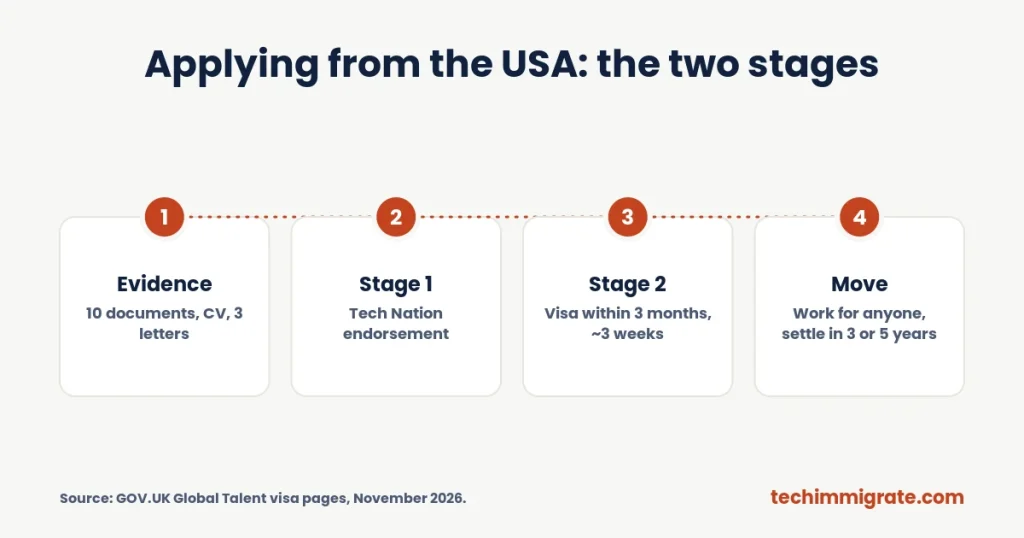
Both stages can be completed while you are living in the US. For a full explanation of each stage, read our guides on Global Talent endorsement and what happens after you are endorsed.
Stage 1 From the USA: Endorsement
The endorsement application is completed online, so applying from the US makes no practical difference to how you submit. What does matter is how you present US-based work.
How Tech Nation reads US evidence
Tech Nation assesses your contribution to the digital technology sector. It does not require your work to be in the UK. Engineers at US companies, founders of US startups and researchers at US universities have all been endorsed. The question is never where you worked. It is whether your evidence shows recognition beyond your immediate role, technical or commercial contribution, and leadership.
Three points come up again and again for US-based applicants:
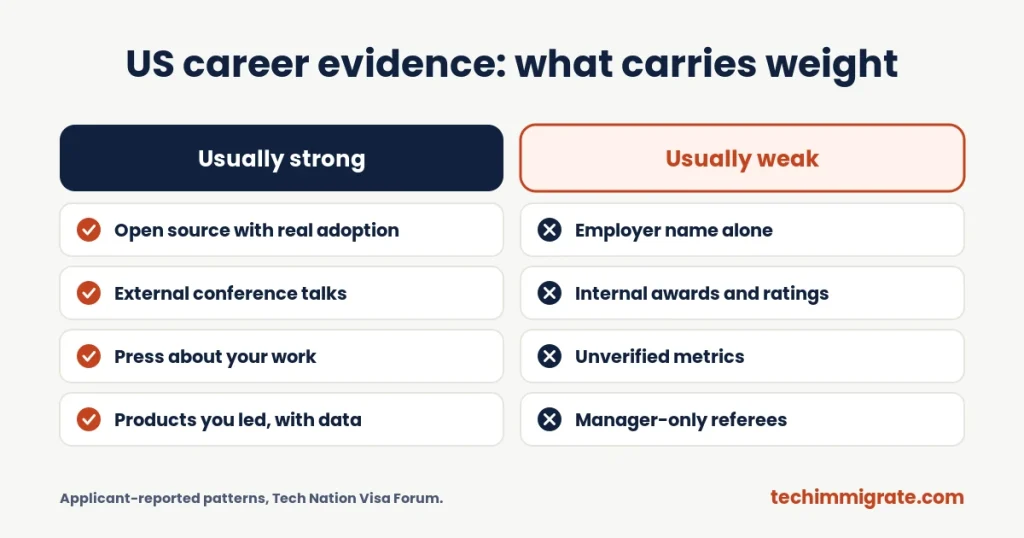
- Big-company names do not prove impact. Working at a well-known Silicon Valley company is not evidence on its own. Tech Nation looks for what you personally built, led or changed, and how others recognised it. Applicants who relied on employer prestige report refusals for lack of individual contribution.
- US metrics need context. Revenue numbers, user counts and performance figures are useful only if the assessor can see what they mean and what part you played. Explain scale in plain terms and show your role.
- Internal awards rarely carry weight. Performance ratings, spot bonuses and internal hackathon wins are seen as part of normal employment. External recognition carries far more weight: conference talks, open-source adoption, press coverage, judging roles and industry awards.
Your letters of recommendation
You need three letters from established people in the digital technology sector who know your work. Your referees can be in the US. Strong letters come from people who can describe your specific contribution and its impact on the wider sector, not just your team. Generic praise from a manager is one of the most common weaknesses applicants report. Read our guide to writing a recommendation letter that works and our list of the right types of referee.
The Migration Advisory Committee's review of talent routes, published on 17 November 2026, recommended that referees send letters directly to endorsing bodies in future. That change has not been made yet, but it is worth telling your referees now that the letters must be their own words.
Exceptional Talent or Exceptional Promise?
If you have more than about five years of recognised leadership, Exceptional Talent is usually the target. It leads to settlement after 3 years. If you are earlier in your career, Exceptional Promise is designed for you, and it leads to settlement after 5 years. Our comparison of Exceptional Talent and Exceptional Promise explains how to choose.
How long endorsement takes
Tech Nation aims to decide endorsement applications within 8 weeks of receiving them from the Home Office. Applicants report a range of timings. The fast track that once offered quicker decisions was removed in August 2025. Our Global Talent timeline guide breaks down what applicants report for each stage.
Stage 2 From the USA: The Visa
Once you have your endorsement letter, the visa application is far simpler.
- Apply within 3 months. The 3 months run from the date on your endorsement letter. If you miss the window, the endorsement cannot be used.
- Prove your identity. Depending on your passport, you will either scan your passport with the UK Immigration: ID Check app or book an appointment at a visa application centre to give fingerprints and a photo. The application tells you which applies. There are visa application centres in several major US cities.
- Wait for the decision. GOV.UK says you will usually get a decision within 3 weeks once you have applied online, proved your identity and provided your documents. It can take longer if documents need checking or an interview is needed. You may be able to pay for a faster decision.
- Get your eVisa. Your status is digital. You access it through your UKVI account and use it to prove your right to work and rent in the UK.
Choosing how long a visa to apply for
You can choose a visa of 1 to 5 years in a single application. You pay the Immigration Health Surcharge for every year you choose. Most people moving permanently pick 5 years so that they do not need to extend before settling, but if cash flow matters, a shorter visa followed by an extension is possible. Our Global Talent cost breakdown shows the totals.
Bringing your family
Your partner and children under 18 can apply as your dependants, either with you or later. Each dependant pays the visa fee and the health surcharge. Dependants can work and study in the UK. Partners must show the relationship is genuine: a marriage certificate, civil partnership certificate, or evidence of living together for at least 2 years.
What It Costs, Compared With US Routes
Here are the main fees for one person applying from the US. Fees change, so always check GOV.UK before you pay.
| Cost | Amount | When you pay |
|---|---|---|
| Endorsement application | £561 | Stage 1 |
| Visa application | £205 | Stage 2 |
| Immigration Health Surcharge | £1,035 a year | Stage 2, for the full length of your visa |
| Indefinite leave to remain | £3,226 | When you settle |
| Each dependant: visa | £766 (£561 + £205) | Stage 2 |
| Each dependant: health surcharge | £1,035 a year | Stage 2 |
A single applicant choosing a 5-year visa pays £561 + £205 + £5,175 = £5,941 in government fees up front. That is a meaningful sum, but it is a fraction of the employer-side cost of many US work visa routes, and you pay it yourself rather than relying on an employer.
Compare that with the US options many readers know:
| UK Global Talent | US H-1B | US O-1A | |
|---|---|---|---|
| Employer needed? | No | Yes | Yes (employer or agent) |
| Lottery? | No | Yes, for cap-subject petitions | No |
| Change employer freely? | Yes | Needs a new petition | Needs a new or amended petition |
| Self-employment allowed? | Yes | No | Limited |
| Path to permanent residence | 3 or 5 years | Separate green card process | Separate green card process |
| Family can work? | Yes | Only in limited cases | No |
This is a comparison of how the routes work, not legal advice on US immigration. If you hold US status now, speak to a US immigration lawyer before you leave, especially if you might want to return.
Timeline: From Decision to Landing in the UK
A realistic plan for a US-based applicant looks like this:
- Months 1 to 2: build your evidence. Pick your 10 pieces of evidence, draft your personal statement and CV, and brief your referees. This is where most of the work is.
- Month 3: apply for endorsement. Submit online and pay £561.
- Months 3 to 5: wait for Tech Nation. Plan around 8 weeks, sometimes longer.
- Within 3 months of endorsement: apply for the visa. Allow about 3 weeks for a decision, plus time for an identity appointment if you need one.
- Travel and start work. Your visa starts on the date shown in your decision.
Most applicants report 3 to 6 months from first submission to holding a visa, with evidence preparation on top. Our timeline guide has applicant-reported figures for each stage.
Before you give notice: wait until you have the visa decision, not just the endorsement. Endorsement is the hardest stage, but the visa can still be refused on suitability grounds such as immigration history.
US Taxes After You Move
This section is general information for US citizens and green card holders. It is not tax advice, and you should speak to a US-UK cross-border tax adviser before you move.
The US taxes its citizens and green card holders on their worldwide income wherever they live. Moving to the UK does not end your US filing obligation. You will normally file in both countries, but you will not usually pay full tax twice:
- Foreign Tax Credit. You claim credit in the US for UK income tax you have paid. Because UK tax rates are often similar to or higher than US federal rates, many Americans in the UK owe little or no additional federal income tax this way.
- Foreign Earned Income Exclusion. You exclude a set amount of foreign earned income from US tax. The limit is $130,000 for the 2025 tax year and $132,900 for 2026. You cannot use the exclusion and the credit on the same income.
- Filing deadlines. The standard deadline is 15 April. Americans living abroad get an automatic extension to 15 June to file, although interest runs on any tax due from 15 April.
- Account reporting. UK bank accounts above certain thresholds must be reported to the US Treasury (FBAR) and, at higher values, on Form 8938.
- UK savings products. Some popular UK products, such as ISAs and some funds, are treated differently by the IRS. This is one of the most common surprises for Americans in the UK.
If you are not a US citizen or green card holder, leaving the US usually ends your US tax residence, but timing and any remaining US income still matter. Ask an adviser.
On the UK side, you become UK tax resident under the statutory residence test once you spend enough time in the UK, and you pay UK income tax and National Insurance on your earnings. If you keep working remotely for a US employer, check how payroll, tax and social security will be handled before you start.
Working for a US Company From the UK
The Global Talent visa lets you work for any employer, including a US company, while living in the UK. That flexibility is one of the route's biggest advantages, but a few practical points apply:
- Your employer may need UK payroll. A US company employing someone who lives in the UK usually needs to operate UK payroll or use an employer of record. Some will instead engage you as a contractor.
- Social security. The US-UK totalisation agreement decides which country's social security system you pay into, usually based on where you work and for how long. Check before your first payslip.
- Earnings count for settlement. To extend or settle, you must show you have earned money in your field in the UK. Income from a US employer while you live and work in the UK can count, as long as you can evidence it. Our article on the Global Talent caseworker guidance explains what the Home Office checks.
Settling in the UK
If you were endorsed as Exceptional Talent, you can apply for indefinite leave to remain after 3 years. Exceptional Promise holders apply after 5 years. To settle, you must:
- have spent no more than 180 days outside the UK in any 12-month period during the qualifying period;
- show you have earned money in your field in the UK;
- pass the Life in the UK test;
- meet the English language requirement. Applicants from the USA meet this automatically if they are US nationals, because the US is a majority English-speaking country. Others may need a test or a qualification taught in English.
The UK government's earned settlement response, published on 2 November 2026, kept 3-year settlement for the highest-talent group. Rules can change, so check GOV.UK before you rely on any date.
The 180-day rule matters for people who travel back to the US often. Count your days carefully, including weekends and holidays, from the day your visa starts.
Common Mistakes US-Based Applicants Report
These patterns come from applicants posting on the Tech Nation Visa Forum and from our own reading of refusal letters shared publicly. They are applicant-reported, not official guidance.
- Relying on employer prestige. Listing a FAANG employer and job title without showing individual impact.
- Too much internal evidence. Promotion letters, performance reviews and internal awards with no external recognition.
- Unverifiable metrics. Claims about revenue or users with no supporting source, or figures that cannot be traced to the applicant's own work.
- Referees who only know you as a manager. Letters that describe you as a great employee rather than a leader in the field.
- Choosing the wrong route. Senior applicants applying under Exceptional Promise to play safe, or early-career applicants stretching for Exceptional Talent.
- Treating it like an O-1 petition. Some US-based applicants reuse O-1 or EB-1A evidence packs. The criteria overlap but are not the same, and Tech Nation limits you to 10 documents with strict page limits. Evidence must be selected and edited, not copied over.
- AI-written statements. Tech Nation and the Home Office have both raised concerns about AI-generated and templated applications. Your personal statement must be your own account in your own words.
For more on what goes wrong, see our article on Tech Nation rejection reasons and the role guides for software engineers, data scientists and ML engineers, product managers and founders.
Your Evidence: What Works From a US Career
Every role is different, but these types of evidence tend to translate well from a US career:
- Open-source work with real adoption. Repositories, packages or tools used by others, with stars, downloads or dependants you can show.
- Products you led that reached a large market. With your role made explicit and outcomes backed up by public or verifiable data.
- Talks at recognised conferences. Especially invited talks, keynotes and panels outside your employer.
- Patents, papers and standards work. Where you are a named contributor.
- Press coverage about your work. Not just about your employer.
- Founding or scaling a company. Funding, revenue growth, hiring and customer evidence, with your personal contribution clear.
- Mentoring and community leadership. Running meetups, teaching, judging hackathons or advising startups outside your job.
Which of these to choose, how to present them, and how to fit them into 10 documents depends on your role. That is exactly what our role-specific guides cover in depth, with worked examples and checklists. Start with the guide for software developers, data and AI specialists, product managers or startup founders.
Should You Apply From the US or After You Move?
Most people apply from the US, because you need the visa before you can move to work. A few situations are different:
- You are already visiting the UK. You cannot switch into Global Talent from a visitor visa inside the UK. You must apply from outside.
- You are moving with another UK visa. If you come first on a Skilled Worker or Graduate visa, you can usually switch to Global Talent from inside the UK later. Time on some routes does not count towards Global Talent settlement, so plan ahead.
- You are waiting for a US immigration decision. Leaving the US can affect pending US applications. Get US legal advice first.
Is the UK Global Talent Visa Right for You?
The route suits you if you want flexibility: to work for different companies, to freelance, to found a company or to keep working remotely for a US employer while living in the UK. It also suits families who want a clear path to settlement.
It is a harder fit if your evidence is mostly internal to one employer, or if you are early in your career with little external recognition yet. In that case, it can be worth spending 6 to 12 months building recognised evidence before you apply, rather than risking a refusal.
The honest picture is that the bar is high. Freedom of Information data reported by Edgewater Legal suggests Tech Nation refused about 82% of the cases it decided in 2025. Our article on the Global Talent visa success rate explains what the numbers show and how to improve your odds.
Frequently Asked Questions
Yes. Both the endorsement application and the visa application can be made from the USA. Once you are endorsed, you have 3 months to apply for the visa, and a decision usually takes about 3 weeks from outside the UK.
No. The Global Talent visa does not need a job offer, an employer sponsor or a minimum salary. You can work for any employer, be self-employed or start a business.
Yes. Tech Nation assesses your contribution to digital technology wherever it happened. What matters is your individual impact and external recognition, not the location or the name of your employer.
The visa allows it, but your employer will usually need UK payroll or an employer of record, and you will pay UK tax. Check social security rules under the US-UK totalisation agreement before you start.
If you are a US citizen or green card holder, yes. You will usually file in both countries but can use the Foreign Tax Credit or the Foreign Earned Income Exclusion to avoid double taxation. Speak to a cross-border tax adviser.
3 years if you were endorsed as Exceptional Talent, or 5 years for Exceptional Promise, provided you meet the absence, earnings, English and Life in the UK requirements.
Yes. Partners and children who come as your dependants can work and study in the UK.
Not as it is. The criteria overlap, but Tech Nation limits you to 10 documents and assesses leadership and recognition in its own way. Applicants who reuse US petitions without editing them report weaker results.
Plan Your Evidence Before You Apply
Applying from the USA is straightforward once you know the steps. The hard part is choosing and presenting evidence that shows Tech Nation you are a leader or emerging leader in digital technology. Our role-specific Global Talent guides take you through the evidence, the personal statement and the letters for your role, so you can apply with a plan instead of a guess.
How We Checked This Article
We checked the visa process against GOV.UK's pages on applying from outside the UK and the Global Talent visa, and the Home Office Global Talent caseworker guidance (version 19.0, 3 August 2026), in November 2026. US visa context draws on reporting about the $100,000 H-1B fee and the court rulings of June and July 2026, the Department of Homeland Security's August 2026 proposal, and published USCIS data on O-1 approvals. US tax figures come from IRS-based guidance on the Foreign Earned Income Exclusion for 2025 and 2026. The refusal figure comes from a Freedom of Information response published by Edgewater Legal, and the referee proposal from the Migration Advisory Committee's Review of Talent Routes (17 November 2026). Applicant experiences come from the Tech Nation Visa Forum and are applicant-reported, not official guidance.
Tech Immigrate is independent of Tech Nation and the Home Office. This article is general information, not legal or tax advice. Rules and fees change, so check GOV.UK before you apply.
We write practical guides for tech professionals applying for the UK Global Talent visa. Tech Immigrate is independent of Tech Nation and the Home Office, and our articles are general information, not legal advice. Rules and fees change, so always check gov.uk before you apply.