Tech Nation Rejection Reasons: 9 Patterns Applicants Report (and How to Avoid Them)
Tech Nation rejection reasons applicants report, mapped to the official criteria wording. See nine patterns, how to avoid each and how to read a refusal.

In this article
- What Do We Actually Know About Tech Nation Rejection Reasons?
- Where Do Applicants Report Their Refusals?
- Pattern 1: The Role Is Not Product-Led
- Pattern 2: Doing the Job Is Presented as Innovation
- Pattern 3: Employer-Only Evidence, a Top Reported Rejection Reason
- Pattern 4: Talks and Activities Look Minor
- Pattern 5: Company Success Replaces Personal Contribution
- Pattern 6: Letters Are Vague or Generic
- Pattern 7: Evidence Is Too Old, Too Fresh or Unverifiable
- Pattern 8: Wrong Route or Thin Case for the Route
- Pattern 9: Breaking the Evidence Rules Behind Many Rejection Reasons
- A Table of Tech Nation Rejection Reasons Mapped to the Criteria
- How Do You Read a Tech Nation Refusal Letter?
- Why Reports of Tech Nation Rejection Reasons Can Mislead
- Using Tech Nation Rejection Reasons as a Self-Audit
- Which Tech Nation Rejection Reasons Can You Fix Quickly?
- What Can You Do After a Refusal?
- Tech Nation Rejection Reasons FAQ
- Your Next Step
- How We Checked This Article
Tech Nation rejection reasons are not published as a full official list, so this article uses what Tech Nation and gov.uk say plus what applicants report. We map nine reported patterns to the official criteria wording, then show how to avoid each.
It is for applicants who want to avoid a refusal, or who have one and want to read it clearly. Every pattern here is applicant-reported unless we say it is official.
Key takeaways
- Tech Nation does not publish a complete list of refusal reasons, so treat all patterns here as reports, not rules.
- Reports point to a small set of themes: role fit, innovation, independence of evidence, impact, letters and recency.
- Each reported pattern maps to wording in the official criteria, which makes it testable before you apply.
- A refusal letter is easier to use if you sort each comment under one criterion.
- You can ask for a free review within 28 days, but you cannot add new evidence.
What Do We Actually Know About Tech Nation Rejection Reasons?
We know the rules, a short official list of common problems, and many applicant reports, but not an official ranking of why people fail. Treat any site that claims to know the exact top reason with care.
Officially, Tech Nation's panel decides overall whether to endorse. Meeting the criteria is necessary but not enough. Tech Nation's own "what to consider" page lists common reasons, such as vague or generic letters, outdated or unverifiable evidence, and roles that are not product-led.
How this article sorts its sources of Tech Nation rejection reasons
We use three levels of confidence. Official means gov.uk or Tech Nation says it. Adviser-reported means a law firm or consultancy describes it. Applicant-reported means someone who applied describes their own refusal in public. We name the level for each pattern.
Where Do Applicants Report Their Refusals?
Applicants share refusals in public communities, on personal blogs and in case notes from advisers. Each source has limits, so read them as hints.
The Tech Nation visa alumni forum has threads titled around rejection patterns, appeals and evidence reviews. Some applicants also publish their own stories. One public account describes a refusal in which the reviewer said there was not enough hard evidence, that talks looked like product advocacy, and that doing the core tasks of a job is not innovation.
Law firm pages add more cases, but they are marketing too. They tend to show reviews that succeeded. We do not repeat any success rates, because we cannot verify them. For a wider look at what goes wrong, read our guide to Tech Nation endorsement mistakes.
Pattern 1: The Role Is Not Product-Led
Applicants report refusals when their work looks like consultancy, outsourcing or service delivery. This one is official as well as reported.
The gov.uk page on skills covered by Tech Nation says business skills apply to in-house work within product-led digital technology companies. It excludes tech-enabled or service companies such as agencies, outsourcers and marketing firms. Tech Nation's own page also names consulting and non-product-led roles as common weak spots.
Official wording it maps to: the product-led digital technology test, which sits behind the optional criterion on significant contributions to a business.
How to avoid it: Check your last five years against the rule before you collect anything. If most of your work was for clients, look for product work you did, or for contributions outside work. One adviser describes a designer who was refused for consultancy-type work and won on review by showing project work for major tech companies. That is one case, not a promise.
Pattern 2: Doing the Job Is Presented as Innovation
Applicants report that describing normal job tasks as innovation draws a refusal. A reviewer wrote in one adviser's case that improving projects is not necessarily innovation.
Official wording it maps to: the innovation criterion, which asks for a new product or technology and proof that it is new.
How to avoid it: Name what is new, who it is new for, and who outside your team says so. Show a patent grant, a launch with users, or independent coverage. Doing the job well is a fine start, but it is not the proof.
Illustrative example (fictional)
Leila writes that she "improved the checkout flow." Her refusal says this is normal work. On her next attempt she describes a payment routing method her team built, shows its public launch, and adds an independent engineer's statement. The claim now names something new and shows who noticed.
Pattern 3: Employer-Only Evidence, a Top Reported Rejection Reason
Applicants and advisers report that internal documents and promotional material carry little weight. This is a leading reported reason for a weak recognition case.
One law firm notes that reviewers can accept that a document exists yet call it internal or promotional. Tech Nation's guidance says evidence of recognition should come from outside your employer, and that internal awards and your own posts alone do not count.
Official wording it maps to: the mandatory criterion on recognition as a leading or emerging talent in digital technology.
How to avoid it: Put independent proof first. That includes press that names you, invited talks, awards with a public shortlist and statements from outside experts. Keep internal documents for facts they alone can show. Our guide to the criteria explains what each one asks for.
Pattern 4: Talks and Activities Look Minor
Applicants report refusals when speaking or mentoring seems small or tied to a company. In the public account above, a talk was called product advocacy, not independent standing.
Adviser views vary on exact thresholds. One adviser says talks should be on the main stage of a large sector event, and that online-only mentoring does not count. We cannot confirm those numbers in official text, so treat them as adviser opinion.
Official wording it maps to: the criterion on recognition for work outside your day job.
How to avoid it: Show who invited you, how big the event was and what you did that was not marketing. For mentoring, show a structured programme with a named organiser. Evidence made solely for the application tends to look weaker than a steady record, so start early.
Pattern 5: Company Success Replaces Personal Contribution
Applicants report refusals when they present team or company results as their own. This one shows up often in discussions of the contribution criterion.
An adviser writes that reviewers look for a clear line between a specific contribution and the person who made it. Company revenue or user numbers do not draw that line.
Official wording it maps to: the criterion on significant technical, commercial or entrepreneurial contribution to a product-led digital technology business.
How to avoid it: Choose one or two contributions that are yours. State what you did, what changed, and who confirms it. A letter helps, but a letter alone is not enough, so add a document that shows the result.
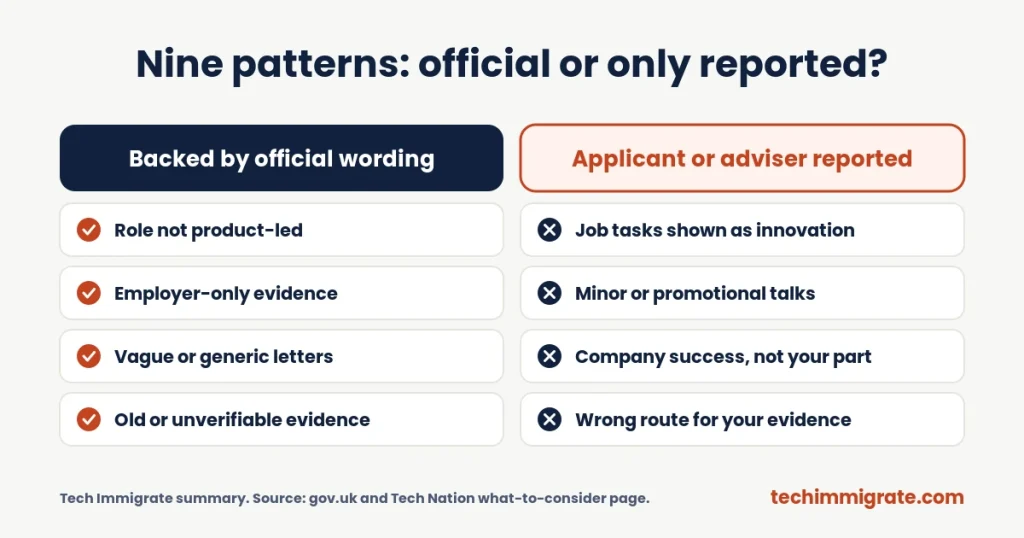
Pattern 6: Letters Are Vague or Generic
This one is official as well as reported. Tech Nation's page lists letters that are vague, generic or lack specific details as a common reason for weak applications.
Applicants and advisers also report templated letters, letters from referees who do not meet the rules, and three letters that repeat the same praise. Referees must be established experts who have known your work for at least 12 months.
Official wording it maps to: the requirement for three recommendation letters, plus the rule that letters support evidence and do not replace it.
How to avoid it: Give each referee a different focus, such as a product, a talk and a contribution. Brief them with facts, but let them write in their own words. Our recommendation letters guide explains who to ask.
Pattern 7: Evidence Is Too Old, Too Fresh or Unverifiable
Tech Nation lists outdated or unverifiable evidence as a common problem. Applicants report that both ends of the timeline can cause concern.
Evidence should come from the last five years. In one adviser's case, a reviewer said that an applicant's hackathon work and articles were mostly from the last six months. The adviser argued on review that the guidance sets only a five-year window and no minimum, and the decision changed. That is one case, and it does not mean recent work will always pass.
Official wording it maps to: the five-year window in the criteria, and the need for evidence that can be checked.
How to avoid it: Use dated, checkable proof from the window. If most of your proof is new, show a trail that makes it credible, such as earlier work that leads to it.
Pattern 8: Wrong Route or Thin Case for the Route
Applicants report refusals when the evidence does not match the route they chose. Exceptional Talent is for established leaders. Exceptional Promise is for emerging leaders.
Advisers describe refusals where the evidence showed potential but the application claimed leadership. Tech Nation assesses you against the route you choose. Read Exceptional Talent vs Exceptional Promise before you decide.
Official wording it maps to: the two routes and their different mandatory criterion wording.
How to avoid it: Be honest about the recognition you have now. If your evidence mostly shows potential, the Promise route may fit better. Applicants in this position often take advice before choosing.
Pattern 9: Breaking the Evidence Rules Behind Many Rejection Reasons
Applicants and advisers report refusals tied to format. Common ones include documents longer than three A4 sides, shrunk or collage images, missing references to the criterion, and templated letters.
Tech Nation's guidance also says AI and language tools are not acceptable in the application. One adviser quotes a warning that using them may weaken your application.
Official wording it maps to: the evidence limits: up to 10 documents, up to 3 A4 sides each, at least 2 per criterion, no document reused for two criteria.
How to avoid it: Plan your 10 documents on one page. Check each exported PDF. Label each document with the criterion and say in one line what it proves. Then write every word yourself.
A Table of Tech Nation Rejection Reasons Mapped to the Criteria
A table helps you test your own set before you submit. Use the middle column to find which criterion a reported pattern touches.
| Reported pattern | Level | Criterion it touches | Quick fix |
|---|---|---|---|
| Not product-led | Official and reported | Contribution criterion | Show product work |
| Job tasks as innovation | Applicant-reported | Innovation | Name what is new |
| Employer-only evidence | Official and reported | Mandatory | Add independent proof |
| Minor talks | Applicant-reported | Outside work | Show host and scale |
| Company success | Adviser-reported | Contribution | Isolate your part |
| Vague letters | Official | Letters | Distinct, specific letters |
| Old or unverifiable | Official | All | Dated, checkable proof |
| Wrong route | Adviser-reported | Mandatory | Match evidence to route |
| Rule breaches | Official and reported | Evidence limits | Audit the set |
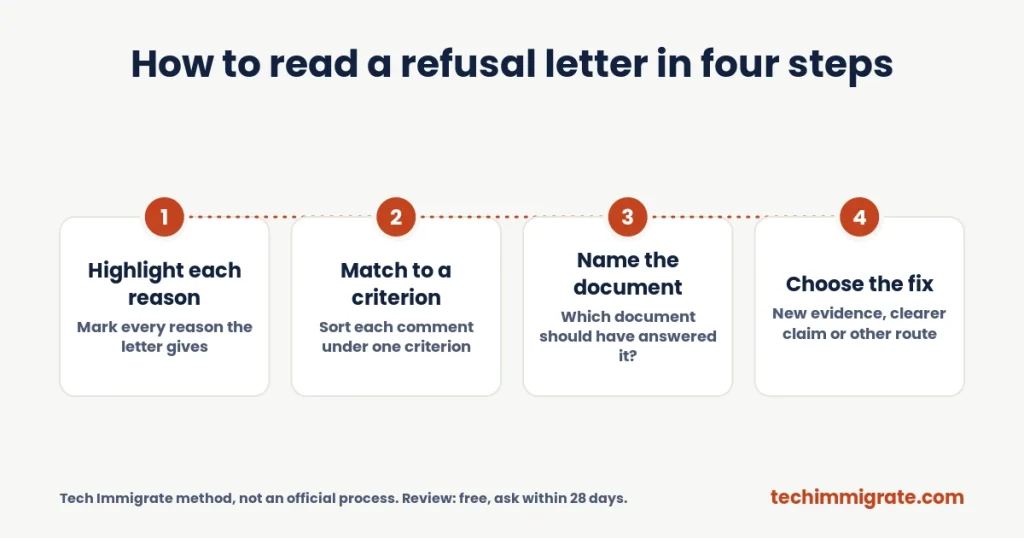
How Do You Read a Tech Nation Refusal Letter?
Read the letter criterion by criterion, because each comment usually points to one of them. Sort every sentence under the criterion it touches, then mark whether it is about the evidence, the claim or the rules.
Applicants report that a refusal gives reasons, but that the reasons can be short. If a comment is vague, do not guess. Ask whether the pattern in the table fits, and whether the document it points to has an independent source.
A four-step reading method
- Highlight each reason the letter gives.
- Match each one to a criterion.
- For each, write the document that should have answered it.
- Mark whether the fix is new evidence, a clearer explanation or a different route.
Illustrative example (fictional)
Marcus gets a refusal that says his evidence is "insufficient" for the contribution criterion. He sorts it. The documents show company growth, not his role, and one letter is generic. The fix is a narrower claim, a metrics export tied to his work and a letter from an outside lead. He now knows what to build before he reapplies.
Why Reports of Tech Nation Rejection Reasons Can Mislead
Public reports are useful, but they are not a fair sample. People write about refusals when they were upset, when they won a review, or when they sell a service. Quiet refusals rarely appear.
So do not read a pattern as a rate. We cannot tell you that one reason is more common than another. A fair use of these reports is to test your own case against them. Ask whether your documents would raise the same question, and fix the answer before you apply.
Three questions to ask of any report
First, who wrote it, and what do they sell? Second, does the claim match the official wording on gov.uk or Tech Nation's pages? Third, is the case from the current guidance, or from an older version? Rules change, so an old forum post can be wrong today.
Using Tech Nation Rejection Reasons as a Self-Audit
You can turn the nine patterns into a quick audit of your own set. Work through the list with your documents in front of you.
- Role: does your work sit at a product-led company, or is it service delivery?
- Innovation: can you name what is new and who confirms it?
- Independence: does each recognition document come from outside your employer?
- Scale: do your talks and mentoring show who invited you and how big the audience was?
- Contribution: can you point to your part, not the team's?
- Letters: does each one cover a different focus with specific facts?
- Dates: is everything inside the last five years and checkable?
- Route: does your evidence show leadership now or potential?
- Rules: do you have 10 or fewer documents, each 3 sides or fewer?
If you answer no to any line, fix it before you apply. A single clear gap is easier to repair than a vague worry.
Illustrative example (fictional)
Noor runs the audit. She fails lines 3 and 5. Her recognition documents are internal, and her contribution claim uses company revenue. She asks a partner firm to confirm her role in a launch, adds a trade article that names her, and rewrites her claim around the feature she led. Her set is the same size, but each document now answers a likely question.
Which Tech Nation Rejection Reasons Can You Fix Quickly?
Some reasons take days to fix, and others take months. Sorting them tells you whether to apply now or wait.
Fixable in days or weeks
Rule breaches, vague letters and unclear labelling are fast fixes. You can trim a document, rewrite a cover note, brief a referee again or replace a shrunk screenshot. Applicants often repair these in a few weeks, because nothing about your career has to change.
Fixable only with time
Product-led fit, independent recognition, and a track record of talks or mentoring take longer. You cannot create real recognition overnight, and evidence made just before applying tends to look thin. In this case, applicants often spend six months or more building a visible record first. It is better to know this before you pay the fee.
Fixable by a different choice
Route and criteria choices sit in between. You may switch from Talent to Promise, or pick a different pair of optional criteria. Both need honest comparison with your evidence. Compare the wording of each option with your documents before you choose, and write down why each one fits.
What Can You Do After a Refusal?
You have three options: request a review, apply again, or change route. The gov.uk page says that if your application is turned down you can request an endorsement review.
A review is free and you must ask within 28 days. You cannot add new evidence, so a review fits best when you think Tech Nation misread what you sent. Tech Nation's visa page says reviews take around four weeks. A new application costs a new fee, but lets you add evidence. Advisers often tell applicants to fix the weakest criterion before reapplying. Read the Global Talent visa costs guide to plan the fees.
Tech Nation Rejection Reasons FAQ
Tech Nation's own page lists vague or generic letters, outdated or unverifiable evidence, and roles that are not product-led. Applicants and advisers also report weak innovation claims, employer-only evidence, minor talks, company success without a personal role, and broken evidence rules.
You can request a free endorsement review within 28 days of the refusal. You cannot add new evidence in a review. If you need to add evidence, you apply again and pay the fee again.
Applicants report that refusal decisions include reasons, though they can be brief. Read each comment against the criteria, then check whether a document in your set answered it. Do not assume the letter lists every weakness.
It can be. The gov.uk guidance says business skills apply to in-house work at product-led companies, not agencies or outsourcers. Applicants in this situation often look for product work, open-source work or other outside recognition before they apply.
Yes. There is no ban on reapplying, but you pay the endorsement fee again. Most applicants fix the weakest criterion first, because repeating the same evidence tends to repeat the same outcome.
Your Next Step
Start by running your own evidence through the table above. Mark each document with its criterion, its source and its date. Our role-specific endorsement guides give you an evidence checklist and planner, so you can see gaps before you apply. Browse them in the guides hub.
Developers can start with the software developers guide. Product people can use the product managers guide. Designers can read the UX and product designers guide. Founders can use the startup founders guide. Want the guide for your role? See the guides.
How We Checked This Article
We checked the rules and the official list of common problems on the gov.uk digital technology page, the gov.uk page on skills covered by Tech Nation, and Tech Nation's what to consider page. For applicant reports, we read a public applicant account and a law firm's review case on recency. We also saw forum thread titles on the Tech Nation visa forum, but we could not open the threads.
These reports are individual cases, so we do not draw statistics from them. Tech Nation's full application guide could not be opened by our tools, so we cross-checked its rules with the sources above. Patterns marked as reported are not official.
Tech Immigrate is independent of Tech Nation and the Home Office. This article is general information, not legal advice, and nobody can guarantee an endorsement. Always confirm current rules on gov.uk before you apply.
We write practical guides for tech professionals applying for the UK Global Talent visa. Tech Immigrate is independent of Tech Nation and the Home Office, and our articles are general information, not legal advice. Rules and fees change, so always check gov.uk before you apply.