Why Data Scientists and AI Specialists Get Refused Global Talent Endorsement
Why data scientists and AI engineers are refused Global Talent endorsement: dashboards, team models, theses. How to review or reapply and get endorsed.


In this article
- How Tech Nation Looks at Data and AI Applications
- The Six Refusal Patterns in Data and AI Applications
- Reason 1: Your Numbers Come From Internal Dashboards
- Reason 2: The Model Was a Team Effort
- Reason 3: Your Employer Sells Services, Not a Product
- Reason 4: Theses, Grants and Pilots Are Not Impact
- Reason 5: Your Outside Work Looks Like Part of Your Job
- Reason 6: Your Recognition Is Not Independent Enough
- Reason 7: Weak or AI-Sounding Letters
- What Recent Data and AI Refusals Show
- Optional Criterion 3 or 4? Choosing Your Criteria
- How Assessors Read Your Evidence Documents
- Review or Reapply?
- How to Rebuild After a Refusal
- Talent or Promise?
- Get the Guide for Data and AI Specialists
- Frequently Asked Questions
- How We Checked This Article
Data scientists and AI engineers are usually refused Global Talent endorsement because their evidence describes a model, not a recognised person. A model that cut fraud by half is a team result until you prove your part. An internal dashboard is a claim until someone outside you confirms it. A thesis, a Kaggle badge or a course certificate shows learning, not leadership. Tech Nation wants independent proof that your data or AI work changed something real and that people outside your employer noticed.
This guide is for data scientists, machine learning engineers, AI researchers and analytics leads who have been refused, or who want to avoid it. It explains the refusal reasons data and AI applicants report, how to decide between a free review and a new application, and how to rebuild the evidence an assessor can actually verify.
Key takeaways
- Internal dashboards are not verifiable on their own. Put a signed letter or official report behind every internal number.
- A model's results belong to the team until you show your share: the code you wrote, the decisions you made and someone senior confirming it.
- Analytics consultancies and AI agencies are usually treated as services firms, not product-led companies.
- Theses, unpublished research, grants and pilot studies show potential, not impact. Assessors have refused them for both innovation and impact criteria.
- Talks and open source done as part of a PhD or job can be dismissed as "within your occupation". Prove they were separate.
- Reviewing for leading AI journals and conferences is strong, independent recognition. Applicants have won reviews by pointing to it.
How Tech Nation Looks at Data and AI Applications
Tech Nation treats most data scientists and machine learning engineers as technical applicants. That means it looks for proven expertise in building, deploying or exploiting a technology stack, shown through evidence other people can check. The gov.uk digital technology guidance sets out the structure: the Mandatory Criterion plus two of four Optional Criteria, up to 10 evidence documents of up to 3 A4 pages each, 3 recommendation letters, a CV and a personal statement.
Data and AI applicants have one advantage most others lack: two strong optional criteria to choose from. Optional Criterion 3 covers significant technical or commercial contributions at a product-led company, which suits applied data scientists. Optional Criterion 4 covers academic contributions through research, which suits AI researchers with peer-reviewed papers. The risk is mixing the two badly: research evidence under the impact criterion, or product dashboards under the research criterion.

The Six Refusal Patterns in Data and AI Applications
The six patterns below were published on the Tech Nation Visa Forum in September 2025 by a regular adviser, quoting recent refusal wording. They are applicant-reported, not official guidance, but they match Tech Nation's own guide.
| Pattern | Reported wording | What it looks like in a data or AI pack |
|---|---|---|
| Individual vs team | "cannot be attributed solely to the applicant's individual work" | "Our model reduced churn by 18%" with no proof of your share |
| Product-led classification | "an IT services and consulting company, not a product-led one" | Years at an analytics consultancy, AI agency or outsourced data team |
| Expertise vs field advancement | "shows expertise but does not constitute a significant, field-advancing contribution" | Strong technical skill, but nothing adopted, cited or recognised outside work |
| Letter authenticity | "The use of templating is evident in many of the letters" | Letters with matching phrases, or that read as if a language model wrote them |
| Award and media credibility | awards with a "very large number of other award winners" | Hackathon participation, Kaggle badges, certificates, local blogs |
| Career history gaps | many years "unaccounted for" | PhD, contract and job dates that overlap or do not match LinkedIn |
Applicants in data and AI roles report the first three most often. Each has a fix.
Reason 1: Your Numbers Come From Internal Dashboards
Data scientists are used to proving things with dashboards, so they put dashboard screenshots in their evidence. Assessors cannot check them. When one data scientist asked the forum for help before a review, advisers warned that dashboard screenshots are not verifiable unless a letter and a point of contact stand behind them.
How to fix it
- Put a signed letter behind every internal number. A head of data, CFO or product lead who is not one of your three referees confirms the figure, the date range and your role.
- Use official records where they exist. An experiment report signed off by a committee, an investor update, a regulator filing or a published annual report carries more weight than a screenshot.
- Give the base, the change and the money. "Defaults fell from 9.4% to 6.1% on a loan book of £38 million a year" tells the assessor what "defaults fell 35%" does not.
- Convert money to GBP. Tech Nation asks for GBP or a summary of conversion rates.
A screenshot can support a page, but it should never be the only proof of a number.
Reason 2: The Model Was a Team Effort
Models are trained on data other people collected, reviewed by other scientists and deployed by engineers. When your evidence says "the fraud model saved £2 million", the assessor asks which part was yours. Tech Nation's guide says evidence must show your personal work, not that of the company or a team.
Show the chain from your work to the result
| Link | What to prove | Proof that works |
|---|---|---|
| Your decision | You chose the approach, features or evaluation | Dated design document or experiment plan with your name |
| Your build | What you wrote and your share | Filtered commit list for the model service, notebook history |
| The test | How the result was measured | A/B test or backtest report, signed off by someone else |
| The result | Before and after, with dates and money | Finance or risk report, confirmed in a letter |
| The outcome | Funding, launch, contract or regulator approval | Public announcement or investor memo |
Tell the assessor how many people were on the team and what share of the work was yours. "One of four data scientists; I wrote 81% of the commits to the scoring service" is specific enough to check.
Fictional example: Priya, an ML engineer at a lending app, was refused because her evidence said "the team's new credit model cut defaults by a third". On reapplication she showed her experiment plan, her 76% share of the model service's commits, the credit committee's signed backtest report and a letter from the chief risk officer naming her as the model's designer. The outcome was the same; the proof now pointed to her.
Reason 3: Your Employer Sells Services, Not a Product
Tech Nation looks for product-led digital technology companies: businesses whose main income comes from their own software, platform or data product. Analytics consultancies, AI agencies that build models for clients, and outsourced data teams are usually classed as services businesses.
One AI and machine learning applicant who applied four times reported that an early refusal found the company in their impact evidence was not shown to be product-led. They were endorsed later, after rebuilding the evidence.
How to fix it
- Open each company document with one line: what the company sells, how it earns money and one size figure.
- Use roles at companies that own their data products: fintech, healthtech, e-commerce, marketplaces, AI start-ups that sell their own model or API.
- An in-house data team at a bank or retailer can count if the work powers a customer-facing digital product, such as a recommendation engine or a credit decision in an app. Internal reporting rarely counts.
- Keep consultancy and agency work on your CV, not in your evidence documents.
Reason 4: Theses, Grants and Pilots Are Not Impact
Data and AI applicants often submit the work they are proudest of: an MSc thesis, a research grant, a pilot with a hospital, a pitch deck for a start-up. Applicants report refusals that treated all of these as intention or potential rather than impact.
One computer-vision data scientist reported a refusal that rejected her MSc thesis as innovation evidence, and found that grants, pilot studies and pitch slides showed intention and potential, not impact. Tech Nation's guide also says undergraduate and MSc thesis research does not qualify for the academic criterion.
What to use instead
| Instead of | Use |
|---|---|
| An MSc thesis | A peer-reviewed paper based on it, or the product it led to |
| A research grant | The published output of the funded research |
| A pilot study | The live deployment that followed, with users and results |
| A pitch deck | Revenue, customers or a funded round, with a public source |
| A course certificate | A model or tool that others adopted |
If you only have potential so far, apply for Exceptional Promise rather than Talent, or build the missing evidence first.
Reason 5: Your Outside Work Looks Like Part of Your Job
Optional Criterion 2 asks for recognition for work beyond your occupation. Tech Nation's guide says this work must be voluntary and not done while representing a company or its products.
Data and AI applicants lose this criterion when the assessor decides their outside work was really part of the job. One AI researcher reported a refusal that treated his talks as part of his PhD, and his GitHub work and teaching as part of his current field of work. A data scientist reported that an AI community she ran was seen as within her professional occupation.
How to fix it
- State in writing that each item was unpaid, done in your own time and not on behalf of your employer or university.
- Show that open-source projects live under your own account, not your employer's or lab's.
- For communities you run, show they are separate: their own name, their own venue, members from many companies.
- Get a letter from the event organiser, host or programme director confirming your personal role.
Reason 6: Your Recognition Is Not Independent Enough
The Mandatory Criterion needs recognition as a leading or emerging talent. Data and AI applicants often submit things that are not selective or not independent: Kaggle participation, hackathon certificates, online course awards, internal "star performer" awards and their own Medium posts.
Recognition that works for data and AI specialists
- Reviewing for leading AI journals and conferences. You were selected to judge other people's research. One AI researcher was endorsed on review in June 2023 after advisers pointed out that his selection as a reviewer for top AI venues was already in his pack and had not been mentioned in the refusal.
- Top competition finishes with large fields, such as a top placement in a well-known global competition, stated with the number of teams.
- Main-stage talks at sector-leading events with 100+ attendees, not workshops.
- Press that names you and describes your work.
- Invitations from global AI companies or research groups to speak, write or join expert programmes.
- Judging at recognised AI hackathons or awards, chosen from nominees.
For each item, give the selection rate or the size of the field. "Top 2% of 4,100 teams" means something; "Kaggle Expert" on its own does not.
Reason 7: Weak or AI-Sounding Letters
Tech Nation's applicant guide says letters written with AI tools are not acceptable and that templated letters may be treated as fraudulent. Data and AI applicants are especially exposed: they often know how to prompt a model to draft a letter, and assessors know it too.
Applicants also report refusals where letters came only from fellow academics or read as character references. A letter that says you are brilliant and hardworking adds nothing an assessor can use.
How to fix it
- Choose one referee from industry, one from outside your employers and, if you are a researcher, one senior academic who knows your work but is not your co-author on everything.
- Give each referee a one-page brief of facts and let them write in their own words.
- Ask each one for something only they saw: a model review, a launch decision, a paper they reviewed.
- Check that no two letters share phrases or structure.
What Recent Data and AI Refusals Show
The cases below come from data and AI applicants who published their refusals and evidence on the Tech Nation Visa Forum in 2025 and 2026. They are applicant-reported, and adviser comments are forum opinion, not official guidance.
| Case (date) | What happened | The lesson |
|---|---|---|
| Data scientist and start-up founder, Exceptional Promise (August 2025) | Refused on every criterion. The applicant reported the panel said film awards recognised a project rather than the applicant, an MSc thesis was not valid innovation evidence, and grants, pilots and pitch decks showed intention and potential rather than impact. Some work looked like contracting, and some evidence exceeded the 3-page limit. | Recognition must be of you, and impact must be measured, not promised. |
| AI and robotics graduate, Exceptional Promise (decision June 2026) | Refused on recognition, outside contributions and research. The panel, as reported, found recognition principally academic and institutional, outside work aimed largely at students, and papers in venues of limited standing with no citations yet. The decision came 59 days after submission. | Academic prizes and student audiences are not sector recognition. Research needs standing and uptake. |
| Data engineer at a food-tech start-up (feedback, May 2026) | Forum reviewers said judging 58 datathon submissions for a large data community, with rubrics and an organiser's certificate, was credible recognition at Promise level, while early hackathon placings were weak. A national newspaper article about the start-up's growth did not name her, so her CEO's letter would need to state she was the sole data engineer behind it. Reviewers also flagged overlapping hours on two employment letters. | Assessing others' work counts. Press that omits your name needs a letter to connect it to you. Check every date. |
| Founder-engineer of an AI start-up, Exceptional Promise (refused 2026) | The applicant reported being told Promise was no longer available because of more than five years' track record, that the product was too early to judge, revenue was small, a non-binding letter of intent carried little weight, and the letters were very similar to each other. Reviewers advised arguing only provable factual errors in the review. | Count your years in tech carefully, and do not rely on early traction or letters of intent. |
Optional Criterion 3 or 4? Choosing Your Criteria
| Your strongest evidence | Best criteria |
|---|---|
| Models in production at product companies, with measured results | MC + OC2 + OC3 |
| Peer-reviewed papers, citations, reviewing roles | MC + OC2 + OC4 or MC + OC3 + OC4 |
| A new technique others adopted, or a granted patent | Consider OC1, with its own documents |
| A mix of applied work and a few papers | MC + OC3 + OC4, keeping each document to one criterion |
Tech Nation's guide says research for the academic criterion must be endorsed by a recognised expert, through peer review in a recognised publication or by a leading senior academic who supervised you directly. Preprints alone are weak. Give citation counts from a named source and date.
One applicant reported that a paper accepted for the academic criterion in one application was described as not meaningful in the next. Assessments can vary, so give each item enough context that a new assessor understands its standing without background knowledge.
How Assessors Read Your Evidence Documents
Each evidence document can be up to 3 sides of A4, and assessors are not required to read past page 3. That makes the first page the most important page in your application. Endorsed applicants treat page 1 as the argument and the pages after it as the proof, so an assessor can see the claim, the criterion and why it matters within a minute.
Three things decide whether a data and AI document works:
- One claim, one criterion. A document that tries to prove two things usually proves neither, and the same evidence cannot be used under two criteria.
- Proof from someone other than you. Your own descriptions and screenshots support a claim; a signed letter, an official record or a public source carries it.
- Readable, not crammed. Tech Nation says excessively compressed evidence is not acceptable. Cut to what matters instead of shrinking it.
Our guide includes the full 3-page template, with a worked example for each kind of data and AI evidence and the proof to gather for every page.
Review or Reapply?
An endorsement review is free and must be requested within 28 days of the decision. You cannot add new evidence. It works when the assessor overlooked or misread something already in your pack.
| Refusal says | What to do |
|---|---|
| Your reviewing roles, awards or letters were not considered, and they are in the pack | Review: quote the refusal and point to the document and page |
| Your outside work was "part of your job", and your pack shows it was unpaid and separate | Review |
| Your numbers are "from internal dashboards", and a signed report or letter in the pack confirms them | Review |
| Your company is not product-led, and page 1 explained its product revenue | Review |
| Your evidence relies on a thesis, grant or pilot | Reapply with published or deployed work |
| Your numbers have no independent confirmation | Reapply with letters and reports |
| Your letters are generic or from unsuitable referees | Reapply: new letters are not allowed on review |
Applicants report that winning reviews are short and precise: each refusal sentence, then the exact document, page and item that answers it. One data scientist submitted a review in late September 2024, pointing to lines in her existing letters, and was endorsed in mid-October.
If you reapply, the endorsement fee is due again (£561 at the time of writing). Our articles on the endorsement review and on Global Talent refusals explain both routes in detail.
How to Rebuild After a Refusal
Most refused applicants do not need a new career. They need the same career presented properly. The rebuild usually happens in three phases.
- Read the refusal properly. Sort every sentence into evidence the assessor overlooked, evidence they misread, and genuine gaps. Only the first two belong in a review.
- Fix the proof, not the wording. Most data and AI refusals come from missing attribution or missing independent confirmation, which takes weeks to collect. Start those requests first.
- Check everything matches. Dates, titles and figures must agree across your CV, LinkedIn, letters, statement and evidence before you pay the fee again.
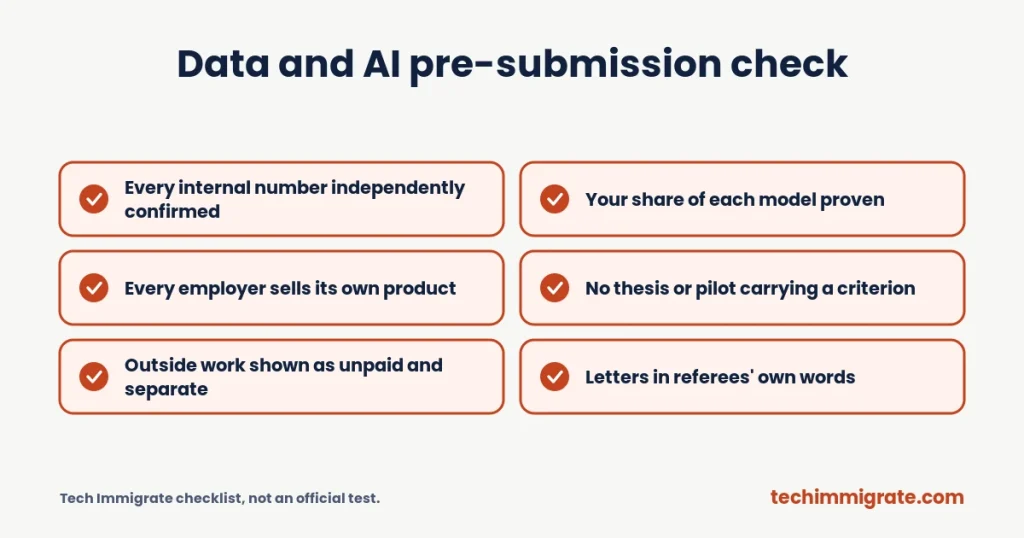
If your evidence already exists, this typically takes 8 to 12 weeks. If you need new recognition or a move to a product-led company, plan for six to twelve months. Our guide includes the week-by-week planner, 25 evidence checklists and the full pre-submission check.
Talent or Promise?
Exceptional Promise suits data scientists and AI researchers early in their careers, including final-year PhD students with strong publications. Exceptional Talent suits people with sustained recognition over several years. Talent leads to settlement after 3 years and Promise after 5. Choose by evidence, and make sure your LinkedIn matches the route. Our comparison of Exceptional Talent and Exceptional Promise explains the trade-offs, and our article on academic contributions covers the research criterion in depth.
Get the Guide for Data and AI Specialists
Our Global Talent Visa Endorsement Guide for Data and AI Specialists turns every fix in this article into steps. It includes evidence checklists for applied and research profiles, a 12-week planner, the 3-page evidence template, a review method with a worked example and a full fictional mock evidence pack.
I was refused the first time I applied for Global Talent, then reapplied and was endorsed. The guide is built so you can avoid the mistakes I made.
Frequently Asked Questions
The most common reasons are internal dashboard numbers with no independent confirmation, model results credited to the team, work at analytics consultancies that are not product-led, theses or pilots presented as impact, and outside work that the assessor treats as part of the job.
Only as support. Applicants report advisers warning that screenshots are not verifiable on their own. Put a signed letter from someone senior, or an official report, behind every internal number.
Not for the academic criterion: Tech Nation's guide excludes undergraduate and MSc thesis research. Use a peer-reviewed paper based on it, or the deployed product it led to.
Use Optional Criterion 4 for peer-reviewed research with citations or reviewing roles, and Optional Criterion 3 for models in production with measured commercial results. Never put the same item under both.
It can be strong recognition, because you were selected to assess other experts' work. One AI researcher reported winning a review after showing that his reviewer selection for top venues was already in his pack.
Yes, free within 28 days, but you cannot add new evidence. It works only if the assessor overlooked or misread evidence already submitted. Weak proof or generic letters need a new application.
On its own, usually not. A top finish in a large, well-known competition can support it if you state the number of teams and your placing, alongside other independent recognition.
For the bigger picture, including how many applications Tech Nation endorses and how that has changed, read Global Talent Visa Success Rate: What the Published Numbers Show.
How We Checked This Article
We checked the rules here against the gov.uk Global Talent digital technology guidance and Tech Nation's Global Talent Visa Application Guide. The six refusal patterns come from a Tech Nation Visa Forum analysis published in September 2025. Refusal examples come from data scientists and AI applicants who published their refusals and reviews on the same forum. This material is applicant-reported, not official guidance.
Forum threads we used:
- Most common rejection patterns, Q3 2025
- Data scientist and founder: refusal, 2025
- AI and robotics: refusal, 2026
- Data engineer: evidence feedback, 2026
- Founder-engineer: Promise refusal and review draft, 2026
- AI/ML researcher: Promise refusal and review
- Data scientist: endorsed after review
- AI and machine learning: endorsed after three refusals
The endorsement fee was £561 at the time of writing. Check current fees and rules on gov.uk before you apply.
Tech Immigrate is independent of Tech Nation and the Home Office. This article is general information, not legal advice, and nobody can guarantee an endorsement. Named examples are fictional.
We write practical guides for tech professionals applying for the UK Global Talent visa. Tech Immigrate is independent of Tech Nation and the Home Office, and our articles are general information, not legal advice. Rules and fees change, so always check gov.uk before you apply.