Global Talent Visa Recommendation Letter Sample: An Annotated Example
A Global Talent visa recommendation letter sample, annotated paragraph by paragraph: weak vs strong wording, GOV.UK rules and how to brief referees.


In this article
- Before the Sample: What GOV.UK Requires
- The Fictional Applicant
- Part 1: The Opening and the Author's Credentials
- Part 2: How the Author Knows the Applicant
- Part 3: Specific Achievements With Results
- Part 4: Recognition Beyond the Applicant's Employer
- Part 5: Contribution to UK Digital Technology and Future Plans
- Part 6: The Closing
- How the Three Letters Should Work Together
- How to Brief Your Referees
- How Strong Letters Differ by Role
- Letters From Referees Outside the UK
- What Happens if Tech Nation Contacts Your Referee
- Common Mistakes in Recommendation Letters
- Is It Acceptable to Draft a Letter for Your Referee?
- Checking a Letter Before You Submit It
- Your Next Step
- How We Checked This Article
Most people preparing a Global Talent application search for a sample recommendation letter at some point. It makes sense: the letters are one of the most important parts of the application, and it is hard to brief a referee when you have never seen a strong letter. The problem is that most samples online are either generic praise that would weaken an application, or full templates that tempt referees to copy and paste, which assessors can spot.
This article takes a different approach. Instead of a template to copy, it walks through an annotated example, paragraph by paragraph, written about a fictional applicant. For each part, it shows what a weak version looks like, what a stronger version looks like, and why the difference matters to a Tech Nation assessor. Use it to understand what good looks like, then make sure every letter you submit is written by the referee, in their own words, about your real work.
Key takeaways
- You must submit 3 letters of recommendation for the digital technology route.
- GOV.UK says each author must be an established expert in digital technology, judged by Tech Nation, and must have known your work for at least 12 months.
- Each letter must give different examples, and must say how you would benefit from living in the UK, how you would contribute to UK digital technology, and your future work plans.
- Letters must be typed, dated and signed, and no more than 3 sides of A4, excluding the author's credentials and contact details.
- The strongest letters are specific: named projects, measurable results, and a comparison with others at your stage.
- Tech Nation's guidance says AI use within your application is not acceptable, and it may contact referees. Letters must be genuinely written by the author.
Before the Sample: What GOV.UK Requires
GOV.UK sets out the formal requirements for letters on the digital technology route. Every letter in your application must meet them, however strong the content.
The author must
- Be an established expert in digital technology. Tech Nation judges whether they meet this standard.
- Have known your work for at least 12 months.
Each letter must
- Give different examples to show your achievements, skills, experience and contribution to the digital technology sector. Three letters saying the same thing are much weaker than three that each add something.
- Say how you would benefit from living in the UK.
- Say how you would contribute to the digital technology field in the UK.
- Explain your plans for future work.
- Be typed and dated.
- Be no more than 3 single sides of A4, excluding the author's credentials and contact details.
- Be signed by the author, or by someone on behalf of the organisation recommending you.
In practice, most strong letters are on the author's organisation's letterhead and include the author's email address and phone number, so that Tech Nation can check them.
The Fictional Applicant
The annotated example below is written about a fictional applicant, so that the commentary has something concrete to refer to.
Lena Varga is a senior machine learning engineer with 6 years of experience. At a payments scale-up, she designed and led the build of a fraud detection system that cut fraud losses significantly. She maintains an open source library for model monitoring that other companies use in production. She has spoken at two well-known developer conferences and mentors engineers through a recognised industry programme. She is applying under Exceptional Promise, using the innovation and recognition beyond occupation criteria.
The letter is written by a fictional referee, Dr Tomas Reyes, Head of Machine Learning at a different, well-known fintech company. He met Lena when his team adopted her open source library and has collaborated with her for over 2 years.
Everything about Lena, Tomas and their companies is invented for illustration.
Part 1: The Opening and the Author's Credentials
Weak version
I am writing to recommend Lena Varga for the Global Talent visa. She is an excellent engineer and I am happy to support her application.
Stronger version
I am writing in support of Lena Varga's application for endorsement under the Global Talent visa (digital technology). I am Head of Machine Learning at [Company], where I lead a team of 40 engineers building risk and fraud systems used by more than 2,000 merchants. I have 15 years' experience in applied machine learning, have published on fraud detection, and regularly review talks for [Conference]. I have known Lena's work for over 2 years.
Why it matters
The assessor's first question is whether the author is an established expert whose opinion counts. The stronger version answers that in a few lines: role, scale, experience and standing in the field. It also confirms the 12-month requirement straight away. The weak version tells the assessor nothing about the author and uses generic language that appears in thousands of letters.
Keep this section short. The author's full CV or biography can be attached separately, and the credentials do not count towards the 3-page limit.
Part 2: How the Author Knows the Applicant
Weak version
I have worked with Lena on several projects and know her well.
Stronger version
I first came across Lena's work in early 2024, when my team evaluated open source tools for monitoring models in production. We adopted her library, [Library], after comparing it with two commercial products. Since then I have worked with Lena directly: she advised my team on integrating the library into our pipeline, and we co-presented a case study at [Conference] in 2025. I am not, and have never been, her employer or manager.
Why it matters
Assessors want to know whether the author has real knowledge of your work, and whether they are independent. A specific account of how the relationship began, what they saw and how long it has lasted makes the letter credible. A clear statement that the author is not your manager signals independence, which strengthens the evidence of recognition beyond your employer.
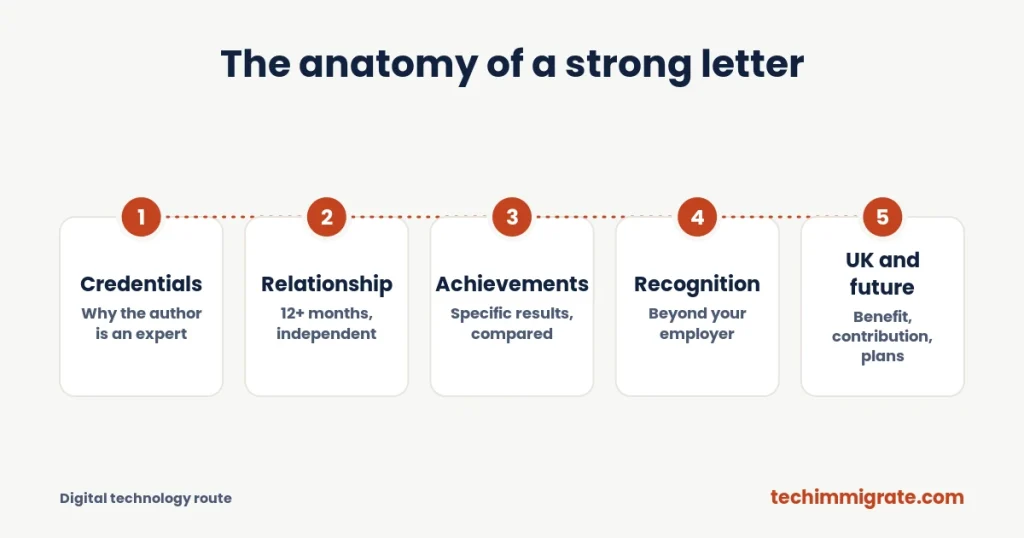
Part 3: Specific Achievements With Results
This is the heart of the letter. Each of your three letters should cover different achievements, so plan with your referees who will write about what.
Weak version
Lena is a very talented engineer who has made major contributions to machine learning. She is innovative, hardworking and a strong leader.
Stronger version
Lena's library solves a problem that most machine learning teams struggle with: detecting when a model's behaviour drifts in production before it causes harm. Before adopting it, my team relied on manual checks and caught drift on average several weeks after it began. With Lena's library, we now detect it within days. This has had a direct effect on fraud losses and on the trust our merchants place in our systems.
What impressed me most is that Lena built the library while working full time, and designed it so that it works across different modelling frameworks. That design choice is why it has been adopted by teams at [Company A] and [Company B], as well as mine. I know of no other engineer at her career stage who has built a tool with this level of adoption across the industry.
Why it matters
The stronger version does four things the weak one does not. It explains the problem in plain language. It shows a measurable result. It links the result to Lena personally. And it compares her with others at her stage, which is exactly what an Exceptional Promise assessor needs to see. Adjectives like "talented" and "innovative" carry no weight unless the letter shows why they are true.
Numbers and confidentiality
Referees sometimes cannot share exact figures. That is fine. Ranges, percentages or relative statements, such as "reduced detection time from weeks to days", still show impact. What matters is that the claim is specific enough to be meaningful and honest enough to be checked.
Part 4: Recognition Beyond the Applicant's Employer
Weak version
Lena is well known in the industry.
Stronger version
Lena's work is recognised well beyond her own company. Her talk on production model monitoring at [Conference] was one of the most attended sessions in the machine learning track, and I have since heard her work referenced by speakers from other companies. She also mentors early-career engineers through [Programme], which selects mentors from across the UK tech sector.
Why it matters
The mandatory criterion asks for recognition as a leading talent, or a potential one, beyond your own employer. A letter from an independent expert describing that recognition is strong evidence for it. Where possible, the referee should mention things the assessor can verify in your other evidence, such as the conference talk, so that the letter and the evidence reinforce each other.
Part 5: Contribution to UK Digital Technology and Future Plans
GOV.UK requires every letter to cover how you would benefit from living in the UK, how you would contribute to the UK digital technology field, and your future plans. Many letters miss this or treat it as an afterthought.
Weak version
Lena would be a great asset to the UK.
Stronger version
The UK has one of the strongest fintech sectors in the world, and the risks Lena's work addresses are central to it. Being based in the UK would give Lena direct access to the companies, regulators and research groups working on trustworthy machine learning in financial services. In turn, I expect her to contribute through her open source work, which UK companies already use, through speaking and mentoring within the UK community, and through her plans to lead a machine learning platform team at a UK scale-up. I have discussed these plans with her, and I believe they are realistic and ambitious.
Why it matters
This section turns a letter about the past into a case for the future. It should be specific to you and to the UK, and it should match what you say in your personal statement. If your letter says you plan to found a start-up and your statement says you plan to join a large company, the assessor will notice.
Part 6: The Closing
Weak version
I strongly recommend her. Please contact me if you need more information.
Stronger version
In my view, Lena is among the most promising machine learning engineers of her generation in fintech. I support her application without reservation. I am happy to be contacted to confirm anything in this letter at [email] or [phone].
[Signature] Dr Tomas Reyes, Head of Machine Learning, [Company]. [Date].
Why it matters
A clear, confident summary helps the assessor, and contact details let Tech Nation check the letter. Make sure the letter is signed and dated. A missing signature or date can undermine an otherwise strong letter.

How the Three Letters Should Work Together
One strong letter is not enough. Your three letters should work as a set, each adding something different.
| Letter | Author | Focus |
|---|---|---|
| Letter 1 | Independent expert who uses your work | Innovation and adoption beyond your employer |
| Letter 2 | Former senior leader who saw your impact closely | Significant contributions and measurable results |
| Letter 3 | Community or industry leader | Recognition, speaking, mentoring and influence |
For Lena, letter 1 might be Tomas's letter above. Letter 2 might come from her former CTO, describing the fraud detection system and its results. Letter 3 might come from the organiser of a respected conference or the lead of the mentoring programme, describing her standing in the community.
Avoid three letters from people at the same company, and avoid letters that all describe the same project. GOV.UK says each letter must give different examples.
How to Brief Your Referees
Your referees are busy, and they may never have written a Global Talent letter before. A good brief makes a strong letter far more likely, without putting words in their mouth.
- Explain the purpose. Tell them what the Global Talent visa is and what Tech Nation looks for.
- Share the formal requirements. Length, signature, date, contact details, and the points every letter must cover.
- Suggest a focus. Tell each referee which achievements you would like them to cover, so the three letters do not overlap.
- Give them the facts. Dates, project names, results and links they can check, so that their letter is accurate.
- Ask them to write in their own words. Tech Nation may contact them, and the letter must reflect their genuine view.
- Give them time. Ask several weeks in advance, and follow up politely.
How Strong Letters Differ by Role
The structure above works for every role, but the content of Part 3 changes a lot depending on what you do.
- Software engineers: adoption of tools or libraries, architecture decisions that changed what a company could do, performance or reliability gains, and influence on how other engineers work.
- Data and AI specialists: models or systems in production with measurable outcomes, research contributions that others use, and recognition from the research or practitioner community.
- Product managers: products or features the applicant owned, with growth, retention or revenue results, and evidence that other product leaders see them as a reference point.
- Designers: design work that changed user outcomes, design systems adopted widely, and recognition from the design community.
- Founders: the innovation behind the company, traction, investment and the founder's personal role in each.
- Tech sales and growth leaders: markets opened, revenue built and teams scaled at a product-led company, with the applicant's personal contribution made clear.
Whatever your role, the referee should describe outcomes they have seen or can vouch for, not just repeat your job description.
Letters From Referees Outside the UK
The digital technology route does not require your referees to be based in the UK. Many strong applications include letters from established experts in other countries, especially for applicants who have built their careers abroad. What matters is that the author is an established expert in digital technology and has known your work for at least 12 months. If your referee's organisation is less well known in the UK, their credentials section becomes more important: it should make their standing clear to an assessor who may not recognise the company name.
If a letter is not in English, you will need a full translation. It is usually much simpler to ask referees to write in English from the start.
What Happens if Tech Nation Contacts Your Referee
Tech Nation's guidance says it may carry out checks on applications, which can include contacting referees. If this happens, the referee will usually be asked to confirm that they wrote the letter and that its contents reflect their view. A referee who wrote the letter themselves will find this easy. A referee who signed a letter drafted by someone else, or who cannot remember the details, may struggle, and that can damage the application. Tech Nation's guidance also says that false or misleading evidence can make you ineligible and be reported to the Home Office. This is another reason to keep letters honest, specific and genuinely the referee's own work.
Let each referee know in advance that they may be contacted, and make sure the contact details in the letter are ones they actually check.
Common Mistakes in Recommendation Letters
- Generic praise with no examples. The single most common weakness.
- Authors who are not established experts. Tech Nation judges the author's standing.
- Authors who have not known your work for 12 months. This is a formal requirement.
- Three letters covering the same project. Each must give different examples.
- Missing the UK and future plans sections. GOV.UK requires them in every letter.
- Letters that contradict your statement or CV. Make sure the story is consistent.
- Letters longer than 3 pages. Excluding credentials and contact details.
- Unsigned or undated letters. Easy to avoid, and damaging if missed.
- Copied templates or AI-written text. Assessors can recognise them, and Tech Nation's guidance says AI use is not acceptable.
Is It Acceptable to Draft a Letter for Your Referee?
Many applicants wonder whether they can write a draft for a busy referee to edit. It is common for applicants to provide facts, dates and a suggested focus, and that is sensible. But the letter must be the referee's own view, in their own words, and they must be willing to stand behind every sentence if contacted. A letter that reads like it was written by the applicant, or that uses the same phrasing as your personal statement, weakens your case. Tech Nation's guidance on AI also makes clear that content generated by AI is not acceptable within the application.
The safest approach is to give your referee a factual brief and let them write. If they ask you for help, offer facts and corrections rather than prose.
Checking a Letter Before You Submit It
When you receive each letter, check it against this list.
- Does it say who the author is and why they are an established expert?
- Does it confirm they have known your work for at least 12 months?
- Does it give specific examples, different from the other letters?
- Does it cover how you would benefit from the UK, how you would contribute, and your future plans?
- Is it typed, dated, signed and within 3 pages?
- Does it include the author's contact details?
- Is it consistent with your CV and personal statement?
If a letter falls short, ask the referee politely for a revision, explaining which requirement is missing. Most referees are happy to help once they understand what is needed.
Three for the digital technology route.
An established expert in digital technology who has known your work for at least 12 months. Tech Nation judges whether the author meets this standard.
Up to 3 single sides of A4, excluding the author's credentials and contact details.
Use examples to understand what good looks like, but each letter must be written by the referee, in their own words, with different examples.
How you would benefit from living in the UK, how you would contribute to UK digital technology, and your future plans, plus specific examples of your work.
They can, if they are an established expert, but letters from independent experts are usually stronger evidence of recognition beyond your employer.
Your Next Step
Letters work best when they fit a clear evidence strategy for your role. Our role-specific Global Talent guides include referee briefing checklists, examples of how strong letters differ by role, and guidance on matching letters to your evidence, for software developers, data and AI specialists, product managers, designers, founders and more. For more on choosing referees, read our articles on who to ask for Global Talent letters, the 7 rules for recommendation letters and the types of referee to approach.
How We Checked This Article
We checked the letter requirements against GOV.UK's documents you need for endorsement for the digital technology route, and Tech Nation's applicant guidance on AI and verification, in November 2026. The sample letter, applicant, referee and companies are fictional.
Tech Immigrate is independent of the Home Office and Tech Nation. This article is general information, not legal advice. Check GOV.UK before you apply.
We write practical guides for tech professionals applying for the UK Global Talent visa. Tech Immigrate is independent of Tech Nation and the Home Office, and our articles are general information, not legal advice. Rules and fees change, so always check gov.uk before you apply.