Global Talent Visa Portfolio Checklist: 12 Evidence Items to Include (and 5 to Skip)
Use this Global Talent Visa portfolio checklist to choose 12 evidence items, skip 5 weak ones, and run a final check before you submit. Get the template.

In this article
- What is a Global Talent Visa portfolio checklist?
- What goes into the application file
- The 12 evidence items to include
- The 5 items to skip
- Illustrative example (fictional): a before-and-after audit
- A free inventory table you can copy
- Global Talent Visa portfolio checklist: final quality checks
- How to present each document
- How to use the Global Talent Visa portfolio checklist in five steps
- Global Talent Visa portfolio checklist by career stage
- What strong and weak evidence look like
- Illustrative example (fictional): the final six weeks
- What does it cost, and how long does it take?
- What if your checklist has gaps?
- Where to find evidence you forgot
- Global Talent Visa portfolio checklist FAQ
- Your Next Step
- How We Checked This Article
A Global Talent Visa portfolio checklist lists the evidence you include, the proof you skip, and the checks you run before you submit. You can send up to 10 documents, so every slot has to earn its place.
Most refusals start with a poor mix of documents, not a poor career. This guide gives 12 evidence items by criterion, 5 items to skip, a quality checklist, and a template you can copy.
Key takeaways
- You can send up to 10 evidence documents, each up to 3 A4 sides, plus a CV and three recommendation letters.
- Twelve evidence item types cover the mandatory criterion and all four optional criteria. You will only use some of them.
- Skip internal praise, stand-alone social posts, certificates, vanity numbers and reused documents.
- Every document needs a date, your exact role, a source other people can check, and one criterion.
- Run the quality checklist last, because small format errors can weaken a strong file.
What is a Global Talent Visa portfolio checklist?
A Global Talent Visa portfolio checklist is a working list of every document in your application, with the criterion each one proves. It helps you see gaps, repeats and weak items before Tech Nation does.
The word "portfolio" can mislead. You are not building a showcase of your work. You are building a case file. Tech Nation's independent panel decides overall whether to endorse you, so the file has to prove recognition and contribution clearly.
Use the checklist in three passes. First, collect items. Next, match each item to one criterion. Finally, run the quality checks near the end of this guide.
What goes into the application file
Your application has five parts, and only the evidence documents count toward the limit of 10. The gov.uk page sets the size of each part.
| Part | Limit | Notes |
|---|---|---|
| Evidence documents | Up to 10, each up to 3 A4 sides | At least 2 for the mandatory criterion and 2 per optional criterion |
| CV | Up to 3 A4 sides | Typed, with career history and relevant publications |
| Recommendation letters | 3 letters, each up to 3 sides | Typed, dated and signed, from established experts |
| Personal statement | Part of the application | Explains your plans and links your evidence |
| Proof of business connection | Only for founders or senior executives | Accounts or sales data covering the right period |
The letters must come from established digital technology experts who have known your work for at least 12 months. Letters support your evidence, but they cannot replace it. Read our recommendation letters guide before you ask.
You need one mandatory criterion plus two of four optional criteria. Our criteria guide explains each one in full.
The 12 evidence items to include
The 12 items below cover every criterion, and most applicants use six to ten of them. So pick the ones you can prove, not the ones that sound best.
Mandatory criterion: recognition (items 1 to 4)
The mandatory criterion asks for recognition by others as a leading or emerging talent in digital technology in the last five years. These four items fit best.
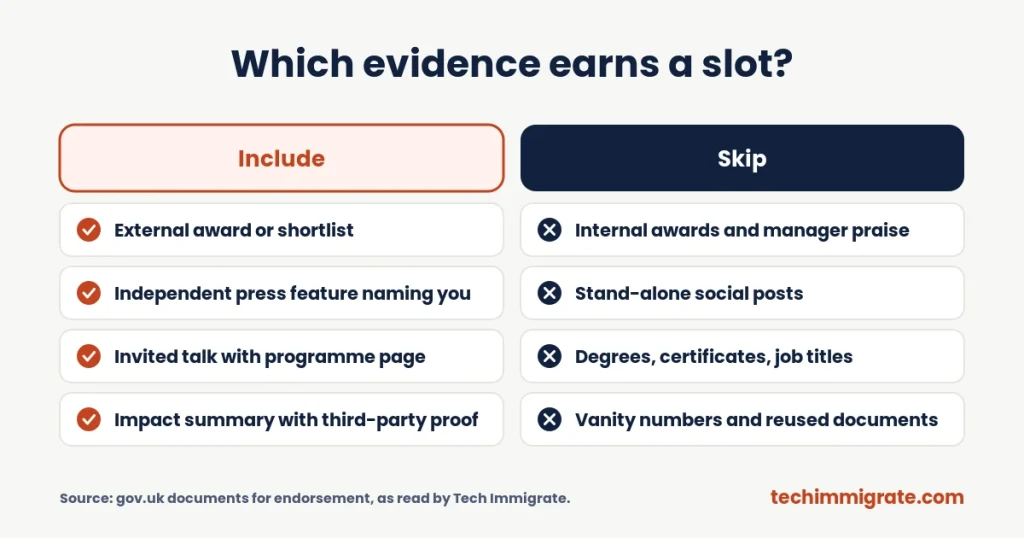
- An external award or shortlist. Choose a prize from an independent body with published judging criteria. Also include the award page, the entry rules and your named role.
- An independent press feature. Use coverage in a credible outlet, as long as it names you and your work. Self-written profiles do not help.
- An invited talk. Provide the programme page, the invitation, the audience size and a recording if one exists.
- A selective programme, fellowship or judging role. Show how people were selected, and how many places or entrants there were.
Optional criterion: innovation (items 5 and 6)
Innovation asks for a record of innovation in a product-led digital technology company. For Talent, that means as a founder or senior executive, or as an employee in a new field. For Promise, it means as a founder or as an employee in a new field.
- A launch record for a new product or feature. Show the market problem, what you built, when you shipped it and the adoption numbers.
- A granted patent or published technical method. Use this only if you hold one. If you do, show the grant record and your named role.
Optional criterion: outside recognition (items 7 and 8)
This criterion looks at your contribution to the sector outside your day job. Think mentoring and collaborative projects.
- A mentoring or teaching record. Include the programme, your hours, the number of people you helped and independent feedback.
- A community or open-source project. Show real use through downloads, stars with context, contributors and adoption, because raw counts alone say little. Our GitHub evidence guide explains how.
Optional criterion: significant contribution (items 9 and 10)
This criterion covers significant technical, commercial or entrepreneurial contributions to a product-led digital technology business.
- An impact summary with third-party confirmation. State the problem, your role and the result. Then say who confirms it.
- Business records that show growth. Use revenue, user or sales data. Founders and senior executives may also need audited accounts.
Optional criterion: academic contribution (items 11 and 12)
Academic contribution covers research published or endorsed by an expert.
- A published paper or cited research. Include the journal or venue, the date, your role and, where you have them, citation data.
- A peer review or programme committee role. Show the invitation, the venue and the dates.
The 5 items to skip
Five common items add pages but not proof, so leave them out of your 10 slots. Applicants and advisers report that these weaken files. Tech Nation's guidance also rules out some of them.
- Internal awards and manager praise. Employer recognition does not show recognition from others, so keep it for your CV if it matters.
- Stand-alone social posts. LinkedIn or Medium posts on their own do not count. They only help when an independent source cites them.
- Degrees, certificates and job titles. These describe your background. They do not prove recognition or contribution. A high salary does not either.
- Vanity numbers. Follower counts and likes mean little unless an independent source gives them context.
- Reused or templated documents. One document cannot serve two criteria. Tech Nation also says it does not accept AI-written or templated documents.
Some advisers add paid mentions and paid speaking slots to this list. We agree that selection and independence matter, so check how each slot was won.
Illustrative example (fictional): a before-and-after audit
An audit swaps weak slots for strong ones without adding new achievements. Here is a fictional applicant, "Kemi", a senior backend engineer with seven years in product-led companies.
Kemi's first list had ten items. Four were internal awards or manager letters. Two were certificates. One was a LinkedIn post, and one repeated her main project in two documents. Only two items came from outside her employer.
After the audit, she dropped six items. She found an accepted conference talk, a trade press quote, a mentoring record and a third-party confirmation of her project results. She also kept her open-source library with its adoption data.
Her final map had two documents for the mandatory criterion, two for outside recognition, and two for contribution. Four slots stayed spare. This is only an illustration and does not predict any decision.
A free inventory table you can copy
An inventory table keeps all items in one place, so you can spot repeats and gaps at a glance. Copy this table into a spreadsheet, and then fill it in.
| ID | Criterion | Evidence item | Date | Your exact role | Independent source | Proof or link | Pages | Use? |
|---|---|---|---|---|---|---|---|---|
| 1 | Mandatory | Invited conference talk | Month and year | Speaker | Event organiser | Programme page | 2 | Yes |
| 2 | Mandatory | Trade press feature | Month and year | Named interviewee | Publication | Article link and PDF copy | 1 | Yes |
| 3 | Outside recognition | Mentoring record | Range | Mentor | Programme lead | Confirmation page | 2 | Yes |
| 4 | Contribution | Product impact summary | Range | Lead engineer | Senior leader | Data export | 3 | Maybe |
| 5 | Any | Internal award | Month and year | Team member | Employer | 1 | No |
Add one row for every candidate item. Then mark "Use?" as yes, maybe or no. Finally, count your yes rows per criterion. You need at least two for each criterion you claim.
Global Talent Visa portfolio checklist: final quality checks
Run these checks at the end, because a strong file can still lose points through small errors. Tick each box before you submit.
Formatting and page limits
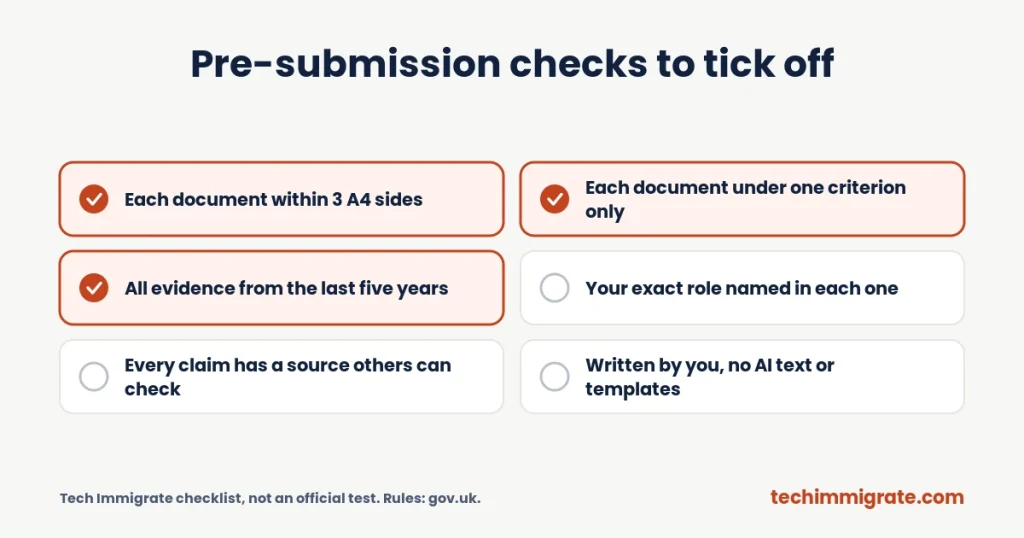
- Each evidence document is typed and runs to no more than 3 A4 sides.
- Your CV is typed and runs to no more than 3 A4 sides.
- Each letter runs to no more than 3 sides, and is typed, dated and signed.
- Nothing is shrunk, collaged or crammed to beat the limit.
- Each file covers one point, not several unrelated items.
No reuse and no overlap
- Each document appears under one criterion only.
- Two documents never prove the same achievement in the same way.
- Every criterion has at least two documents.
Dates and links
- All evidence falls inside the last five years.
- Every item shows a date you can verify.
- Web pages are saved as dated copies with the address visible, because links change.
- Names, titles and dates match across your CV, letters and evidence.
Independence and honesty
- Each document names your exact role, not just the team's.
- Each claim has a source someone else can check.
- You wrote every document yourself, with no AI text or templates.
- Each letter writer is an established expert who has known your work for 12 months or more.
Our endorsement mistakes guide covers more problems that applicants report.
How to present each document
A clear document answers four questions in the first lines: what is this, which criterion does it support, when did it happen, and who confirms it. Reviewers then find the proof without hunting.
First, use a short title and a one-paragraph introduction. Then add the proof, such as a page, a number or a quote from a named source. Keep the language plain and specific.
Label each file the same way, for example "Evidence 3: mentoring record". Add the date and the source. If a document is not in English, applicants often add a translation and a short note on why the source matters.
Adviser sites also suggest keeping one saved copy of every web page. That is sensible practice, not an official rule, but it protects you if a link breaks.
How to use the Global Talent Visa portfolio checklist in five steps
You can build the whole checklist in five steps, and each step takes a few days. Work in this order, because each step feeds the next.
- List everything from the last five years. Include projects, talks, press, awards, mentoring and publications. Do not judge yet.
- Add a source to every row. If nobody outside your team can confirm an item, mark it as weak.
- Match each row to one criterion. If an item fits two, pick the stronger fit and look for a second item for the other.
- Count slots per criterion. Aim for two strong documents per criterion, because that is the minimum.
- Draft, then run the quality checks. Write each document last, and then test it against the checklist below.
Because you do the matching before the writing, you avoid long rewrites. Also, you see early which criterion is thin, so you can start building proof while there is still time.
Global Talent Visa portfolio checklist by career stage
Your stage changes which of the 12 items you can reach, so use the table to set expectations. Tech Nation decides each case on its merits, and this is a pattern rather than a rule.
| Stage | Items usually within reach | Items that often take longer |
|---|---|---|
| Early career | Invited talks, mentoring, open-source projects, product impact summary | Press features, granted patents, peer review roles |
| Mid-career | Awards, press, talks, impact summaries, mentoring | Senior judging roles, major research |
| Senior or established | Press, awards, launch records, business records | Fresh outside recognition if work stays inside one company |
Early-career applicants often look at Exceptional Promise, where the gov.uk page says applicants are likely to have less than 5 years of experience in technology. Established leaders often look at Exceptional Talent. Our guide to Exceptional Talent vs Exceptional Promise explains how to decide.
Whatever your stage, start with the slow items, because talks, awards and press take months. Documents, by contrast, take days to write.
What strong and weak evidence look like
Strong evidence comes from outside, names you, and can be checked. Weak evidence comes from inside, praises your team, and asks the reader to simply trust you. The table below shows pairs that advisers often use.
| Item | Stronger version | Weaker version |
|---|---|---|
| Award | Competitive prize with published criteria | Employer award with no outside judges |
| Talk | Invited slot at an independent event | Internal all-hands session |
| Press | Independent feature that names you | Self-written profile or paid mention |
| Impact | Result confirmed by a senior or outside source | Claim with no confirmation |
| Mentoring | Programme record with hours and outcomes | "I mentor juniors" with no proof |
| Letter | Specific facts, dates and results | Generic praise |
Apply the same test to every item. Ask who else can confirm it, what the date is, and what your exact part was. If you cannot answer all three, the item needs more work or a swap.
Illustrative example (fictional): the final six weeks
A short countdown keeps the last stage calm. Here is how our fictional applicant, "Kemi", planned her final six weeks once her items were chosen.
First, in week one, she froze her list at eight documents. Next, in week two, she saved dated copies of every web page and checked each date. Then she briefed her three referees with her evidence map and asked for drafts.
Later, in week four, she wrote and trimmed each document to three sides. After that, in week five, she ran the quality checks and swapped one weak item. Finally, in week six, she read every file once more for matching names and dates.
Kemi's plan is only an illustration. Real timelines vary, so nobody can promise a result. However, the habit of freezing the list early helps most applicants avoid last-minute changes.
What does it cost, and how long does it take?
At the time of writing, the endorsement fee is £561 and the visa fee is £205. That makes £766 for the main applicant before the Immigration Health Surcharge of £1,035 per year (£776 for under-18s). Dependants pay their own visa fee and surcharge.
Tech Nation usually decides in 5 to 8 weeks. The visa decision usually takes 3 weeks from outside the UK and 8 weeks from inside it. You must apply for the visa within 3 months of the endorsement. There is no points system. Check gov.uk for current figures.
What if your checklist has gaps?
A gap is a signal to build proof, so do not pad your file. If you cannot fill two slots for a criterion, consider another criterion that suits your record better.
If you are refused, you can request a free review within 28 days. You cannot add new evidence to it. A fresh application carries a new fee, so many applicants rebuild the checklist first.
Researchers and academics often hold the strongest items for the academic criterion, so they may start there. If that is you, see our tech researcher guide for a role-specific plan.
Where to find evidence you forgot
Most applicants hold more proof than they think, because good evidence often sits in old emails and folders. Spend an hour searching before you decide you have gaps.
Start with your inbox. Search for words such as "invitation", "shortlisted", "thank you", "keynote" and "interview". Then check your calendar for talks, panels and mentoring sessions. Next, look at event websites, because organisers often keep programme pages for years.
After that, ask colleagues and partners what they remember. Someone may have a press link, a data export or a photo of your session. Also check your company's public pages for case studies that name you.
If an item is old, check the date first. Evidence must come from the last five years, so anything older needs a fresh angle or has to be dropped. Finally, save every find in one folder with a clear name, so you can add it to your inventory table straight away.
Global Talent Visa portfolio checklist FAQ
For digital technology you need up to 10 evidence documents, a CV of up to 3 sides, and three recommendation letters. You also complete a personal statement. If you were a founder or senior executive, you may also need proof of business connection. Each evidence document can run to 3 A4 sides.
Not on their own. Tech Nation's guidance says LinkedIn and Medium posts do not count by themselves. They can help when an independent source cites or reports on them. Choose proof from outside sources, such as press, programme pages and awards.
No. One document cannot be reused for two criteria. You can use the same achievement as inspiration for two different documents, but each needs its own independent proof. Plan this before you write so you do not run short of slots.
You can send up to 10, but you do not have to fill every slot. You need at least 2 for the mandatory criterion and at least 2 for each optional criterion you claim. Strong documents matter more than a full set.
Save a dated copy of the page with the web address visible, and keep the link too. This is advice from adviser sites rather than official guidance. It helps a reader check your claim even if the page changes later.
Your Next Step
Build your inventory table today, then mark every item as yes, maybe or no. Want the guide for your role? See the guides.
For a role-specific checklist, browse the guides hub. Each one is a role-specific endorsement guide with an evidence checklist and planner. Good starting points include the software developer guide, the cybersecurity specialist guide and the product manager guide.
How We Checked This Article
We checked the document limits, the criteria, the letter rules and the business proof rules on the gov.uk page for documents you need to apply. We checked fees, timings and the review rules on the main digital technology page and the refused applications page.
Beyond that, we read adviser and law firm checklists. Where they disagree on letter numbers or statement length, we left those details out. Because our example is fictional, it does not describe a real person.
Tech Immigrate is independent of Tech Nation and the Home Office. This article is general information, not legal advice, and nobody can guarantee an endorsement. Always confirm current rules on gov.uk before you apply.
We write practical guides for tech professionals applying for the UK Global Talent visa. Tech Immigrate is independent of Tech Nation and the Home Office, and our articles are general information, not legal advice. Rules and fees change, so always check gov.uk before you apply.