Tech Nation Application Mistakes: 10 Things to Leave Out (and What to Include Instead)
Avoid Tech Nation application mistakes by knowing what to leave out. See 10 weak items to cut and the stronger evidence to include instead. Check your list.

In this article
- Why Tech Nation Application Mistakes Come From Adding Too Much
- Leave Out 1: Employer-Only Evidence, a Classic Tech Nation Application Mistake
- Leave Out 2: Your Own Posts, With Nothing Else
- Leave Out 3: AI-Written or Templated Text in Your Application
- Leave Out 4: Shrunk, Compressed or Collage Evidence
- Leave Out 5: Padding and Duplicates
- Leave Out 6: Claims Without Proof, the Quietest Tech Nation Application Mistake
- Leave Out 7: Old Evidence and Last-Minute Evidence
- Leave Out 8: Off-Topic Achievements
- Leave Out 9: Unfinished Things
- Leave Out 10: Company Success You Did Not Drive
- A Tech Nation Application Mistakes Decision Table
- A Worked Example: Fixing a Tech Nation Application Mistakes List
- Tech Nation Application Mistakes in Your CV and Statement
- What Not to Cut: Avoiding Over-Correction
- Audit Your Set in 15 Minutes Before You Submit
- How Do You Avoid Tech Nation Application Mistakes When Choosing?
- What if Cutting Leaves You With Too Little?
- Tech Nation Application Mistakes FAQ
- Your Next Step
- How We Checked This Article
The most common Tech Nation application mistakes are things people put in, not things they forget. Weak, internal, duplicate or unproven items dilute your best evidence. This article lists ten leave-out decisions and what to include instead.
It is for applicants who already have a pile of documents and need to choose. We do not repeat the refusal list in our guide to Tech Nation endorsement mistakes. Here the focus is on cutting.
Key takeaways
- Every document you submit either helps or hurts, because you only get 10 documents of up to 3 A4 sides each.
- Anything that comes only from your employer, your own posts, or your own claims should go.
- AI-written or templated text, shrunk or collage screenshots, and bare links should go too.
- Old, unfinished and off-topic material also goes. Replace it with recent, independent proof.
- Test each document with one question: which criterion does it prove, and who outside your company says so?
Why Tech Nation Application Mistakes Come From Adding Too Much
You have 10 evidence documents, so every weak one costs you a strong one. Tech Nation's panel judges what is on the page, and it decides overall whether to endorse you. Meeting the criteria is necessary, but it is not enough on its own.
Applicants often feel safer adding more. In practice, extra material hides the proof that matters. A reader who has to dig through filler may miss the one document that carries your case.
The rules that make Tech Nation application mistakes costly
The rules set a tight frame. You need one mandatory criterion plus two of four optional criteria. Each criterion needs at least two documents, and one document cannot count for two criteria. Evidence should come from the last five years.
Tech Nation's guidance also says each document can run to three A4 sides at most. So you cannot add a fourth page or shrink a fifth page to fit. You can only choose better content. You can read how the criteria work in our Global Talent visa criteria guide.
Leave Out 1: Employer-Only Evidence, a Classic Tech Nation Application Mistake
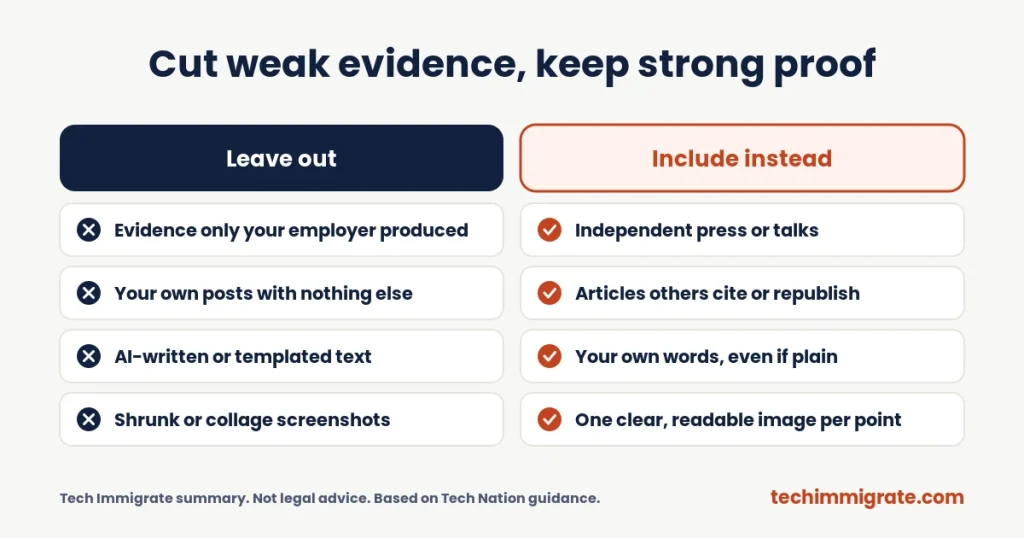
Leave out documents that only your own company produced, because the recognition criteria ask for proof from outside it. Internal awards, internal praise emails and your company's own blog posts usually fall into this group.
Tech Nation's guidance says evidence of recognition should come from outside your employer. An internal "employee of the year" tells the panel your manager is happy. It does not show that the wider sector sees you as a leader.
Include instead: Press or industry coverage that names you, an invited talk at an independent event, an award with a public shortlist, or an independent expert's statement. If your company did produce it, add a line on who outside the company verified it.
Leave Out 2: Your Own Posts, With Nothing Else
Leave out LinkedIn or Medium posts that stand alone, because Tech Nation's guidance says self-published posts on their own do not count as recognition. You wrote them and you published them. Nobody independent has judged them.
That does not mean writing is worthless. One adviser's reading of the guidance, published online, is that self-published content is excluded as media evidence. Treat that as a signal, not a ruling.
Include instead: Articles that an independent publication commissioned, or posts that others cite, translate or reuse. Show the reach with analytics from a source you do not control, or show a named outlet that republished your work.
Leave Out 3: AI-Written or Templated Text in Your Application
Leave out any text that AI tools or a template wrote, because Tech Nation's guidance says AI and language tools are not acceptable in your application. It also says its team will check. One legal adviser quotes the warning that using such tools may weaken your application or raise concerns about its validity.
The same logic applies to templates. Three recommendation letters with the same structure and praise look copied. A personal statement that follows a popular template reads like everyone else's.
Include instead: Your own words, even if they are plain. Referees should write in their own voice about what they saw. You can brief them with facts, but never write their letter. Our personal statement guide shows a criteria-first structure that does not need a template.
Illustrative example (fictional)
Sam has three letters that all say "a hardworking and talented engineer who delivers results." Each one differs only by the referee's name. Sam asks the referees to rewrite them. One covers an open-source library Sam built. One covers a conference talk. The last covers a product feature that shipped to customers. The letters now support different claims, so they add something.
Leave Out 4: Shrunk, Compressed or Collage Evidence
Leave out screenshots that you shrank, stitched or compressed to fit the page limit, because the guidance says evidence must be legible. A collage of six tiny images tells the panel nothing it can read.
The rule is the same for web pages. The guidance says documents should not be bare web links. If you rely on a web page, you provide a scanned or saved copy that clearly shows the hyperlink.
Include instead: One clear image per point, large enough to read, with the key line highlighted. If a long document runs over three sides, extract the most important pages rather than reducing the font. Our GitHub evidence guide shows how to turn a repository into a readable document.
Leave Out 5: Padding and Duplicates
Leave out documents that add no new proof. A second screenshot of the same article, a full 40-page report, or a copy of a document you already use for another criterion are all padding.
The rules do not allow you to reuse one document for two criteria. Even when you use a different part of the same file, it still counts as the same document. Padding also dilutes the case, so a strong document sits next to a weak one and loses force.
Include instead: Fewer documents with one clear job each. Fewer, stronger documents beat a full set of weak ones. Name each file so the reader sees its job at once, such as `04_OC1_Patent-grant.pdf`.
Leave Out 6: Claims Without Proof, the Quietest Tech Nation Application Mistake
Leave out any claim you cannot back with a document the reader can check. Phrases such as "recognised internationally" or "led a major launch" mean little without dates, names and figures.
Assessors can only judge what they can verify. This applies to your CV and personal statement as much as your evidence. If you say your product reached 200,000 users, the panel wants a source for that number.
Include instead: A claim, then the proof, then why it matters. For example: "I built the payment retry system (Document 6, page 2), which cut failed payments from 4% to 2% (internal dashboard export signed by the product director)." The claim is specific and the proof is attached.
Illustrative example (fictional)
Priya writes in her statement that she "mentored dozens of engineers." She has no record of it. She finds a programme page that names her as a mentor, an email from the organiser confirming 18 sessions, and a reference to the programme in a referee letter. She now cuts "dozens" and writes "18 structured sessions," with the proof attached.
Leave Out 7: Old Evidence and Last-Minute Evidence
Leave out evidence from outside the last five years, because the criteria ask for recognition in that period. Your award from eight years ago may be real, but it does not show current standing.
Be careful with evidence you create just before applying. One adviser's reading of the guidance is that material made only for the application gets stricter scrutiny. A talk you gave once last month, with no history behind it, is weaker than a steady pattern.
Include instead: Recent proof with dates visible. If an older item shows a pattern, use it only as context in your CV. Then rely on newer documents for the criteria. Check the dates on every page before you keep it.
Leave Out 8: Off-Topic Achievements
Leave out achievements that are not about digital technology. One adviser lists sports results, non-tech volunteering, minor course certificates and English test results as items to omit. The same adviser notes that this route does not ask for IELTS or similar certificates.
Off-topic items are not harmful in themselves. They simply take a slot that a relevant document could fill. A medal from a school sports day does not help you prove tech leadership.
Include instead: Work that sits in the digital technology sector: speaking at tech events, mentoring tech talent, judging a hackathon, or contributing to a recognised open-source project. For technical roles, remember the product-led rule on the gov.uk Tech Nation skills page.
Leave Out 9: Unfinished Things
Leave out items that are not finished, such as a patent application that is not yet granted, a business plan with no launch, or a draft paper. They show intent, not results.
Advisers who write about the innovation criterion often report that granted patents carry weight while pending ones do not. Treat that as applicant-side advice rather than official wording, and check the current guidance for your own case.
Include instead: Things that are live. That could be a launched product with users, a granted patent with its public ID, a published paper, or a merged contribution. If your main item is still pending, wait until it is done or choose another criterion.
Leave Out 10: Company Success You Did Not Drive
Leave out company-wide results with no line back to you. Revenue growth, funding rounds and user numbers belong to a whole team. The panel wants to see your part.
This matters most for the criterion about significant contributions to a product-led business. Company success is not your evidence. One adviser puts the test as a clear line between a specific contribution and the person who made it.
Include instead: A narrow claim that is yours: the feature you designed, the system you led, the metric you moved, plus proof from outside your own team. A manager's letter helps, but a letter alone is not enough. Add a document that shows the result.
A Tech Nation Application Mistakes Decision Table
A quick table helps you decide whether to keep or cut each item. Use it on every document before you submit.
| Item | Keep or cut? | Why | Include instead |
|---|---|---|---|
| Internal award | Cut | Only your employer says so | Independent press or award |
| Own LinkedIn post | Cut | Self-published | Commissioned article |
| AI-drafted statement | Cut | Not allowed by guidance | Your own words |
| Shrunk screenshot | Cut | Not legible | One clear image |
| Duplicate document | Cut | Adds no new proof | One strong document |
| Unsupported claim | Cut | Cannot be checked | Claim plus proof |
| Evidence over 5 years old | Cut | Outside the window | Recent evidence |
| Non-tech award | Cut | Off topic | Tech-sector work |
| Pending patent | Cut | Not finished | Granted patent |
| Company-wide metric | Cut | No personal line | Your own contribution |
A Worked Example: Fixing a Tech Nation Application Mistakes List
Cutting works best when you start from a full list and test each item. Here is how one applicant might do it.
Illustrative example (fictional)
Daniel has 16 items for a software developer application. He tests each one with two questions. Which criterion does it prove? Who outside his company says so? Four fail the first test, because they prove nothing specific. Three fail the second test, because only his employer vouches for them.
He cuts those seven. He merges two duplicate screenshots into one clear page. Next, he replaces an eight-year-old award with a recent conference invitation. He ends with 8 documents, each with one job, and two slots free for stronger proof he is still gathering. His final set is shorter, but each document earns its place.
Tech Nation Application Mistakes in Your CV and Statement
Your CV and personal statement also need cutting, because they are documents the panel reads first. The CV can run to three sides, and the statement is part of the application too.
What to leave out of the CV
Leave out duties and keep results. A line such as "responsible for backend services" tells the reader little. Next, drop jobs and projects from far outside the five-year window unless they explain a gap. Finally, remove skills lists with no evidence behind them.
Include instead: Dated roles with one or two outcomes each, such as a product launched, a system scaled, or a talk given. Make every date match your letters and evidence.
Tech Nation application mistakes in the personal statement
Leave out a retelling of your career. The panel already has your CV. Leave out big adjectives too, such as "world-class" or "visionary," because they claim without proving.
Include instead: A criteria-by-criteria case. For each criterion, state your claim, point to the document number, and say why it matters. Then explain why the UK and what you plan to contribute. Our recommendation letters guide covers the matching rules for your three referees.
What Not to Cut: Avoiding Over-Correction
Cutting has limits, because some items look weak but do real work. Keep them, and check them twice.
First, keep a document that needs a cover note rather than deleting it. A strong item that is hard to read may only need a clearer first page. Second, keep an internal document when it is the only way to show a personal result, such as a signed dashboard export. Pair it with something independent so it is not alone.
Third, do not cut so far that a criterion falls below two documents. If a criterion drops to one, either find a second piece of proof or switch to a different optional criterion. Finally, never alter original evidence to make it look neater. You may redact confidential details, but changing content is not allowed.
Why this matters for the overall decision
Tech Nation's panel decides overall whether to endorse you. It does not simply tick boxes. A set of ten clear documents tells a coherent story. A set padded with filler tells the panel you could not find enough strong proof, which is the opposite of what you want to say.
Audit Your Set in 15 Minutes Before You Submit
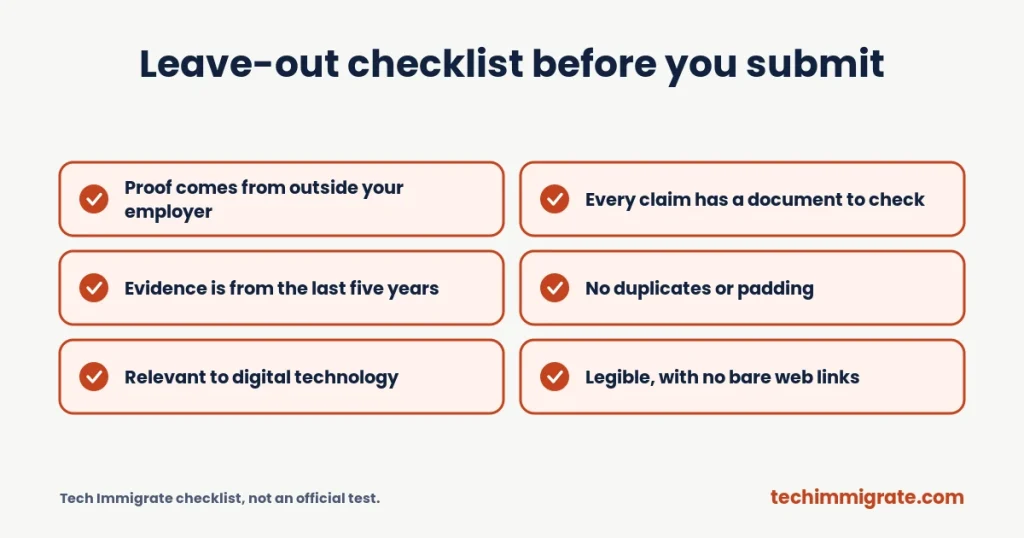
A short audit catches most leave-out problems, because you can check them mechanically. Run these steps in order.
- Count your documents. You should have 10 or fewer.
- Open each exported PDF and check it has three sides or fewer.
- Write the criterion on each document. If one has two, split it or pick one.
- Mark who outside your company vouches for each item.
- Check each date. Anything over five years old needs a strong reason.
- Zoom in on each screenshot. If you cannot read it, replace it.
- Read your statement aloud. Delete every claim that has no document number next to it.
Next, ask a trusted peer in your field to read the set cold. If they cannot tell what each document proves in 30 seconds, an assessor may not either.
How Do You Avoid Tech Nation Application Mistakes When Choosing?
Decide by asking three questions about every document: what does it prove, who outside your company says so, and is it recent? If you cannot answer all three, cut it or fix it.
Then check the rules. Count your documents, check the page count of each exported PDF, and make sure no document supports two criteria. Finally, read the whole set as a stranger would. If a strong document is easy to find, you have cut enough.
What if Cutting Leaves You With Too Little?
If cutting leaves gaps, you have learned something useful before you applied. It is better to find a thin criterion now than in a refusal letter.
Many applicants in this position spend several months building independent proof first. They speak at an event, publish with an outlet, or take on a visible role. Then they apply with stronger documents. A simple plan helps. Pick the thinnest criterion, list three realistic actions, and set a date to review. Small, visible steps count more than a rush of activity just before you apply.
Remember that you can reapply after a refusal, but you pay the fee again, and an endorsement review cannot add new evidence.
Illustrative example (fictional)
Amara's list has one strong document for her second optional criterion and three weak ones. She cuts the weak ones. She then spends four months speaking at two independent meetups and publishing one piece with a trade outlet. Her next review shows two strong documents, so the criterion now stands up.
Tech Nation Application Mistakes FAQ
Leave out evidence that only your employer produced, your own posts with no outside proof, AI-written or templated text, shrunk screenshots, duplicate documents, claims without proof, and anything older than five years. Replace each with independent, recent, readable evidence that proves one criterion.
Tech Nation's guidance says self-published posts on their own do not count as recognition. A post may support a claim if an independent source cites or republishes it. Use it only as an extra, never as the main proof for a criterion.
No. Tech Nation's guidance says AI and language tools are not acceptable in your application and that it will check. Write your personal statement and brief your referees in your own words, even if the language is simple.
No. Under the evidence rules, one document cannot be reused for two criteria. Plan your ten documents so each has one job, and give each criterion at least two documents of its own.
Advisers who write about this route report that you do not need to add English test certificates to your endorsement evidence. Check the current gov.uk page for the visa stage, because the Home Office may ask for other documents then.
Your Next Step
Start by listing every document you plan to submit, then test each one with the three questions above. Our role-specific endorsement guides give you an evidence checklist and planner for your specialism. You can browse all of them in the guides hub.
If you work in code, the software developers guide is a good start. Product people can use the product managers guide. Founders can read the startup founders guide. Data and AI applicants can use the data and AI specialists guide. Want the guide for your role? See the guides.
How We Checked This Article
We checked the rules on the gov.uk digital technology page, the gov.uk page on skills covered by Tech Nation, and Tech Nation's what to consider page. We also read a legal adviser's summary of the endorsement requirements that quotes the AI and web-link wording.
Tech Nation's full application guide is hosted on a page our tools could not open, so we cross-checked its rules against those sources and our own verified notes. Items we describe as an adviser's reading are not official.
Tech Immigrate is independent of Tech Nation and the Home Office. This article is general information, not legal advice, and nobody can guarantee an endorsement. Always confirm current rules on gov.uk before you apply.
We write practical guides for tech professionals applying for the UK Global Talent visa. Tech Immigrate is independent of Tech Nation and the Home Office, and our articles are general information, not legal advice. Rules and fees change, so always check gov.uk before you apply.