Global Talent Visa for Tech Sales and Growth Leaders: What Tech Nation Looks For
Can tech sales professionals get the Global Talent visa? Which sales roles Tech Nation recognises, recognition vs revenue, and which deals count.


In this article
- Can Sales Professionals Get the Global Talent Visa?
- Why Does Tech Nation Favour Growing B2B Companies?
- Which Sales Roles Usually Fit?
- How Do the Criteria Apply to Sales Work?
- Recognition or Revenue? The Mandatory Criterion for Sales
- How Do You Show a Deal Was Yours?
- Which Sales Evidence Is Strong, and Which Is Weak?
- What Recent Commercial Applications Show
- Exceptional Talent or Exceptional Promise for Sales?
- Who Should Write a Sales Professional's Letters?
- Can a Commercial Co-Founder Use This Route?
- What Does the Visa Cost for a Sales Professional?
- Why Do Sales Professionals Choose Global Talent?
- What Should a Sales Professional's Personal Statement Do?
- What Happens If a Sales Professional Is Refused?
- How Should a Sales Professional Start?
- Get the Guide for Tech Sales Professionals
- Frequently Asked Questions
- How We Checked This Article
Tech sales professionals can get the UK Global Talent visa. The government's list of skills covered by Tech Nation, updated on 1 July 2026, names SaaS or enterprise sales leadership for digital services, solution sales experts, and solution sales skills used at a growing B2B digital business, specifically not big-company experience. To be endorsed, you need recognition outside your employer as a leader (Exceptional Talent) or emerging leader (Exceptional Promise), and commercial results at a product-led tech company that can be traced to you, not just to your quota or your company's growth.
This article is for account executives, enterprise and solution sales specialists, sales leaders, heads of revenue, business development leads and partnerships managers at software and digital companies. It explains which sales profiles Tech Nation recognises, why growing B2B companies are favoured over large ones, how to separate recognition from commercial output, which sales evidence carries weight, and what recent applications reported on the Tech Nation Visa Forum show.
Key takeaways
- SaaS or enterprise sales leadership, solution sales experts and solution sales at growing B2B digital businesses are named on the GOV.UK Tech Nation skills list, updated 1 July 2026.
- The list specifically says solution sales at a growing B2B digital business, not big-company experience. Sales at large corporates is a harder case.
- Business skills only count for in-house work at product-led digital technology companies. Reselling someone else's software or selling services is weak.
- Commercial output belongs in OC3. The Mandatory Criterion needs recognition of you as a leader, according to forum reviewers in November 2026.
- Quota attainment, President's Club and internal sales awards are internal signals and rarely carry the Mandatory Criterion.
- Endorsement costs £561 and the visa £205, plus the £1,035 yearly health surcharge.
Can Sales Professionals Get the Global Talent Visa?
Yes. The digital technology route covers business skills as well as technical ones, and sales is one of the business skills Tech Nation assesses. The GOV.UK list of technical and business skills covered by Tech Nation, last updated on 1 July 2026, includes, in paraphrase:
- SaaS or enterprise sales leadership for digital services
- Solution sales experts
- Solution sales skills performed for a growing B2B digital business, not big-company experience
- Commercial or business leads in digital businesses who own revenue, growth, and sales or distribution strategy
The same list says business skills apply only to in-house work at product-led digital technology companies, not at tech-enabled or service companies such as agencies, outsourcers and marketing firms. It also describes corporate roles and managing large corporate teams as unsuitable.
That gives sales professionals a clear picture. Tech Nation is interested in people who sell a digital company's own product, especially people who helped a growing B2B company win its market. It is less interested in sales roles at large, established companies, where a salesperson's individual effect on the business is harder to see.
The visa itself suits commercial people well. There is no sponsor, no salary threshold and no tie to one employer, so you can join an early-stage company, take a fractional revenue role or start your own business. Our article on the benefits of the Global Talent visa covers the advantages and trade-offs.
Why Does Tech Nation Favour Growing B2B Companies?
The skills list's wording on solution sales is unusually specific: experience at a growing B2B digital business, not big-company experience. The reason is visible in the criteria. Tech Nation looks for people who changed something. At a growing company, the first enterprise deals, the first international market or the sales process that made the company scalable can often be traced to a small number of people. At a large company with a strong brand, a large sales team and an established product, it is much harder to show that the result came from you rather than from the system around you.
This does not exclude everyone at a large company. A sales leader who built a new business line, opened a new region or created a sales approach that the wider industry adopted may still have a case. But a strong record of hitting quota at a famous company is, on its own, evidence of competence in a well-run machine.
Which Sales Roles Usually Fit?
| Sales profile | Typical fit | What usually decides it |
|---|---|---|
| Early sales hire or first AE at a funded SaaS start-up | Strong | Deals and processes that took the company to its next stage |
| Head of sales or revenue at a growing B2B digital company | Strong | Revenue growth you led, confirmed by the company or investors |
| Solution or enterprise sales specialist at a scale-up | Good | Strategic deals, new markets or segments you opened |
| Partnerships or business development lead at a product company | Good | Partnerships that changed distribution or revenue |
| Account executive at a large tech company | Mixed | Big-company experience is flagged; show what was uniquely yours |
| Sales at a reseller, distributor or value-added reseller | Weak | The product is someone else's |
| Sales at an IT services or consultancy firm | Weak | Service companies are listed as unsuitable |
| Commission-only or contractor sales for several companies | Weak to mixed | Hard to show in-house contribution |
How Do the Criteria Apply to Sales Work?
You need the Mandatory Criterion plus two of four optional criteria.
| Criterion | What it asks | Sales evidence that fits |
|---|---|---|
| Mandatory | Recognition as a leading talent or emerging leader in digital technology | Independently judged sales or commercial awards, invited talks at tech events, expert roles, media naming you |
| OC1: Innovation | A track record of innovation as a founder, senior executive or employee working on a new digital field or concept | A new go-to-market model, sales motion or channel you created that the company adopted |
| OC2: Beyond your job | Recognition for work outside your occupation that advances the field | A sales method others in tech adopt, structured voluntary mentoring, selective writing |
| OC3: Significant contribution | Commercial contribution at a product-led company | Revenue, new markets or strategic deals you can show were yours |
| OC4: Academic | Research contributions | Rarely relevant |
Most sales applicants pair OC3 with either OC1 or OC2. OC3 carries the commercial results. OC1 suits sales leaders who designed something new, such as a product-led sales motion or an entry strategy for a new market. OC2 suits people with a genuine outside contribution to how tech companies sell.
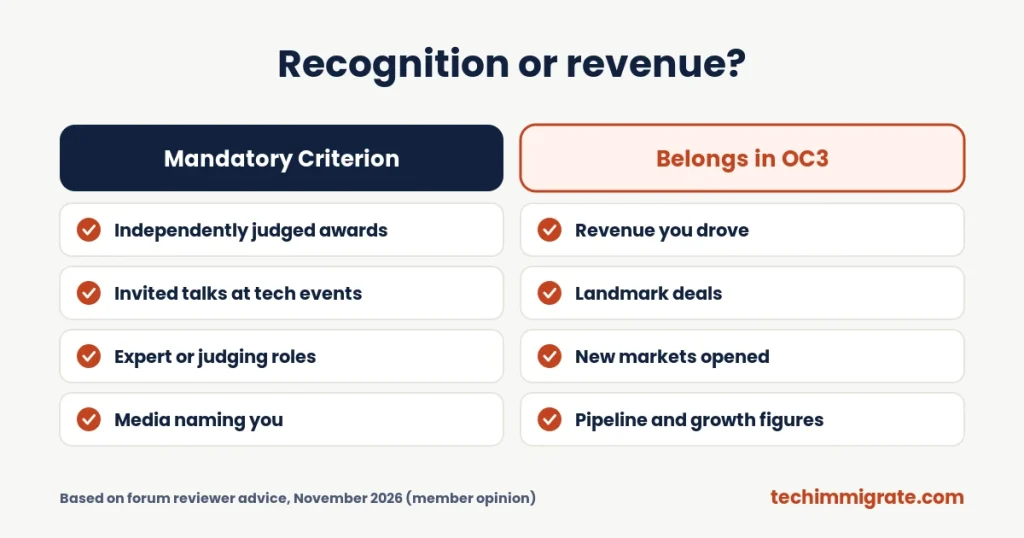
Recognition or Revenue? The Mandatory Criterion for Sales
This is where many sales applications go wrong. Sales professionals have numbers, and it is tempting to lead with them. But the Mandatory Criterion is about recognition, not output.
In a November 2026 forum thread, a solution sales professional proposed revenue and pipeline figures as Mandatory Criterion evidence. Reviewers advised that the Mandatory Criterion should show recognition as a potential leader, that commercial impact belongs under OC3, and that the same evidence should not be used for both. They also said awards and talks need to show independent recognition connected to the applicant's own expertise, not general activity in the sector their employer serves.
Recognition that tends to carry weight for sales professionals:
- Industry awards for sales or commercial leadership with independent judging, published criteria and individual credit.
- Invitations to speak at technology or SaaS events about how you built a sales motion or won a market.
- Expert roles, such as judging start-up competitions, advising accelerator cohorts on go-to-market, or sitting on industry panels.
- Media that names you as the person behind a company's commercial success.
What rarely carries it: President's Club, quota attainment, internal sales awards, commission income and job titles. These are internal signals. Our article on why tech sales professionals get refused covers this and the other refusal patterns.
How Do You Show a Deal Was Yours?
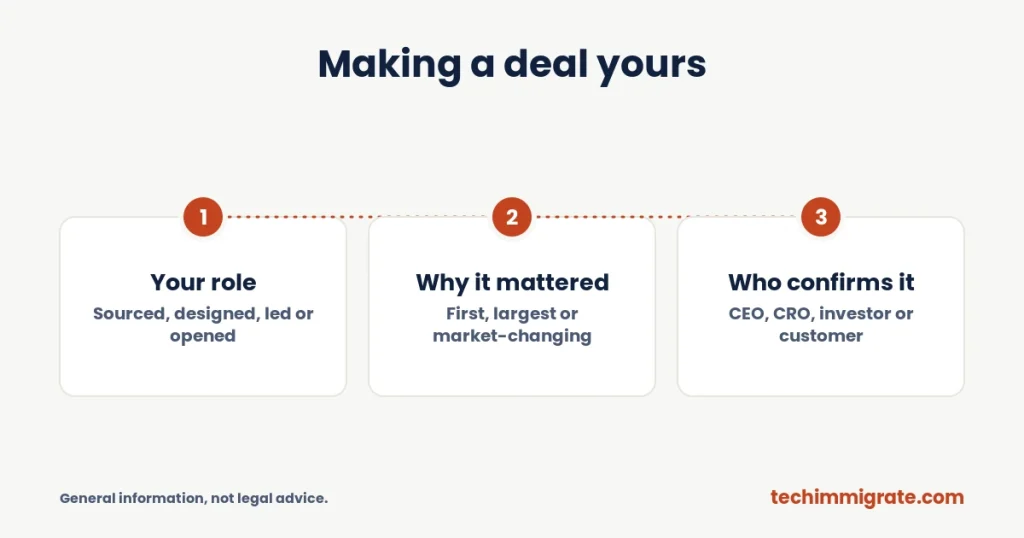
Sales results have many owners. Marketing generated the lead, solutions engineers ran the demo, the founder joined the final call, legal negotiated the contract and customer success renewed it. Assessors know this. To make a sales result yours, show:
- Your specific role. Did you source the opportunity, design the deal, lead the negotiation, open the market or build the process others used?
- Why it mattered. Was it the company's first enterprise customer, its largest deal, its entry into a new country or segment, or a deal that changed its valuation or fundraising?
- Who confirms it. A letter from the chief executive or chief revenue officer, an investor update, a customer reference, a press release naming you, or company-approved figures.
The November 2026 reviewers made a related point about attribution: employee commercial impact can fit OC3, but only if it is clearly attributable to the individual. Screenshots of your CRM and your own spreadsheets are self-reported and are often discounted.
Which Sales Evidence Is Strong, and Which Is Weak?
This is general guidance from the criteria and forum reports, not an official scoring system.
| Evidence | Usually strong when | Usually weak when |
|---|---|---|
| A landmark deal | The company's first or largest, confirmed by leadership | One deal among many at a large company |
| Revenue growth you led | Investor updates or company-approved figures | CRM screenshots |
| A new market or segment | Press or company confirmation that you opened it | A territory you inherited |
| A sales process or playbook | Adopted company-wide and outside, with evidence | An internal document |
| Sales awards | Independent judges, published criteria, named to you | Internal or team awards |
| Talks and articles | Invited, tech audience, selective outlets | Self-published or paid |
| Mentoring | Structured, voluntary, selective, with outcomes | Informal or part of your job |
What Recent Commercial Applications Show
These cases come from the Tech Nation Visa Forum. They are applicant-reported, and replies are member opinion, not official guidance.
- 2022, business applicant refused. An applicant with just over two years in sales, business development and marketing at product-led companies applied under Promise with OC1 and OC3 and was refused on all criteria.
- 2023, business applicant endorsed under Talent. A founder applying in the business category was endorsed within a week on their second application, after refocusing on impact, market expansion and the digital technology side of the organisation.
- 2025, mid-level applicant with CRM work. A business applicant with marketing operations and CRM experience was told letters needed to address specific contributions, and that a long list of certificates on the CV did not help.
- June 2026, developer advocate endorsed. A practitioner described helping a developer relations professional with more than ten years' experience get endorsed under Talent, after reframing evidence that read like a performance review into external validation and commercial impact backed by third parties.
- November 2026, solution sales profile review. A non-founder solution sales professional with awards, talks, revenue figures and mentoring was told non-founders are not excluded, but that revenue belongs in OC3, mentoring must be structured and voluntary, and the evidence leaned towards the employer's sector rather than their own sales expertise.
The pattern: commercial applicants who are endorsed show recognition of themselves and third-party confirmation of commercial results. Those who struggle lead with internal metrics. Our article on the Global Talent visa success rate shows how much stricter Tech Nation has become.
Exceptional Talent or Exceptional Promise for Sales?
| Exceptional Talent | Exceptional Promise | |
|---|---|---|
| Typical profile | Sales or revenue leader with sector standing | Earlier-career seller with emerging recognition |
| Experience | Usually more than 5 years | 5 years or less in digital technology |
| Recognition | Recognised across the tech sector | Early, external recognition |
| Settlement | After 3 years | After 5 years |
In November 2026, reviewers told a sales professional with several awards and large revenue figures that Talent might suit them better, and that applying for Promise meant showing their full technology career history, not only recent years. Promise is intended for people early in their careers, described in refusal wording shared on the forum as five years or less in digital technology. Our article on Exceptional Talent vs Exceptional Promise explains the choice.
Who Should Write a Sales Professional's Letters?
You need three letters from established leaders in digital technology. Strong writers for sales applicants usually include:
- A chief executive, founder or chief revenue officer who saw your deals and processes change the company's trajectory.
- An investor or board member who saw your commercial results in board reporting.
- A senior customer or partner, ideally a leader at a technology company, who can describe what you did and why it mattered.
Letters that describe you as a top performer, or that list your quota results, add little. Letters that explain a specific achievement, why it was difficult and what it changed, add a lot. Letters must be sent as signed documents; the Home Office does not accept web links. Our guide to recommendation letters covers who to ask.
Can a Commercial Co-Founder Use This Route?
Many commercial people in tech are co-founders: the chief executive or chief revenue officer who sells while a technical co-founder builds. Founder evidence can be strong, because founders own outcomes clearly, and the skills list includes leaders who have scaled a significant product-led digital business.
The same tests still apply. The company must earn its money from its own digital product, not services. Press about the company needs to name you and describe your role. Revenue and customer figures should come from sources a stranger could check, such as investor updates, payment provider data or filed accounts. Our article on the Global Talent visa for start-up founders covers founder evidence in more depth.
What Does the Visa Cost for a Sales Professional?
Figures checked on GOV.UK in November 2026:
| Item | Cost or time |
|---|---|
| Endorsement (Stage 1) | £561 |
| Visa (Stage 2) | £205 |
| Immigration Health Surcharge | £1,035 per adult per year |
| Each partner or child | £766 each, plus their surcharge |
| Endorsement decision | Usually 5 to 8 weeks |
| Visa decision | About 3 weeks outside the UK, 8 weeks inside |
| Free endorsement review | Within 28 days of a refusal; no new evidence |
| Settlement | After 3 years (Talent) or 5 years (Promise) |
The government's earned settlement response of 2 November 2026 keeps 3 years for a highest talent group that includes Global Talent, while setting a 10-year baseline for most routes. New rules are expected from December 2026. Our cost breakdown has worked examples.
Why Do Sales Professionals Choose Global Talent?
Sales careers in tech move quickly. People join early-stage companies, move to bigger ones when the company is acquired, take fractional or advisory roles, and sometimes start their own businesses. A sponsored visa makes each of those moves harder: a new employer needs a sponsor licence, and early-stage companies often do not have one.
Global Talent removes that constraint. It also removes the salary threshold, which matters for sales roles where much of the pay is variable commission. If you are already in the UK on another visa, you can usually switch to Global Talent from inside the country once endorsed.
What Should a Sales Professional's Personal Statement Do?
Since February 2026, the personal statement is typed into the Home Office form. For sales applicants, it should do three things that the documents cannot do on their own.
First, explain where the work happened: name the product-led companies and make clear you sold their own digital products in-house. Second, separate recognition from results: say what others outside your company have recognised you for, then point to the commercial results that support your optional criteria. Third, describe your plans in the UK tech sector in specific terms, such as the kind of company you want to help grow and the market you know.
Avoid writing it like a sales pitch. Assessors respond to specific, verifiable facts, not to persuasive language, and AI-written content has been cited in 2025 and 2026 refusals. Our guide to the Global Talent personal statement covers structure and length.
What Happens If a Sales Professional Is Refused?
A refusal can be challenged with a free endorsement review, requested within 28 days. The review is decided on the evidence you already sent; you cannot add anything new. It is worth requesting when the panel clearly misread a document, for example by treating a landmark deal as a team result when a senior letter confirmed it was yours.
For most sales refusals, though, the problem is the evidence rather than the reading of it: internal awards used as recognition, revenue figures from your own CRM, or experience at a reseller or large company. A review cannot fix those. A new application, built on external recognition and confirmed results, is usually the better path. Forum members report that each application is assessed on its own, so a criterion that passed before can fail next time if it is presented differently. Our article on how to challenge a Global Talent refusal explains every route.
How Should a Sales Professional Start?
Before paying £561:
- Check each employer against the product-led test and the big-company wording on the skills list.
- Separate recognition from revenue. Put external recognition in one list and commercial results in another.
- Pick two or three landmark results and find who will confirm your role in each.
- Drop internal signals such as quota, President's Club and internal awards as main evidence.
- Choose referees who can speak to specific achievements, including at least one outside the company.
- Read the current Tech Nation guide and GOV.UK pages. Since August 2025 you apply on GOV.UK and email documents to the Home Office.
Our article on the Global Talent business route explains how business applicants can show innovation without a patent.
Get the Guide for Tech Sales Professionals
The Global Talent Visa Endorsement Guide for Tech Sales Professionals is 107 pages, aligned with Tech Nation's applicant guide. It shows how to turn commercial work into evidence Tech Nation accepts, with 20 evidence checklists, a 12-week planner, and the refusal reasons sales applicants face with fixes for each.
I was refused the first time I applied for Global Talent, then reapplied and was endorsed. The guide is built on what changed between those two applications.
Frequently Asked Questions
Yes. SaaS or enterprise sales leadership, solution sales experts and solution sales at growing B2B digital businesses are named on the GOV.UK Tech Nation skills list, updated 1 July 2026.
It can, but the skills list describes solution sales at a growing B2B digital business as not big-company experience. At large companies, it is harder to show that results came from you.
Rarely on their own. They are internal company signals. The Mandatory Criterion needs recognition of you from outside your employer.
Usually under OC3, significant commercial contribution at a product-led company. Forum reviewers in November 2026 advised keeping commercial output out of the Mandatory Criterion.
It is hard. Business skills count for in-house work at product-led companies selling their own product. Resellers and service companies are a weak fit.
Yes. Forum reviewers in 2026 confirmed non-founders are not excluded, provided their commercial impact is clearly attributable to them.
GOV.UK says endorsement decisions usually take 5 to 8 weeks.
How We Checked This Article
We checked eligibility, fees, timings and settlement periods on the GOV.UK digital technology Global Talent pages and the list of technical and business skills covered by Tech Nation, updated 1 July 2026, in November 2026. Process details draw on the Home Office Global Talent caseworker guidance published 3 August 2026.
Applicant cases come from the Tech Nation Visa Forum: a November 2026 solution sales profile review, a June 2026 developer advocate endorsement, a 2025 business applicant review, a 2023 business category endorsement and a 2022 business applicant refusal. Forum material is applicant-reported or member opinion, not official guidance.
Tech Immigrate is independent of Tech Nation and the Home Office. This article is general information, not legal advice.
We write practical guides for tech professionals applying for the UK Global Talent visa. Tech Immigrate is independent of Tech Nation and the Home Office, and our articles are general information, not legal advice. Rules and fees change, so always check gov.uk before you apply.