Global Talent Visa Business Route: 6 Ways to Prove Innovation (Without a Patent)
The Global Talent Visa business route asks you to prove innovation, not just success. See six evidence types, examples and mistakes, then check your fit.

In this article
- What Is the Global Talent Visa Business Route?
- How the Global Talent Visa Business Route Criteria Work
- What Does Innovation Mean for OC1?
- The Product-Led Test on the Global Talent Visa Business Route
- 6 Ways to Prove Innovation Without a Patent
- What Counts and What Does Not
- Illustrative Example (Fictional): A Founder With Strong Revenue
- Illustrative Example (Fictional): A Business-Side Leader Inside a Product Company
- Splitting Ten Documents on the Global Talent Visa Business Route
- Global Talent Visa Business Route: Do You Need Funding or a UK Company?
- An OC1 Document Checklist for the Business Route
- Illustrative Example (Fictional): An Investor on the Business Route
- Global Talent Visa Business Route if You Are Pre-Revenue
- How to Write One OC1 Document
- Global Talent Visa Business Route Mistakes to Avoid
- Exceptional Talent or Exceptional Promise on the Business Route?
- How Recent Must Your Innovation Evidence Be?
- A Four-Week Evidence Plan
- Global Talent Visa Business Route FAQ
- Your Next Step
- How We Checked This Article
The Global Talent Visa business route lets founders and commercial leaders apply without a coding background. You prove innovation through products you shaped, results you can measure and people outside your company who confirm them. Instead of a patent, you use dated records.
This article is for applicants whose work sits in a company, not in a code editor. First, it shows what innovation evidence can look like, what Tech Nation tends to discount, and where applicants in your position often slip.
Key takeaways
- The business route is the commercial, investment or digital product side of digital technology. It still needs a company that makes software, hardware or data technology.
- Innovation (OC1) is one of four optional criteria. You need two of the four, plus the mandatory criterion.
- Strong innovation evidence ties a named product or feature to dated launches, metrics and outside proof.
- Company revenue alone does not show that you innovated. Show your own decisions and results.
- Each document counts for one criterion only, so plan your ten documents before you collect anything.
What Is the Global Talent Visa Business Route?
The Global Talent Visa business route is the path for applicants whose strength is commercial, investment or digital product expertise rather than engineering. On gov.uk, Global Talent for digital technology names two backgrounds: technical, such as developer, engineer or data scientist, and business. The business side covers people with commercial, investment or digital product expertise in a technology company that creates software, hardware or processes data.
You do not need a job offer, but you do need an endorsement from Tech Nation first, then a visa application to the Home Office. At the time of writing, the endorsement fee is £561 and the visa fee is £205. Check the gov.uk digital technology page and the wider gov.uk Global Talent page for current figures before you plan.
Founders, chief executives, heads of product, growth and revenue leaders, and investors often fit this side. So do business-side managers inside product companies.
In practice, the label matters less than the evidence. A founder who coded the first version may still choose the business framing if the evidence shows commercial leadership. Likewise, a product leader with some technical skill should pick the side where the strongest documents sit.
How the Global Talent Visa Business Route Criteria Work
Every applicant needs one mandatory criterion plus two of four optional criteria. The mandatory criterion is recognition as a leading talent, or an emerging one, in digital technology within the last five years. Meeting the criteria is necessary, but it is not enough. Tech Nation's independent panel decides overall whether to endorse.
The four optional criteria are:
- Innovation (OC1): shown through a product-led company or a new product or technology.
- Recognition (OC2): credit for work outside your day job.
- Contribution (OC3): a significant technical, commercial or entrepreneurial input to a product-led digital technology business.
- Academic work (OC4): research, peer review or similar contributions.
Business applicants most often pair OC1 with OC3. If you want the full breakdown, read our Global Talent Visa criteria guide.
What Does Innovation Mean for OC1?
Put simply, innovation here means you created something new in a product-led digital business, and you can prove it happened and mattered. It is a claim about what you built or led, not about how busy or successful the company looks.
Think of it as three questions a reviewer asks. What was new? Which part was yours? Then, what changed because of it? A page that answers all three still beats ten pages that answer none.
Because Tech Nation's guidance wording changes over time, open the current guidance on technation.io before you finalise your plan, and check how it describes innovation for your route.
The Product-Led Test on the Global Talent Visa Business Route
Your company must pass the product-led test before any innovation evidence helps you. Tech Nation looks for a business that makes a digital product it owns, such as software, a platform, hardware or a data product.
However, agencies, consultancies and services firms often struggle here. In practice, a services firm can still qualify if you can show a product line it built and owned. The product must be the centre of the story, because a side project will not carry the case.
Answer these before you gather anything:
- Does the company own a digital product that customers use or buy?
- Can you name the product and show it live, or show dated records of it?
- Did you shape what the product does, who it serves or how it earns?
- Can someone outside the company confirm the product exists and works?
If you answer no to the first two, pause. Fix the story before you spend weeks on evidence.
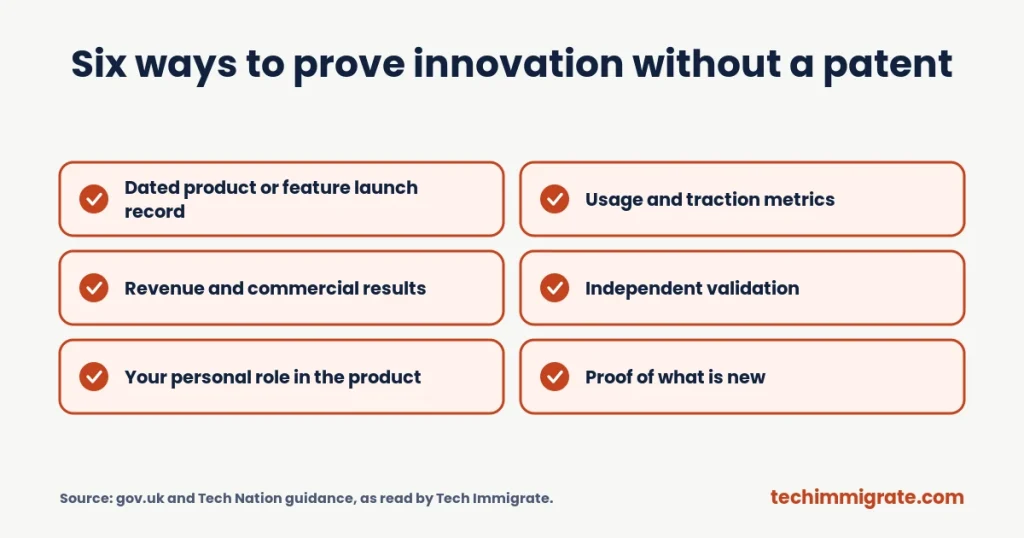
6 Ways to Prove Innovation Without a Patent
You can prove innovation through six kinds of evidence, and none of them needs a patent. A patent can help, but it is not the only door. Most business applicants have no patent, so they show new products and technology in other ways.
1. A dated product or feature launch record
A launch record shows what you shipped and when. For example, use release notes, a public changelog, a product page with a date, or an archived page. Pair it with one line about what was new compared with what existed before.
2. Usage and traction metrics
Metrics show that people used what you made, so they carry weight. For instance, use monthly active users, signups, retention, transactions processed or customers by country. Show the source, such as an analytics export, and the date range. A number with no source reads as a claim.
3. Revenue and commercial results
Revenue shows the market paid for the new thing. Then back it up with invoices, signed contracts, audited or accountant-prepared accounts, or a payment provider report. Also tie the figures to the product or feature you built, not to the whole company.
4. Independent validation
Validation comes from people who do not work for you. For example, think of customer case studies, partner agreements, investor term sheets, accelerator acceptance, a regulator's approval, or a news article about the product. Tech Nation's guidance asks for evidence from outside your employer for recognition, so this type carries weight.
5. Your personal role in the product
A reviewer must see your hand in the work. So use a product roadmap you wrote, a decision memo, a pricing model you designed, or a letter from a customer or investor that names what you did. Specific beats flattering.
6. Proof of what is new
First, explain why the product is different from the alternatives. A short comparison with named competitors, a market-first claim backed by a source, or a technical architecture note can do this. Keep it factual, and then keep it to a page.
What Counts and What Does Not
Evidence counts when it is dated, sourced, linked to you and outside your own control. It fails when it is a claim, a team result or a job description. Use this table to sort your own pile before you decide.
| Evidence | Usually helps | Usually weak |
|---|---|---|
| Launch records | Dated release notes naming the product | An undated screenshot |
| Metrics | Analytics export with a source and date range | A number in a slide deck |
| Revenue | Accountant-prepared accounts, invoices | A founder's own spreadsheet |
| Press | Independent article about the product | A press release you wrote |
| Awards | External, competitive, named award | An internal "employee of the year" |
| Letters | Specific, from an expert who knows the work | Generic praise |
| Social posts | A source for a fact, in support | LinkedIn or Medium posts alone |
Tech Nation's guidance says internal awards and personal posts on their own do not count. It also says documents must not be AI-written or templated. So write each one yourself, in your own words.
Illustrative Example (Fictional): A Founder With Strong Revenue
Illustrative example (fictional): Amara runs a payments app for small shops. Revenue is growing, and she has 4,000 paying merchants. Because she wants to use OC1, she drafts her evidence.
Her first draft has one document, titled "Company overview". It lists revenue, headcount and a funding round. However, the reviewer cannot see what Amara created or what was new.
She rebuilds the case around one feature she designed: instant payouts. Then she chooses two documents for OC1.
- Document 1: a launch record with dated release notes, the product page and a one-paragraph note on what instant payouts replaced.
- Document 2: an analytics export showing merchant adoption of the feature, plus a signed letter from a partner bank confirming the integration.
Now the reviewer sees a named product, a date, a personal role, a result and an outside voice. That is the shape to copy.
Illustrative Example (Fictional): A Business-Side Leader Inside a Product Company
Illustrative example (fictional): Daniel is head of growth at a language-learning app. He did not write the code, but he designed a new onboarding flow and a pricing model that lifted paid conversion.
His evidence has to avoid a common trap, so he cannot claim the app's whole success. Instead, he claims the onboarding and pricing work only.
| Document | What it shows |
|---|---|
| Experiment log with dates and results | What he tested and what changed |
| Product analytics export | Conversion before and after the launch |
| Letter from the chief product officer | His specific decisions and results |
Daniel still needs a second OC1 document that comes from outside the company, such as a press article or a partner statement. Without it, the case rests on internal sources only.
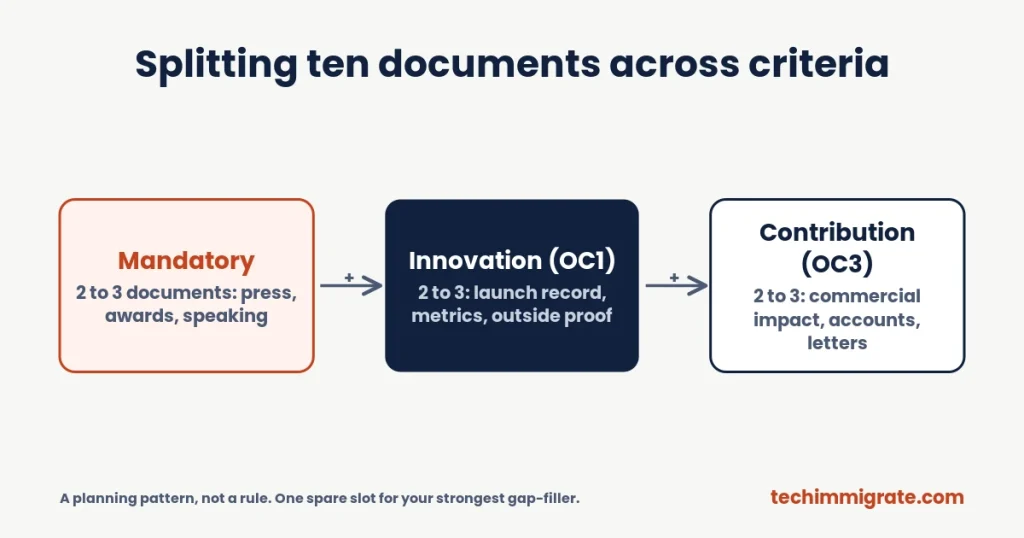
Splitting Ten Documents on the Global Talent Visa Business Route
You get up to ten documents, each up to three A4 sides, with at least two for each criterion you claim. One document cannot serve two criteria. So, plan the whole portfolio first.
A typical split for a business applicant looks like this:
| Criterion | Documents | Example content |
|---|---|---|
| Mandatory (MC) | 2-3 | Independent recognition, press, awards, speaking |
| OC1 innovation | 2-3 | Launch record, metrics, outside validation |
| OC3 contribution | 2-3 | Personal commercial impact, accounts, letters of impact |
| Spare | 1 | Strongest gap-filler |
This is a planning pattern, not a rule, because you may choose different optional criteria, and the right split depends on your evidence. Evidence must come from the last five years.
Also remember that three recommendation letters sit alongside the ten documents. They support your evidence, but they cannot replace it. Our guide to recommendation letters explains who should write them.
Global Talent Visa Business Route: Do You Need Funding or a UK Company?
You do not need a patent, outside funding or a UK-registered company to use the Global Talent Visa business route. The criteria look at your recognition and your contribution, not your cap table. Funding is optional. However, funding can serve as independent validation, because investors checked your work before they paid.
Applicants in this situation often ask whether bootstrapped companies are weaker, and the answer is no. They are not, if the evidence is strong. Audited or accountant-prepared revenue, paying customers and contracts can show the same market proof that funding shows.
A company outside the UK can also work, because the criteria concern digital technology leadership. Meanwhile, the visa itself is for working in the UK. Check how your situation fits with a regulated adviser if it is complex.
An OC1 Document Checklist for the Business Route
Before you keep a document, test it against six questions. If it fails two or more, replace it. Tech Nation reviews each one on its own, so weak pages cost you a slot.
- It names the product or feature, not just the company.
- It carries a date inside the last five years.
- Your role appears in plain words.
- A number sits inside, and the number has a source.
- Someone outside your company could confirm it.
- It fits on three A4 sides without shrinking the text.
Because Tech Nation does not accept shrunk or collage evidence, plan your layout early. If a screenshot is too small to read, crop it, and then explain it in two clear lines.
Illustrative Example (Fictional): An Investor on the Business Route
Illustrative example (fictional): Priya is an early-stage investor who backs software startups. She wants to show innovation, but she does not build products herself.
Her case works when she links her decisions to products that others built. She shows the new category she backed first, the term sheet she led, and the product's later growth. Finally, a founder letter explains what she changed in the company's plan.
However, she must avoid claiming the portfolio's success as her own. So her documents show the specific decision, the date and the outcome. If she cannot show her part, she should move that item out of OC1.
Global Talent Visa Business Route if You Are Pre-Revenue
Pre-revenue applicants can still prove innovation, because revenue is only one kind of proof. For example, strong alternatives include user numbers, a signed pilot, a grant, an accelerator place or a working product that reviewers can see.
In practice, a pilot agreement with a named customer carries real weight, since the customer chose to commit. Likewise, an accelerator acceptance letter shows that outsiders judged the product worth backing. Even so, a pre-revenue case needs more independent validation, not less. If you have none yet, applicants in this situation often wait and build it first. Our startup founders guide covers pre-revenue planning in more detail.
How to Write One OC1 Document
Each document should read like a short brief, not a brochure. Write it yourself, since Tech Nation does not accept AI-written or templated pages. Use this simple layout when you start.
- Headline. One line naming the product and what was new.
- Context. Two or three sentences on the problem and the date you launched.
- Your role. Say what you decided or built, in the first person.
- Results. Two or three numbers, each with a source.
- Proof. Point to the attached export, link, letter or article.
Then read it as a stranger would. If a reader outside your industry cannot follow the point in one minute, simplify it. Finally, remove adjectives that you cannot support with a fact.
Global Talent Visa Business Route Mistakes to Avoid
Most weak OC1 cases fail through five repeating habits. Applicants report these in forum threads and adviser blogs, but they are not official. So treat them as applicant-reported patterns, not Tech Nation statements.
- Using company success as personal proof. Revenue and headcount say little about what you created.
- Skipping the product-led test. A services company with no owned product struggles to show innovation.
- Relying on internal evidence. Internal awards, your own posts and your own slides carry little weight.
- Writing claims instead of evidence. "Industry-leading" needs a dated, sourced fact behind it.
- Reusing a document. One document cannot count for two criteria, so duplicates waste a slot.
Our article on Tech Nation endorsement mistakes covers more general errors.
Exceptional Talent or Exceptional Promise on the Business Route?
Both routes exist for business applicants, and the choice matters. Exceptional Talent suits established leaders, and Exceptional Promise suits emerging ones. Settlement can come after three years on Talent and five on Promise.
The choice changes how you frame innovation. For example, a talent case shows a track record of results over time. A promise case can show one strong product or feature plus signs of future leadership. Read our Exceptional Talent vs Exceptional Promise comparison before you decide.
How Recent Must Your Innovation Evidence Be?
Your evidence should come from the last five years, so older launches need a fresh angle. If your best product shipped six years ago, look at what happened since. Later versions, new markets or new partners can bring the story back inside the window.
Meanwhile, do not stretch dates to fit. A reviewer will compare your CV, your letters and your documents. If the timelines disagree, doubt spreads to everything else. Therefore, check every date against one master timeline before you submit.
A Four-Week Evidence Plan
Most applicants need weeks, not days, to gather real evidence. Tech Nation says preparation can take up to 12 weeks, so this four-week plan covers the OC1 part only.
- Week 1: First, pick the product or feature. Then confirm it passes the product-led test.
- Week 2: Collect launch records, analytics exports and accounts. Also note the source and date for each.
- Week 3: Ask for outside proof, such as partner confirmation, press or customer letters.
- Week 4: Finally, write each document yourself. Keep it to three A4 sides and delete anything you cannot source.
Allow extra time for letters, because referees need to have known your work for at least 12 months.
Global Talent Visa Business Route FAQ
Yes, because a patent is not required. Business applicants can prove innovation with dated launch records, usage metrics, revenue evidence, independent validation and a clear account of their own role. Check the current Tech Nation guidance on technation.io, because wording can change.
Innovation means you created or led something new in a product-led digital technology company, and you can prove it. Reviewers look for a named product or feature, a date, your personal role, a measurable result and evidence from outside your employer.
Revenue helps but does not stand alone. It shows the market paid, yet it does not show what you created. Link the figures to a specific product or feature you shaped, and add an outside source such as a customer, partner or press article.
It is harder, since Tech Nation looks for product-led digital technology businesses. Applicants in this situation often focus on a product the firm built and owned, and show that product with dated records, metrics and outside proof.
You need at least two documents for each criterion you claim, out of a maximum of ten. Each document can be up to three A4 sides, while one document cannot count for two criteria.
Your Next Step
Start by building your evidence plan. Want the guide for your role? See the guides. Next, pick the role-specific guide that matches your work.
Our guides hub lists role-specific endorsement guides, each with an evidence checklist and planner. Founders can start with the startup founders guide. Commercial and analytical roles may prefer the business analysts guide, the product managers guide or the tech investors guide.
How We Checked This Article
We checked the route structure, fees and timings against the gov.uk Global Talent digital technology page and the main gov.uk Global Talent page. We checked the application process and preparation time on the Tech Nation visa page. Then, we read adviser articles and applicant discussions to find common evidence mistakes. Where a point comes from applicants, we say so, because it is not official guidance.
Tech Immigrate is independent of Tech Nation and the Home Office. This article is general information, not legal advice, and nobody can guarantee an endorsement. Always confirm current rules on gov.uk before you apply.
We write practical guides for tech professionals applying for the UK Global Talent visa. Tech Immigrate is independent of Tech Nation and the Home Office, and our articles are general information, not legal advice. Rules and fees change, so always check gov.uk before you apply.