Why Tech Sales Professionals Get Refused Global Talent Endorsement (and What to Do)
Why tech sales professionals are refused Global Talent endorsement: quota evidence, company revenue, reseller roles. How to review or reapply.


In this article
- Can Sales Professionals Get the Global Talent Visa?
- The Six Refusal Patterns for Sales Applicants
- Reason 1: Quota Is Not Evidence
- Reason 2: The Revenue Belongs to the Company
- Reason 3: Your Employer Sells Someone Else's Product
- Reason 4: "Functional and Not Exceptional"
- Reason 5: Letters That Sound Like You
- Reason 6: Recognition That Stays Inside the Company
- Reason 7: Contractor or Commission-Only Status
- What Forum Reviewers Tell Commercial Applicants in 2026
- Choosing Criteria as a Sales Professional
- How Assessors Read Your Evidence Documents
- Review or Reapply After a Sales Refusal?
- How to Rebuild After a Refusal
- Your Personal Statement as a Sales Applicant
- Is a Refusal the End?
- Talent or Promise for Sales Professionals
- Get the Guide for Tech Sales Professionals
- Frequently Asked Questions
- How We Checked This Article
Tech sales professionals are usually refused Global Talent endorsement because their evidence shows a strong salesperson, not a leader in digital technology. Quota attainment is internal and hard to verify. Company revenue gets credited to the company, not to you. Resellers, systems integrators and consultancies fail the product-led test. And letters from your own managers read as internal praise. To be endorsed, you need named deals you owned at a product-led company, independent confirmation of your part, and recognition from people outside your employer.
This guide is for account executives, sales directors, heads of sales, partnerships and business development leads, sales engineers, chief revenue officers and country managers in tech. It uses refusal wording that sales applicants have published to explain what assessors look for, when a free review is worth it, and how to rebuild a sales application.
Key takeaways
- "120% of quota" is internal and unverifiable. Lead with named contracts, their value in GBP and the revenue they produced.
- Company revenue is not your revenue. Show the deals you owned, your share of growth and a senior letter confirming it.
- Resellers, distributors, systems integrators and consultancies usually fail the product-led test.
- Doing the sales job well is described as "functional" and "tactical". Leadership means strategy: markets chosen, pricing set, partner models built.
- Letters must describe only what each writer saw first-hand. Assessors have questioned letters that praised things the writer could not have witnessed.
- Customers, partners and investors make stronger referees than your own managers.
Can Sales Professionals Get the Global Talent Visa?
Yes. Tech Nation assesses business applicants as well as technical ones, and its list of business skills includes sales and business development for growing digital businesses. GOV.UK's list of the skills Tech Nation covers favours sales experience in a growing B2B digital business, not big-company experience, and excludes corporate roles or managing large corporate teams with no link to a product.
The structure is the same as for every applicant: the Mandatory Criterion plus two of four Optional Criteria, with up to 10 evidence documents of up to 3 A4 pages, 3 recommendation letters, a CV and a personal statement. The gov.uk digital technology pages set out the details.
The Six Refusal Patterns for Sales Applicants
A regular adviser on the Tech Nation Visa Forum published six patterns from recent refusals in September 2025. They are applicant-reported, not official guidance.
| Pattern | Reported wording | How it hits sales professionals |
|---|---|---|
| Individual vs team | "cannot be attributed solely to the applicant's individual work" | Company revenue growth shown, not your deals |
| Product-led classification | "an IT services and consulting company, not a product-led one" | Resellers, integrators, consultancies, outsourcing |
| Expertise vs field advancement | "shows expertise but does not constitute a significant, field-advancing contribution" | Hitting quota every year, with no wider impact |
| Letter authenticity | "The use of templating is evident in many of the letters" | Letters that sound like one author, usually you |
| Award and media credibility | awards with a "very large number of other award winners" | Club and President's awards, sales leaderboards, low-reach outlets |
| Career history gaps | many years "unaccounted for" | Commission-only, contract and advisory work left off |
Reason 1: Quota Is Not Evidence
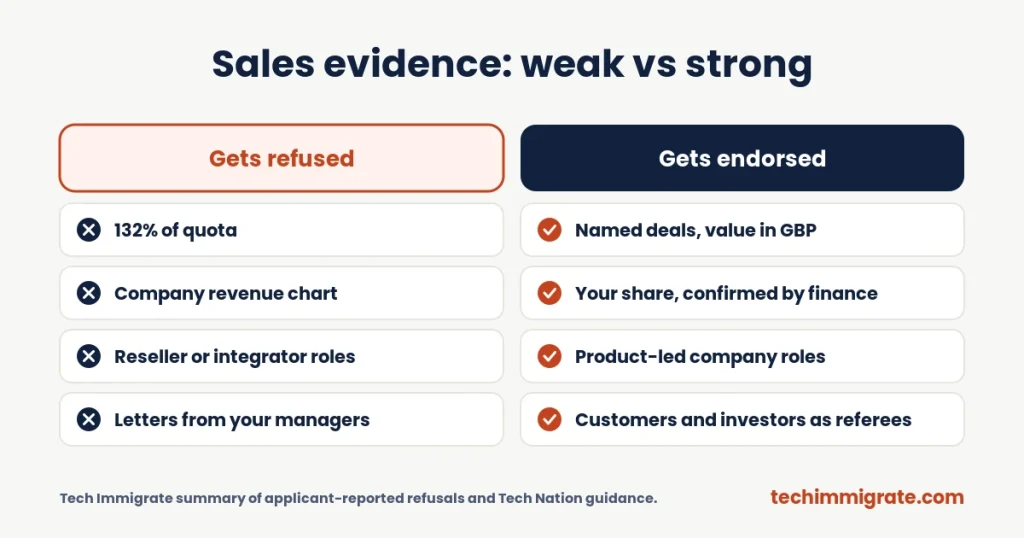
Sales professionals measure themselves by quota attainment, so they lead with it: "Achieved 132% of target three years running." An assessor cannot check that, and does not know whether the target was hard. Internal sales awards, such as President's Club, have the same problem: they are given by your employer to many people.
What to lead with instead
| Instead of | Lead with |
|---|---|
| 132% of quota | Closed 14 enterprise contracts worth £3.8 million in annual recurring revenue |
| President's Club winner | Won the company's first three bank customers in a new country |
| Top rep on the leaderboard | Grew the partner channel from zero to 31% of new revenue |
| Exceeded pipeline targets | Built the outbound model the company still uses, now run by a team of eight |
Name customers where contracts allow, or describe them precisely ("a top-10 UK bank by assets"). Give contract values in GBP, with dates. Add redacted contract pages or signed confirmation from finance.
Reason 2: The Revenue Belongs to the Company
One applicant's published refusal said it was not clear what the candidate's unique and individual contributions were to some of the metrics submitted, and what impact could be attributed solely to them. Sales applicants often submit company revenue charts. The assessor sees a growing company, not a leader.
How to show your part
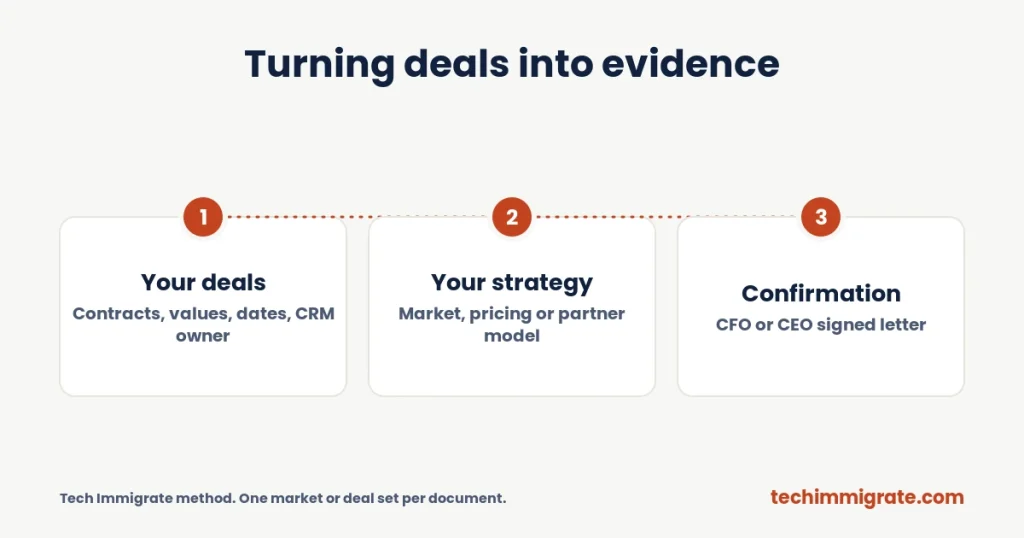
- Your deals: a list of the contracts you personally owned, with value and date, matching your CRM records.
- Your share: "My deals were £2.1 million of the company's £5.6 million new revenue in 2024, 38%."
- Your strategy: the market, segment or pricing decision you made, dated, with your name.
- Your confirmation: a CEO, CFO or CRO who is not one of your referees confirms the figures and your role in a signed letter.
Fictional example: Kwame, an enterprise account director at a payments software company, was refused because his evidence showed the company growing from £4 million to £11 million in revenue. On reapplication he listed the nine contracts he closed, totalling £2.6 million a year, showed a CRM export with him as owner on each, included redacted signature pages for the three largest, and added a letter from the chief financial officer confirming his deals were 37% of new revenue that year.
Reason 3: Your Employer Sells Someone Else's Product
Tech Nation looks for product-led companies that sell their own software or platform. Many sales professionals have worked for resellers, distributors and systems integrators that sell other vendors' licences, or for IT services firms selling staff time. That is service work.
Applicants have published refusals stating an employer was not eligible because it was an IT services and consulting company, and another, about a large retailer, saying the company was not a tech company.
Which sales employers usually count
| Employer | Usually counts? |
|---|---|
| SaaS, fintech, API or platform company selling its own product | Yes |
| Insurtech, lendtech or embedded-finance platform | Often, if you present the platform, not the policies or loans |
| Very large tech corporate | Case by case; lead with deals you owned and outside recognition |
| Bank, insurer or telco digital unit | Risky; centre the evidence on a named digital product |
| Reseller, distributor or systems integrator | Usually no |
| IT services, outsourcing or consultancy | No |
| Commission-only agent or freelance sales contractor | Usually no, for impact evidence |
Open every company document with one line on the product and how the company earns money. If your employer could be mistaken for a non-tech business, such as an embedded insurance platform, lead with the app or API, not the financial product.
Reason 4: "Functional and Not Exceptional"
Forum replies to one business development applicant summarised the refusal feedback as "functional and not exceptional" and the impact as "tactical". This is the expertise versus field advancement pattern in sales form. Closing deals is the job.
What leadership looks like in sales
- Opening a market: first customers in a new country or segment, which became a lasting revenue line.
- Designing a model: a pricing structure, partner programme or sales motion the company adopted.
- Building a team or playbook: others now sell the way you designed, with results.
- Influencing the field: your methods taught, adopted or written about outside your company.
Each of these needs proof from someone other than you: a board update, a partner agreement, a press article, a letter from a customer or investor.
Reason 5: Letters That Sound Like You
Sales applicants have published refusals about letters in particular. One said the writers spoke about accomplishments they had not worked closely on, which hinted at influence from the applicant. Others report templating noticed across letters, and requests for third-party evidence from people who are not colleagues or employers.
How to fix it
- Customers, partners and investors make stronger referees than managers. They saw your work from outside.
- Each writer describes only what they saw. A customer describes the deal and its effect on their business; an investor describes the market you opened.
- Each writer needs their own standing. A CEO title alone does not make someone an established expert, as forum advisers have noted. Include their credentials in the letter file.
- No drafts. Send facts, not words. Tech Nation says templated or AI-written letters are not acceptable.
Our article on choosing letter writers covers referee choice in more depth.
Reason 6: Recognition That Stays Inside the Company
Applicants have published refusals describing achievements as internal impact and noting recognition that was not on a major platform. Internal awards, sales kick-off speeches and company newsletters do not show that the wider industry recognises you.
Recognition that works for sales leaders
| Evidence | What makes it count |
|---|---|
| Main-stage talk | A sector-leading tech event, selected, 100+ attendees, not sponsored by your employer |
| Press about you | A national or international tech or business outlet naming you and your results |
| Industry award | Won by you, with published judging and few winners |
| Judging or advisory role | Chosen to judge awards or advise accelerators or start-ups |
| Structured mentoring | A selective programme, mainly in person, with mentee outcomes |
| Pay above market | Supporting only, benchmarked against a published source |
Salary and commission can support the Mandatory Criterion, but Tech Nation's guide says salary information alone is insufficient. Keep it behind outside recognition.
Reason 7: Contractor or Commission-Only Status
One applicant's refusal said the candidate was a freelance contractor and therefore did not meet Optional Criterion 3, which needs you to be an employee, founder, senior executive or board member of a product-led company. Commission-only and contract sales roles are common, so this catches many applicants.
How to fix it
- Include an employment contract or HR letter for every role your evidence relies on.
- If you were paid through a contractor arrangement but worked full-time, include the clause showing hours and exclusivity.
- Disclose contract, advisory and side work on your CV; do not leave it for the assessor to find on LinkedIn.
What Forum Reviewers Tell Commercial Applicants in 2026
Beyond published refusals, experienced members of the Tech Nation Visa Forum regularly review commercial applicants' evidence before they submit. Their comments are opinion, not official guidance, but recent reviews of sales, business development and commercial leaders repeat the same points:
- A list of contracts is a record of work, not recognition. One reviewer said a list of deployments with contract values and user numbers reads as work delivered rather than recognition of the applicant. Contracts belong under impact, with a senior letter tying them to you.
- A job title is not recognition. Founder, director or head-of-sales titles describe a role. Recognition needs someone outside the company naming you.
- Finalist is weaker than winner. A finalist placing can support the Mandatory Criterion but should not carry it alone.
- A contract with its negotiation trail is strong commercial evidence. Reviewers rated a signed customer contract, with the correspondence showing who led the deal, as solid proof of commercial leadership.
- Impact must go beyond self-claims. Show direct, quantified effects on core company metrics, confirmed by someone other than you.
Choosing Criteria as a Sales Professional
| Criterion | Sales evidence that fits |
|---|---|
| Mandatory Criterion | Talks, press naming you, awards won, judging and advisory roles, pay above market (supporting) |
| Optional Criterion 2 | Structured mentoring, unpaid invited writing, coaching start-ups through recognised programmes |
| Optional Criterion 3 | Named contracts and markets you won at product-led companies, with confirmation |
| Optional Criterion 1 | Rarely: only with a product or commercial model that was genuinely new, and that you created |
Most sales professionals do best with the Mandatory Criterion plus Optional Criteria 2 and 3. Forum advisers have warned against choosing Optional Criterion 1 without a product you built.
How Assessors Read Your Evidence Documents
Each evidence document can be up to 3 sides of A4, and assessors are not required to read past page 3. That makes the first page the most important page in your application. Endorsed applicants treat page 1 as the argument and the pages after it as the proof, so an assessor can see the claim, the criterion and why it matters within a minute.
Three things decide whether a sales document works:
- One claim, one criterion. A document that tries to prove two things usually proves neither, and the same evidence cannot be used under two criteria.
- Proof from someone other than you. Your own descriptions and screenshots support a claim; a signed letter, an official record or a public source carries it.
- Readable, not crammed. Tech Nation says excessively compressed evidence is not acceptable. Cut to what matters instead of shrinking it.
Our guide includes the full 3-page template, with a worked example for each kind of sales evidence and the proof to gather for every page.
Review or Reapply After a Sales Refusal?
An endorsement review is free and must be requested within 28 days of the decision. You cannot add new evidence, so it works only when the assessor overlooked or misread something already in your pack.
| What the refusal says | Best route |
|---|---|
| You were a contractor, and your pack includes a full-time employment contract | Review |
| Your contribution to the metrics is unclear, and your pack lists your deals with confirmation | Review |
| Your employer is not product-led, and page 1 explained its software revenue | Review |
| Your evidence is quota, internal awards or company revenue | Reapply with named deals and confirmation |
| Your employer is a reseller or consultancy | Reapply with product-company evidence |
| Your letters were generic or from managers only | Reapply with customers, partners and investors |
One applicant's first review answered a contractor point, but the decision was upheld for a new reason about individual contribution. Because the reason was new, a second review was allowed, and it led to endorsement. You can only request a second review on new reasons.
If you reapply, the endorsement fee is due again (£561 at the time of writing). Our articles on the endorsement review and on Global Talent refusals explain both routes.
How to Rebuild After a Refusal
Most refused applicants do not need a new career. They need the same career presented properly. The rebuild usually happens in three phases.
- Read the refusal properly. Sort every sentence into evidence the assessor overlooked, evidence they misread, and genuine gaps. Only the first two belong in a review.
- Fix the proof, not the wording. Most sales refusals come from missing attribution or missing independent confirmation, which takes weeks to collect. Start those requests first.
- Check everything matches. Dates, titles and figures must agree across your CV, LinkedIn, letters, statement and evidence before you pay the fee again.
If your evidence already exists, this typically takes 8 to 12 weeks. If you need new recognition or a move to a product-led company, plan for six to twelve months. Our guide includes the week-by-week planner, 20 evidence checklists and the full pre-submission check.
Your Personal Statement as a Sales Applicant
The personal statement is written in the Home Office form and should be consistent with the rest of your pack. Tech Nation's guide says it should answer four questions: why you want to come to the UK, your planned occupation in the UK, which region or city you plan to live in, and how the UK digital technology sector will benefit from your work.
Sales applicants often write statements full of energy and short on facts. Vague plans have been described in refusals as a wish rather than a plan. A strong sales statement does three things:
- Cites your evidence by number. "The three bank contracts in document 8 opened a new revenue line worth £1.9 million a year."
- Names a concrete UK role. For example, head of sales or partnerships for a UK fintech or SaaS scale-up selling into regulated industries.
- Explains the benefit in commercial terms. Which UK companies you will help grow, which markets you will help them enter, and what you will do outside your job, such as mentoring founders on a structured programme.
Use the same numbers as your evidence and letters. Do not overstate: "one of the best salespeople in Africa" invites doubt, while "won the company's first three enterprise customers in a new country" invites belief.
Is a Refusal the End?
No. A refusal from Tech Nation is a decision about the evidence you sent, not a final judgement on your career. Many applicants who post their stories publicly were refused once, sometimes twice, and were endorsed after a review or a stronger second application. What changed was rarely their experience. It was how clearly the pack showed their personal contribution, how independent the proof was, and whether each document matched the criterion it was filed under.
The most useful thing you can do after a refusal is read it calmly, line by line, and treat it as a list of what the assessor could not see. Each line points to a specific gap: a missing letter, an unproven number, a role that was not explained. Fix those gaps one at a time and the next application is a different application.
Talent or Promise for Sales Professionals
Exceptional Promise suits sales professionals earlier in their careers with fast-rising results and early outside recognition. Exceptional Talent suits sales leaders with sustained recognition over several years. Talent leads to settlement after 3 years; Promise after 5. Choose by your evidence. Our comparison of Exceptional Talent and Exceptional Promise explains the choice, and our article on the business route covers business applicants in general.
Get the Guide for Tech Sales Professionals
Our Global Talent Visa Endorsement Guide for Tech Sales shows how to build every document in this article. It includes evidence checklists, a 12-week planner, the 3-page evidence template, refusal fixes and a complete fictional mock evidence pack for a sales leader.
I was refused the first time I applied for Global Talent, then reapplied and was endorsed. The guide is built around the difference between those two applications.
Frequently Asked Questions
Yes, if you have led sales or business development at product-led tech companies and can show named deals you owned, independent confirmation of your contribution, and recognition from outside your employer.
Common reasons are quota attainment as the main evidence, company revenue with no proof of personal contribution, reseller or consultancy employers, letters from managers only, internal awards as recognition, and contractor or commission-only status.
Not on its own. It is internal and hard to verify. Lead with named contracts, their value in GBP and the revenue they produced, confirmed by finance or a senior leader.
Usually not. Resellers and systems integrators sell other companies' products, which Tech Nation treats as service work. Use in-house roles at product companies for evidence.
Customers, partners and investors who saw your work from outside, plus one senior industry figure. Each should describe only what they witnessed, in their own words, with their credentials attached.
As supporting evidence for the Mandatory Criterion, with a published benchmark. Tech Nation's guide says salary information alone is insufficient.
Yes, free within 28 days, if the assessor overlooked or misread evidence you submitted. If your evidence was quota-based or from a reseller, reapply with stronger evidence instead.
For the bigger picture, including how many applications Tech Nation endorses and how that has changed, read Global Talent Visa Success Rate: What the Published Numbers Show.
How We Checked This Article
We checked the rules in this article against the gov.uk Global Talent digital technology guidance, GOV.UK's list of skills covered by Tech Nation, and Tech Nation's Global Talent Visa Application Guide. Refusal wording and case examples come from sales and business development applicants who published their refusals on the Tech Nation Visa Forum, and from a September 2025 forum analysis of refusal patterns. This material is applicant-reported and unverified.
Forum threads we used:
- Most common rejection patterns, Q3 2025
- Business development applicant: Promise refusal, 2023
- Startup owner: endorsed after a second review
- Commercial leader: evidence portfolio feedback, 2026
- Founder and leader: evidence feedback, 2026
- Accelerator-backed founder: evidence feedback, 2026
- Business applicant: Exceptional Talent evidence feedback
The endorsement fee was £561 at the time of writing. Check current fees and rules on gov.uk before you apply.
Tech Immigrate is independent of Tech Nation and the Home Office. This article is general information, not legal advice, and nobody can guarantee an endorsement. Named examples are fictional.
We write practical guides for tech professionals applying for the UK Global Talent visa. Tech Immigrate is independent of Tech Nation and the Home Office, and our articles are general information, not legal advice. Rules and fees change, so always check gov.uk before you apply.