Benefits of Global Talent Visa: 9 Real Advantages (and 3 Trade-Offs)
Benefits of Global Talent Visa explained: no sponsor, flexible work, family rights and fast settlement, plus honest trade-offs. See if it suits you.

In this article
- What Are the Benefits of Global Talent Visa Status?
- Benefit 1: No Job Offer or Sponsor Needed
- Benefit 2: Freedom to Change Roles and Employers
- Benefit 3: Self-Employment and Founding a Company
- Benefit 4: No Minimum Salary
- Benefit 5: A Long Visa That Renews
- Benefit 6: Your Family Can Join You
- Benefit 7: Faster Settlement
- Benefit 8: You Can Study
- Benefit 9: Switching From Inside the UK
- What Are the Three Trade-Offs of the Global Talent Visa?
- Common Misunderstandings About the Benefits
- What to Do After You Get the Visa
- Benefits of Global Talent Visa Status: Who Gains Most?
- How to Decide If the Benefits Outweigh the Trade-Offs
- Benefits of Global Talent Visa FAQ
- Your Next Step
- How We Checked This Article
The main benefits of Global Talent Visa status are that you need no job offer or sponsor, you can work for yourself or an employer, your family can join you, and you may settle after 3 or 5 years. Every route has trade-offs, and this one has three big ones.
This guide checks each advantage against gov.uk, then covers the costs and limits honestly. It is for tech professionals who want to know whether the route fits their plans before they spend months on evidence.
Key takeaways
- You do not need a job offer or an employer sponsor, according to the gov.uk eligibility page.
- You can change employers, work for yourself or run a business, with one exception for professional sport.
- Partners and children can apply as dependants, and a partner can usually work.
- Settlement may come after 3 or 5 years, depending on your route.
- The trade-offs are a heavy evidence burden, a panel with discretion and real upfront costs. Nobody can guarantee an endorsement.
What Are the Benefits of Global Talent Visa Status?
The Global Talent Visa gives you independence: you do not tie your right to stay to one employer. Gov.uk describes it as a route for leaders and potential leaders in digital technology, academia and research, and arts and culture.
For tech applicants, a Tech Nation panel first decides whether to endorse you. The Home Office then decides the visa. The benefits below apply once you hold the visa, so they matter only if both steps go your way.
Nine advantages at a glance
| # | Benefit | What gov.uk or the rules say |
|---|---|---|
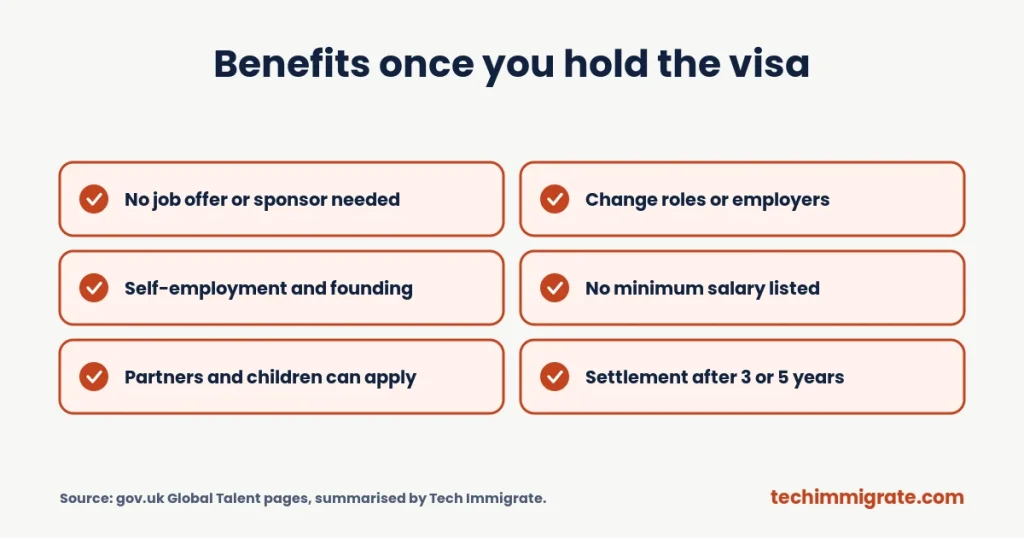
| 1 | No sponsor needed | No job offer is listed in the eligibility requirements |
| 2 | Change roles freely | Work is permitted, with limited exceptions |
| 3 | Self-employment and founding | Self-employment is permitted |
| 4 | No minimum salary | The eligibility page lists none |
| 5 | Long visa, renewable | Up to 5 years at a time, with no overall limit |
| 6 | Family can join | Partners and children can apply |
| 7 | Fast settlement | After 3 or 5 years, by route |
| 8 | Study allowed | Permitted, subject to a security check for some subjects |
| 9 | Switching from inside the UK | Many visa holders can switch |
Benefit 1: No Job Offer or Sponsor Needed
You do not need an employer to sponsor you, and gov.uk lists no job offer among the requirements. Instead, you need an endorsement from Tech Nation that shows you are a leader or potential leader in digital technology.
This changes your position at work. A sponsored worker depends on one company for the right to stay. A Global Talent holder does not.
Why this matters in practice
Imagine a job search without sponsorship questions. Employers do not need to sponsor you, so you can take a short contract or a freelance project. That does not guarantee offers, but it removes one barrier.
Illustrative example (fictional)
A fictional data engineer is made redundant while on a sponsored visa and has a short window to find a new sponsor. A second fictional engineer on a Global Talent Visa is made redundant in the same month. She can look for work at her own pace, because her permission does not depend on that employer. Her search is still hard, but her visa is not at stake.
Benefit 2: Freedom to Change Roles and Employers
Gov.uk's rules allow work on this route, so you can change jobs without asking the Home Office for new permission. The Royal Society's visa guidance, for example, lists changing roles or employers among the route's features.
The rules say work is permitted except as a professional sportsperson, including a sports coach. For almost every tech worker, that exception never applies.
Moving between jobs
If you take a new role, you do not need a new sponsor or a certificate. You should still keep your own records of earnings in your field, because gov.uk asks for that evidence when you extend. We cover this in the trade-offs section.
Working for more than one client
Applicants often combine a main job with consulting, advising or open-source work. The rules permit work and self-employment, so a portfolio career is possible. Check the current rules on gov.uk for any conditions that apply to your case.
Benefit 3: Self-Employment and Founding a Company
The route permits self-employment, so you can freelance or found a company without a separate visa. That makes it popular with founders and independent engineers.
Our criteria guide shows how founders can use their company work as evidence. The endorsement is separate from the freedom to work, though, so a strong start-up does not replace a strong application.
Benefits of Global Talent Visa Status for Founders
A founder can build a product without waiting for a sponsor licence or a salary threshold. For example, a fictional founder can take no salary in the first months, because the route has no minimum pay requirement.
However, extensions and settlement ask you to show that you earned money in your field. A founder with no income for years may need a plan for that evidence. See the trade-offs section for details.
Illustrative example (fictional)
A fictional founder moves to the UK and spends her first year building a prototype. She pays herself a small salary and keeps the payslips. At her extension she can show earnings in her field, as gov.uk asks. Her path worked because she planned the paperwork, not because the visa made it automatic.
Benefit 4: No Minimum Salary
The gov.uk eligibility page lists no minimum salary, so you are not tied to a pay threshold. That helps early-career applicants, founders and people changing sector.
This differs from many sponsored routes, where a salary floor decides whether a job can be sponsored. Here the endorsement is what counts at the start.
What this does not mean
No minimum salary does not mean no financial planning. You still need to live, pay the fees and cover the health surcharge. Our benefits and costs page covers the money side.
Also, the extension and settlement steps ask for evidence of earnings in your field. A salary floor does not exist, but income evidence does.
Benefit 5: A Long Visa That Renews
Gov.uk says you can stay up to 5 years at a time and extend for 1 to 5 years, with no overall limit on total time. That gives you a stable base for planning.
Stability matters for mortgages, schools and long projects. A longer visa means fewer renewals, though each extension needs its own application and fees.
Illustrative example (fictional)
A fictional engineer takes a five-year grant. In year two she changes employer, in year three she starts a side project, and in year four she goes freelance. Her permission stays the same through all three moves, because the route is not tied to one job. She still keeps her payslips and invoices, since the extension will ask for them.
Extending the visa
To extend, gov.uk says your endorsing organisation must not have withdrawn its approval. You must also show you earned money in your expert field during your time in the UK, for example with payslips.
Benefit 6: Your Family Can Join You
Partners and children can apply as dependants, so the visa works for families. Gov.uk says a partner can be a spouse, civil partner or unmarried partner, and children under 18 generally qualify.
Dependants can work, apart from the same professional sport exception. They can also study. They cannot claim most public benefits, because the route carries no access to public funds.
Benefits of Global Talent Visa Status for Families
Many sponsored routes tie a partner's rights to restrictions. Here the dependant can work, so a household can plan two incomes. For this reason, applicants with partners often value the route.
Each dependant pays their own visa fee and surcharge. Read the gov.uk partner and children page for the current rules.
Illustrative example (fictional)
A fictional couple moves with one child. The partner finds a job within a few months, and the child starts school. They budget for three sets of fees before they apply, so no cost surprises them later.
Benefit 7: Faster Settlement
Gov.uk says you may be able to settle after 3 or 5 years, depending on your field and how you apply. For tech applicants, the endorsement route decides the timing.
In our guide on Exceptional Talent versus Exceptional Promise, the Talent route points to 3 years and the Promise route to 5. Settlement has its own conditions, so the shorter path is a possibility, not a promise.
What settlement asks for
The immigration rules ask for earnings in your field during your last period of permission. They also require the Life in the UK test and an English language level. Check gov.uk for current absence limits and language rules.
Why it matters
Settled status lets you live, work and study without a time limit. It removes the need for further renewals.
Benefit 8: You Can Study
The rules allow study, so you can take a course or a degree while you hold the visa. This is useful if you want to retrain or add a qualification.
Study is subject to a security check for some sensitive subjects, called ATAS. Check whether your subject needs it before you enrol.
Combining work and study
Many applicants work and study part time. The route does not require full-time employment, so the mix is your choice. Keep evidence of your earnings, because extensions and settlement ask for it.
Benefit 9: Switching From Inside the UK
Many people already in the UK can switch to this visa, so you do not always need to leave first. Gov.uk lists visas that cannot switch, such as visit visas.
Student visa holders have extra conditions, so read the gov.uk switching page. Decisions from inside the UK usually take about 8 weeks. You also cannot travel outside the UK, Ireland, the Channel Islands or the Isle of Man while the application is pending, or the application is withdrawn.
Planning a switch
If your current visa expires soon, plan early. Count back from your expiry date, and leave room for the endorsement stage as well as the visa decision. An endorsement application does not extend your stay. Only a granted visa does.
What Are the Three Trade-Offs of the Global Talent Visa?
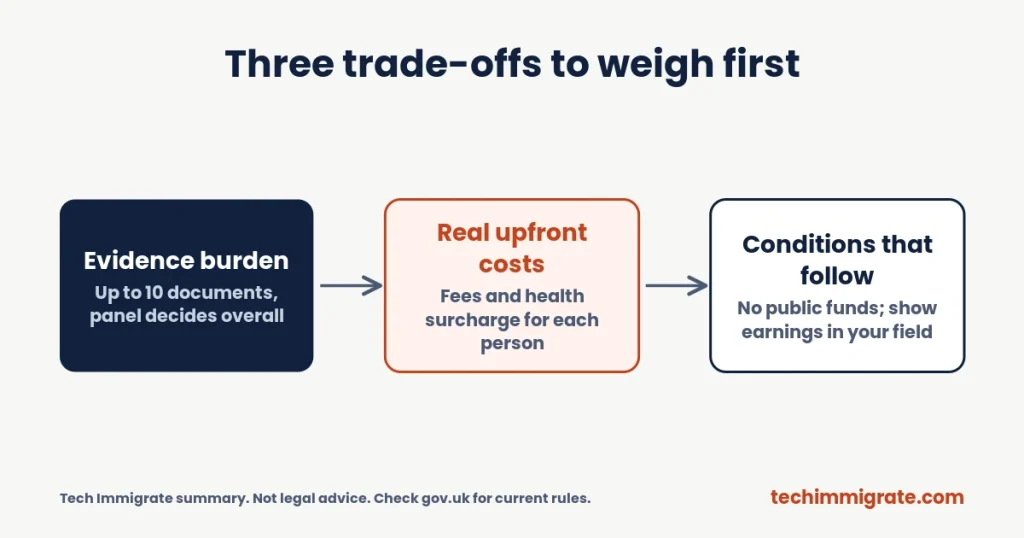
The three big trade-offs are the evidence burden, the cost and the conditions that follow. They do not cancel the benefits, but you should weigh them with open eyes.
Trade-off 1: The evidence burden and panel discretion
You must prove your case with up to 10 documents, with at least two per criterion, plus three recommendation letters. Meeting each criterion is necessary but not sufficient, because the panel decides overall whether to endorse.
No one can promise an outcome. A strong-looking file can still be refused, and applicants report that weak evidence is a common reason. Our mistakes guide lists patterns that applicants report, though these are not official findings.
Trade-off 2: Real upfront costs
At the time of writing, the endorsement and visa fees total GBP 766, and the health surcharge is usually GBP 1,035 per adult for each year. Dependants pay their own fees. A refusal means a new endorsement fee.
The visa carries these costs even though it needs no sponsor. Check gov.uk for current figures before you plan.
Trade-off 3: Conditions that follow you
The route has no access to public funds. Extensions need your endorsing body not to have withdrawn approval. You must also show earnings in your field.
For tech applicants, the product-led requirement adds a further limit. Tech Nation's guidance expects the work to sit in a product-led digital technology business, and the panel also looks at how you will contribute from the UK. A role outside that scope may not fit.
Common Misunderstandings About the Benefits
Most misunderstandings come from reading one benefit without its condition. Each advantage above has a limit, and the limits matter as much as the headline.
- "No sponsor" does not mean "no assessment." A panel still reviews your evidence, and it decides overall.
- "No minimum salary" does not mean "no income evidence." Extensions and settlement ask for earnings in your field.
- "Fast settlement" does not mean "automatic settlement." The route sets conditions, such as English, the Life in the UK test and absence rules.
- "Work freely" does not mean "work in any field forever." Your permission links to the field in which you were endorsed.
- "Family can join" does not mean "family pays nothing." Each person pays their own visa fee and surcharge.
- A points score does not exist. The route has no points system, so no calculator can predict a result.
Reading the rules with care
When a blog or video lists benefits, check whether it names a gov.uk page. If it does not, treat the claim as a lead, not a fact. We left out tax and fee comparisons in this guide for that reason.
What to Do After You Get the Visa
Once the visa arrives, a few habits protect your benefits for the years that follow. Applicants in this situation often set these up in the first month.
- Keep every payslip, invoice and contract in one folder, with dates.
- Note your visa end date and set reminders six months before it.
- Keep your evidence file, so a future extension starts from a full record.
- Log long trips abroad, because settlement has absence rules.
- Check gov.uk once a year for rule or fee changes.
Keeping your field in focus
The earnings you show should link to the field of your endorsement. A tech applicant who earns in tech has a clear record. A person who changes field completely may need advice before an extension.
Illustrative example (fictional)
A fictional product manager keeps a spreadsheet of contracts, pay dates and projects from day one. Three years later she can show her earnings in minutes. A colleague with no records spends weeks rebuilding his history. Both held the same visa, but only one planned for the paperwork.
Benefits of Global Talent Visa Status: Who Gains Most?
The route often suits people with a strong public record and flexible plans, because the benefits reward independence. It suits others less, and an honest check helps you decide.
Applicants in this situation often fit one of these profiles:
- Founders or early employees who want to build without a sponsor.
- A senior engineer with a record outside their employer, such as talks or open-source work.
- A specialist who wants the option to change jobs without a new sponsor.
- Families that value a partner's right to work.
Who may find it harder
People with little evidence outside their employer may find the endorsement hard. So might those in roles far from product-led technology. Want the guide for your role? See the guides.
How to Decide If the Benefits Outweigh the Trade-Offs
Decide by scoring your own plans against the benefits and your readiness against the trade-offs. This gives you a clearer view than a general list.
- Write down which of the nine benefits matter to you.
- List the evidence you already hold that comes from outside your employer.
- Estimate the full cost for everyone who will apply.
- Check that your role fits a product-led digital technology business.
- Decide how long you want to stay and whether settlement matters.
Illustrative example (fictional)
A fictional security engineer scores the route. Benefits 1, 2 and 7 matter most, because she wants freedom and a settled future. Her evidence is thin, so she spends three months building it before she applies. She treats the delay as an investment, not a setback.
When another route may fit better
If you have a stable sponsor and plan to stay with one employer, a sponsored route may meet your needs. We do not compare routes in detail here, because rules and fees change. Check gov.uk for the route that fits your case.
Benefits of Global Talent Visa FAQ
The main benefits are that you need no job offer or sponsor, you can change jobs or work for yourself, your family can apply, there is no minimum salary on the eligibility page, and you may settle after 3 or 5 years. An endorsement is not guaranteed.
No. Gov.uk lists no job offer among the eligibility requirements. Instead, you need an endorsement from Tech Nation showing you are a leader or potential leader in digital technology, or an eligible prize. The panel decides overall whether to endorse you.
Yes. The immigration rules permit self-employment, so you can freelance or found a company. However, gov.uk asks for evidence of earnings in your field when you extend, so keep records. Check the current rules for any conditions that apply to you.
Gov.uk says dependants can work, except as a professional sportsperson or coach, and they can study. They have no access to public funds. Each dependant pays their own visa fee and health surcharge, so check the current partner page.
The main trade-offs are the heavy evidence burden, a panel that decides overall, and real upfront costs. There is also no access to public funds, and you must show earnings in your field to extend. For tech applicants, the product-led requirement adds a further limit.
Your Next Step
If the benefits fit your plans, the next job is evidence. Our role-specific endorsement guides give you an evidence checklist and planner, so you can see what your case needs. Start at the guides hub, or pick your role: software developers, data and AI specialists, product managers or startup founders.
Want the guide for your role? See the guides.
How We Checked This Article
We checked each benefit on gov.uk: the Global Talent overview and the eligibility, extension, dependant and switching pages. We also read the Global Talent section of the immigration rules for the work, study and public funds conditions.
Next, we compared our list with guidance from the Royal Society and several law firm and university pages. We did not use claims we could not confirm on gov.uk, such as tax treatment or fee comparisons with other routes. Applicant comments about refusals are applicant-reported, not official.
Tech Immigrate is independent of Tech Nation and the Home Office. This article is general information, not legal advice, and nobody can guarantee an endorsement. Always confirm current rules on gov.uk before you apply.
We write practical guides for tech professionals applying for the UK Global Talent visa. Tech Immigrate is independent of Tech Nation and the Home Office, and our articles are general information, not legal advice. Rules and fees change, so always check gov.uk before you apply.