Why Digital Marketers Get Refused Global Talent Endorsement (and What to Do)
Why digital marketers are refused Global Talent endorsement: agency work, bought growth, vanity metrics. How to review or reapply and get endorsed.


In this article
- Can Digital Marketers Get the Global Talent Visa?
- The Six Refusal Patterns, Applied to Marketers
- Reason 1: Your Experience Is at an Agency
- Reason 2: You Bought the Growth
- Reason 3: Growth Has Many Parents
- Reason 4: Vanity Metrics and Self-Made Recognition
- Reason 5: Your Outside Work Is Really a Business
- Reason 6: Letters That Read Like Copy
- Reason 7: Missing Freelance and Side Projects
- Five Marketing Results That Make Strong Evidence
- What Real Marketer Refusals and Reviews Show
- Choosing Criteria as a Marketer
- How Assessors Read Your Evidence Documents
- Review or Reapply After a Marketing Refusal?
- How to Rebuild After a Refusal
- Talent or Promise for Marketers
- Get the Guide for Digital Marketers
- Frequently Asked Questions
- How We Checked This Article
Digital marketers are usually refused Global Talent endorsement because their evidence shows campaigns, not a leader in digital technology. Agency client work is treated as services, not product-led. Growth numbers get credited to the product, the sales team or the ad budget. Follower counts, certificates and self-published content are not recognition. To be endorsed, a marketer must show measured, attributable growth at a product-led tech company, and recognition from people outside their employer.
This guide is for growth marketers, performance marketers, product marketers, SEO and content leads, lifecycle and CRM specialists and marketing leaders in tech. It explains why marketers are refused, how the six refusal patterns apply to marketing work, and how to rebuild an application that survives them.
Key takeaways
- Marketing at an agency, for clients, is usually treated as services work and dismissed as evidence.
- Growth you bought with ad spend is not the same as growth you created. Show efficiency, not just volume: cost per acquisition, payback, retention.
- Results need attribution. Show the experiment, your decisions and a leader confirming your part.
- Followers, impressions, certificates and your own LinkedIn posts are not recognition.
- Courses you sell or teach for money do not count as contributions outside your occupation.
- Most marketers apply as business applicants, so commercial evidence from product-led companies carries the application.
Can Digital Marketers Get the Global Talent Visa?
Yes, but only in the right roles. Tech Nation assesses business applicants as well as technical ones. GOV.UK's list of skills Tech Nation covers (updated 1 July 2026) names "in-house performance marketing experts" at digital businesses, and lists consultancy, service delivery and outsourcing as generally unsuitable. In-house is the key word. What does not qualify is marketing as a general skill, or marketing services sold to other businesses.
The gov.uk digital technology guidance sets the structure: the Mandatory Criterion plus two of four Optional Criteria, using up to 10 evidence documents of up to 3 A4 pages, 3 recommendation letters, a CV and a personal statement. The question for every document is the same: does this show a recognised leader in digital technology, or a capable marketer doing their job?

The Six Refusal Patterns, Applied to Marketers
In September 2025 a regular adviser on the Tech Nation Visa Forum published six patterns from recent refusals, quoting the wording. The analysis is applicant-reported, not official guidance, but it matches Tech Nation's own guide.
| Pattern | Reported wording | What it looks like for marketers |
|---|---|---|
| Product-led classification | "an IT services and consulting company, not a product-led one" | Agency, consultancy and freelance client campaigns |
| Individual vs team | "cannot be attributed solely to the applicant's individual work" | "We grew revenue 4x" with no proof of marketing's or your share |
| Expertise vs field advancement | "shows expertise but does not constitute a significant, field-advancing contribution" | Strong campaigns, but nothing recognised or adopted outside your job |
| Award and media credibility | awards with a "very large number of other award winners" | Top-100 lists, pay-to-enter marketing awards, sponsored features |
| Letter authenticity | "The use of templating is evident in many of the letters" | Polished letters with matching phrases, written by a skilled copywriter: you |
| Career history gaps | many years "unaccounted for" | Freelance and side-business years left off the CV |
Reason 1: Your Experience Is at an Agency
Many digital marketers learn their craft at agencies, running campaigns for many clients. Tech Nation looks for product-led companies: businesses that earn their main income from their own software or platform. Agencies sell services, so their work is usually dismissed, however impressive the results. Tech Nation's list of backgrounds that are generally not suitable includes consultancy and service delivery.
Which marketing roles usually count
| Role and employer | Usually counts? |
|---|---|
| Growth or product marketing at a SaaS, app, fintech or marketplace | Yes |
| Marketing lead at a funded tech start-up | Yes |
| Marketing at a big tech product company, with your part clear | Yes, with care |
| Digital marketing for a retailer, bank or brand | Sometimes, only for a customer-facing digital product |
| Digital marketing agency or consultancy | No, for evidence |
| Freelance campaigns for clients | No, for evidence |
| Selling courses, coaching or marketing services | No |
Keep agency years on your CV so your career is complete. Build your evidence from product-company roles. If your whole career is agency work, consider moving in-house at a tech company and building evidence there; six to twelve months in the right role can change your application.
Your job title matters too. Labels such as growth marketing, performance marketing or product marketing tell an assessor you worked on a product's commercial results. A bare "social media manager" title reads as a communications role, even if the work was more. Use your real title, but describe the scope accurately on page 1 of each document: the budget you owned, the channels you ran and the revenue targets you were measured on.
Reason 2: You Bought the Growth
Marketers often present growth as user or revenue numbers: "grew signups from 2,000 to 40,000 a month". An assessor may wonder whether that came from a larger budget. Spending more money is not leadership.
Show efficiency and quality, not just volume
| Instead of | Show |
|---|---|
| Signups grew 20x | Signups grew 20x while cost per acquisition fell from £38 to £11 |
| Revenue from paid channels doubled | Payback period fell from 14 months to 5 months |
| Traffic grew 300% | Organic signups grew from 900 to 7,400 a month with no paid spend |
| Email list reached 200,000 | Lifecycle emails lifted 90-day retention from 31% to 44% |
| Ran 40 campaigns | Built the experiment programme that found the three channels now driving 70% of new revenue |
Give every figure a base, a date range and a source. Convert money to GBP. Tech Nation asks for GBP or a summary of conversion rates.
Third-party proof beats your own dashboards
Assessors treat internal dashboards and Slack screenshots as self-reported. Back each key number with something from outside your own work: a published case study by an ad platform or marketing tool featuring your campaign, a board or investor report, a finance team's signed confirmation, or a partner's letter. The stronger the outside source, the less the assessor has to take your word for it.
Reason 3: Growth Has Many Parents
When a company grows, the product team, sales team, founders and market all claim part of it. Tech Nation's guide says evidence must show your personal work, not that of the company or a team. Marketers lose this criterion when they submit company growth charts with no link to their own decisions.
Build an attribution chain
- Your decision: the channel, positioning, pricing page or experiment you proposed, dated, with your name.
- Your execution: what you built or ran personally, and the team around you.
- The test: an experiment, holdout or channel attribution report showing the effect.
- The result: the commercial change, with dates and source.
- The confirmation: a CEO, CFO or head of growth who is not one of your referees, in a signed letter.
Fictional example: Chidi, a growth marketer at a B2B payments start-up, was refused because his evidence said "marketing drove 3x revenue growth in 2024". On reapplication he showed the referral programme he designed, the holdout test proving it caused 41% of new business accounts in its first six months, cost per acquisition falling from £120 to £46, and a signed letter from the chief financial officer confirming the figures and his ownership of the programme.
Reason 4: Vanity Metrics and Self-Made Recognition
Marketers are good at building audiences, so they often submit audience numbers as recognition. Assessors usually see them differently.
- Followers and impressions show reach, not that experts recognise you.
- Your own LinkedIn posts, blog or newsletter are self-published. Tech Nation's guide says self-published articles are not sufficient for the Mandatory Criterion.
- Certificates from ad platforms or analytics tools show training.
- Top-100 lists and pay-to-enter awards are not selective enough.
- Sponsored features and paid placements are advertising, not recognition.
Recognition that works for marketers
| Evidence | What makes it count |
|---|---|
| Main-stage talk | A sector-leading tech or growth event, selected, at least 100 attendees, not sponsored |
| Press about you | A national or international tech or business outlet that names you and your results |
| Award | Won by you, with published judging and a small number of winners |
| Judging | Chosen to judge a recognised marketing or tech award |
| Invited writing | A known industry publication or global tech company invited you, unpaid |
| Expert role | Advisory board, programme committee or selection panel in tech |
For each item, explain the size of the audience and how selective it was. Assessors in London may not know a regional event or publication.
Reason 5: Your Outside Work Is Really a Business
Optional Criterion 2 asks for recognition for work beyond your occupation. Tech Nation's guide says this work must be voluntary and not done while representing a company or its products, and that your own courses and training do not count.
Marketers often run paid courses, coaching, consulting or communities with paid tiers. These are businesses, not voluntary contributions, so they rarely help with this criterion. They also need declaring: Tech Nation asks for evidence of businesses you founded or ran as a senior executive in the last five years.
What works for Optional Criterion 2
- Unpaid, invited writing for recognised publications, drawing on your own results.
- Mentoring on a structured programme with selection criteria, mainly in person. Online mentoring platforms on their own are not usually enough.
- A free open resource other marketers use, such as a template library or a tool, with usage data over time.
- Volunteering your marketing skills for a recognised non-profit tech initiative, confirmed by its director.
- Speaking at sector-leading events in a personal capacity.
Reason 6: Letters That Read Like Copy
Marketers write well, and that is a risk. A marketer who drafts letters for busy founders produces three letters in the same voice. Tech Nation's guide says templated letters may be treated as fraudulent, and that letters written with AI tools are not acceptable.
How to fix it
- Send each referee a short brief of facts, not a draft.
- Give each referee different evidence to cover.
- Ask each one for something only they saw: a board meeting, a launch decision, a result they checked themselves.
- Choose at least one referee from outside your employers, such as an investor, partner or event organiser.
- Avoid current managers, immediate colleagues and friends. Tech Nation says their letters are not sufficient as evidence of recognition.
Our article on who should write your letters explains referee choice in more detail.
Reason 7: Missing Freelance and Side Projects
Marketers often freelance between roles, run side projects or consult on weekends. If your LinkedIn shows these and your CV does not, the assessor may treat it as hidden history. If it pushes your career past about five years, it can also affect an Exceptional Promise application.
How to fix it
- List every role, including freelance and agency work, on your CV.
- Label freelance work as freelance.
- Declare side businesses, including dissolved ones, from the last five years.
- Make every title and month match across your CV, LinkedIn and evidence.
Five Marketing Results That Make Strong Evidence
Not every good result makes good evidence. These five types of result tend to work for marketers, because each can be measured, attributed and confirmed by someone else.
- A new acquisition channel you opened. The company had no meaningful revenue from the channel before you, and now it does. Show the month it started, the share of new customers it brings and its cost per acquisition against other channels.
- A pricing or packaging change you led. Show the test, the effect on conversion and average revenue per customer, and a finance lead's confirmation. Pricing work links marketing directly to revenue, which assessors understand.
- A retention or lifecycle programme. Show cohort retention before and after, and the revenue it protected. Retention is hard to buy with budget, so it answers the "you bought the growth" doubt.
- A market launch. Entering a new country or segment, with your plan, the launch date, customers won in the first months and the revenue that followed.
- Efficiency at scale. Growing volume while cutting cost per acquisition or payback period. This shows judgement, not spending.
For each one, name the product-led company in one line, state the team size and your role, and attach a signed confirmation from someone senior. One strong, attributable result is worth more than five campaigns with impressive charts and no proof of your part.
What Real Marketer Refusals and Reviews Show
Marketers have published their refusals and draft evidence on the Tech Nation Visa Forum, and experienced members have reviewed them in public. The cases below are applicant-reported and the comments are forum opinion, not official guidance, but the same points come up again and again.
| Case (year) | What happened | The lesson |
|---|---|---|
| SEO digital marketer, Exceptional Promise (2022) | Refused on every criterion. The panel said web analytics and payment schedules did not demonstrate leading talent, the letters were brief and vague, and the impact evidence did not explain why it was significant. The applicant was also treated as an affiliate partner, not an employee. | Traffic dashboards and payment history are not recognition. Explain why each result matters, and prove employment. |
| Product marketing manager, Exceptional Promise (refused, then endorsed in 2023) | The first application failed the Mandatory Criterion and innovation but passed impact. The applicant reported that assessors were confused about wording, the seniority of a start-up role, and what was a contribution versus an innovation. The second application focused innovation on one product, used clearly titled pages for each criterion and seven corroborating letters. | Leave nothing to interpretation. One focused story per criterion beats several thin ones. |
| Product marketing and growth lead in fintech, Exceptional Promise (2026) | The applicant reported pro forma feedback on weak digital technology recognition and insufficient individual attribution and product-led framing for impact. Work on a bank's products was treated as not digital technology or product-led, and the assessor doubted a talk reached 100 people. | Bank marketing rarely counts, and talk audiences need proof from the organiser. |
| Social media manager at a listed cloud company (feedback, 2026) | A forum reviewer said social media manager is not a standalone discipline, that a scholarship is not sector recognition, and that team awards are usually dismissed unless your own role is proven. | Describe your scope as growth, performance or product marketing, and get letters confirming your personal part in any award. |
| Growth lead at a UK fintech (feedback, 2026) | Reviewers said meeting invites prove attendance, not contribution, that press which omits your name mainly proves company success, and that campaign or process improvements read as process improvement, not innovation. | Tell a story of what you owned and what changed because of you. Do not stretch campaigns into the innovation criterion. |
Points forum reviewers repeat for marketers
- Internal evidence is not enough. Reviewers regularly warn that impact on your own company needs third-party proof behind it.
- Use metrics with benchmarks. "% growth" on its own is weak; compare results with industry benchmarks and give absolute figures.
- Self-hosted writing hurts. Articles on GitHub, LinkedIn or Medium are not valid recognition. Publish with recognised outlets and keep the acceptance emails.
- Workshops are weaker than main-stage talks. Tech Nation's guide says leading a workshop or running a session at a conference is not sufficient on its own.
- Salary is supporting evidence. Reviewers disagree on how much weight it carries, so never let it carry the Mandatory Criterion alone.
- Using a product is not innovating. Running excellent campaigns on an existing ad platform is unlikely to meet the innovation criterion. Most marketers are better served by Optional Criterion 3.
Choosing Criteria as a Marketer
| Criterion | Marketing evidence that fits |
|---|---|
| Mandatory Criterion | Main-stage talks, press naming you, award wins, judging, invitations from global tech companies |
| Optional Criterion 2 | Unpaid invited writing, structured mentoring, free resources other marketers adopt |
| Optional Criterion 3 | Measured, attributable growth at product-led companies, with efficiency figures |
| Optional Criterion 1 | A new growth model or product that independent sources call new, with commercial results |
Most marketers do best with the Mandatory Criterion plus Optional Criteria 2 and 3. Tech Nation describes Optional Criterion 3 as impact, not necessarily innovation, which fits marketing results well. Put the criterion in every file name and on page 1.
How Assessors Read Your Evidence Documents
Each evidence document can be up to 3 sides of A4, and assessors are not required to read past page 3. That makes the first page the most important page in your application. Endorsed applicants treat page 1 as the argument and the pages after it as the proof, so an assessor can see the claim, the criterion and why it matters within a minute.
Three things decide whether a marketing document works:
- One claim, one criterion. A document that tries to prove two things usually proves neither, and the same evidence cannot be used under two criteria.
- Proof from someone other than you. Your own descriptions and screenshots support a claim; a signed letter, an official record or a public source carries it.
- Readable, not crammed. Tech Nation says excessively compressed evidence is not acceptable. Cut to what matters instead of shrinking it.
Our guide includes the full 3-page template, with a worked example for each kind of marketing evidence and the proof to gather for every page.
Review or Reapply After a Marketing Refusal?
An endorsement review is free and must be requested within 28 days of the decision. You cannot add new evidence. It works only when the assessor overlooked or misread something already in your pack.
| What the refusal says | Best route |
|---|---|
| Your employer is not product-led, and page 1 explained its software revenue | Review |
| Your growth was a team effort, and your pack includes the experiment and a leader's letter confirming your part | Review |
| Evidence is missing that you did submit | Review: point to the document and page |
| Your evidence relies on agency or client work | Reapply with product-company evidence |
| Your recognition is followers, certificates or your own posts | Reapply with independent recognition |
| Your outside work is a paid course or consultancy | Reapply with voluntary contributions |
Write each review point in the same order: the criterion, the exact refusal sentence, the document and page that answers it, why it meets the criterion, and your request. If you reapply, the endorsement fee is due again (£561 at the time of writing). Our guides to the endorsement review and to what to do after a refusal explain both routes.
How to Rebuild After a Refusal
Most refused applicants do not need a new career. They need the same career presented properly. The rebuild usually happens in three phases.
- Read the refusal properly. Sort every sentence into evidence the assessor overlooked, evidence they misread, and genuine gaps. Only the first two belong in a review.
- Fix the proof, not the wording. Most marketing refusals come from missing attribution or missing independent confirmation, which takes weeks to collect. Start those requests first.
- Check everything matches. Dates, titles and figures must agree across your CV, LinkedIn, letters, statement and evidence before you pay the fee again.
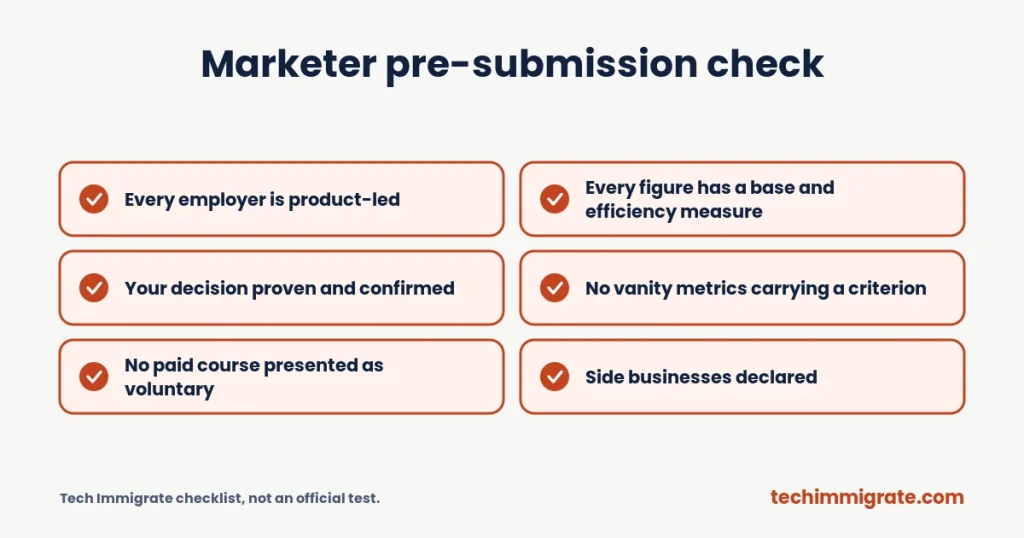
If your evidence already exists, this typically takes 8 to 12 weeks. If you need new recognition or a move to a product-led company, plan for six to twelve months. Our guide includes the week-by-week planner, 17 evidence checklists and the full pre-submission check.
Talent or Promise for Marketers
Exceptional Promise suits marketers earlier in their careers with fast-rising, independent recognition. Exceptional Talent suits marketing leaders with sustained recognition over several years. Talent leads to settlement after 3 years; Promise after 5. Choose by evidence, and check your LinkedIn fits the route.
A useful rule of thumb: if most of your independent recognition comes from the last two years, and your strongest results are from one or two companies, Promise is usually the safer route. If you have five or more years of recognised work across several product companies, with talks, press or judging spread over that time, Talent gets you to settlement two years sooner. Applying as Talent with Promise-level evidence makes every claim look overstated. Our comparison of Exceptional Talent and Exceptional Promise explains the choice.
Get the Guide for Digital Marketers
Our Endorsement Guide for Digital Marketing Professionals shows how to build every document in this article. It is 95 pages in 7 parts, aligned with Tech Nation's applicant guide, and includes a complete 10-document fictional mock evidence pack, evidence, letter, CV and statement templates, 17 evidence checklists, a 12-week planner, 40 refusal fixes, 10 decoded refusal cases and a step-by-step review method with two worked examples. If you work at an agency, its 6 to 12 month plan shows how to build evidence at a product-led company.
I was refused the first time I applied for Global Talent, then reapplied and was endorsed. The guide is built around the lessons from both applications.
Frequently Asked Questions
Yes, if you have worked in marketing or growth roles at product-led tech companies and can show measured, attributable results and independent recognition. Marketing services sold to clients usually do not qualify.
Common reasons are agency or client work that is not product-led, growth that looks bought with ad spend, company results with no proof of personal contribution, vanity metrics or self-published content as recognition, and paid courses presented as voluntary work.
Usually not as evidence, because agencies are services businesses. Keep it on your CV and use in-house roles at tech companies for your evidence documents.
No. Followers show reach, and your own posts are self-published, which Tech Nation's guide says is not sufficient. Use talks, press, awards and judging chosen by others.
They show training, not recognition. List them on your CV but do not rely on them as evidence.
Not if it is paid or your own course. Tech Nation's guide says the work must be voluntary and that your own courses and training do not count.
Only if the assessor overlooked or misread evidence you submitted. The review is free within 28 days but you cannot add new evidence. Weak or agency-based evidence needs a new application.
For the bigger picture, including how many applications Tech Nation endorses and how that has changed, read Global Talent Visa Success Rate: What the Published Numbers Show.
How We Checked This Article
We checked the rules here against the gov.uk Global Talent digital technology guidance and Tech Nation's Global Talent Visa Application Guide. The six refusal patterns come from a Tech Nation Visa Forum analysis published in September 2025. The marketer cases come from refusals, reviews and evidence drafts that marketers published on the same forum between 2022 and 2026. All forum material is applicant-reported or member opinion, not official guidance.
Forum threads we used:
- Most common rejection patterns, Q3 2025
- SEO digital marketer: Promise refusal
- Product marketing manager: endorsed on second application
- Product marketing and growth lead: reapplication after refusal
- Social media manager: profile feedback
- Growth lead at a UK fintech: evidence feedback
- Product marketing manager: evidence checklist feedback
- Digital marketer: evidence draft feedback
The endorsement fee was £561 at the time of writing. Check current fees and rules on gov.uk before you apply.
Tech Immigrate is independent of Tech Nation and the Home Office. This article is general information, not legal advice, and nobody can guarantee an endorsement. Named examples are fictional.
We write practical guides for tech professionals applying for the UK Global Talent visa. Tech Immigrate is independent of Tech Nation and the Home Office, and our articles are general information, not legal advice. Rules and fees change, so always check gov.uk before you apply.