
Why Startup Founders Get Refused Global Talent Endorsement (and What to Do)
Why startup founders are refused Global Talent endorsement: screenshots not accounts, start-up press, team milestones. How to review or reapply.

In this article
- How Tech Nation Assesses Founders
- The Six Refusal Patterns for Founders
- Reason 1: Screenshots Instead of Formal Accounts
- Reason 2: Your Recognition Is Really Company News
- Reason 3: Team Milestones Are Not Your Innovation
- Reason 4: Self-Reported Metrics
- Reason 5: Too Early
- Reason 6: Outside Work Tied to Your Start-Up
- Reason 7: Letters That Repeat the Pitch
- What Recent Founder Refusals Show
- Choosing Criteria as a Founder
- How Assessors Read Your Evidence Documents
- Review or Reapply After a Founder Refusal?
- How to Rebuild After a Refusal
- Your Personal Statement as a Founder
- Is a Refusal the End?
- Talent or Promise for Founders
- Get the Guide for Startup Founders
- Frequently Asked Questions
- How We Checked This Article
Startup founders are usually refused Global Talent endorsement because their evidence describes the company, not their own recognised leadership, and because it does not meet the formal proof Tech Nation asks founders for. Funding announcements and founder profiles are company news. Transaction screenshots are not formal accounts. Usage figures from your own dashboard are self-reported. And team milestones do not show your personal innovation. To be endorsed, a founder needs formal accounts or sales by country, independent proof of what the company achieved, and recognition that is clearly about them.
This guide is for founders, co-founders, technical founders and CTOs of tech start-ups. It uses refusal wording founders have published to explain what assessors look for, when a free review can win, and how to rebuild a founder application.
Key takeaways
- Founders must prove the company: formal accounts signed by the directors (audited, or covering more than 12 months), or customer numbers and sales for each country.
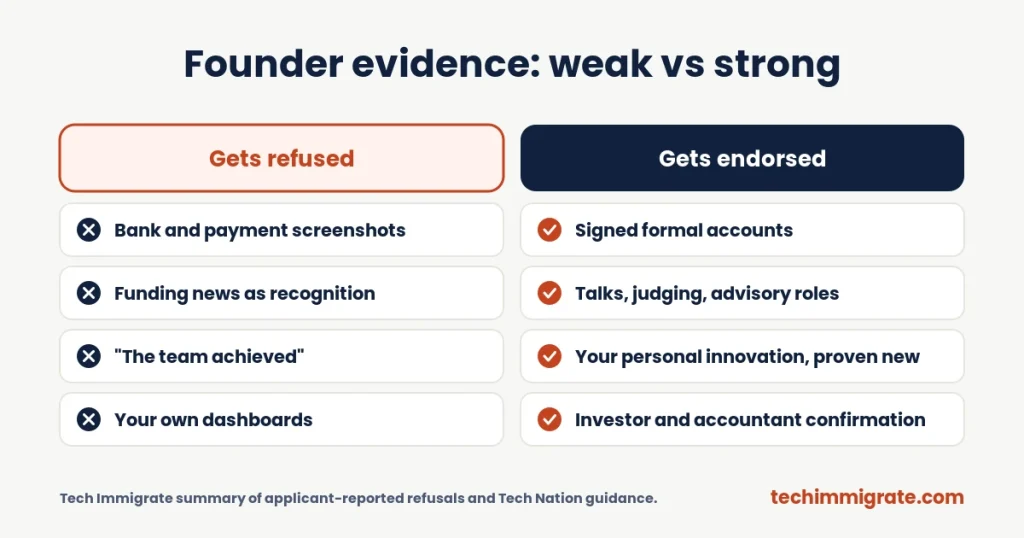
- Revenue shown through bank or transaction screenshots has been refused because it is not formal accounts.
- Press about your start-up, pitch-competition wins and funding news can be dismissed as "of a founder or startup profile nature". Recognition must be about you as a leader.
- "The team achieved" does not prove your innovation. Show what you personally invented, decided or built.
- Very early companies have been refused as "too early". Scale and outside recognition often need more time.
- Declare every business you founded or ran in the last five years, including dissolved ones.
How Tech Nation Assesses Founders
Founders usually apply as business applicants, which means showing proven commercial, investment or product expertise in building digital products. Technical founders and CTOs can apply as technical or business applicants. Either way, the structure is the same: the Mandatory Criterion plus two of four Optional Criteria, up to 10 evidence documents of up to 3 A4 pages, 3 recommendation letters, a CV and a personal statement. The gov.uk digital technology guidance sets out the details.
Founders face a requirement most applicants do not. GOV.UK asks founders and senior executives from the last five years to show their connection to the business, with customer numbers and sales for each country, or the last audited accounts signed by the directors. Tech Nation's guide adds that unaudited accounts must cover more than 12 months, must include a profit and loss statement and a balance sheet signed by the directors, and that projections, business plans and articles of association do not count.
The Six Refusal Patterns for Founders
A regular adviser on the Tech Nation Visa Forum published six patterns from recent refusals in September 2025, quoting the wording. The analysis is applicant-reported, not official guidance. The fundraising wording in the second pattern is especially relevant to founders.
| Pattern | Reported wording | How it hits founders |
|---|---|---|
| Individual vs team | "The fundraising outcomes are the result of a team effort, and cannot be attributed solely to the applicant's individual work" | Rounds, launches and growth credited to the whole team |
| Expertise vs field advancement | "shows expertise but does not constitute a significant, field-advancing contribution" | A competent start-up with little scale or outside recognition |
| Award and media credibility | awards with a "very large number of other award winners" | Pitch competitions, founder lists, sponsored features |
| Product-led classification | "an IT services and consulting company, not a product-led one" | Agencies and dev shops presented as start-ups |
| Letter authenticity | "The use of templating is evident in many of the letters" | Investors and advisers signing letters the founder drafted |
| Career history gaps | many years "unaccounted for" | Earlier ventures, consulting and dissolved companies left out |
Reason 1: Screenshots Instead of Formal Accounts
This is the most avoidable founder refusal. One technical founder published a 2026 refusal that rejected the innovation criterion partly because revenue was shown with transaction screenshots. Another founder's refusal, reported in an investor forum thread, said revenue was shown through screenshots rather than the formal accounts the guidance requests.
What Tech Nation asks founders for
| Proof | What counts | What does not |
|---|---|---|
| Accounts | Audited accounts, or unaudited accounts covering more than 12 months, with profit and loss and balance sheet, signed by the directors | Bank alerts, payment dashboards, projections, business plans |
| Sales | Customer numbers for each country, and a ranking of sales channels with when sales were made | A single revenue chart with no breakdown |
| Connection | Your shareholding and role, from the company register or cap table | A LinkedIn title |
If your company has not yet filed accounts covering more than 12 months, consider waiting until it has. Applying without them makes the innovation and impact criteria much harder.
Reason 2: Your Recognition Is Really Company News
Founders naturally collect start-up press: funding announcements, launch coverage, "30 start-ups to watch" lists and pitch-competition wins. One founder's refusal described two tech-press features, an interview and a pitch-competition win as being "of a founder or startup profile nature". Another noted that articles were clustered in the twelve months before the application.
Why this happens
The Mandatory Criterion asks whether you are recognised as a leading talent in digital technology. A funding announcement says investors backed your company. It does not say the industry sees you as a leader. A cluster of articles just before you apply looks like a press campaign.
Recognition that is about you
- Invitations to speak on the main stage at sector-leading events, selected on your expertise.
- Judging or mentoring roles at recognised accelerators, chosen from many candidates.
- Advisory or board roles at other tech companies or industry bodies.
- Press that describes your expertise or your views on the sector, not just your round.
- Awards that name you personally, with published judging and few winners.
- Recognition spread over several years, not concentrated before your application.
Keep funding announcements, but use them as proof of impact under Optional Criterion 3, not as recognition under the Mandatory Criterion.
Reason 3: Team Milestones Are Not Your Innovation
One fintech co-founder and CEO who had raised over £1 million reported that the innovation criterion was refused because the evidence outlined the milestones the team had worked on. The founder requested a review without new evidence, pointing to the guidance on businesses established as a founder and to innovation already described in the letters, the Mandatory Criterion documents and a whitepaper. The review was sent on 7 May 2024, and the applicant was endorsed on 24 May.
How to show personal innovation
- What was new: what existed in the market before, and what your product did differently. Use independent sources, such as analysts, press or investors, to confirm it was new.
- What you did: the product decisions, design, architecture or business model you personally created.
- That it worked: product in market and traction through revenue, which Tech Nation's guide asks for.
- That it was yours: letters from investors, co-founders or early customers confirming your role.
Architecture diagrams alone are not enough. One early-stage founder's refusal said system architecture documents were noted, but did not in themselves represent innovation.
Reason 4: Self-Reported Metrics
One founder of a consumer AI app with tens of thousands of monthly users reported that the impact criterion was refused because the metrics were self-reported. Founders own their dashboards, so every number they produce looks self-reported to an assessor.
How to make metrics independent
| Metric | Independent proof |
|---|---|
| Revenue | Formal accounts signed by directors; accountant's letter |
| Users and downloads | App store console exports with dates; third-party analytics |
| Customers | Customer letters or public case studies; customer numbers by country |
| Funding | Public announcement; investor letter; company register filings |
| Growth | Investor update extracts, shared with investor permission |
An investor, accountant or customer confirming a number in a signed letter turns a claim into evidence.
Reason 5: Too Early
One AI education founder whose first meaningful tech role began in 2021 reported a refusal saying there were few especially impressive accolades, that company formation was purely procedural, and that the company was too early. Another refusal reported in founder discussions described a company as too early-stage, with insufficient scale and wider-sector recognition.
No amount of presentation fixes a company that has not yet reached scale. If your start-up is very young, you have three options:
- Apply for Exceptional Promise, which is for people with the potential to lead. Assessors may move founders with under five years in tech to Promise themselves.
- Use a different employer. If you led product or engineering at a scaled company before founding, that role may carry Optional Criterion 3.
- Wait and build. Twelve more months of formal accounts, customers and outside recognition can change the outcome.
Reason 6: Outside Work Tied to Your Start-Up
Optional Criterion 2 asks for recognition for work beyond your occupation. Founders often submit talks, mentoring and community work that promote their start-up. Tech Nation's guide says this work must be voluntary and not done while representing a company or its products.
Applicants report refusals that treated outside work tied to their start-up as not outside work at all. Choose independent, unpaid contributions: mentoring on a structured accelerator programme, judging, speaking on topics wider than your product, or open resources other founders use.
Reason 7: Letters That Repeat the Pitch
Founders often ask investors and advisers to sign letters they drafted themselves. Tech Nation's guide says templated or AI-written letters are not acceptable and may be treated as fraudulent. Founders also report refusals saying letters praised them but did not show the level of national or international recognition assessors look for.
How to fix it
- Choose referees with their own public standing: an investor with a track record, a leading founder or executive, an industry body leader.
- Brief each with facts and let them write.
- Ask each to cite concrete recognition they know of: awards, appointments, invitations, press.
- Avoid co-founders and your own employees as recommendation letter writers.
What Recent Founder Refusals Show
The cases below come from founders who published their refusals on the Tech Nation Visa Forum. They are applicant-reported, and reviewer comments are forum opinion, not official guidance.
| Case (date) | What happened | The lesson |
|---|---|---|
| Technical co-founder of an AI education app, Exceptional Promise (July to August 2026) | Refused on every criterion about five weeks after referral. As reported, press was founder-profile interview content clustered in the year before applying, revenue was shown with transaction screenshots and bank notifications, and impact was the strongest part but lacked independent verification of its significance. Letters came from former colleagues. The applicant chose not to appeal. | Separating your personal contribution is not enough; its significance must be confirmed by someone independent. |
| Founder of an AI product with research papers, Exceptional Promise (July 2026) | As reported, the panel found some recognition eligible but too early-stage, the live product's adoption and revenue too limited for innovation, and the first-author papers too recent, with limited adoption and engagement. Reviewers advised against a review, and suggested strengthening existing evidence rather than replacing it, and waiting for independent citations. | Time can be the missing ingredient. Build traction and citations, then reapply. |
| Founder of an AI education start-up, Exceptional Promise (refused 2025) | The applicant reported the panel said much of the evidence was self-authored, some letters lacked digital signature audit trails, company formation was purely procedural, the architecture did not represent innovation, and a presentation sat within the orbit of the founder's own company. | Outside work linked to your own start-up is not outside work. |
| Health-tech co-founder, Exceptional Promise (refused 2024) | Refused within days. All evidence was submitted as Google Drive links, and most talks were tied to the applicant's own company. Reviewers noted that assessors do not have to open external links, and that a media piece labelled as a partner post was paid content. | Put proof inside the documents, and never rely on paid coverage. |
One reviewer's advice to founders sums it up: show the chain from your personal contribution to a measurable result to independent validation, and make your recognition clearly about you rather than the company.
Choosing Criteria as a Founder
| Criterion | Founder evidence that fits |
|---|---|
| Mandatory Criterion | Talks, judging and advisory roles, personal awards, press about your expertise |
| Optional Criterion 1 | A genuinely new product, proven new by outside sources, with formal accounts and traction |
| Optional Criterion 2 | Independent mentoring, judging, open resources and talks not promoting your start-up |
| Optional Criterion 3 | Revenue, customers and funding with formal proof, and your personal part in them |
Many founders choose Optional Criteria 1 and 3. Tech Nation warns that the same evidence for both may not be enough, because innovation and impact are different tests, so give each its own documents. Our articles on the Global Talent visa for startup founders and the Tech Nation startup founder route cover criterion choice in more detail.
How Assessors Read Your Evidence Documents
Each evidence document can be up to 3 sides of A4, and assessors are not required to read past page 3. That makes the first page the most important page in your application. Endorsed applicants treat page 1 as the argument and the pages after it as the proof, so an assessor can see the claim, the criterion and why it matters within a minute.
Three things decide whether a founder document works:
- One claim, one criterion. A document that tries to prove two things usually proves neither, and the same evidence cannot be used under two criteria.
- Proof from someone other than you. Your own descriptions and screenshots support a claim; a signed letter, an official record or a public source carries it.
- Readable, not crammed. Tech Nation says excessively compressed evidence is not acceptable. Cut to what matters instead of shrinking it.
Our guide includes the full 3-page template, with a worked example for each kind of founder evidence and the proof to gather for every page.
Review or Reapply After a Founder Refusal?
An endorsement review is free and must be requested within 28 days. You cannot add new evidence, so it works only when the assessor overlooked or misread evidence already in your pack.
| What the refusal says | Best route |
|---|---|
| Your innovation was "team milestones", and your pack describes your personal innovation | Review: point to the exact pages |
| You were a contractor, and your pack shows your founder or director role | Review |
| Revenue was shown with screenshots | Reapply with formal accounts |
| Metrics were self-reported | Reapply with independent proof |
| Recognition was start-up profile press | Reapply with recognition about you |
| The company is too early | Build scale and recognition, then reapply |
If a review is refused for new reasons, you can request a second review on those reasons only. If you reapply, the endorsement fee is due again (£561 at the time of writing). Our guides to the endorsement review and to Global Talent refusals explain both routes.
How to Rebuild After a Refusal
Most refused applicants do not need a new career. They need the same career presented properly. The rebuild usually happens in three phases.
- Read the refusal properly. Sort every sentence into evidence the assessor overlooked, evidence they misread, and genuine gaps. Only the first two belong in a review.
- Fix the proof, not the wording. Most founder refusals come from missing attribution or missing independent confirmation, which takes weeks to collect. Start those requests first.
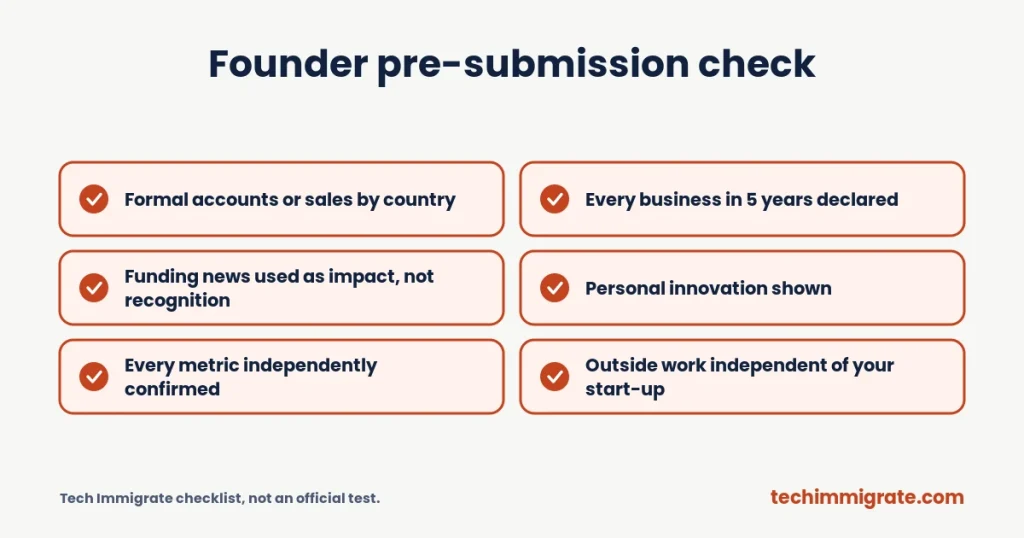
- Check everything matches. Dates, titles and figures must agree across your CV, LinkedIn, letters, statement and evidence before you pay the fee again.
If your evidence already exists, this typically takes 8 to 12 weeks. If you need new recognition or a move to a product-led company, plan for six to twelve months. Our guide includes the week-by-week planner, 17 evidence checklists and the full pre-submission check.
Your Personal Statement as a Founder
The personal statement is written in the Home Office form. Tech Nation's guide says it should answer four questions: why you want to come to the UK, your planned occupation, the region or city you will live in, and how the UK digital technology sector will benefit from your work.
Founders often write a pitch instead of a statement: market size, vision and a hockey-stick forecast. Assessors are not investors. They want to know what you have already done, shown in the evidence, and what you will concretely do in the UK.
A strong founder statement:
- Starts with your record, citing documents by number: "The accounts in document 8 show revenue growing from £210,000 to £780,000 between 2023 and 2025."
- Names the UK plan precisely: opening a UK entity, hiring a first UK team, selling to named UK customer types, or joining a UK company in a defined role.
- Picks a city and gives a reason, such as a sector cluster, customers or investors there.
- Explains the benefit: jobs, products UK businesses will use, and what you will do outside your company, such as mentoring founders on a structured programme.
Avoid forecasts you cannot support. Reported refusals have described vague plans as a wish rather than a plan, and a statement that promises more than the evidence shows weakens everything else in the pack.
Is a Refusal the End?
No. A refusal from Tech Nation is a decision about the evidence you sent, not a final judgement on your career. Many applicants who post their stories publicly were refused once, sometimes twice, and were endorsed after a review or a stronger second application. What changed was rarely their experience. It was how clearly the pack showed their personal contribution, how independent the proof was, and whether each document matched the criterion it was filed under.
The most useful thing you can do after a refusal is read it calmly, line by line, and treat it as a list of what the assessor could not see. Each line points to a specific gap: a missing letter, an unproven number, a role that was not explained. Fix those gaps one at a time and the next application is a different application.
Talent or Promise for Founders
Exceptional Promise suits founders whose companies or careers are still young. Exceptional Talent suits founders with sustained recognition and companies at scale. Talent leads to settlement after 3 years; Promise after 5. Assessors can place you on Promise themselves if your tech experience is under five years. Our comparison of Exceptional Talent and Exceptional Promise explains how to choose.
Get the Guide for Startup Founders
Our Global Talent Visa Endorsement Guide for Startup Founders shows how to build every document in this article. It includes evidence checklists, the formal-accounts rules, a 12-week planner, the 3-page evidence template, a review method and a complete fictional mock evidence pack for a founder.
I was refused the first time I applied for Global Talent, then reapplied and was endorsed. The guide is built around the mistakes that cost me the first application.
Frequently Asked Questions
Common reasons are revenue shown with screenshots instead of formal accounts, start-up press used as personal recognition, team milestones presented as personal innovation, self-reported metrics, companies that are too early, and outside work tied to the start-up.
Audited accounts, or unaudited accounts covering more than 12 months, with a profit and loss statement and a balance sheet signed by the directors. Alternatively, customer numbers and sales for each country. Projections and business plans do not count.
Funding and launch coverage is company news and has been dismissed as founder or start-up profile material. Use it as impact evidence, and build recognition about you: talks, judging, advisory roles and personal awards.
If it has little revenue, few customers and no formal accounts, assessors may say it is too early. Consider Exceptional Promise, evidence from an earlier role, or waiting until you have more scale and recognition.
It is better not to. Choose referees with their own public standing who know your work, such as investors, other founders or industry leaders, and let them write in their own words.
Yes, free within 28 days, if the assessor overlooked or misread evidence you submitted. One founder won a review by pointing to innovation already described in the pack. Screenshots or self-reported metrics need a new application.
Yes. Tech Nation asks for evidence of businesses you founded or ran as a senior executive in the last five years, including dissolved ones.
For the bigger picture, including how many applications Tech Nation endorses and how that has changed, read Global Talent Visa Success Rate: What the Published Numbers Show.
How We Checked This Article
We checked the rules here against the gov.uk Global Talent digital technology guidance and Tech Nation's Global Talent Visa Application Guide, including its rules on formal accounts. Refusal wording and case examples come from founders who published their refusals and reviews on the Tech Nation Visa Forum, and from a September 2025 forum analysis of refusal patterns. This material is applicant-reported, not official guidance.
Forum threads we used:
- Most common rejection patterns, Q3 2025
- Technical founder: refusal, 2026
- Founder with research: refusal, 2026
- AI education founder: refusal, 2025
- Health-tech co-founder: refusal, 2024
- Startup owner: endorsed after a second review
- Founder and leader: evidence feedback, 2026
The endorsement fee was £561 at the time of writing. Check current fees and rules on gov.uk before you apply.
Tech Immigrate is independent of Tech Nation and the Home Office. This article is general information, not legal advice, and nobody can guarantee an endorsement. Named examples are fictional.
We write practical guides for tech professionals applying for the UK Global Talent visa. Tech Immigrate is independent of Tech Nation and the Home Office, and our articles are general information, not legal advice. Rules and fees change, so always check gov.uk before you apply.


