ILR for Dependants: When Your Partner and Children Can Settle
When can your partner and children get indefinite leave to remain? Qualifying periods, the Global Talent gap, fees, evidence and the settlement reforms.


In this article
- How Dependant Settlement Works
- Partners: The Requirements
- Children: The Requirements
- The Global Talent Timing Gap
- Skilled Worker Families
- Fees
- Applying Together vs Separately
- What Dependants Who Are Not Yet Eligible Should Do
- How the Earned Settlement Reforms May Change Things
- Continuous Residence for Dependants
- Does the Partner's Job Matter?
- Children Turning 18 Before Settlement
- Planning Dates for the Whole Family
- Evidence for Dependant ILR Applications
- A Worked Example: A Global Talent Family
- A Worked Example: A Skilled Worker Family Arriving in Stages
- If the Relationship Ends Before Settlement
- After Dependants Settle
- Questions to Answer Before Anyone Applies
- Common Mistakes
- Plan Settlement for the Whole Family
- How We Checked This Article
When a main applicant gets indefinite leave to remain (ILR), it is natural to assume the whole family settles at the same time. Often they can, but not always. Partners and children have their own qualifying periods, their own requirements and their own applications. A partner who joined later, a child who turned 18, or a family on Global Talent where the main applicant settles after 3 years can all find that their dates do not line up.
This guide explains how ILR works for dependants: when partners and children can settle, what each must show, the fees, how the rules differ between Skilled Worker and Global Talent, what happens to dependants who are not yet eligible, and how the earned settlement reforms may change things. It is written for tech families on work routes.
Key takeaways
- Dependants usually apply for ILR in their own right, with their own application and fee of £3,226 per person.
- Partners usually need to have completed their own qualifying period, often 5 years, as a dependant before they can settle.
- On Global Talent, a main applicant endorsed under exceptional talent may settle after 3 years, but their partner usually still needs 5 years.
- Adult partners must meet the English and Life in the UK requirements, unless exempt. Children under 18 are exempt from both.
- Children can usually settle when both parents are settled or applying at the same time, unless one parent has sole responsibility or there are serious reasons.
- Dependants who are not yet eligible can extend their permission until they are.
- Under the earned settlement reforms, partners who arrived with the main applicant may settle on the same timeline, while partners who join later may need to complete the qualifying period separately.
How Dependant Settlement Works
Every person in your family has their own immigration status, shown in their own eVisa. That means each person needs their own route to ILR. The main applicant's ILR does not automatically extend to the partner or children.
In most cases, dependants settle in one of two ways:
- At the same time as the main applicant, if they have completed their own qualifying period.
- Later, once they reach their qualifying period, while the main applicant is already settled.
The key question for each family member is: how long have they held permission as a dependant on this route, and do they meet the other requirements?
Partners: The Requirements
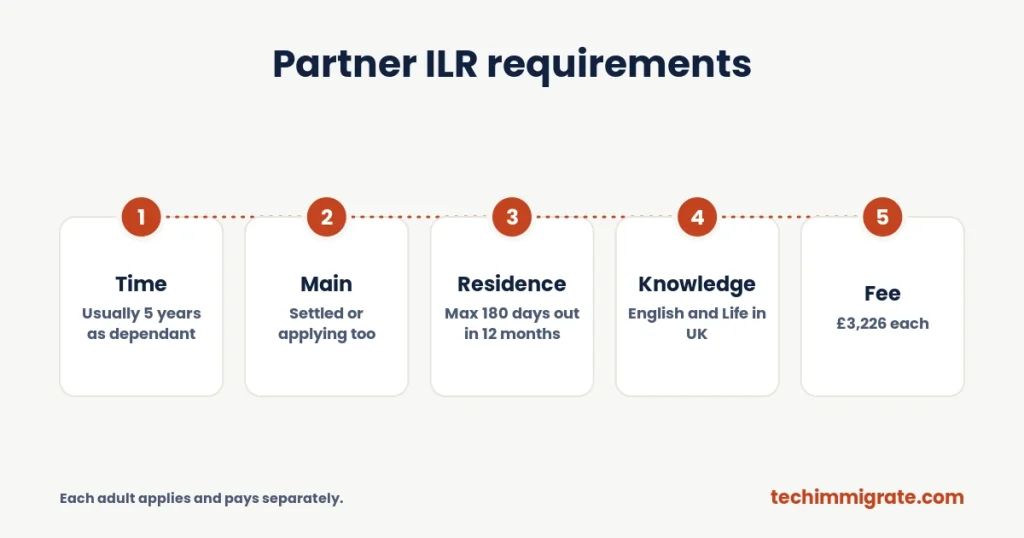
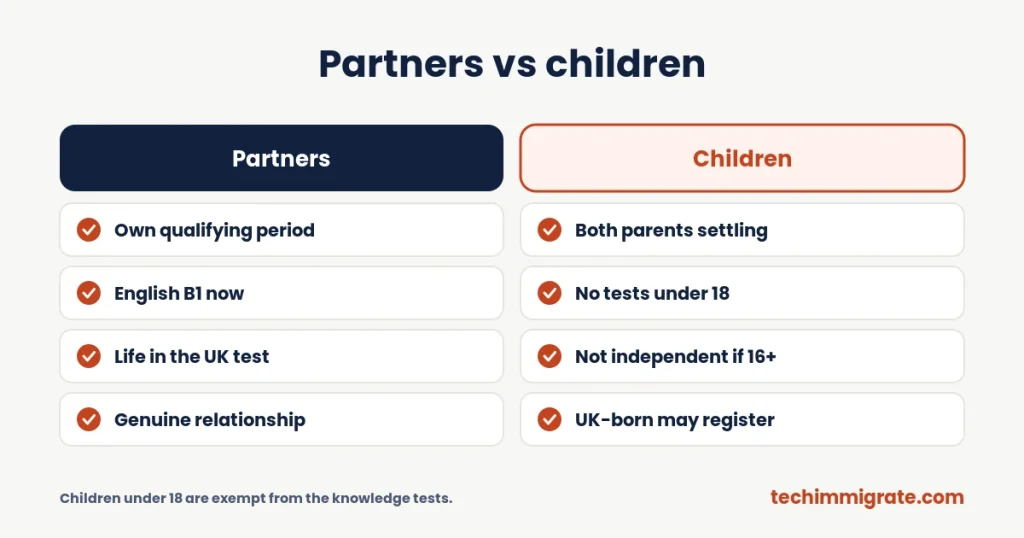
Under the current rules for work routes, a partner can usually apply for ILR if:
- they have spent the required continuous period in the UK as the main applicant's partner, usually 5 years;
- the main applicant has ILR or is applying for it at the same time;
- the relationship is genuine and continuing, and they intend to live together permanently in the UK;
- they meet the continuous residence requirement, with no more than 180 days outside the UK in any 12-month period;
- they have passed the Life in the UK test;
- they meet the English requirement at B1, unless exempt;
- they meet the suitability requirements, such as no serious criminality and no significant NHS debts.
Adult partners aged 65 or over, or with a long-term condition that prevents them from meeting the knowledge requirements, are exempt from English and the Life in the UK test.
Children: The Requirements
A child can usually apply for ILR if:
- they hold permission as a dependant on the route;
- both parents are settled or applying for ILR at the same time, unless the parent applying has sole responsibility for the child, or there are serious and compelling reasons;
- if they are 16 or over, they are not living an independent life;
- they meet the suitability requirements.
Children under 18 do not need to pass the Life in the UK test or meet the English requirement. Children aged 18 or over who were first granted permission as dependants before they turned 18 can usually settle with the family, as long as they still live with you and are not leading an independent life, but they will need to meet the knowledge requirements unless exempt.
The Global Talent Timing Gap
Global Talent creates a common timing issue. A main applicant endorsed under exceptional talent can usually settle after 3 years under the current rules. Their partner, however, usually needs 5 years as a dependant before settling.
In practice, this means:
- the main applicant gets ILR at year 3;
- the partner extends their dependant permission to cover the gap;
- the partner applies for ILR at year 5.
Children can often settle at the same time as the main applicant, as long as both parents are settled or applying together, or the sole responsibility rules apply. Because the partner is not yet settling at year 3, check the rules carefully before applying for children at that point.
Our guide to Global Talent visa ILR explains the main applicant's requirements, and our guide to Global Talent dependants covers the dependant route.
Skilled Worker Families
On the Skilled Worker route, the main applicant and dependants usually have the same 5-year qualifying period under the current rules. If the whole family arrived together, they can usually apply for ILR together.
If your partner joined you later, for example a year after you arrived, they may reach 5 years a year after you. In that case:
- you apply for ILR when you reach 5 years;
- your partner extends their dependant permission;
- your partner applies for ILR when they reach 5 years.
Our guide to the Skilled Worker dependant visa and to extending a Skilled Worker dependant visa explains how to keep dependants' permission aligned.
Fees
Each dependant pays the ILR fee in full:
| Family member | ILR fee |
|---|---|
| Main applicant | £3,226 |
| Partner | £3,226 |
| Each child | £3,226 |
For a family of four, that is £12,904. On top of that, budget for:
- the Life in the UK test at £50 for each adult;
- English tests for any adult who needs one;
- priority services, if available: £500 for priority or £1,000 for super priority, per application.
There is no health surcharge on ILR applications. Our guide to ILR fees explains the costs in more detail.
Applying Together vs Separately
When dependants are eligible at the same time as the main applicant, most families apply together, linking the applications. This has advantages:
- decisions are usually made together;
- children's applications can rely on both parents applying at the same time;
- the family can plan travel and other commitments around one process.
When a dependant is not yet eligible, they apply separately later. The main applicant's ILR will be part of their evidence.
What Dependants Who Are Not Yet Eligible Should Do
If the main applicant settles before a dependant is eligible, the dependant needs to keep their permission valid until they qualify. Options depend on the route:
- Extend as a dependant. Partners and children can usually extend their dependant permission, even after the main applicant has settled, to bridge the gap.
- Switch to a family route. In some situations, a partner may be able to switch to the partner route under the family rules, as the partner of a settled person, but this has its own requirements, including a financial requirement.
- Switch to their own visa. A partner who qualifies for their own work visa, such as Skilled Worker or Global Talent, may prefer to switch. Time on a different route may not always combine towards settlement, so check carefully.
Take advice if you are unsure, because the wrong choice can reset a dependant's settlement clock.
How the Earned Settlement Reforms May Change Things
The government's response to the earned settlement consultation, published on 2 November 2026, sets out a new framework for settlement:
- a 10-year default qualifying period;
- a 5-year path for people earning at least £50,271;
- a 3-year path for those earning at least £125,141, or in the highest talent group;
- mandatory requirements including English at B2, the Life in the UK test, and no debts to public bodies.
For dependants, the response indicates that:
- partners who arrived with the main applicant may be able to settle at the same time as the main applicant;
- partners who joined later may need to complete the same qualifying period separately;
- children are expected to be exempt from the income, English and Life in the UK requirements.
The changes are expected to be implemented over 2027, and there is no general transitional protection for people already on a route. If your family is close to settlement, applying under the current rules as soon as each person is eligible may be the safest approach. Our guide to the new indefinite leave to remain rules explains the full package.
Continuous Residence for Dependants
Each adult dependant's absences are counted separately. A partner who spends long periods abroad, for example caring for relatives or working on overseas projects, may break continuous residence even if the main applicant has not. The usual rule on work routes is no more than 180 days outside the UK in any rolling 12-month period during the qualifying period.
This catches families out more often than any other requirement. Common situations include:
- a partner who returns to their home country for several months after a baby is born;
- a partner who works remotely for an overseas employer and travels frequently;
- a partner who stays abroad for a long period to finish a job or sell a property before joining permanently.
Keep a separate travel log for each adult, and check every rolling 12-month window before applying. If a partner has exceeded the limit, take advice, because some absences for serious or compelling reasons may be considered.
Does the Partner's Job Matter?
Under the current rules for work-route dependants, the partner's own earnings do not usually affect their eligibility for ILR. They can work in any job, part-time or full-time, or not work at all.
Under the earned settlement reforms, earnings become central to the main applicant's path. The response also refers to a sustained contribution requirement for settlement, linked to earnings above a minimum level, with couples able to combine their earnings in some cases. How this will apply to dependants is a detail to watch as the rules are finalised. If your partner works, keeping records of their earnings, such as payslips and P60s, is a sensible precaution.
Children Turning 18 Before Settlement
Children who turn 18 during the qualifying period are a common source of uncertainty. Under the current rules, a child first granted permission as a dependant before they turned 18 can usually go on to settle with the family, as long as:
- they continue to live with the parents, apart from periods at boarding school, university or college, or on holiday;
- they are not married or in a civil partnership, and have not formed an independent family unit;
- they are financially dependent on the parents;
- they meet the English and Life in the UK requirements, now that they are adults, unless exempt.
A child studying at a university away from home can still usually qualify, but evidence that they return home during holidays and are supported by the parents helps.
Planning Dates for the Whole Family
A simple table helps families see where each person stands:
| Family member | Arrived | Route | Qualifying period | Earliest ILR |
|---|---|---|---|---|
| Main applicant | Jan 2024 | Global Talent (exceptional talent) | 3 years | Jan 2027 |
| Partner | Jan 2024 | Dependant | 5 years | Jan 2029 |
| Child | Jan 2024 | Dependant | With parents | Jan 2029, or earlier if rules allow |
Fill in a table like this for your own family at the start of your time in the UK, and review it whenever someone's circumstances change.
Evidence for Dependant ILR Applications
For partners
- marriage or civil partnership certificate, or evidence of living together for unmarried partners;
- evidence that you have lived together throughout the qualifying period, such as joint tenancy agreements, council tax bills, bank statements and utility bills at the same address;
- the partner's Life in the UK test reference number and English evidence;
- a record of absences from the UK;
- the main applicant's ILR decision or application reference.
For children
- full birth certificate showing both parents;
- evidence that the child lives with you, such as school letters or GP registration;
- for children aged 16 or over, evidence that they are not leading an independent life;
- if only one parent is applying, evidence of sole responsibility or serious and compelling reasons.
A Worked Example: A Global Talent Family
A machine learning engineer was endorsed under exceptional talent and arrived in the UK in January 2024 with her husband and their 6-year-old daughter.
- January 2027: she reaches 3 years and applies for ILR.
- Her husband has 3 years as a dependant, so he cannot settle yet. He extends his dependant permission for 2 years.
- Their daughter needs both parents settled or applying together, unless sole responsibility applies. Because the husband is not settling yet, they decide to extend her permission too and apply for her ILR later.
- January 2029: the husband reaches 5 years and applies for ILR, and their daughter applies at the same time.
Under the earned settlement proposals, if the reforms apply before the husband's application, he may be able to settle on the same timeline as his wife because he arrived with her. The family keeps an eye on the final rules.
A Worked Example: A Skilled Worker Family Arriving in Stages
A software architect arrived on a Skilled Worker visa in March 2022. His partner joined in March 2023, and their son was born in the UK in 2024.
- March 2027: he reaches 5 years and applies for ILR.
- His partner has 4 years and must extend until March 2028.
- Their son, born in the UK before either parent was settled, is not automatically British. Once the father has ILR, the son may be able to register as a British citizen, rather than applying for ILR.
The family plans the partner's ILR for March 2028 and checks the son's registration options.
If the Relationship Ends Before Settlement
A partner's route to ILR depends on the relationship continuing. If the relationship breaks down before the partner settles, they can no longer rely on the main applicant. Options may include:
- switching to their own work visa, such as Skilled Worker with their own sponsor, or Global Talent if they qualify;
- applying under other parts of the rules, for example if they have children who are British or settled, or if the relationship ended because of domestic abuse, where special provisions may apply;
- in some cases, applying on the basis of private life or long residence, although the government has said the long residence route will close under the reforms.
The main applicant may be required to tell the Home Office about the relationship ending, and the partner's permission may be shortened. Advice early on is important, because time limits can be short.
After Dependants Settle
Once a dependant has ILR, they are free from the conditions of the dependant route. A partner can work, study or start a business without restriction, and their status no longer depends on the main applicant. Each settled family member can apply for British citizenship once they meet the requirements, usually 12 months after ILR. Our guide to moving from ILR to British citizenship explains the next step, including registration options for children.
Questions to Answer Before Anyone Applies
Before your family submits any ILR applications, sit down together and answer these questions for each person:
- When did their current route start, and how long have they held permission on it?
- Have they kept continuous residence, checking every rolling 12-month window?
- Have the adults passed the Life in the UK test and got English evidence at the right level?
- Is the main applicant already settled, or applying at the same time?
- For children, are both parents settling, or does a sole responsibility or serious reasons exception apply?
- Does anyone have a criminal record, immigration breach or unpaid NHS charges that needs declaring?
- Is any family member's permission due to expire before they become eligible?
Writing the answers down often reveals a gap early enough to fix it, such as an English test that has not been booked or a dependant extension that is needed first.
Common Mistakes
- Assuming dependants settle automatically. Each needs their own application.
- Ignoring different qualifying periods. Partners who joined later or are on Global Talent may need longer.
- Letting dependants' permission expire. If a dependant is not yet eligible, extend their permission first.
- Forgetting the knowledge requirements. Adult partners need English and the Life in the UK test.
- Weak evidence of living together. Gather documents covering the whole qualifying period.
- Not checking options for UK-born children. Registration as a British citizen may be possible once a parent settles.
Yes, if they have completed their own qualifying period as your dependant and meet the other requirements.
Usually 5 years as your dependant on work routes, even if you settle sooner, for example on Global Talent.
No. Children under 18 are exempt from the Life in the UK test and the English requirement.
£3,226 per person, including each child.
They can usually extend their dependant permission until they qualify.
Usually only if both parents are settled or applying together, unless you have sole responsibility or there are serious and compelling reasons.
Partners who arrived with the main applicant may be able to settle on the same timeline under the proposals, but check the final rules.
Plan Settlement for the Whole Family
The safest way to handle dependant settlement is to map every family member's dates from the start, keep their permission aligned, and prepare evidence for each person. If you are in tech and want a faster path to settlement, Global Talent may help, but remember that your partner's timeline may differ. Our role-specific Global Talent guides explain how to build an application Tech Nation will endorse.
From our own experience: when a Global Talent visa holder on our team applied for ILR with their family using super priority, the main application was approved on the same day as the biometrics appointment, and the partner's and child's applications were approved the next day. That is one family's experience, not a promise. GOV.UK says super priority usually gives a decision by the end of the next working day, and some cases take longer if extra checks are needed.
How We Checked This Article
We checked dependant settlement rules against GOV.UK's indefinite leave to remain pages and route pages for Skilled Worker and Global Talent in November 2026. Fees are from the Home Office fee tables in force at the time of writing. Settlement reforms are from law firm summaries of the earned settlement response of 2 November 2026.
Tech Immigrate is independent of the Home Office. This article is general information, not legal advice. Check GOV.UK before you apply.
We write practical guides for tech professionals applying for the UK Global Talent visa. Tech Immigrate is independent of Tech Nation and the Home Office, and our articles are general information, not legal advice. Rules and fees change, so always check gov.uk before you apply.