How to Switch to the Global Talent Visa From Inside the UK
Switching to the Global Talent visa from inside the UK: who can switch, timing with your current visa, your job, settlement time and costs.


In this article
- Why Tech Professionals Switch
- Who Can Switch
- Who Cannot Switch
- How Switching Works, Step by Step
- Timing Your Switch Around Your Current Visa
- What Happens to Your Job
- Your Settlement Clock When You Switch
- Switching From Each Route: What Changes
- Costs of Switching
- Your Family When You Switch
- Telling Your Employer
- Do Not Travel While You Wait
- Common Switching Mistakes
- Building Evidence While You Are in the UK
- Should You Switch Now or Wait?
- Frequently Asked Questions
- Start With the Endorsement
- How We Checked This Article
If you already live and work in the UK on another visa, you do not have to leave to get a Global Talent visa: you can usually switch from inside the UK. For many tech professionals on a Skilled Worker or Graduate visa, switching is the single biggest upgrade available: no more sponsor, no more salary thresholds, freedom to change jobs or start a business, and, for Exceptional Talent holders, a path to settlement in 3 years.
This guide explains how to switch to the Global Talent visa from inside the UK: who can switch, who cannot, how the process works alongside your current visa, what happens to your job and your settlement clock, what it costs, and the mistakes to avoid. It is written for tech professionals already in the UK, whatever route brought them here.
Key takeaways
- You can switch to Global Talent from inside the UK if you hold a visa that allows switching. Skilled Worker and Graduate visa holders usually can.
- You cannot switch from a visit visa, short-term student visa, Parent of a Child Student visa, seasonal worker visa, domestic worker in a private household visa, immigration bail, or permission outside the rules.
- Student visa holders can switch only if they have completed their sponsored course, or have studied a full-time PhD for at least 24 months.
- You must apply within 3 months of your endorsement. The visa fee is £205 after a £561 endorsement, plus the health surcharge.
- Decisions usually take 8 weeks. You can stay in the UK while you wait, but you must not travel abroad or the application will be withdrawn.
- Time on Skilled Worker can be combined with Global Talent towards settlement. Time on the Graduate, High Potential Individual and Student routes does not count.
- Keep your current job until the Global Talent visa is granted, especially on a sponsored visa.
Why Tech Professionals Switch
The main reasons people already in the UK switch to Global Talent are freedom and speed.
| Skilled Worker | Global Talent | |
|---|---|---|
| Tied to an employer | Yes, to your sponsor | No |
| Salary threshold | Yes | No |
| Change jobs | Needs a new sponsor and usually a new application | Freely |
| Self-employment or side business | Restricted | Allowed |
| Settlement under current rules | 5 years | 3 years (Exceptional Talent) or 5 years (Exceptional Promise) |
| Partner's work rights | Can work | Can work |
| Cost to employer | Sponsor licence, certificate of sponsorship, Immigration Skills Charge | None |
Settlement is changing. The government's earned settlement response of 2 November 2026 sets a default 10-year path for most people, with 5 years for those earning at least £50,271 in three of the last five years, and 3 years for those earning at least £125,141 or in a "Highest Talent Group" expected to include Global Talent. Details depend on Migration Advisory Committee advice and rules due over 2027. If the reforms go ahead as proposed, the gap between Skilled Worker and Global Talent could become even wider.
Who Can Switch
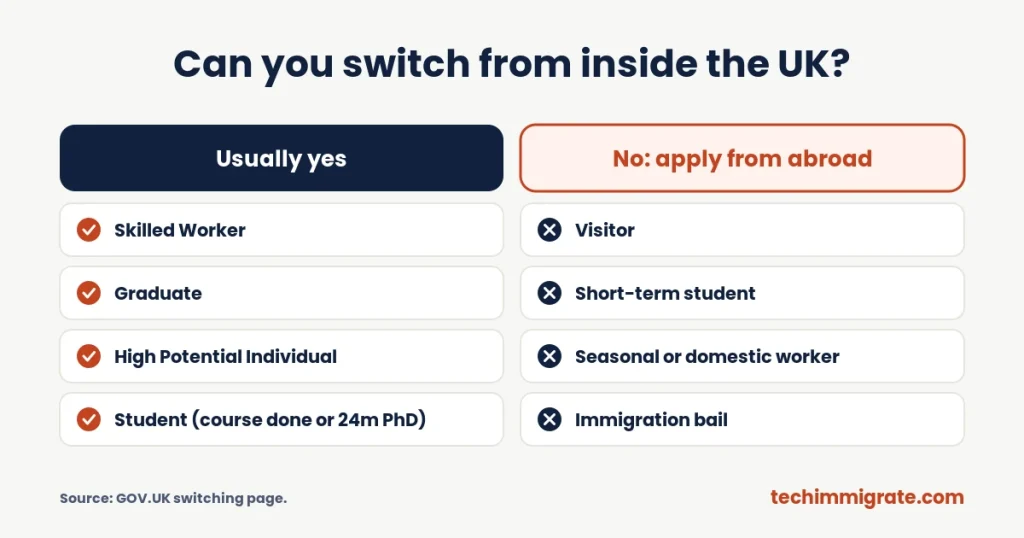
GOV.UK says you can switch to Global Talent if you are already in the UK on a different visa, as long as your current visa is not on the list of routes that cannot switch. In practice, tech professionals commonly switch from:
- Skilled Worker, including Health and Care Worker;
- Graduate;
- High Potential Individual;
- Student, once the course is completed or after 24 months of a full-time PhD;
- Innovator Founder or Start-up/Innovator legacy routes;
- Scale-up and Global Business Mobility routes;
- Dependant visas on other routes, if the dependant has their own endorsement.
If you hold settled or pre-settled status under the EU Settlement Scheme, you do not need a Global Talent visa to live and work in the UK.
Who Cannot Switch
GOV.UK lists people who must leave the UK and apply from abroad:
- visit visa holders;
- short-term student visa holders;
- Parent of a Child Student visa holders;
- seasonal worker visa holders;
- domestic worker in a private household visa holders;
- people on immigration bail;
- people with permission to stay outside the immigration rules, for example on compassionate grounds.
If you are in the UK as a visitor and get endorsed, you must leave and apply from outside the UK.
The student rule
If you are on a Student visa, you can only switch to Global Talent if you have completed your sponsored course, or if you are studying a full-time PhD and have studied it for at least 24 months. If you have not reached that point, you would need to apply from abroad or wait.
How Switching Works, Step by Step
Switching uses the same two stages as any Global Talent application. The difference is that you do both from inside the UK while keeping your current visa.
- Prepare your endorsement application while you continue in your current role.
- Apply for endorsement (Stage 1) on GOV.UK and pay £561. Email your documents to the Home Office.
- Wait for Tech Nation's decision. Applicants report most decisions within 5 to 8 weeks of paying.
- Apply to switch (Stage 2) within 3 months of your endorsement letter, using the in-country switching application. Pay £205 and the health surcharge.
- Prove your identity with the UK Immigration: ID Check app or at a UK Visa and Citizenship Application Services appointment.
- Wait for the decision, usually within 8 weeks. You can stay in the UK while you wait.
- Receive your new eVisa and update your employer.
GOV.UK says a faster decision may be available for an extra fee. You will be told if you are eligible when you apply.
Timing Your Switch Around Your Current Visa
Timing is where most switching problems come from.
Your current visa must still be valid when you apply
You must apply to switch before your current permission expires. If you apply in time, you can usually stay in the UK on your current conditions while the Global Talent application is decided. If your visa expires before you apply, you lose the right to switch and may face serious problems.
Build in time for Stage 1
Stage 1 typically takes several weeks after you pay, and preparing a strong application usually takes longer. If your current visa ends in four months, starting preparation now is sensible. If it ends in four weeks, you probably need a plan B, such as extending your current visa, and should take advice.
The Graduate visa cannot be extended
Graduate visa holders have a fixed period, and the Graduate visa cannot be extended. If you are aiming to switch to Global Talent, start early in your Graduate period so that a refusal at Stage 1 does not leave you without options.
What Happens to Your Job
If you are on a Skilled Worker visa
Your current permission depends on your sponsor. Until your Global Talent visa is granted:
- stay in your sponsored role, on the terms in your certificate of sponsorship;
- do not resign or start a new job outside your sponsorship;
- do not start a side business that your current visa does not allow.
If you leave your sponsored job early, your sponsor must report it, and the Home Office can cut your permission short. Wait for the decision.
Once you switch, you are no longer sponsored. Your employer stops sponsor reporting for you and you no longer count towards their sponsor licence. Your employer will need to check your right to work again using a share code from your new eVisa.
If you are on a Graduate visa
You can already work for any employer, so switching changes less day to day. The main gain is a longer-term visa that counts towards settlement.
If you are self-employed or founding a company
Global Talent allows self-employment and running a business. If your current visa restricts this, wait until the switch is granted before you start.
Your Settlement Clock When You Switch
This is the part of switching that matters most for long-term planning.
| Time spent on | Counts towards Global Talent settlement? |
|---|---|
| Skilled Worker | Yes, can be combined, according to the caseworker guidance |
| Innovator Founder | Yes, can be combined, according to the caseworker guidance |
| Graduate | No |
| High Potential Individual | No |
| Student | No |
| Visitor | No |
The Home Office caseworker guidance confirms that qualifying time on certain routes, including Global Talent, Skilled Worker and Innovator Founder, can be combined. That is why many people who switch from Skilled Worker to Global Talent count their earlier years.
The earned settlement response proposes that time on routes such as Student, Graduate, High Potential Individual and Global Business Mobility will not count under the new framework either.
Worked example
An engineer spends 2 years on a Skilled Worker visa, gets endorsed as Exceptional Talent, and switches. Under the current rules, the engineer may be able to combine those 2 years with Global Talent time towards the 3-year qualifying period, subject to the absence, earnings and other requirements. Staying on Skilled Worker would have meant 5 years under the current rules. Our Global Talent ILR guide explains the settlement requirements.
A Graduate visa holder who switches starts their settlement clock when Global Talent permission begins, because Graduate time does not count.

Switching From Each Route: What Changes
The mechanics of switching are the same for everyone, but what you gain and what to watch for depend on where you start.
From Skilled Worker
This is the most common switch for tech professionals. You lose nothing in work rights and gain a great deal: no sponsor, no going rate, no restriction on second jobs or self-employment. You can take a lower-paid role you care about, go part-time, join a startup that does not hold a sponsor licence, or start your own company. Your settlement time on Skilled Worker can be combined with Global Talent time, and Exceptional Talent holders may settle sooner than they would have on Skilled Worker.
The main risk is timing: never leave your sponsored role before the Global Talent decision.
From Graduate
Graduate visa holders already have open work rights, but the visa is short and cannot be extended, and its time does not count towards settlement. Switching gives you a visa of up to 5 years that does count. If you are early in your career, Exceptional Promise is often the realistic level. Apply as early in your Graduate period as your evidence allows, so you have time to reapply or switch to Skilled Worker if Stage 1 is refused.
From High Potential Individual
The High Potential Individual visa also has open work rights but a fixed term, and its time does not count towards settlement. Switching to Global Talent turns a temporary stay into a route to settlement.
From Innovator Founder
Founders on the Innovator Founder route are tied to their endorsed business and to check-ins with their endorsing body. Switching to Global Talent removes those ties. Time on Innovator Founder can be combined with Global Talent towards settlement, according to the caseworker guidance. Founders need to show their own leadership and the company's traction to Tech Nation. Our article on Global Talent for startup founders explains what Tech Nation looks for.
From a dependant visa
If you are in the UK as the dependant of someone on another route, you may be able to switch to Global Talent in your own right with your own endorsement. This can give you independence from your partner's visa and, if you are endorsed as Exceptional Talent, a faster settlement path of your own. Check carefully how your time as a dependant counts.
Costs of Switching
| Cost | Amount |
|---|---|
| Stage 1 endorsement | £561 |
| Stage 2 switching application | £205 |
| Immigration Health Surcharge | £1,035 per year of the new visa |
| Each dependant | £766 plus £1,035 per year |
| Faster decision (optional, where available) | Extra fee |
You pay a new health surcharge for the full length of the Global Talent visa you choose. If you still had time left on your previous visa, you may be able to claim a partial refund of the surcharge you paid for that unused period. Check the current refund rules on GOV.UK.
There is also a cost saving for your employer: Global Talent holders do not need sponsorship, so your employer does not pay the certificate of sponsorship fee or the Immigration Skills Charge for you.
Your Family When You Switch
Your partner and children apply separately, at the same time as you or before their current visas expire. They each pay £766 plus the health surcharge. They must not travel while their applications are pending.
Remember that under the current rules, dependants usually need 5 years to settle, even when the main applicant can settle at 3. Plan visa lengths with that in mind. Our article on Global Talent dependants explains the family rules.
Telling Your Employer
You do not need your employer's permission to apply for Global Talent, but on a sponsored visa it is usually wise to tell them once you are endorsed, so that HR can plan for the change. Most employers see it as good news: you no longer depend on their sponsor licence, and they no longer pay sponsorship costs for you. When your new eVisa arrives, give HR a right-to-work share code so they can update their records. If you are planning to leave, your Global Talent visa means you can do so on your own timetable, without needing a new sponsor.
Do Not Travel While You Wait
GOV.UK is clear: you must not leave the UK, Ireland, the Channel Islands or the Isle of Man until you get a decision. If you do, your switching application will be withdrawn. If you have travel planned, either apply after you return or postpone the trip.
If your current visa is about to expire and you are abroad, you cannot switch from outside the UK. You would need to apply from abroad as a fresh entry clearance application.
Common Switching Mistakes
- Letting the current visa expire before applying to switch.
- Resigning from a sponsored job before the Global Talent visa is granted.
- Travelling while the switching application is pending.
- Assuming Graduate time counts towards settlement.
- Applying as a student before finishing the course or before 24 months of a PhD.
- Missing the 3-month window after endorsement because of a busy period at work.
- Starting a business or freelancing before the switch is approved.
- Leaving family members' applications too late, so their visas lapse.
Building Evidence While You Are in the UK
One advantage of switching from inside the UK is that you can build evidence while you are already part of the UK tech scene. Many successful applicants use their time on another visa to strengthen their case:
- Speak at UK meetups and conferences. London, Manchester, Edinburgh, Bristol and Cambridge all have active tech communities with regular events looking for speakers.
- Get involved in UK open source and community projects, or mentor through recognised programmes.
- Make your work visible. Write about projects you led, with your employer's permission, and share results publicly where you can.
- Build relationships with senior people outside your immediate team, who could later act as referees.
- Keep a record of every talk, article, award, judging role and piece of press as it happens. It is much harder to reconstruct later.
You still need to be careful about what your current visa allows. Unpaid speaking and community work are usually fine, but paid side work may not be allowed on a Skilled Worker visa. Check your conditions.
Should You Switch Now or Wait?
Switching is usually worth it as soon as you are endorsed. But a few situations deserve a pause:
- You are close to settlement on your current route. If you are a few months away from indefinite leave to remain as a Skilled Worker under the current rules, switching may not speed things up. Compare the dates.
- Your evidence is not ready. A refusal costs £561 and time. If your current visa has plenty of time left, it may be better to build stronger evidence first. Our eligibility self-check can help.
- Your current visa ends very soon. If there is not enough time for Stage 1 and Stage 2, you may need to extend your current visa first. Take advice.
Frequently Asked Questions
Yes, if your current visa allows it. Skilled Worker and Graduate visa holders usually can. You cannot switch from a visit visa and some other routes.
Only if you have completed your sponsored course, or have studied a full-time PhD for at least 24 months.
Endorsement usually takes several weeks. After that, GOV.UK says switching decisions are usually made within 8 weeks.
Yes, on the conditions of your current visa, if you applied before it expired. On a Skilled Worker visa, stay in your sponsored job until the decision.
The caseworker guidance says time on certain routes, including Skilled Worker, can be combined with Global Talent towards settlement.
No. Time on the Graduate route does not count towards settlement.
No. Your application will be withdrawn if you leave the UK, Ireland, the Channel Islands or the Isle of Man before a decision.
£561 for endorsement and £205 for the visa, plus the Immigration Health Surcharge of £1,035 per year. Each dependant pays £766 plus the surcharge.
Start With the Endorsement
If you are already in the UK, you have an advantage: time to prepare without uprooting your life. Switching is the easy part. The endorsement is what decides whether you get the freedom of Global Talent. Our role-specific Global Talent guides show what Tech Nation looks for in your field, so you can build your application while you still have time on your current visa.
Related reading: Global Talent vs Skilled Worker Visa: Which Is Better for Tech Workers? and UK Graduate Visa (PSW): Rules, Length and What Comes Next.
How We Checked This Article
We checked the switching rules against GOV.UK's page on switching to a Global Talent visa, Appendix Global Talent and the Home Office Global Talent caseworker guidance (version 19.0, 3 August 2026), in November 2026. Fees come from the Home Office fee schedule in force from 8 April 2026. The settlement reform section draws on the government's response to the earned settlement consultation (2 November 2026) as summarised by Lewis Silkin. Endorsement timings are applicant-reported on the Tech Nation Visa Forum.
Tech Immigrate is independent of Tech Nation and the Home Office. This article is general information, not legal advice. Check GOV.UK or take regulated advice before you switch.
We write practical guides for tech professionals applying for the UK Global Talent visa. Tech Immigrate is independent of Tech Nation and the Home Office, and our articles are general information, not legal advice. Rules and fees change, so always check gov.uk before you apply.