How to Apply for Indefinite Leave to Remain: Step by Step
How to apply for indefinite leave to remain step by step: eligibility, timing, absences, Life in the UK, English, documents, fees and decision times.


In this article
- Step 1: Check You Are Eligible
- Step 2: Combine Time From Different Routes, Carefully
- Step 3: Work Out Your Earliest Application Date
- Step 4: Count Your Absences
- Step 5: Pass the Life in the UK Test
- Step 6: Meet the English Requirement
- Step 7: Gather Your Documents
- Step 8: Complete the Online Application
- Step 9: Pay the Fee
- Step 10: Prove Your Identity
- Skilled Workers: Your Employer's Part
- Applying as a Family
- A Document Checklist
- Step 11: Wait for a Decision
- Special Situations
- Step 12: After ILR Is Granted
- Standard, Priority or Super Priority?
- A Sample Timeline
- What Caseworkers Check
- Keeping Your ILR
- If Your Application Is Refused
- Common Mistakes
- Frequently Asked Questions
- A Faster Route to Settlement
- How We Checked This Article
Applying for indefinite leave to remain (ILR) is one of the most important immigration applications you will make in the UK. It turns temporary permission into permanent residence, ends the cycle of visa extensions and health surcharge payments, and opens the door to British citizenship. It is also an application where small mistakes, such as applying a few days early or miscounting absences, can lead to an expensive refusal.
This guide walks you through applying for ILR step by step, mainly for people on work routes such as Skilled Worker and Global Talent: checking you are eligible, timing your application, gathering documents, completing the form, paying fees, proving your identity, waiting for a decision and what happens afterwards. It also explains how the settlement reforms announced in November 2026 may affect your timing.
Key takeaways
- Check your qualifying period for your route first: for example 5 years on Skilled Worker, or 3 years for Global Talent Exceptional Talent, under the current rules.
- Count your absences carefully. Most work routes require that you have not spent more than 180 days outside the UK in any 12-month period during the qualifying period.
- You will usually need to pass the Life in the UK test and meet the English requirement before you apply.
- The ILR fee is £3,226 per person from 8 April 2026. Priority (£500 extra) and super priority (£1,000 extra) services may be available.
- Standard decisions usually take up to 6 months. Do not travel outside the UK, Ireland, the Channel Islands or the Isle of Man while your application is pending, or it will be withdrawn on work routes.
- The earned settlement reforms will change qualifying periods and requirements from 2027. If you are eligible now, applying sooner may let you be decided under the current rules.
Step 1: Check You Are Eligible
ILR requirements depend on your route. Before anything else, find the rules for the route you are on, because the qualifying period, absence rules and specific requirements differ.
| Route | Qualifying period under current rules | Route-specific requirements |
|---|---|---|
| Skilled Worker | 5 years | Still sponsored, salary at or above the settlement threshold, employer confirms you are still needed |
| Global Talent (Exceptional Talent, research bodies, prize) | 3 years | Earned money in your field, endorsement not withdrawn |
| Global Talent (Exceptional Promise) | 5 years | Earned money in your field, endorsement not withdrawn |
| Innovator Founder | 3 years | Business criteria and endorsing body confirmation |
| Partner of a British citizen or settled person | 5 years | Relationship, financial and accommodation requirements |
| Dependant of a work visa holder | Usually 5 years | Relationship and living together |
Most work routes also require:
- continuous residence for the qualifying period, usually with no more than 180 days outside the UK in any 12-month period;
- English at the required level, currently B1 on most routes, rising to B2 under the reforms and from 26 March 2027 on routes such as Global Talent;
- the Life in the UK test;
- suitability, including no serious criminality and no immigration breaches.
Our guides on Global Talent ILR and the new ILR rules explain the route-specific details.
Step 2: Combine Time From Different Routes, Carefully
Some routes allow time to be combined. The Home Office continuous residence guidance says Skilled Worker migrants can qualify after 5 years of continuous residence on any combination of routes including Skilled Worker, Global Talent, Innovator Founder, T2 Minister of Religion and International Sportsperson. The Global Talent caseworker guidance also allows certain routes to be combined.
Time on Student, Graduate, High Potential Individual and visitor routes generally does not count. Map every period of permission you have held, with start and end dates, before you rely on a settlement date.
Step 3: Work Out Your Earliest Application Date
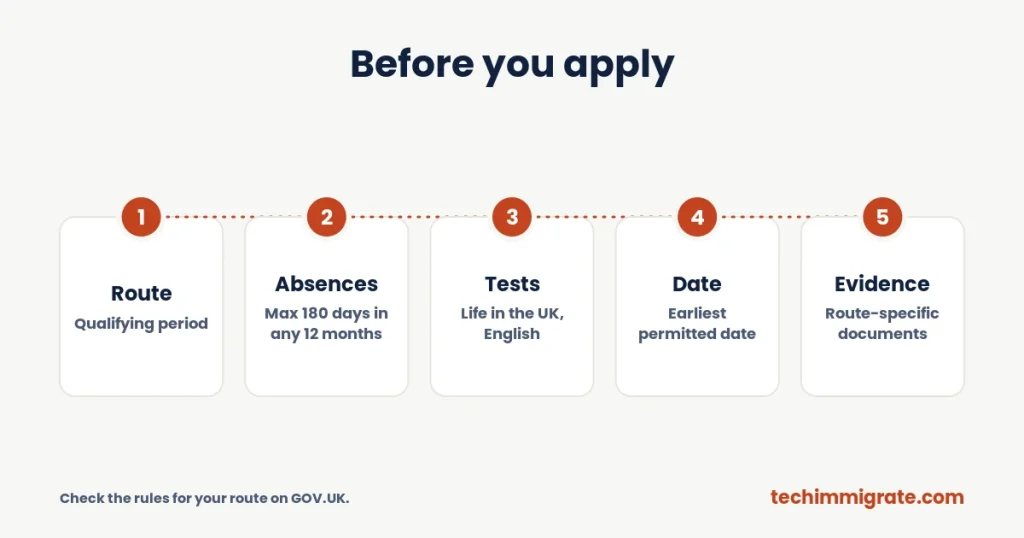
Applying even one day too early can lead to refusal and loss of the fee. On many routes, applicants can apply up to 28 days before completing the qualifying period, but check the rules for your route.
To work out your date:
- Find the start date of the first period of permission that counts.
- Add the qualifying period, for example 5 years.
- Check whether your route allows you to apply a set number of days early.
- Check that every 12-month window in the period has no more than 180 days of absences.
If you are near the earned settlement changes, timing matters even more. Applications are normally decided under the rules in force on the date of decision, and there is no general exemption for people already in the UK.
Step 4: Count Your Absences
The absence rule catches many people out. To count absences:
- List every trip abroad in the qualifying period, with dates of departure and return.
- Count whole days outside the UK. Under the Home Office approach, the days you leave and return are generally not counted as days of absence, but check the current guidance for your route.
- Check every rolling 12-month period, not just calendar years.
- Keep evidence, such as boarding passes and passport stamps, in case caseworkers ask.
There are limited exceptions for absences for serious or compelling reasons and some research absences on certain routes. If you have exceeded the limit, take advice before applying.
Step 5: Pass the Life in the UK Test
Most adults applying for ILR must pass the Life in the UK test. It is a computer-based test about British traditions, history and customs, taken at an approved test centre. It costs £50. Book it well in advance and pass it before you apply. Use the official study materials, and allow time to retake it if needed, because you cannot apply without a pass. Keep your pass reference, because you will need it on the application form.
People aged 65 or over and people with certain long-term conditions may be exempt.
Step 6: Meet the English Requirement
You usually need to show English at the required level, unless you are exempt. Common ways to meet it include:
- being a national of a majority English-speaking country;
- having a degree taught in English, confirmed where needed;
- passing an approved English test at the required level.
If you met the English requirement at a lower level for an earlier visa, check whether that still counts for settlement. The reforms raise the level to B2, so if you are not exempt and plan to apply after the change applies to your route, consider taking a B2 test.
Step 7: Gather Your Documents
The documents depend on your route, but typically include:
- your passport or travel document, and any previous passports from the qualifying period;
- your Life in the UK test reference;
- evidence of English, if not exempt;
- a list of absences;
- route-specific evidence.
Route-specific evidence typically means:
- for Skilled Worker: details from your sponsor confirming your employment and salary;
- for Global Talent: evidence that you have earned money in your field, such as payslips, P60s, tax records or company accounts;
- for partners: evidence of your relationship and living together.
Keep your documents organised by section, and name files clearly so you can find them quickly if the caseworker asks for something. Where a document is not in English or Welsh, include a proper translation. A clear set of evidence makes the caseworker's job easier and reduces the chance of requests for more information.
Step 8: Complete the Online Application
You apply online on GOV.UK using the settlement form for your route. Work routes typically use the form known as SET(O), and partner routes the form known as SET(M), though the online journey is route-based. The form asks about:
- your personal details and immigration history;
- your qualifying period and absences;
- your English and Life in the UK test;
- your employment, earnings or other route-specific requirements;
- criminal convictions and other suitability questions;
- any family members applying with you.
Answer every question accurately and completely. Failing to disclose something relevant, such as a conviction or a previous refusal, can lead to refusal for deception, which is far more serious than the underlying issue.
Step 9: Pay the Fee
| Item | Cost |
|---|---|
| ILR application | £3,226 per person |
| Priority service (optional, where available) | £500 extra |
| Super priority service (optional, where available) | £1,000 extra |
| Life in the UK test | £50 |
| Immigration Health Surcharge | Not payable on ILR |
The ILR fee rose from £3,029 to £3,226 on 8 April 2026. Each family member pays the full fee.
Step 10: Prove Your Identity
Depending on your circumstances, you will either use the UK Immigration: ID Check app or attend a UK Visa and Citizenship Application Services appointment to give fingerprints and a photo and upload documents. Book promptly, because appointment availability varies.
Skilled Workers: Your Employer's Part
If you are settling on the Skilled Worker route, your sponsor plays a role. Under the current rules, you generally need to show that you are still employed by your sponsor, that your salary meets the settlement threshold that applies to you, and that your employer still needs you. Your employer usually confirms this in a letter. Ask HR early, because large employers may have a set process and timescale for these letters.
If you have changed sponsors during your qualifying period, that is normally fine, as long as each change was properly authorised and there were no gaps in your permission.
Applying as a Family
Your partner and children can often apply at the same time as you, but each person must meet their own requirements:
- Partners usually need to have completed their own qualifying period as your dependant, be in a genuine relationship with you and living together, and meet the English and Life in the UK requirements unless exempt.
- Children usually need both parents to be settling or settled, unless an exception applies, and to be under 18 or already your dependant.
- Each person pays the full fee of £3,226.
On some routes, including Global Talent, the main applicant can settle sooner than dependants under the current rules. Plan for each person's date separately. The earned settlement reforms propose that partners who arrive with the main applicant could settle at the same time.
A Document Checklist
| Document | Who needs it |
|---|---|
| Current passport and previous passports | Everyone |
| Life in the UK test pass reference | Adults, unless exempt |
| English evidence | Adults, unless exempt |
| List of absences with dates | Everyone |
| Employer letter, payslips | Skilled Workers |
| Earnings evidence in your field | Global Talent holders |
| Relationship and cohabitation evidence | Partners |
| Birth certificates | Children |
Step 11: Wait for a Decision
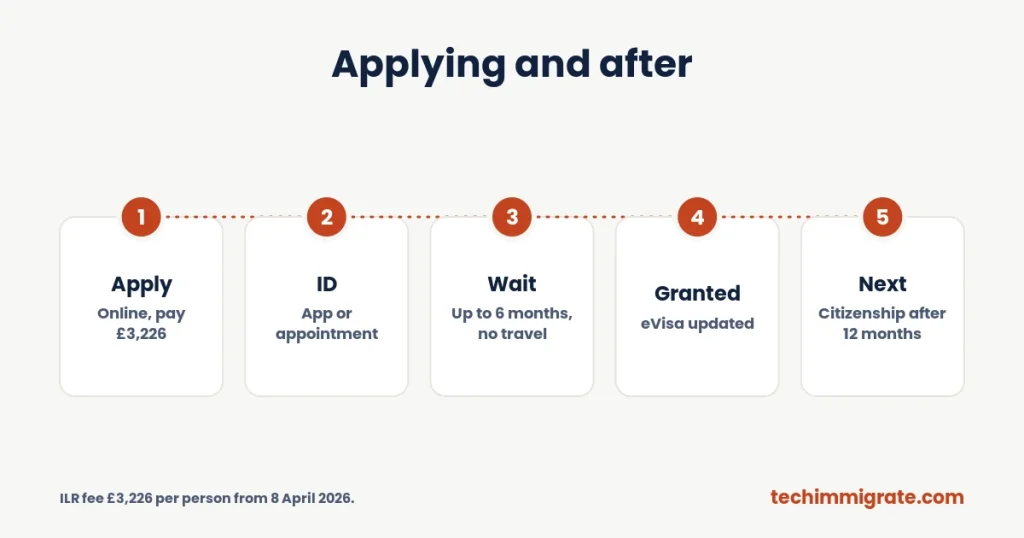
Standard ILR applications are usually decided within 6 months. Priority service usually gives a decision within 30 working days of your identity appointment, and super priority by the end of the next working day, where available. Applicants report that many straightforward standard cases are decided faster than 6 months, but some take longer.
While you wait:
- Do not travel outside the UK, Ireland, the Channel Islands or the Isle of Man. On work routes, GOV.UK warns that your application will be withdrawn if you travel.
- Your current conditions continue if you applied before your previous permission expired.
- Respond quickly to any request for more information.
Special Situations
Gaps in your permission. If there was a period when you did not hold permission, for example because an extension was made late, it can break continuous residence. Some short gaps may be disregarded in limited circumstances. Take advice before applying if your history includes a gap.
A change of name. If your name changed during the qualifying period, for example on marriage, include evidence such as a marriage certificate or deed poll, and make sure your passport and UKVI account match.
Previous refusals. You must declare previous refusals in the UK and abroad. A refusal does not stop you settling, but failing to declare one can lead to refusal for deception.
Time spent abroad for work. Long business trips count as absences on most routes. If your job involves frequent travel, keep a detailed log and check your rolling 12-month totals regularly.
Changing routes near the end. Switching to a new route close to your settlement date can change the rules that apply. Check carefully before switching.
Step 12: After ILR Is Granted
When ILR is granted, your eVisa is updated to show indefinite leave to remain with no end date. Then:
- Check your eVisa for errors.
- Give your employer a new share code, so they can record that you no longer need follow-up checks.
- Plan for citizenship. Most people can apply to naturalise as British 12 months after ILR, or straight away if married to a British citizen. Naturalisation costs £1,709 plus £130 for the ceremony.
- Keep your status. ILR can lapse if you spend more than 2 years continuously outside the UK.
Standard, Priority or Super Priority?
The standard service is included in the £3,226 fee and usually takes up to 6 months. Priority and super priority cost £500 and £1,000 extra and aim for much faster decisions, where available. Which is worth it?
- Choose standard if you have no travel planned, your current permission is secure while you wait, and you are comfortable waiting.
- Consider priority if you need to travel, start a job that requires settled status, or apply for citizenship or a mortgage on a timescale.
- Consider super priority if timing is critical, for example a family emergency abroad.
Priority services have limited daily slots and are not available on every route or at every location. Check availability when you apply. Remember that faster processing does not change the outcome; a weak application is refused just as quickly.
A Sample Timeline
| When | Action |
|---|---|
| 6 months before eligibility | Check route rules, map permissions, count absences |
| 4 months before | Book and pass the Life in the UK test |
| 3 months before | Confirm English evidence; take a test if needed |
| 2 months before | Request employer letter or gather earnings evidence |
| 1 month before | Prepare all documents, check family members' eligibility |
| Earliest permitted date | Apply online, pay, book identity appointment |
| Up to 6 months later | Decision under the standard service |
What Caseworkers Check
Caseworkers work through validity, suitability and eligibility. In practice, they check that you used the right form and paid the fee, that you have no disqualifying criminality or immigration breaches, that your qualifying period and absences meet the rules, that your English and Life in the UK requirements are met, and that your route-specific requirements are satisfied. They may ask for more information if something is unclear. A well-organised application, with a clear absence list and evidence that matches what you have declared, makes their work faster and reduces the chance of delay. Inconsistencies, such as dates on your absence list that do not match your passport stamps, or salary figures that do not match your payslips, are a common reason for requests for more information. Check everything against your source documents before you submit.
Keeping Your ILR
Once granted, ILR does not expire as long as you keep living in the UK. It can lapse if you spend more than 2 years continuously outside the UK. It can also be revoked in limited circumstances, such as serious criminality or if it was obtained by deception. Our articles on these topics explain the details.
If Your Application Is Refused
Your refusal letter explains the reasons and whether you can ask for an administrative review, which costs £80 where available, or appeal in limited cases. Deadlines are short. Common refusal reasons include applying too early, excess absences, missing English or Life in the UK evidence, route-specific requirements not met, and undisclosed suitability issues. Take advice quickly, especially if your previous permission has expired.
Common Mistakes
- Applying too early. Even a few days early can mean refusal.
- Miscounting absences by using calendar years instead of rolling 12-month windows.
- Assuming Graduate or Student time counts.
- Forgetting the Life in the UK test until the last minute.
- Not disclosing old convictions, speeding fines that led to court, or previous refusals.
- Travelling while the application is pending.
- Missing route-specific evidence, such as Global Talent earnings evidence.
- Leaving family members out, or not checking their own eligibility.
Frequently Asked Questions
Check you meet the requirements for your route, pass the Life in the UK test, meet the English requirement, then apply online on GOV.UK, pay £3,226 and prove your identity.
Standard applications are usually decided within 6 months. Priority and super priority services, where available, aim for decisions usually within 30 working days, or by the end of the next working day for super priority.
On many routes you can apply up to 28 days before completing the qualifying period. Check the rules for your route, because applying too early leads to refusal.
No. On work routes, your application will be withdrawn if you travel outside the UK, Ireland, the Channel Islands or the Isle of Man before a decision.
No. The Immigration Health Surcharge is not payable on ILR applications.
Your eVisa shows indefinite leave to remain. Most people can apply for British citizenship 12 months later.
Often, yes, but each person must meet their own requirements and pay the full fee. On some routes, dependants need longer qualifying periods than the main applicant.
Declare any convictions, cautions and penalties the form asks about. If you are unsure whether something counts, take advice rather than leaving it out.
They may. Changes will be implemented over 2027, and applications are normally decided under the rules in force on the decision date. If you are eligible now, applying sooner may help.
A Faster Route to Settlement
ILR is the result of years of planning: the right route, careful records, a clean immigration history and good timing. If you are still years away, start keeping a travel log and an evidence folder now, because reconstructing five years of trips and payslips at the last minute is stressful and error-prone. If you are early in your UK journey, your route determines how soon you can settle. For tech professionals, Global Talent offers one of the fastest paths. Our role-specific Global Talent guides explain how to qualify.
How We Checked This Article
We checked the process against GOV.UK's settlement pages, the Global Talent settlement page, the Home Office continuous residence guidance and Global Talent caseworker guidance, in November 2026. Fees come from the Home Office fee schedule in force from 8 April 2026. The reform section draws on the government's earned settlement response (2 November 2026). Typical processing experiences are applicant-reported and vary.
Tech Immigrate is independent of the Home Office. This article is general information, not legal advice. Check GOV.UK for your route before you apply.
We write practical guides for tech professionals applying for the UK Global Talent visa. Tech Immigrate is independent of Tech Nation and the Home Office, and our articles are general information, not legal advice. Rules and fees change, so always check gov.uk before you apply.