English Test for Indefinite Leave to Remain: Level, Exams and Exemptions
The English requirement for indefinite leave to remain: B1 now, B2 under the reforms, approved tests, degree evidence, exemptions and how to plan.


In this article
- Why English Matters for Settlement
- The Level You Need Now: B1
- The Level You Will Need Under the Reforms: B2
- Ways to Meet the Requirement
- How Long a Test Result Lasts
- Who Is Exempt
- Route-by-Route: What Applies to You
- A Worked Example: Software Engineer With a Degree From Abroad
- A Worked Example: Product Designer Without a Degree
- How to Prepare for a Speaking and Listening Test
- Costs and Booking
- Understanding CEFR Levels in Practice
- What If You Fail the Test?
- English Evidence Checklist
- Common Mistakes
- Planning Your Timeline
- How the Reforms Affect Your Planning
- English and British Citizenship
- Get Your English Evidence Sorted Early
- How We Checked This Article
The English language requirement is one of the most common reasons indefinite leave to remain (ILR) applications run into trouble. Many people assume that because they work in English every day, or because they proved their English for an earlier visa, the requirement is already covered. Sometimes it is. Often it is not, because the level, the type of test and the validity rules are different for settlement.
This guide explains the English test requirement for indefinite leave to remain: the level you need now, the change to B2 under the earned settlement reforms, which tests are accepted, who is exempt, how degrees and nationality can count, and how to plan so that English does not hold up your settlement. It is written for people on work routes such as Skilled Worker and Global Talent.
Key takeaways
- For ILR, you currently need English at B1 level of the Common European Framework of Reference (CEFR), in speaking and listening.
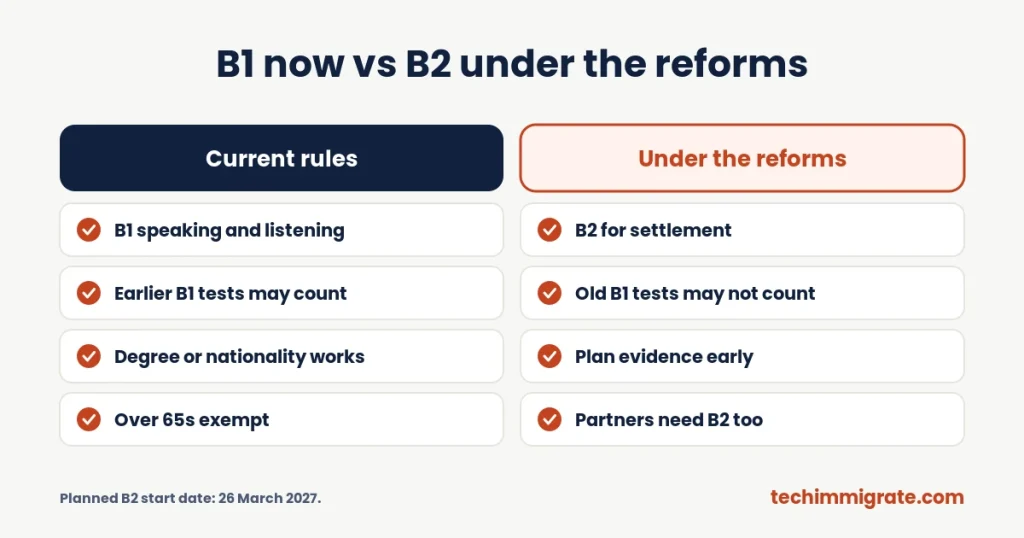
- Under the earned settlement reforms, the settlement English level is due to rise to B2, with a planned start date of 26 March 2027.
- You can meet the requirement through nationality, a degree taught in English, or an approved Secure English Language Test (SELT).
- Settlement tests only need to cover speaking and listening, not reading and writing.
- SELT results are generally valid for 2 years from the date the test is awarded, so timing matters.
- People aged 65 or over, under 18, or with a long-term condition that prevents them from meeting the requirement are exempt.
- If you are taking a test anyway, aiming for B2 protects you against the reforms.
Why English Matters for Settlement
The Home Office wants people who settle permanently to be able to take part in everyday life, work and community activities in English. The English requirement is one of two knowledge requirements for settlement. The other is the Life in the UK test. Both normally apply to applicants aged 18 to 64.
The English requirement for ILR is separate from the requirement you met when you first got your visa. A Skilled Worker who proved English at B1 in 2022 has not necessarily proved it in the right way for settlement, and a Global Talent holder may never have been asked to prove English at all, because the Global Talent route does not have an English requirement at entry.
The Level You Need Now: B1
Under the current rules, ILR applicants on most routes must show English at CEFR level B1 or above, in speaking and listening. B1 is often described as an intermediate level. At B1, you can deal with most everyday situations, describe experiences and events, and give brief reasons for opinions.
For most people working in UK tech, B1 is well below their working level of English. The challenge is rarely ability. It is having the right evidence in the right form.
The Level You Will Need Under the Reforms: B2
The government's response to the earned settlement consultation, published on 2 November 2026, confirmed that English at B2 will be a mandatory requirement for settlement. The planned start date for the higher level is 26 March 2027.
B2 is an upper-intermediate level. At B2, you can understand the main ideas of complex text, interact with a degree of fluency with native speakers, and produce clear, detailed explanations. Again, most people working in technical or professional roles will be comfortably at this level, but the evidence must show it.
If you expect to apply for ILR after the reforms take effect, plan now for B2 evidence. If you take a test before then, choose one at B2 or above so that it covers you either way.
Ways to Meet the Requirement
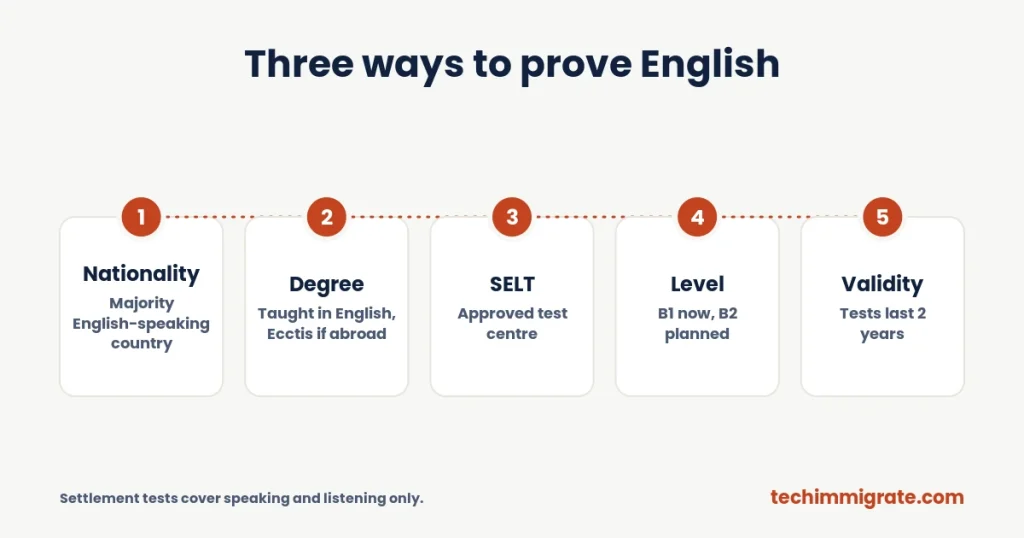
There are three main ways to show your English for settlement.
1. Your nationality
If you are a national of a majority English-speaking country on the Home Office list, you meet the requirement automatically. The list includes countries such as Australia, Canada, Jamaica, New Zealand and the USA, among others. Check the current list on GOV.UK, because it is set by the Immigration Rules and can change. If your nationality is on the list, you only need your passport.
2. A degree taught in English
You can meet the requirement with an academic qualification equivalent to a UK bachelor's degree or above, taught or researched in English.
- If the degree was awarded in the UK, your certificate is usually enough.
- If the degree was awarded outside the UK, you need confirmation from Ecctis, the UK's national agency for qualifications, that it is equivalent to a UK bachelor's degree or higher, and that it was taught in English.
- If the degree was awarded by a university in a majority English-speaking country, Ecctis confirmation of equivalence may be enough, without a separate statement on the language of teaching.
This is often the easiest option for tech workers. Many hold a computer science, engineering or business degree taught in English. A degree at bachelor's level or above meets B1, and under the reforms the government is expected to treat degree evidence in a similar way, but check the guidance when it is published.
3. A Secure English Language Test (SELT)
If you cannot rely on nationality or a degree, you need to pass an approved SELT at the right level. For settlement, the test only needs to cover speaking and listening. GOV.UK lists these approved providers in the UK:
| Provider | Test names |
|---|---|
| Trinity College London | Secure English Language Tests for UKVI (ISE or GESE) |
| IELTS SELT Consortium | IELTS for UKVI or IELTS Life Skills |
| LANGUAGECERT | International ESOL SELT, Academic SELT or General SELT |
| Pearson | PTE Academic UKVI or PTE Home |
Outside the UK, PSI Services offers Skills for English UKVI, alongside IELTS, LANGUAGECERT and Pearson. For settlement, you will usually take the test in the UK, because you live here.
The most popular options for ILR are the speaking and listening tests, such as Trinity GESE, IELTS Life Skills and PTE Home, because they test exactly what is required and nothing more. You must take the test at an approved centre. Tests taken at other centres, or tests that are not on the approved list, will not be accepted.
How Long a Test Result Lasts
GOV.UK says SELT results are valid for 2 years from the date the test is awarded. This matters for planning. If you take a test too early, it may have expired by the time you apply for ILR.
There is an important exception. If you used a SELT at the right level in an earlier successful application, and the Home Office accepted it, you may be able to rely on that earlier evidence for settlement, even if the test is now more than 2 years old. Whether this works depends on the level and type of the earlier test and the rules for your route, so check carefully. A test that proved B1 in all four skills for an earlier visa will not help you if the settlement requirement has moved to B2.
Who Is Exempt
You do not need to meet the English requirement for settlement if you are:
- aged 65 or over;
- under 18;
- living with a long-term physical or mental condition that prevents you from meeting the requirement, supported by medical evidence.
Exemptions are narrow. Being busy, being a native speaker of a language other than English, or having worked in English for years does not make you exempt.
Route-by-Route: What Applies to You
Skilled Worker
Many Skilled Workers proved English at B1 when they first applied. That evidence may count for settlement if it was at B1 or above and met the speaking and listening requirement. Since 8 January 2026, new Skilled Worker applicants need B2, but people extending on the route usually keep the B1 requirement. Under the reforms, B2 will be needed for settlement, so a B1 certificate from your entry application may no longer be enough once the change takes effect.
Global Talent
Global Talent has no English requirement at entry, so most Global Talent holders need to prove English for the first time at the ILR stage. A degree taught in English is often the simplest route. If you do not have one, book a speaking and listening SELT. Our guide to Global Talent visa ILR covers the other settlement requirements.
Dependants
Adult partners must meet the English requirement for settlement themselves, unless exempt. Children under 18 are exempt. Under the reforms, partners are expected to need B2 as well, so plan their evidence alongside yours.
A Worked Example: Software Engineer With a Degree From Abroad
A software engineer on Global Talent has a bachelor's degree in computer science from a university in India, where the course was taught in English. He plans to apply for ILR in mid-2027.
- He applies to Ecctis for a Statement of Comparability and an English Language Assessment confirming the degree is equivalent to a UK bachelor's degree and was taught in English.
- Ecctis confirms both.
- He uses this evidence in his ILR application.
Because he will apply after the planned B2 start date, he keeps an eye on the final guidance. If degree evidence continues to count at B2, as is expected, he does not need a test. If not, he books a B2 speaking and listening test with plenty of time before his application.
A Worked Example: Product Designer Without a Degree
A product designer on a Skilled Worker visa does not hold a degree. She proved English at B1 with a four-skills test for her first visa in 2022. She will reach 5 years in 2027.
Her options:
- Rely on her earlier B1 test, if it was accepted for her visa and meets the settlement rules. This works only if she applies before the B2 requirement takes effect.
- Take a B2 speaking and listening test now. This protects her whatever happens with the reforms.
She books a B2 test in late 2026, passes, and keeps the result ready. Because the result is valid for 2 years, it covers her planned application date.
How to Prepare for a Speaking and Listening Test
If you need a test, a little preparation goes a long way, even if your everyday English is strong:
- Know the format. Each provider has its own structure. Trinity GESE, for example, is a one-to-one conversation with an examiner. IELTS Life Skills is taken with another candidate. PTE Home is computer-based.
- Book the right level. Check that the test is approved for settlement and that you are booking the B1 or B2 version you need.
- Practise speaking about everyday topics. Settlement tests focus on daily life, not technical vocabulary.
- Bring the right ID. Centres are strict about identity documents. Use the same passport you will use in your ILR application.
- Check the result reference. You will need the unique reference number in your application.
Costs and Booking
Test fees vary by provider and level, and are set by the providers rather than the Home Office. Expect to pay around £150 to £200 for most speaking and listening tests in the UK. Ecctis statements for degree evidence also carry a fee. Book well in advance, especially in busy months, because popular centres can fill up.
Understanding CEFR Levels in Practice
The CEFR is the common scale used across Europe to describe language ability. It runs from A1, the most basic, to C2, near-native mastery. The levels that matter for UK immigration are:
| Level | Description | Where it applies |
|---|---|---|
| A1 | Basic | Some family routes at entry |
| B1 | Intermediate | ILR now, Skilled Worker extensions |
| B2 | Upper intermediate | New Skilled Worker applicants, ILR under the reforms |
| C1 | Advanced | Not required for work routes |
Each test provider reports results in its own way. For IELTS for UKVI, Home Office guidance has generally treated a score of 4.0 in each tested skill as B1 and 5.5 as B2, while IELTS Life Skills reports a simple pass at a named level. Trinity GESE uses grades, with grades 5 and 6 at B1 and grades 7 to 9 at B2. Check the provider's mapping before you book, so that you know exactly what score you need.
If you work in a professional or technical role in English, a B2 result is very likely to be within reach. The main reason people fall short is unfamiliarity with the test format, not their underlying English.
What If You Fail the Test?
Failing a SELT is not a disaster, but it costs time and money. There is no limit on how many times you can take a test, and a failed attempt does not count against you in your ILR application. You simply submit the result of the test you passed. If you fail:
- read the score report to see which skill let you down, usually speaking or listening under time pressure;
- practise with the provider's official sample materials, which show the exact format;
- consider a different provider whose format suits you better, for example a one-to-one conversation rather than a computer-based test;
- rebook early enough to leave a buffer before your ILR date.
The bigger risk is leaving the test until the last few weeks. If you need to resit, a late booking can push your ILR application past your planned date, or past the point when new rules take effect.
English Evidence Checklist
Before you submit your ILR application, check that you have:
- your passport, if you rely on nationality;
- your degree certificate and Ecctis confirmation, if you rely on a degree from outside the UK;
- your SELT unique reference number, the test date and the level, if you rely on a test;
- confirmation that the test was taken at an approved centre and covers speaking and listening;
- for partners, their own evidence or exemption.
Match the name on your evidence with the name on your passport. If they differ, for example after marriage, include evidence of the change.
Common Mistakes
- Using a test from an unapproved centre. Only approved SELT centres count.
- Booking the wrong test. An academic test that is not on the SELT list, or a test at the wrong level, will be rejected.
- Letting the result expire. A test taken more than 2 years before your application may not be valid, unless you can rely on the earlier-acceptance rule.
- Assuming a Skilled Worker test covers settlement. It may not, especially once B2 applies.
- Not getting Ecctis confirmation for a degree from abroad. Your certificate alone is not enough.
- Forgetting your partner. Adult partners need their own evidence, unless exempt.
Planning Your Timeline
Work backwards from your expected ILR date:
- 18 to 24 months before. Decide how you will meet the requirement: nationality, degree or test.
- 12 months before. If using a degree from abroad, apply to Ecctis. If taking a test, book it, aiming for B2.
- 6 months before. Check your evidence is valid for your application date and the level that will apply.
- At application. Upload the evidence and quote any test reference numbers.
Combine this with your Life in the UK test, so that both knowledge requirements are done well before you apply.
How the Reforms Affect Your Planning
The earned settlement reforms make the English requirement stricter, but they also make settlement more complex overall. Alongside B2 English, the response sets out a 10-year default qualifying period, with shorter paths for higher earners and recognised talent, and new requirements such as no debts to public bodies. Our guide to the new indefinite leave to remain rules explains the full package, and the ILR requirements checklist brings all the requirements together.
For most tech workers, English is the easiest requirement to fix. Getting B2 evidence in place early removes one source of risk while the rest of the reforms are being finalised. It also means that if your settlement date moves, for example because your earnings put you on a different path, your English evidence is already done and you can focus on the requirements that are harder to change, such as continuous residence and earnings records.
English and British Citizenship
If you plan to apply for British citizenship after ILR, you will need to meet an English requirement again. Evidence accepted for ILR can usually be reused for naturalisation, as long as it was at the right level. This is another reason to get B2 evidence now: it may cover you for both settlement and citizenship.
Currently B1 in speaking and listening. Under the earned settlement reforms, the level is due to rise to B2, with a planned start date of 26 March 2027.
Approved SELTs from Trinity College London, the IELTS SELT Consortium, LANGUAGECERT and Pearson in the UK. Settlement only needs speaking and listening.
Yes, if it is equivalent to a UK bachelor's degree or higher and was taught in English. Degrees from outside the UK need Ecctis confirmation.
SELT results are generally valid for 2 years from the date awarded, unless you can rely on a test accepted in an earlier successful application.
No, if you are a national of a majority English-speaking country on the Home Office list. Your passport is the evidence.
Yes, adult partners need to meet the requirement unless they are exempt.
Sometimes, if it was at the right level and type. It may not work once the B2 requirement applies.
Get Your English Evidence Sorted Early
English is one of the simplest requirements to meet and one of the easiest to get wrong. Check which route applies to you, plan for B2, and keep your evidence ready well before your settlement date. If you are on a work route in tech and want a faster, more flexible path to settlement, our role-specific Global Talent guides explain how to build an application Tech Nation will endorse.
How We Checked This Article
We checked approved tests, providers and validity against GOV.UK's SELT guidance and the settlement requirements against GOV.UK's indefinite leave to remain pages, in November 2026. The B2 settlement requirement and start date come from law firm summaries of the earned settlement response of 2 November 2026. Test fees are indicative and set by providers.
Tech Immigrate is independent of the Home Office. This article is general information, not legal advice. Check GOV.UK before you apply.
We write practical guides for tech professionals applying for the UK Global Talent visa. Tech Immigrate is independent of Tech Nation and the Home Office, and our articles are general information, not legal advice. Rules and fees change, so always check gov.uk before you apply.